

Vendor and well master data quality represents the accuracy, consistency, completeness, and timeliness of core business entities across exploration, production, procurement, and finance systems. High data quality ensures seamless operational execution, strict regulatory compliance, and precise financial accounting.
Master data serves as the single source of truth across energy enterprises. In oil and gas operations, master data spans two primary operational pillars: procurement entities and asset entities. Procurement entities involve vendor master data maintenance, contracts, and supplier records. Asset entities encompass well and wellbore identifiers, reservoir assets, and facility equipment structures.
Substandard master data creates severe operational inefficiencies across core business units. Incorrect vendor addresses delay critical wellsite deliveries, leading to costly Non-Productive Time (NPT). Misaligned well identifiers cause improper allocation of production volumes, resulting in distorted financial reporting and joint venture accounting disputes. Establishing high data quality involves designating a clear system of record designation to eliminate data silos between Enterprise Resource Planning (ERP) applications like SAP, Computerized Maintenance Management Systems (CMMS), and specialized subsurface software.
Workforce skill gaps frequently exacerbate data quality issues across operational teams. Technical personnel, procurement specialists, and accounting staff often lack structured training regarding data entry standards, governance frameworks, and data lifecycle management. When employees understand the operational downstream impact of data entry errors, operational risk drops significantly. Professional training establishes a unified understanding of data governance, ensuring cross-functional teams enforce strict data standards across all daily workflows.
Why Do Oil and Gas Companies Struggle with Master Data Quality?
Oil and gas companies struggle with data quality due to legacy system fragmentation, corporate mergers, decentralized field operations, manual entry processes, and a lack of cross-departmental data governance training among technical and administrative personnel.
Upstream, midstream, and downstream operations traditionally operate in functional siloes. Exploration and production teams utilize technical software applications for geological modeling and drilling execution. Supply chain management teams rely on ERP applications to process purchase orders and manage vendor records. Finance departments maintain separate charts of accounts governance frameworks to manage joint venture billing and corporate tax reporting.
When these disparate systems integrate without rigorous data standards, duplicate records proliferate rapid speed. A single oilfield service supplier might exist under six distinct vendor codes due to minor spelling variations or local office entries. Similarly, wells drilled across multiple decades often possess conflicting well and wellbore identifiers, complicating reservoir performance monitoring and compliance reporting to regulatory bodies.
Manual data entry remains another significant vulnerability within field operations. Wellsite supervisors, logistics coordinators, and maintenance engineers frequently input operational logs under tight time constraints. Without standardized drop-down taxonomies or automated validation rules, field personnel enter non-standard acronyms, missing cost object hierarchy details, or incorrect material master records. Addressing these systemic challenges requires targeted professional development programs that train employees on data stewardship, change request and approval workflow protocols, and structured data entry principles.
How Does Poor Data Governance Impact Financial and Operational Performance?
Poor data governance directly inflates operating costs, delays drilling projects, creates joint venture compliance risks, impairs supply chain efficiency, and distorts executive decision-making across complex oil and gas asset portfolios.
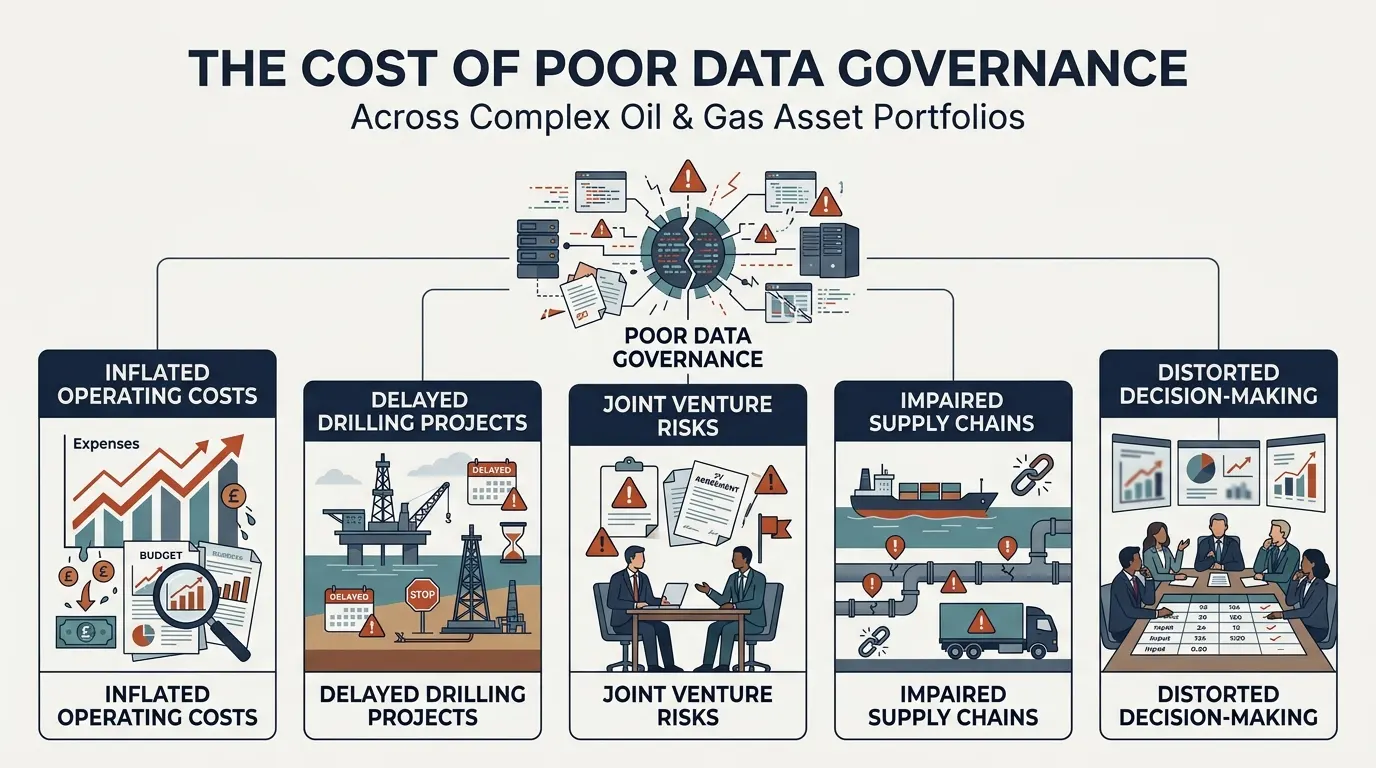
Inaccurate vendor master files directly disrupt supply chain management. Duplicate records lead to overpayments, uncaptured volume discounts, and inaccurate spend analytics during contract negotiations. In severe cases, poor vendor data results in fraudulent payments or transactions with unsanctioned entities, exposing energy corporations to massive legal penalties.
Operational risks in field execution escalate when well data lacks integrity. Misidentified wellbores lead to inaccurate reservoir stimulation operations, erroneous pressure tracking, and environmental safety violations. A failure to synchronize material master records across regional warehouses forces procurement teams to purchase redundant spare parts, tying up millions of Dollars in excess inventory while critical equipment remains unavailable during emergency shutdowns.
Financial management suffers when data quality degrades. Joint venture partners regularly perform audits on shared assets. Discrepancies within the chart of accounts governance framework or misallocated expenses caused by flawed cost object hierarchy structures lead to lengthy legal disputes and forced financial clawbacks. Establishing workforce competency in master data audit routines ensures financial records remain fully verifiable and compliant with industry regulations.
How Does Master Data Quality Training Work in Corporate Environments?
Corporate master data quality training operates as a structured learning pathway that converts organizational data policies into everyday employee behaviors through interactive instruction, practical system exercises, case-based learning, and performance evaluations.
Organizational implementation begins with a thorough training needs analysis across key departments, including procurement, logistics, drilling operations, production engineering, and corporate finance. Training providers design tailored curricula based on the specific enterprise systems, asset types, and operational workflows used within the energy enterprise.
Training delivery follows a structured four-stage implementation process designed to build sustainable workforce skills:
Foundational Principles and Governance Alignment: Employees complete instructor-led workshops or interactive digital learning modules that cover core data management concepts, data ownership principles, and system of record designation architecture.
System-Specific Practical Application: Trainees participate in hands-on simulation labs where they navigate actual enterprise software interfaces. Learners practice applying duplicate record prevention techniques and executing standardized change request and approval workflow processes.
Departmental Scenario Execution: Participants work through real-world case studies reflecting actual operational scenarios, such as onboarding complex international vendors, setting up subsea well structures, or mapping material master records across multi-site facilities.
Competency Assessment and Continuous Review: Learners undergo practical skill assessments to confirm mastery of data quality protocols. Line managers monitor post-training operational metrics to verify workplace application and identify areas requiring refresher training.
Flexible delivery formats ensure seamless integration into demanding corporate schedules. Organizations deploy 3-day intensive classroom workshops for core project teams, 6-week hybrid learning paths for distributed regional business units, or self-paced digital learning modules for continuous onboarding of new personnel.
What Core Components Must a Master Data Training Program Include?
A robust master data training program must integrate technical taxonomy principles, enterprise system workflows, data stewardship responsibilities, governance frameworks, data cleanup methodologies, and practical software simulation tools.
Effective enterprise training programs build comprehensive skills across six functional modules:
Vendor Master Data Maintenance: Training covers step-by-step procedures for creating, updating, and archiving vendor profiles. Participants learn tax identification verification, banking detail validation, anti-bribery compliance screening, and global supplier taxonomy mapping.
Well and Wellbore Identifier Standards: Learners master global identification standards, including American Petroleum Institute (API) number structures, Professional Petroleum Data Management (PPDM) data models, and Global Unique Identifiers (GUIDs). The curriculum emphasizes accurate hierarchy setup from surface locations down to completion zones.
Financial Data Integration: Instruction focuses on integrating data structures with core accounting models. Course topics include cost object hierarchy alignment, chart of accounts governance, joint venture spend tracking, and automated invoice-to-PO matching rules.
Materials and Logistics Governance: Employees learn proper standardization protocols for material master records. Training emphasizes equipment cataloging, spare part classification, stock keeping unit (SKU) rationalization, and duplicate item elimination across field warehouses.
Governance and Change Management Workflows: Participants practice operating within structured change request and approval workflow software. Lessons detail clear roles for data creators, data stewards, data approvers, and system administrators.
Audit and Quality Assurance Techniques: Training equips learners with the tools required to conduct a comprehensive master data audit. Employees learn automated data profiling, error tracking, duplicate identification algorithms, and corrective action reporting.
Learning methodologies rely heavily on practical execution. Instructors utilize case-based learning derived from historical energy sector data failures, live system simulations, guided software exercises, and practical peer reviews. This practical orientation guarantees that technical concepts directly translate into error-free workplace execution.
Which Roles Benefit Most from Master Data Quality Training?
HR managers, L&D leaders, procurement specialists, drilling engineers, finance controllers, data stewards, and IT system administrators achieve immediate performance gains through structured master data quality training.
Cross-functional alignment is vital for enterprise-wide data governance. Distinct departments benefit from specialized training focuses tailored to their primary operational duties:
Department / Role | Primary Operational Focus | Key Training Outcome |
Supply Chain & Procurement | Vendor master data maintenance, supplier onboarding, catalog management | Eliminates duplicate vendors, accelerates vendor approval times, improves spend visibility |
Drilling & Field Operations | Well and wellbore identifiers, equipment tracking, field operational logs | Reduces non-productive time, ensures precise field spend tracking, accurate well reporting |
Finance & Accounting | Cost object hierarchy, chart of accounts governance, joint venture billing | Eliminates invoice exceptions, streamlines audit preparation, prevents allocation errors |
Data Governance & IT | System of record designation, change request and approval workflow management | Enforces enterprise data policies, maintains system integrations, automates data profiling |
L&D and HR Decision-Makers | Workforce competency mapping, operational skill gap reduction, training ROI | Establishes scalable training frameworks, reduces employee onboarding time |
Industries operating complex capital assets benefit significantly from this training framework. Beyond oil and gas exploration and production companies, adjacent sectors such as petro-chemical processing, mining, power generation, maritime shipping, and heavy construction utilize these exact data governance principles to optimize large-scale capital projects.
What Measurable Outcomes Does Master Data Training Produce?
Master data quality training delivers measurable outcomes, including up to 85% fewer duplicate data records, 40% faster vendor onboarding, 25% reduction in procurement cycle times, and significant drops in joint venture audit exceptions.
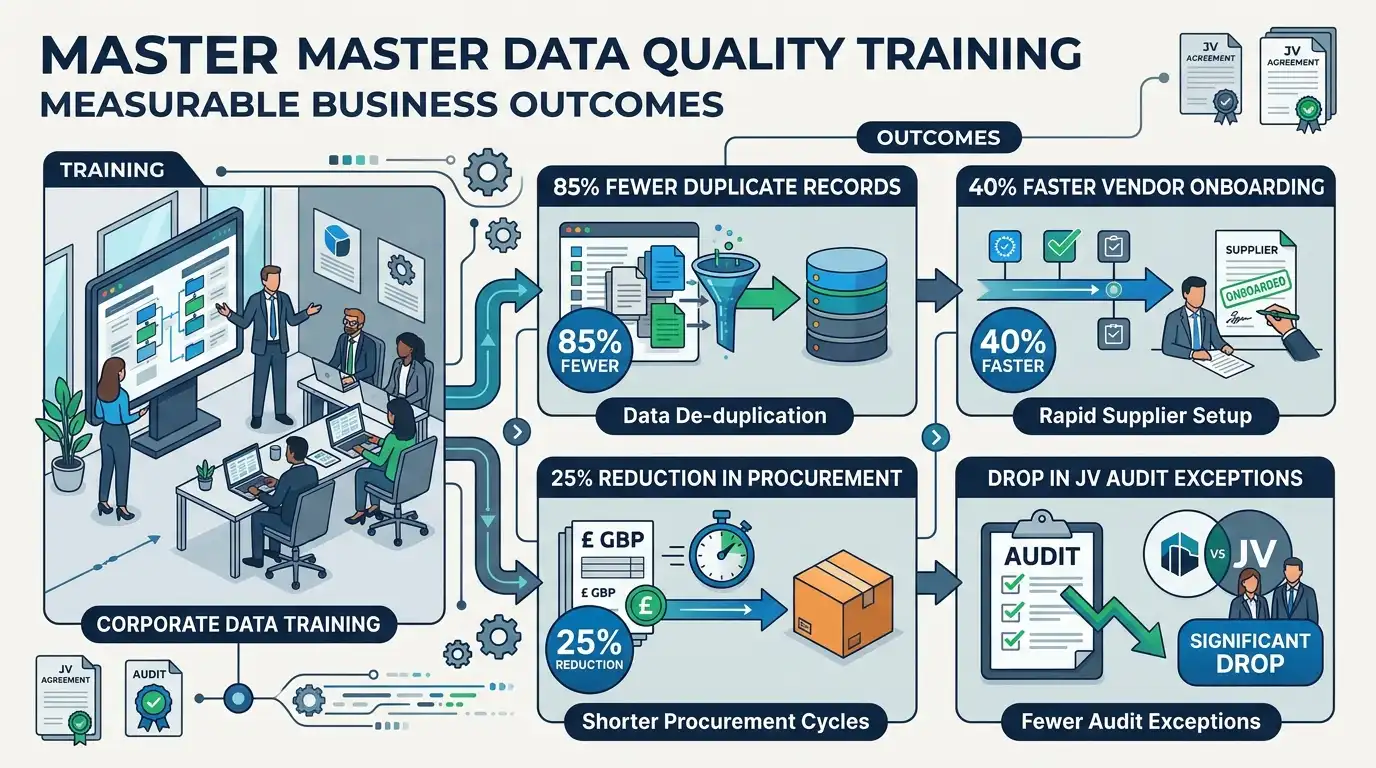
Quantifiable metrics allow corporate leaders to evaluate training return on investment (ROI) and monitor long-term performance improvements. Well-trained workforces achieve key performance indicator (KPI) benchmarks across major operational areas:
Procurement Efficiency: Organizations achieve a 35% reduction in invoice processing delays caused by vendor master errors. Automated 3-way matching rates improve from 62% to over 91% within 90 days of workforce training completion.
Field Logistics Optimization: Standardized material master records reduce emergency hot-shot deliveries to offshore rigs by 28%. Spare part inventory holding costs decline by 14% through successful SKU rationalization.
Financial Accuracy and Compliance: Audit readiness improves dramatically, with joint venture billing dispute resolution times dropping by 50%. Misallocated operational expenses decrease to less than 0.5% of total annual operating expenditure.
Operational Safety and Integrity: Unambiguous wellbore identifiers eliminate 100% of regulatory reporting errors associated with multi-zone production tracking, maintaining full legal compliance across all operating jurisdictions.
Implementing structured training also boosts employee retention rates. When employees receive clear instructions, user-friendly data workflows, and robust software tools, workplace frustration decreases. Competent staff spend less time fixing administrative data errors and more time executing high-value engineering, strategic procurement, and financial management tasks.
Understanding the business impact of data governance highlights the necessity of implementing targeted interventions to resolve persistent organizational challenges. Organizations evaluating options for structured capability building should explore How to Improve Vendor and Well Master Data Quality and Consistency to learn how practical learning interventions systematically resolve deep-seated data errors across global energy operations.
For organizations seeking to equip their procurement, technical, and finance teams with these essential competencies, enrolling key personnel in the Data Governance & Master Data: Vendor & Well Training Course provides the hands-on expertise required to establish and maintain accurate, audit-ready enterprise master data.
What Are Common Misconceptions About Corporate Master Data Training?
Common misconceptions include believing data quality is purely an IT software issue, assuming one-time cleanup projects fix data issues permanently, and viewing data governance training as an unnecessary administrative expense.
A widespread misconception across corporate leadership is that installing advanced data management software automatically resolves data quality problems. Software tools provide necessary technical infrastructure, but human operators input, interpret, and manage data daily. Without practical workforce training, employees introduce inaccurate information directly into expensive new enterprise software systems.
Another frequent error is relying on periodic, outsourced data cleansing projects. Third-party consultants can clean existing databases, but data degrades rapidly once normal business operations resume if the internal workforce lacks proper data entry habits. Sustainable data quality requires ongoing training that embeds data stewardship into corporate culture.
Finally, organizations often treat master data training as a generic, off-the-shelf HR compliance requirement. Generic data courses fail because they lack industry context. Oil and gas data structures require specialized instruction covering complex domain specifics like subsea well configurations, joint operating agreements, and specialized oilfield service taxonomies. Tailored, outcome-based professional development programs ensure learners gain practical skills directly applicable to real-world energy operations.
Frequently Asked Questions
What is oil and gas petroleum digital finance and automation?
Oil and gas petroleum digital finance and automation involves integrating advanced software, robotics, and cloud technologies into energy sector financial workflows to streamline accounting, invoicing, and reporting. The Institute For Oil & Gas Training provides professional programs that teach teams how to automate joint venture billing, financial risk management, and expenditure tracking. This digital transformation reduces manual data entry, minimizes financial reconciliation errors, and accelerates monthly reporting cycles for energy corporations.
How does finance automation improve operations in the oil and gas industry?
Finance automation streamlines joint interest billing, vendor payment processing, and field ticket auditing across complex upstream and downstream assets. By removing manual administrative bottlenecks, energy companies achieve greater financial transparency, reduce operational cost overheads, and enforce regulatory compliance. Structured professional instruction from the Institute For Oil & Gas Training equips finance and accounting personnel with the practical skills required to execute automated workflows seamlessly across enterprise platforms.
Who should attend a digital finance and automation training course in oil and gas?
This training is designed for corporate financial controllers, joint venture accountants, finance managers, system administrators, and business analysts working within energy enterprises. Personnel responsible for financial reporting, treasury management, and corporate auditing gain critical technical competencies through practical coursework delivered by the Institute For Oil & Gas Training. Training these key decision-makers helps organizations bridge employee skill gaps and accelerate the adoption of automated financial systems.
What are the main benefits of automating petroleum financial workflows?
Automating petroleum financial workflows delivers higher data accuracy, faster invoice processing cycles, reduced audit friction, and enhanced real-time financial analytics for executive management. Organizations eliminate costly billing discrepancies between joint venture operating partners while improving cash flow visibility across multi-asset portfolios. Through practical, outcome-based learning modules, the Institute For Oil & Gas Training ensures finance teams can configure and govern automated financial controls effectively.
What skills are taught in an oil and gas digital finance training program?
Participants learn how to manage automated chart of accounts structures, implement electronic invoice matching, configure joint venture accounting software, and utilize predictive financial modeling tools. The curriculum delivered by the Institute For Oil & Gas Training focuses on real-world system application, financial data governance, and robotic process automation across petroleum accounting workflows. Learners develop actionable expertise to eliminate manual financial redundancies and improve enterprise-wide accounting efficiency.
Related training courses
Digital Transformation in Petroleum Finance: Strategy & Roadmap Training Course
- Specialisation
- Oil & Gas Petroleum Digital Finance & Automation
- Duration
- 5 days · 15 CPD hours
Data Governance & Master Data: Ownership & Standards Training Course
- Specialisation
- Oil & Gas Petroleum Digital Finance & Automation
- Duration
- 5 days · 15 CPD hours
Automation of JV & PSC Reporting: Process Candidates Training Course
- Specialisation
- Oil & Gas Petroleum Digital Finance & Automation
- Duration
- 5 days · 15 CPD hours
More articles

Automation of JV and PSC Reporting Data Integration Training by Institute For Oil & Gas Training
Master automated JV and PSC reporting data integration. Review course modules, delivery formats, and learning outcomes to enroll with confidence.
Read article →
How to Integrate Financial and Operational Data for Automated JV and PSC Reporting
Learn how to integrate financial and operational data for automated JV and PSC reporting. Compare methods, architectures, and implementation frameworks.
Read article →
Why Data Integration Is Essential for Automated JV and PSC Reporting
Learn why data integration automates JV and PSC reporting in petroleum finance, closing skill gaps, reducing reconciliation errors, and driving efficiency.
Read article →