

Master data governance in upstream and midstream operations directly dictates financial accuracy, procurement efficiency, and regulatory compliance. Establishing high-quality master data requires a structured framework that standardises entity creation, unifies taxonomy across legacy platforms, and enforces strict data ownership across cross-functional enterprise workflows.
Evaluating the foundational operational risks of poor information architecture is the first step toward building an enterprise-wide remediation framework. Understanding Why Vendor and Well Master Data Quality Matters in Oil and Gas allows asset managers and data stewards to pinpoint root causes of operational friction, such as duplicate payments, misallocated drilling expenses, and non-compliant field reporting. Addressing these systemic data quality gaps requires moving from reactive cleanup routines to proactive governance protocols.
What Causes Master Data Inconsistencies in Oil and Gas Enterprise Systems?
Master data inconsistencies originate from decentralized data entry, legacy system mergers, missing taxonomy standards, and inadequate validation rules at ingestion. These structural failures produce duplicate records, misaligned financial coding, unverified vendor profiles, and conflicting well identifiers across disparate enterprise resource planning systems.
Decentralized Data Entry across Field and Corporate Offices
Upstream operations frequently operate in geographically isolated environments where field personnel log data into localized applications. When field operations create vendor records or log well intervention logs without real-time synchronization to central Enterprise Resource Planning (ERP) databases, data integrity suffers immediately. Local variations in vendor naming conventions—such as abbreviated entity names or omitted legal designators—create duplicate master records that undermine central procurement visibility.
System Mergers and Legacy Database Migration
Asset acquisitions and corporate consolidations merge distinct database architectures containing conflicting metadata schemas. Migrating data from legacy land management tools or regional accounting databases into a single system of record designation often introduces thousands of redundant entries. Without automated deduplication and strict field mapping during migration, historical errors permanently corrupt the target environment.
Absence of Unified Enterprise Taxonomy
Without a standardized data dictionary, disparate business units define primary entities using incompatible attributes. Procurement teams focus on tax identifiers and banking details, while field operations track operational capabilities and safety ratings. The lack of an integrated schema prevents the creation of a single source of truth for vendor master data maintenance and well identity management.
How Do You Standardise Well and Wellbore Identification Across Systems?
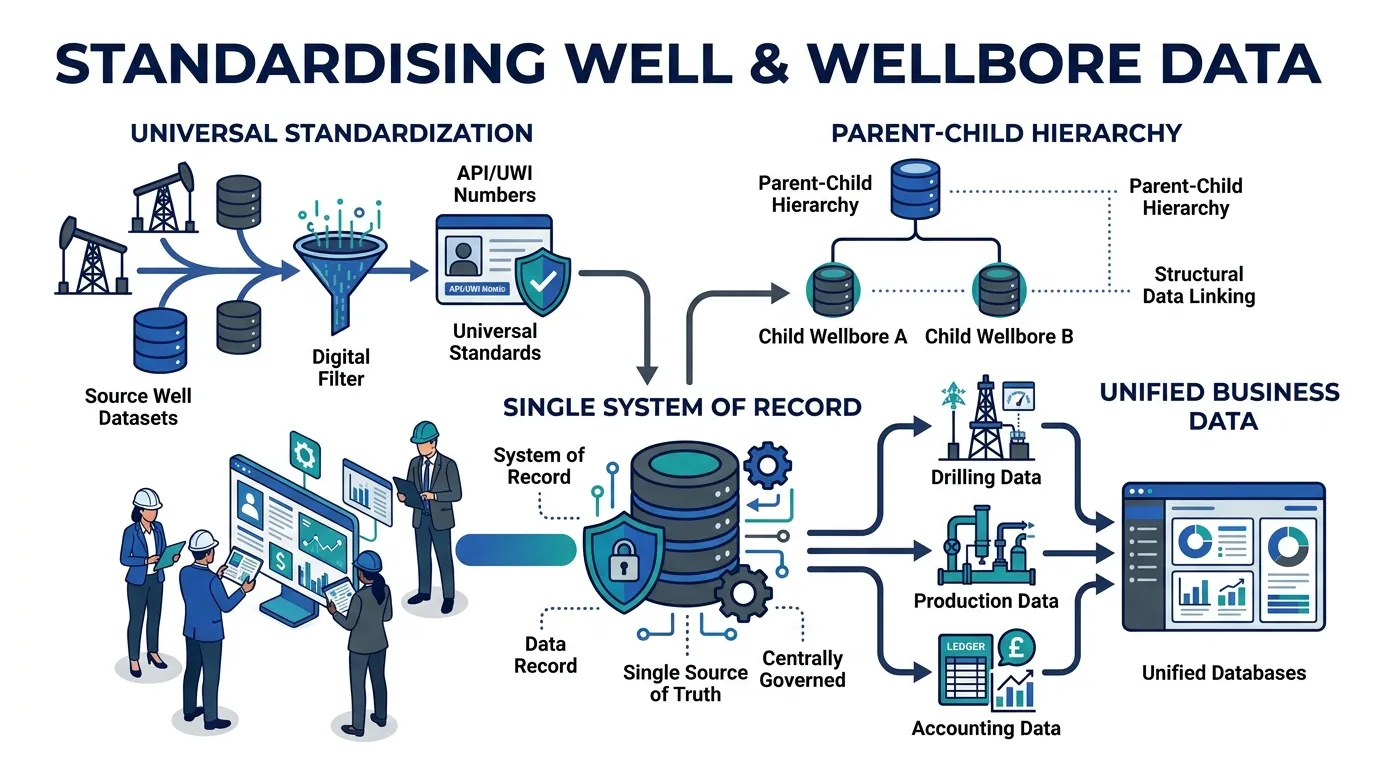
Standardising well and wellbore identifiers requires adopting universal industry standards like API/UWI numbers, enforcing strict parent-child data hierarchies, and establishing a single system of record designation. This architecture unifies drilling, production, and accounting data across all operational databases.
Implementing Universal Unique Identifiers (API / UWI Framework)
The foundation of well master data integrity rests on strict adherence to standard identifier schemes, such as the American Petroleum Institute (API) number or the Unique Well Identifier (UWI). Every physical wellbore must be assigned a permanent, unalterable numerical code at spudding. Systems must block manual overrides and restrict user access from editing primary UWI strings once generated by authoritative regulatory or corporate land systems.
Structuring Well, Wellbore, and Completion Hierarchies
Operational reporting fails when software platforms conflate a surface wellhead with individual subsurface wellbores or completion intervals. Enterprise data models must enforce a strict one-to-many parent-child hierarchy:
Well Head Level: Represents the physical surface location, surface ownership, and primary lease details.
Wellbore Level: Tracks the subsurface trajectory, drilling logs, casing design, and sidetrack paths.
Completion Level: Captures specific producing horizons, perforations, artificial lift equipment, and volumetric flow rates.
Mapping financial cost objects directly to these specific structural levels ensures accurate depletion accounting and precise capital expenditure tracking.
Designating Authoritative Systems of Record
To eliminate conflicting well attributes across departments, organisations must establish clear system of record designations for each data field. The land management database serves as the sole authority for lease boundaries and royalty rights; the subsurface engineering application maintains master borehole trajectories; the financial ERP controls the cost center links. Automated integration pipelines must push updates from these authoritative tools to downstream applications, prohibiting direct data edits inside secondary software.
How Can Organisations Prevent Duplicate Vendor Records in Procurement Systems?
Preventing duplicate vendor records requires implementing mandatory front-end validation controls, enforcing tax identification verification, automating fuzzy-logic matching algorithms during vendor onboarding, and routing all creation requests through a centralized data stewardship team.
Mandatory Pre-Creation Validation and Search Protocols
Duplicate records often form because users create new profiles rather than searching thoroughly for existing vendors. Software workflows must mandate a multi-attribute search—querying tax registration numbers, legal entity names, address lines, and bank account details—before unlocking the new vendor request screen.
Tax Identification and Legal Entity Verification
Tax Identification Numbers (TIN), Employer Identification Numbers (EIN), or corporate registry numbers serve as immutable primary keys for vendor entity verification. Enforcing automated syntax validation and real-time integration with government business registries ensures that non-standard or fake tax numbers are rejected at entry.
Fuzzy-Logic Algorithmic Matching
Exact-string matching fails to detect minor typographical variations, such as "Schlumberger Ltd" versus "Schlumberger Limited." Deploying fuzzy-logic matching algorithms within the vendor request portal scores incoming submissions against existing records based on phonetic similarity, address matching, and string distance metrics. Submissions exceeding a pre-set similarity threshold are flagged for manual review by data stewards.
What Governance Framework Enforces Master Data Consistency Across Departments?
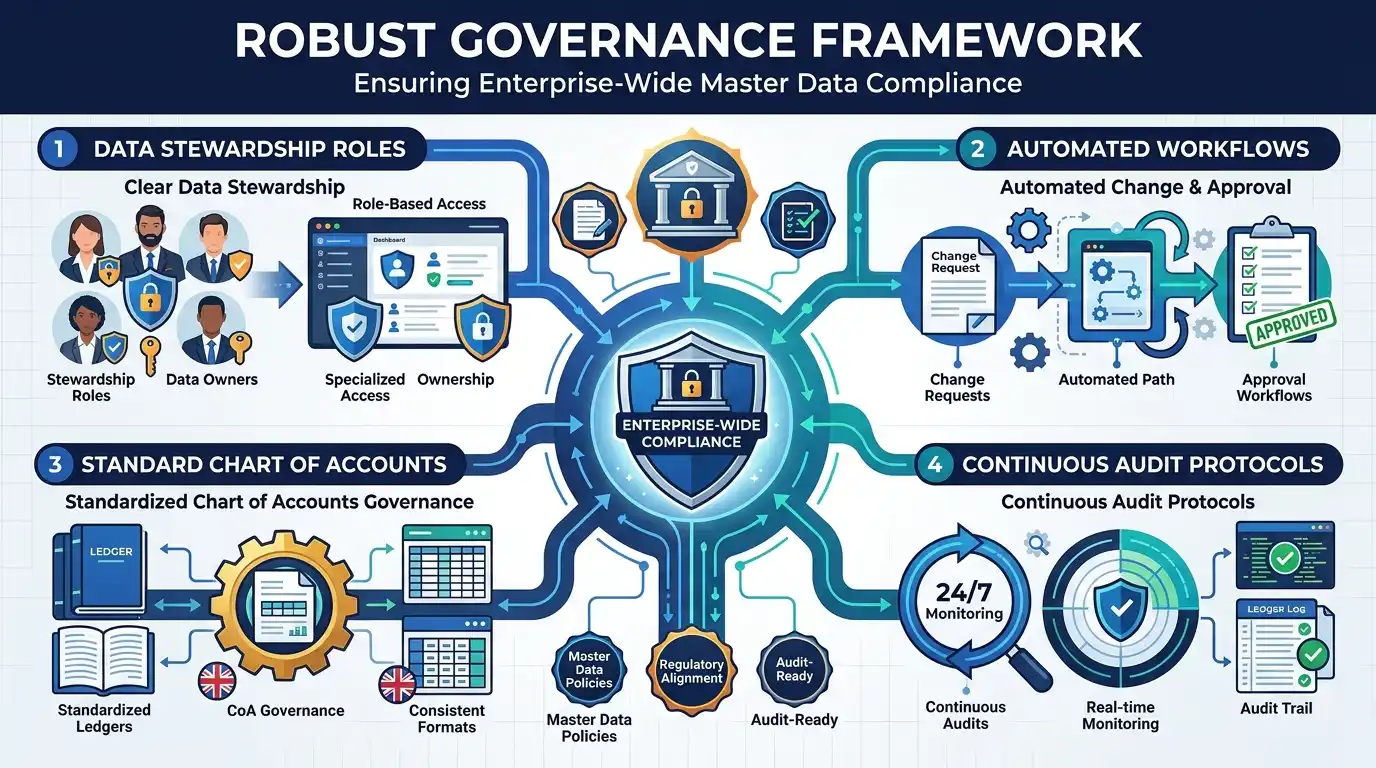
A robust governance framework combines clear data stewardship roles, automated change request and approval workflows, standardized chart of accounts governance, and continuous audit protocols to ensure enterprise-wide compliance with master data policies.
Data Ownership and Stewardship Roles
Governance requires explicit accountability. Organisations must divide data management roles into two functional tiers:
Data Owners: Executive leaders accountable for the domain's data strategy, policy enforcement, and risk exposure.
Data Stewards: Domain experts responsible for daily data validation, reviewing change requests, resolving duplicate flags, and managing reference taxonomies.
Automated Change Request and Approval Workflows
Direct database edits by end-users present severe operational risks. All additions, modifications, or deletions of master records must flow through an automated change request and approval workflow. The workflow logs user credentials, timestamps, change justifications, and pre-change data values, ensuring total auditability for compliance standards.
Aligning Material Master Records and Financial Controls
Vendor data governance must interface directly with internal financial structures. Linking material master records and vendor profiles to standardised cost object hierarchy definitions prevents misallocations of operating expenditure (OPEX) and capital expenditure (CAPEX). Integrating these domains ensures that procurement purchase orders automatically inherit correct general ledger accounts, tax codes, and authorisation levels.
Continuous Master Data Audits and Data Profiling
Data governance is an ongoing maintenance discipline rather than a one-time project. Automated master data audit scripts should run continuously across enterprise databases to identify data drift, missing mandatory fields, unlinked orphan records, and unauthorised manual entries. Weekly reporting dashboards flag exceptions directly to data stewards for rapid remediation.
Evaluating Master Data Governance Implementation Options
Selecting the right strategy to rectify master data quality depends on organisational complexity, internal technical capabilities, existing software infrastructure, and budgetary limits. The table below evaluates the primary approaches used by energy sector organisations:
Strategy | Primary Mechanism | Implementation Timeline | Risk Level | Resource Intensity | Long-Term Sustainability |
Manual Batch Cleanup | Periodic database sweeps and manual deduplication scripts. | 1 – 3 Months | High (Errors return quickly) | Low Initial / High Recurring | Low |
Custom Middleware & ETL Rules | In-house point-to-point data validation and integration scripts. | 6 – 12 Months | Moderate (Maintenance overhead) | High Technical Effort | Moderate |
Enterprise MDM Software Deployment | Centralized Master Data Management software layer platform. | 12 – 24 Months | High (Implementation complexity) | Extremely High (CAPEX/OPEX) | High |
Role-Based Workforce Training & Frameworks | Standardizing operational procedures, taxonomies, and user skills. | 2 – 4 Months | Low (Immediate operational alignment) | Moderate | High |
Decision Framework: Selecting the Right Data Governance Approach
When evaluating how to resolve vendor and well master data issues, decision-makers must align their choice with organizational scale, existing system capabilities, and urgent business priorities.
Operational Challenge | Recommended Governance Strategy | Primary Success Metric | Required Organizational Prerequisite |
High volume of duplicate vendor payments | Front-end validation rules paired with vendor data stewardship workflows. | 0% duplicate TIN creation; < 1% payment rejections. | Dedicated data steward in Accounts Payable/Procurement. |
Inaccurate well cost accumulation across ERPs | Well hierarchy standardisation using mandatory API/UWI primary keys. | 100% cost allocation accuracy to correct wellbore levels. | Executive agreement on system of record designation. |
Unstandardized material descriptions across sites | Material master record taxonomy harmonization and central gating. | 95%+ catalog search accuracy; reduction in excess inventory. | Standardized cataloging schema (e.g., UNSPSC). |
Widespread manual entry errors by system users | Targeted enterprise capability development via structured training programs. | > 90% first-time data validation pass rate. | Structured learning path tailored to energy data workflows. |
Building Long-Term Master Data Integrity
Improving vendor and well master data quality is fundamentally a structural and operational initiative. While technical validation rules and Master Data Management (MDM) platforms provide necessary technological guardrails, data governance frameworks only succeed when the workforce possesses the core competencies to execute them consistently. Addressing skill gaps across procurement teams, field engineers, land managers, and IT personnel ensures that standardized taxonomies, chart of accounts governance, and audit workflows are maintained across daily operations.
Organizations evaluating structural interventions must align software upgrades with workforce capability development. Investing in targeted educational programs—such as the Data Governance and Master Data Vendor and Well Training by Institute For Oil & Gas Training—builds the internal capability required to enforce system of record rules, execute change request workflows, and audit master data assets effectively.
Building sustainable enterprise data quality requires enrolling team members in dedicated specialized instruction. Completing the Data Governance & Master Data: Vendor & Well Training Course equips asset managers, data stewards, and ERP administrators with actionable frameworks to eliminate duplicate records, streamline well master hierarchies, and ensure ongoing regulatory compliance across the asset lifecycle.
Frequently Asked Questions
What is Oil & Gas Petroleum Digital Finance & Automation training?
Oil & Gas Petroleum Digital Finance & Automation training provided by the Institute For Oil & Gas Training focuses on integrating advanced financial technologies, predictive data analytics, automated joint venture accounting, and digital workflow systems into energy sector financial operations. This professional development program helps finance teams transition from manual record-keeping to automated, real-time financial reporting and risk management across upstream, midstream, and downstream operations.
How does digital finance automation improve operational efficiency in the petroleum sector?
Digital finance automation streamlines operational efficiency by removing manual data entry bottlenecks, accelerating monthly financial closing cycles, and reducing human error in complex petroleum accounting. The Institute For Oil & Gas Training equips professionals with techniques for implementing automated enterprise resource planning (ERP) systems, joint-interest billing (JIB) routines, and robotic process automation (RPA) for rapid transaction processing.
Who should take the Oil & Gas Petroleum Digital Finance & Automation course?
The Oil & Gas Petroleum Digital Finance & Automation program offered by the Institute For Oil & Gas Training is designed for petroleum financial analysts, energy sector CFOs, accounting managers, risk compliance officers, and IT professionals handling energy financial systems. It benefits both mid-career finance personnel seeking digital skill upgrades and executives responsible for driving digital transformation across corporate energy operations.
What key tools and technologies are covered in this training program?
The course covers industry-standard digital tools including specialized oil and gas ERP platforms, business intelligence (BI) data visualization software, automated reconciliations systems, and blockchain-enabled contract tracking. The Institute For Oil & Gas Training incorporates practical scenarios demonstrating how data analytics, machine learning, and automated auditing tools optimize petroleum cash flow and joint venture tracking.
What is the ROI of implementing finance automation in oil and gas companies?
Implementing finance automation significantly reduces administrative overhead, minimizes billing disputes with joint venture partners, and provides real-time capital expenditure visibility for asset management. Through targeted instruction from the Institute For Oil & Gas Training, finance teams learn how Oil & Gas Petroleum Digital Finance & Automation strategies lower compliance risks, eliminate audit discrepancies, and deliver measurable operational cost savings.
Related training courses
ERP Systems for Oil & Gas Implementation Training Course
- Specialisation
- Oil & Gas Petroleum Digital Finance & Automation
- Duration
- 5 days · 15 CPD hours
ERP Systems for Oil & Gas: Access Controls Training Course
- Specialisation
- Oil & Gas Petroleum Digital Finance & Automation
- Duration
- 5 days · 13 CPD hours
Power BI for Production & Cost Dashboards: Modelling Training Course
- Specialisation
- Oil & Gas Petroleum Digital Finance & Automation
- Duration
- 5 days · 15 CPD hours
More articles

Automation of JV and PSC Reporting Data Integration Training by Institute For Oil & Gas Training
Master automated JV and PSC reporting data integration. Review course modules, delivery formats, and learning outcomes to enroll with confidence.
Read article →
How to Integrate Financial and Operational Data for Automated JV and PSC Reporting
Learn how to integrate financial and operational data for automated JV and PSC reporting. Compare methods, architectures, and implementation frameworks.
Read article →
Why Data Integration Is Essential for Automated JV and PSC Reporting
Learn why data integration automates JV and PSC reporting in petroleum finance, closing skill gaps, reducing reconciliation errors, and driving efficiency.
Read article →