

Oil and gas accounting requires accurate integration between financial ledgers and operational production data. Joint venture (JV) and production sharing contract (PSC) management often suffers from manual data entry, disconnected spreadsheets, and weak audit trails. The Automation of JV and PSC Reporting Data Integration Training by Institute For Oil & Gas Training addresses these operational risks by equipping joint venture accountants, asset financial controllers, and upstream systems analysts with technical patterns for automated data ingestion, validation, and partner statement distribution.
Upstream operations run on split operational and financial systems. Production volumes are logged in field management software, while costs accrue in central ERP platforms. Manual extraction creates reconciliation delays, cash call errors, and partner audit disputes. Why Data Integration Is Essential for Automated JV and PSC Reporting explains how manual data pipelines expose joint ventures to financial misstatements and operational delays.
What is this training course and what reporting challenges does it solve?
This training course provides structured instruction on automating data flows between field management tools, ERP platforms, and partner reporting systems. It resolves manual data handling errors, eliminates month-end reconciliation bottlenecks, and ensures compliance with upstream accounting contracts.
Joint venture accounting and production sharing agreement administration require strict adherence to complex cost-sharing formulas and cost recovery rules. Traditional reporting relies on manual data extraction from legacy databases, manual alignment of financial codes with operational metrics, and custom spreadsheet formulas. This fragmented methodology introduces operational friction, increases human error, and extends month-end closing timelines.
Corporate finance and joint venture accounting departments often face discrepancies when matching field volume data with general ledger costs. Disconnected systems hinder the validation of gross-to-net calculations, overhead allocations, and inventory balances. Without automated validation protocols, accounting teams spend valuable hours performing manual reconciliations rather than analysing asset performance or preparing for partner audit reviews.
The course delivers a framework for engineering automated data pipelines that ingest, standardise, and reconcile upstream data. Participants study real-world integration architectures designed specifically for joint operating agreements (JOAs) and PSC production-sharing schedules. The Institute For Oil & Gas Training created this curriculum to transition accounting teams from manual processing to managed automated controls.
Why is the curriculum structured for technical and financial integration?
The curriculum uses a linear engineering framework that transitions learners from raw data ingestion to automated reconciliation, partner distribution, and system governance. This design ensures accounting and IT professionals build scalable, compliant integration workflows for upstream assets.
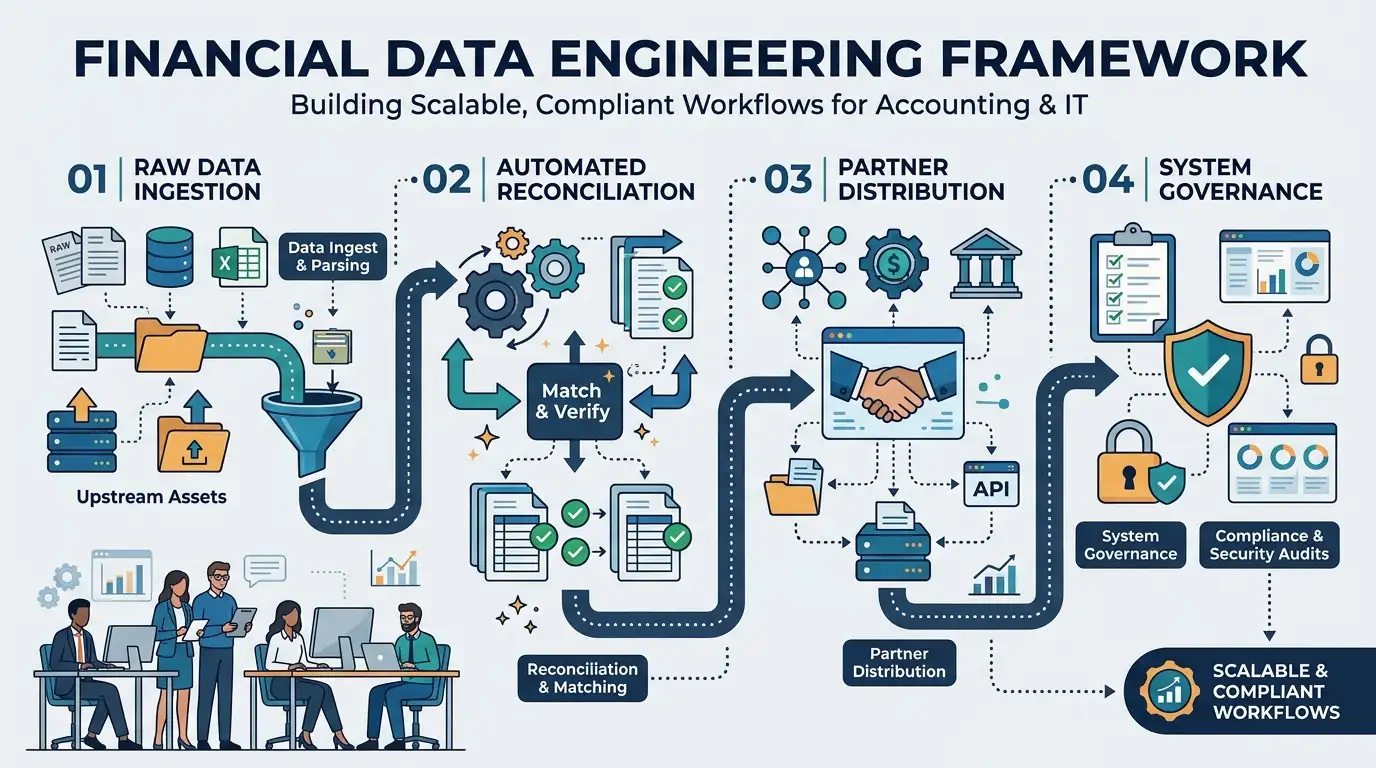
Upstream financial management requires a clear understanding of both accounting rules and enterprise data architecture. The curriculum bridges technical IT operations and financial reporting requirements. How to Integrate Financial and Operational Data for Automated JV and PSC Reporting outlines the foundational principles of mapping accounting codes to field volume data across multi-tier enterprise systems.
The course progression ensures that participants move systematically through every stage of data integration engineering:
Source Data Architecture and Mapping
Participants analyze how operational database schemas align with joint venture general ledgers, Authority for Expenditure (AFE) tracking systems, and land management registers.
Ingestion Protocol Configuration
Learners evaluate the technical criteria for choosing between scheduled file extractions and event-driven API endpoints based on source system capabilities and latency requirements.
Automated Reconciliation Logic Engine
The program covers the design of rules-based validation engines that cross-check volumetric inputs against financial general ledger entries prior to partner statement calculation.
Output Governance and Security Architecture
Participants learn to build secure delivery channels and audit log frameworks that satisfy regulatory compliance and joint venture partner verification requirements.
What specific technical modules and skills are included in the program?
Participants gain practical skills in data mapping, API integration, automated reconciliation rule creation, error management, and secure partner statement distribution. The modules combine theoretical concepts with hands-on technical exercises using real upstream accounting scenarios.
The course is structured into six detailed technical modules:
Module 1: Upstream Data Architecture and Source System Integration
Evaluation of ERP database structures, field production databases, and JOA/PSC accounting modules.
Establishing standardized data dictionaries across disparate financial and operational software platforms.
Principles of source system integration for multi-operator joint ventures and concession blocks.
Database schema alignment strategies for joint venture billing, cost allocation, and revenue distribution.
Module 2: Data Ingestion: API and File Based Data Feeds
Implementation specifications for API and file based data feeds across corporate IT boundaries.
Extraction protocols for structured files including CSV, XML, JSON, and direct database queries.
Batch processing scheduling versus event-driven stream integration for month-end reporting windows.
Network security standards, authentication methods, and data encryption techniques during transit.
Module 3: Data Transformation, Validation and Reconciliation Checks
Building rules-based engines for automated validation and reconciliation checks on financial transactions.
Configuring automated control totals to verify data integrity across operational and ledger interfaces.
Cost allocation automation according to variable participating interests and PSC cost recovery caps.
Cross-system validation formulas for matching daily production volumes against monthly lifting statements.
Module 4: Error Handling, Alerts, and Exception Management
Designing comprehensive error handling and alerts workflows for data schema mismatches.
Automated routing of failed reconciliation checks to relevant finance or IT team members.
Exception logging systems that preserve raw data files while flagging operational variance.
Remediation procedures for handling retro-active adjustments in production metrics or general ledger accounts.
Module 5: Secure Partner Portal Distribution and Version Control
Building workflows for secure partner portal distribution of cash calls and billing statements.
Maintaining immutable digital audit trails and version control of statements across adjustment cycles.
Role-based access control (RBAC) configurations for multi-partner joint operation management.
Automated generation of standardized partner reports in PDF, XLSX, and machine-readable formats.
Module 6: Automation Governance and Documentation
Establishing strict automation governance and documentation standards for financial audit compliance.
Standard operating procedure (SOP) development for system maintainability and team onboarding.
Compliance mapping against SOX controls, JOA audit provisions, and host-government PSC terms.
Continuous monitoring, system maintenance strategies, and platform performance optimization.
How is the training course delivered and assessed?
The course offers flexible delivery options, including instructor-led live virtual classrooms, interactive hands-on workshops, and on-site corporate sessions. Skill mastery is evaluated through practical integration projects, data validation exercises, and a final capstone assessment.
The Institute For Oil & Gas Training provides three delivery formats tailored to corporate requirements and team locations:
Instructional Methods
Instructors deliver technical concepts using real upstream database schemas and financial data sets. Participants work through hands-on integration projects within sandbox enterprise environments.
Workshops emphasize practical problem-solving using industry-standard tools. Rather than evaluating passive comprehension, the learning process focuses on building functional integration scripts, validation routines, and report generation workflows.
Assessment and Skill Verification Framework
To verify skill development, the Institute For Oil & Gas Training uses a structured evaluation methodology:
Practical Data Ingestion Exercises: Candidates configure automated file parsers and API connectors to ingest complex production and financial data files.
Reconciliation Engine Design Assignment: Participants create logic rules to identify, flag, and route system variances across production records and ledger accounts.
Audit Trail and Statement Versioning Exam: Practical demonstration of setting up secure partner access protocols and statement revision histories.
Capstone Integration Project: Learners design an end-to-end automated reporting pipeline, including data mapping, automated control checks, exception alert routing, and governance documentation.
What measurable operational results and performance gains can organizations expect?
Organizations achieve up to an 80% decrease in statement generation time, total elimination of manual data entry errors, accelerated month-end financial closes, and improved compliance during joint venture partner audits.
Implementing automated data integration pipelines transforms asset financial management. By replacing spreadsheet-based workflows with structured data integration tools, companies protect their joint operations from costly billing disputes and financial misstatements.
Key Organizational Outcomes
Accelerated Month-End Closing
Automating ingestion and validation processes reduces joint venture monthly close timelines from weeks to days, allowing accounting teams to release cash calls faster.
Complete Audit Readiness
Standardized version management and digital tracking systems maintain full traceability for every line item, simplifying host government and partner audit reviews.
Decreased Operational Risk
Automated control totals detect file corruption, duplicate entries, and missing data points before statement generation, preventing incorrect cash calls.
Optimized Resource Allocation
Automating routine data aggregation allows financial analysts and joint venture accountants to focus on strategic financial analysis, contract negotiation, and asset optimization.
The Institute For Oil & Gas Training designs its course materials to deliver immediate corporate returns, giving finance leaders clear visibility into asset profitability and partner obligations.
What are the eligibility criteria and enrollment process for individuals and teams?
The course is designed for joint venture accountants, financial controllers, upstream systems analysts, and finance IT managers. Applicants should have a foundational understanding of upstream accounting principles or enterprise data management concepts.
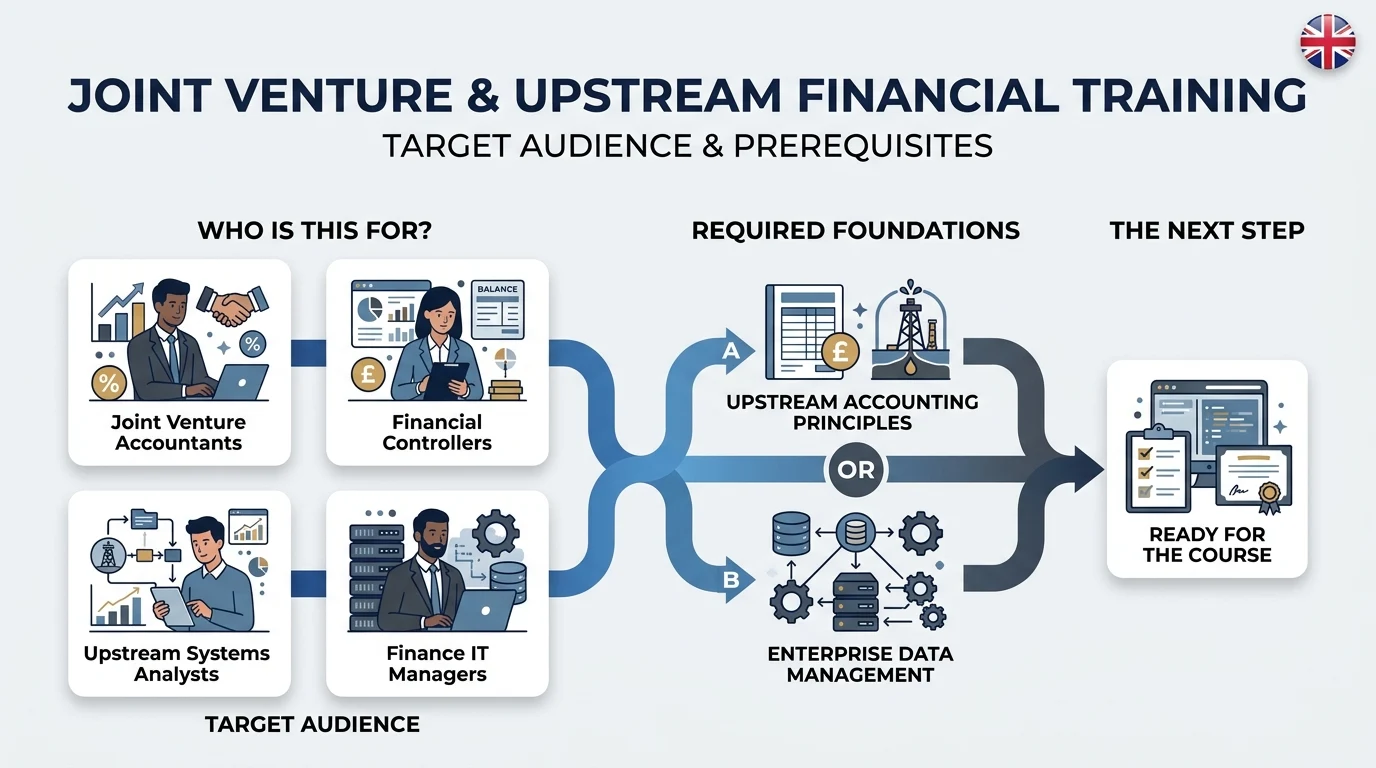
The Institute For Oil & Gas Training maintains clear entry standards to ensure balanced group dynamics and productive practical sessions.
Entry Requirements
Professional Background: A minimum of two years of experience in oil and gas accounting, upstream financial management, or enterprise resource planning (ERP) system administration.
Technical Baseline: Basic familiarity with database structures, general ledger concepts, and common data formats (XLSX, CSV, XML).
Corporate Prerequisites: Corporate-sponsored cohorts should have access to sample (sanitized) system data structures to maximize project relevance during practical workshops.
Enrollment and Onboarding Process
Application Submission: Candidates or corporate HR teams submit an application detailing current technical roles and learning objectives.
Profile Evaluation: Academic leads at the Institute For Oil & Gas Training review the applicant's experience to ensure alignment with course content.
Format Confirmation: Corporate clients select their preferred delivery option (live virtual, on-site, or hybrid) and set schedule milestones.
Pre-Course Technical Onboarding: Approved participants receive access to system sandbox environments, preliminary technical reading, and software configuration guides.
To reserve corporate seats or register individual team members, apply for course access.
Frequently Asked Questions
What is Oil & Gas Petroleum Digital Finance & Automation?
Oil & Gas Petroleum Digital Finance & Automation involves integrating digital technologies—such as robotic process automation (RPA), enterprise resource planning (ERP) integrations, and automated joint venture accounting—into upstream, midstream, and downstream financial workflows. The Institute For Oil & Gas Training provides specialized instruction on automating production-sharing contracts, reconciliation checks, and energy market financial reporting to eliminate manual data handling.
How does digital finance automation improve petroleum accounting efficiency?
Digital finance automation replaces manual spreadsheet data entry with real-time data integration pipelines connecting operational field databases to general ledgers. Professionals trained by the Institute For Oil & Gas Training learn to implement continuous audit trails, automated control totals, and automated partner statement distribution, reducing month-end closing cycles and billing errors.
Who should enroll in Oil & Gas Petroleum Digital Finance & Automation training?
This training is designed for joint venture accountants, asset financial controllers, upstream systems analysts, and energy finance managers seeking to update legacy accounting methods. Courses delivered by the Institute For Oil & Gas Training help corporate finance and IT departments bridge technical automation with energy sector compliance requirements.
What software and integration tools are covered in energy digital finance courses?
Curricula typically cover API and file-based data ingestion models, automated reconciliation engines, ERP financial modules, and secure partner portal distribution systems. The Institute For Oil & Gas Training focuses on practical framework integration, enabling participants to manage multi-operator cost allocations and regulatory reporting efficiently.
What are the key business benefits of adopting financial automation in oil and gas?
Implementing modern financial automation reduces joint venture statement generation timelines, prevents cash call discrepancies, and ensures full audit compliance for host-government and partner reviews. Training programs from the Institute For Oil & Gas Training prepare corporate teams to minimize operational risk while optimizing strategic financial management across exploration and production assets.
Related training courses
Digital Transformation in Petroleum Finance: AI & RPA Training Course
- Specialisation
- Oil & Gas Petroleum Digital Finance & Automation
- Duration
- 5 days · 15 CPD hours
Microsoft Copilot for Oil & Gas Finance Applications Training Course
- Specialisation
- Oil & Gas Petroleum Digital Finance & Automation
- Duration
- 5 days · 15 CPD hours
Microsoft Copilot for Oil & Gas Finance Governance Training Course
- Specialisation
- Oil & Gas Petroleum Digital Finance & Automation
- Duration
- 5 days · 15 CPD hours
More articles

How to Integrate Financial and Operational Data for Automated JV and PSC Reporting
Learn how to integrate financial and operational data for automated JV and PSC reporting. Compare methods, architectures, and implementation frameworks.
Read article →
Why Data Integration Is Essential for Automated JV and PSC Reporting
Learn why data integration automates JV and PSC reporting in petroleum finance, closing skill gaps, reducing reconciliation errors, and driving efficiency.
Read article →
Automation of JV and PSC Reporting Process Candidates Training by Institute For Oil & Gas Training
Evaluate the Automation of JV and PSC Reporting Process Candidates Training syllabus, outcomes, delivery formats, and enterprise enrollment paths.
Read article →