

Data integration for Joint Venture and Production Sharing Contract reporting is the structural synchronization of financial, operational, and non-financial data streams across upstream oil and gas accounting environments to achieve automated, audit-ready compliance statement generation.
In petroleum operations, joint ventures (JVs) and production sharing contracts (PSCs) govern thousands of transactions daily across multiple operating partners. Operators must allocate capital expenditures, operating expenditures, and produced volumes strictly in accordance with Joint Operating Agreements (JOAs) and Accounting Procedures. Manual data extraction from disparate enterprise resource planning systems leads to structural reporting bottlenecks.
Data integration establishes automated pipelines between general ledgers, production databases, and asset management platforms. It standardizes disparate data models into unified reporting structures, eliminating manual spreadsheet manipulations. For corporate learning and development leaders, training teams on integrated reporting workflows closes persistent technical skill gaps within joint venture accounting departments.
Corporate accounting environments demand absolute precision during joint interest billing (JIB) and cost recovery statement compilation. Legacy processes rely on manual copy-pasting across isolated spreadsheets, which introduces severe operational risks. Modern upstream finance teams require structured competency frameworks covering API data ingestion, automated control totals, and rule-based allocation engines.
Establishing data integration skills across joint venture accounting teams transforms reporting from a reactive administrative burden into an automated, controlled workflow. Organizations implementing structured training programs in integrated financial workflows reduce statement compilation times from weeks to hours while maintaining compliance with international petroleum accounting standards.
How Does Integrated Data Flow Function Within Automated Joint Venture Accounting Workflows?
Integrated data flow functions by ingesting, validating, transforming, and distributing financial and operational data automatically from source systems through allocation rule engines directly to secure non-operator financial reporting portals.
Stage 1: Data Ingestion and Source System Integration
Financial systems continuously extract raw data from core enterprise resource planning platforms such as SAP, Oracle, and SunSystems alongside production monitoring tools like P2 Energy Solutions and Merrick. Pipelines absorb structured financial transactions, joint interest billing vouchers, maintenance work orders, and daily oil, gas, and water production volumes.
Structured data pipelines rely on both direct API endpoints and scheduled batch file transfers to ingest information across multi-company database architectures without human intervention.
Stage 2: Automated Validation and Reconciliation Checks
Ingested raw files pass through automated validation gates before entering the central calculations database. Validation frameworks test data completeness, detect missing joint venture partner codes, flag unapproved authorization for expenditure (AFE) numbers, and verify mathematical integrity across sub-ledgers.
System integrity relies on automated control totals that compare financial balances between source enterprise resource planning platforms and joint venture allocation tables. Discrepancies automatically trigger exception workflows for accounting review.
Stage 3: Allocation Transformation Engine Execution
The transformed data model applies complex Joint Operating Agreement cost-sharing percentages and Production Sharing Contract cost recovery formulas. The calculation engine processes overhead allocations, capital cost caps, sliding-scale royalty percentages, and profit oil splits across distinct equity joint venture structures.
Rule-based calculation architectures handle multi-currency conversions and historical retro-adjustments without corrupting prior period closed ledgers.
Stage 4: Secure Distribution and Audit Lineage Archival
The final allocation outputs generate standardized Joint Interest Billing statements, PSC cost recovery schedules, and cash call notices. The platform publishes these final files directly to secure partner distribution channels, while simultaneously creating an immutable lineage record for external joint venture audits.
Integrated system architectures maintain full traceabilities, allowing joint venture auditors to drill down from high-level partner statements directly to line-item general ledger source transactions.
What Key Components Are Included in a Modern Data Integration Framework for Petroleum Accounting?
A modern data integration framework includes robust source system integration, API and file-based data feeds, validation and reconciliation checks, automated control totals, error handling and alerts, secure partner portal distribution, version control of statements, and automation governance and documentation.
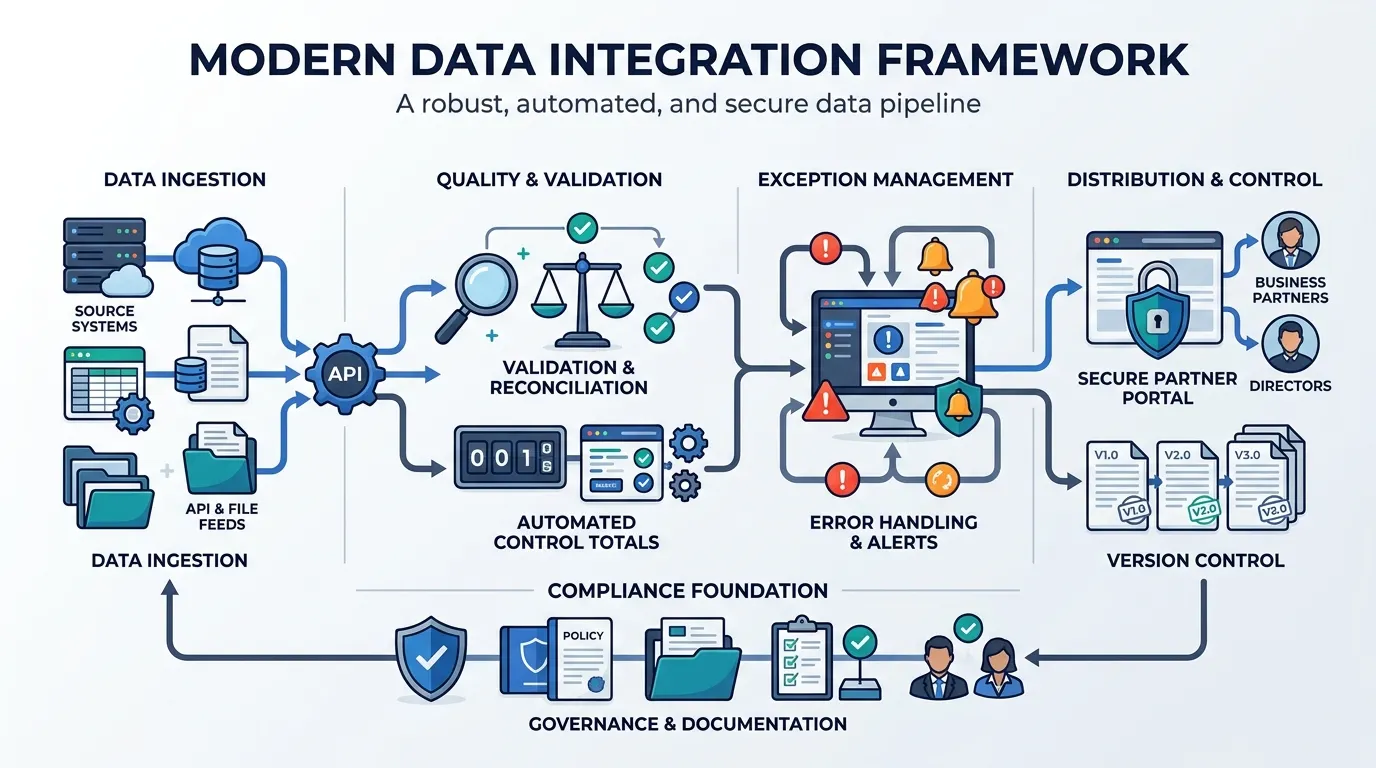
Core Architecture Components
Source system integration: Establishes native connectivity between core financial general ledgers, asset management databases, and field operation tracking tools.
API and file-based data feeds: Configures real-time rest APIs, GraphQL endpoints, and automated secure file transfer protocol (SFTP) batch ingestion tasks.
Validation and reconciliation checks: Executes automated rule sets that verify transactional metadata, partner ownership percentages, and currency exchange parameters.
Automated control totals: Verifies mathematical parity between source ledger balances and downstream joint venture partner statements prior to closing reporting cycles.
Operational and Governance Components
Error handling and alerts: Routes system exceptions, unmapped cost centers, and failed data validation checks instantly to designated finance teams via automated notifications.
Secure partner portal distribution: Delivers encrypted Joint Interest Billing statements, monthly cash calls, and production volume reports directly to joint venture partners through centralized web interfaces.
Version control of statements: Preserves historic statement iterations, maintaining clear time-stamped records of prior-period adjustments and revised joint venture allocations.
Automation governance and documentation: Defines explicit operational rules, user access roles, audit logs, and system data dictionaries across the entire enterprise data architecture.
Organisations upskilling their finance and technology teams in these eight core components build resilient digital capabilities. Technical mastery of integrated data frameworks ensures seamless alignment between operational asset management and corporate financial reporting obligations.
How Do Organisations Implement Integrated Data Systems Through Structured Professional Development?
Organisations implement integrated data systems through structured professional development by combining cross-functional skill-gap analyses, role-tailored technical curricula, simulation-based workshops, practical implementation projects, and objective competency evaluations.
Implementing automated reporting platforms requires technical fluency across accounting, IT, and joint venture asset management teams. System deployments often fail due to user resistance and skill deficits rather than software limitations. A structured corporate learning strategy bridges technical gaps and accelerates system adoption across operating units.
Step 1 involves a comprehensive skill-gap analysis across finance and joint venture operations teams. Learning managers evaluate current competencies in data extraction, database architecture, SQL querying, joint operating agreement interpretation, and automated control verification. This diagnostic phase establishes baselines for corporate upskilling programs.
Step 2 focuses on curriculum design and delivery format selection. Organisations deploy hybrid learning models combining instructor-led technical workshops with hands-on sandbox laboratories. Finance professionals learn to configure data integration pipelines, build validation rules, and establish automated control totals within simulated enterprise resource planning environments.
Step 3 executes practical, scenario-based learning modules. Trainees process complex joint venture scenarios, including retro-active equity adjustments, multi-partner cost cap overruns, and complex production sharing cost recovery splits. Participants build error handling protocols and audit trace models using real-world operational data sets.
Step 4 establishes rigorous post-training assessment and operational governance integration. L&D leaders evaluate employee competency through practical workflow builds and system configuration tests. Mastering structural data integration concepts enables accounting departments to execute full software rollouts smoothly, ensuring immediate operational efficiency.
What Measurable Business Outcomes and Performance Metrics Does Integrated Reporting Training Produce?
Integrated reporting training produces measurable business outcomes including a 75% reduction in financial close cycles, a 90% drop in statement reconciliation errors, complete audit-lineage compliance, and significant productivity gains.
Key Performance Indicators (KPIs)
Monthly close cycle duration: Reduces statement generation time from 15 business days down to 3 business days per closing cycle.
Statement error rate: Cuts partner billing discrepancies and manual spreadsheet formula errors by over 90%.
Audit dispute resolution time: Accelerates joint venture audit responses from months to days through instant lineage tracking.
Capacity reallocation: Shifts 85% of joint venture accounting work hours from manual data entry to strategic financial analysis.
Enterprises investing in technical data integration skills yield clear, quantifiable returns on investment. Upstream oil and gas companies operating across joint venture assets face substantial financial penalties, delayed cash calls, and costly partner litigation when JIB and PSC statements contain errors or experience distribution delays.
Professional development in automated financial workflows transforms joint venture accounting departments into agile, high-performing operational units. Standardizing data feeds and automated validation protocols reduces corporate risk profiles while strengthening joint venture partner relationships across international operating jurisdictions.
Which Corporate Teams, Roles, and Industries Require Technical Upskilling in Data Integration?
Corporate teams in joint venture accounting, financial operations, IT data engineering, internal audit, and legal compliance across capital-intensive industries require technical upskilling in data integration.
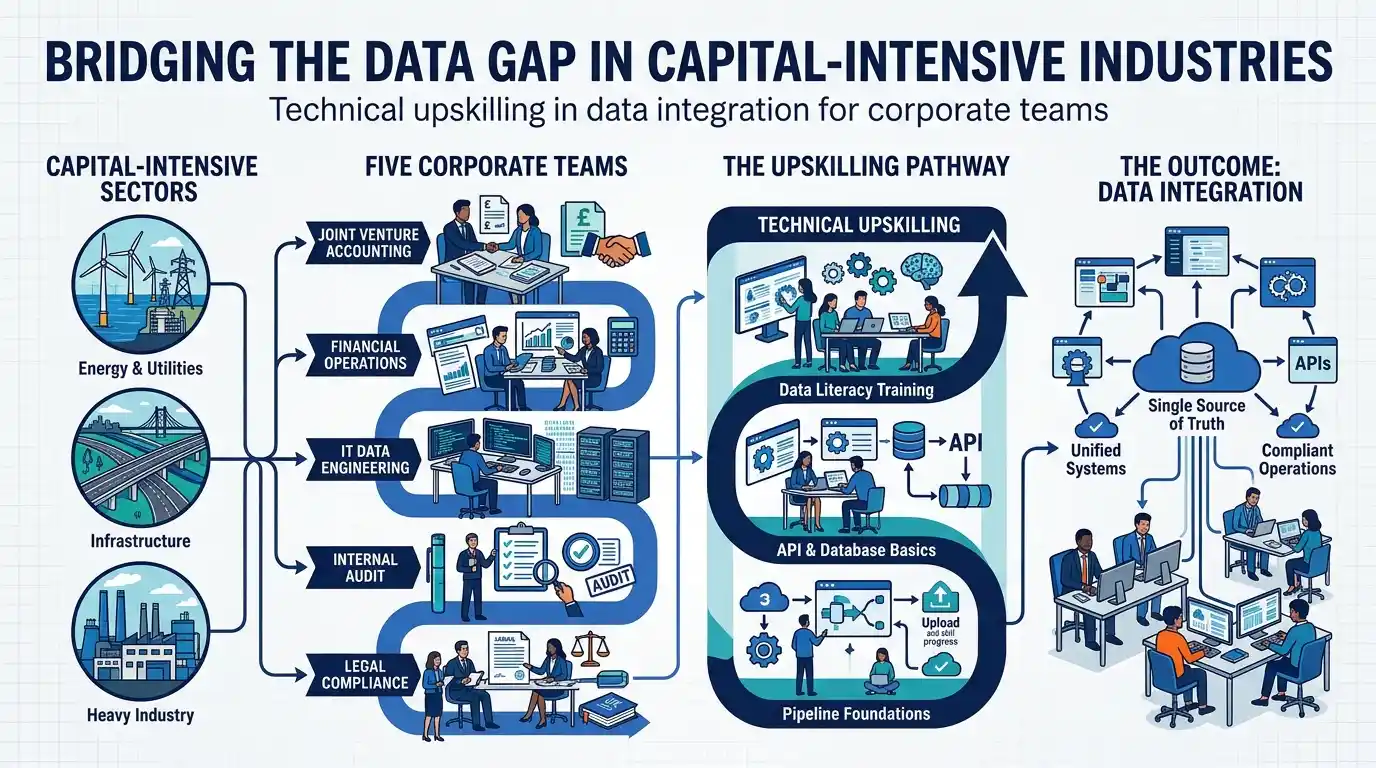
Key Corporate Roles Needing Training
Joint venture financial accountants: Must master automated allocation rule engines, partner code mappings, and statement validation frameworks.
Financial controllers: Require deep knowledge of automated control totals, exception handling oversight, and enterprise risk mitigation.
IT and data architecture specialists: Need advanced capabilities in designing secure API data pipelines, database schemas, and enterprise software connectors.
Joint venture audit and compliance managers: Depend on structural understanding of digital audit trails, automated version control, and partner portal governance.
Targeted Industry Sectors
Upstream oil and gas operations: Managing complex Joint Operating Agreements, deepwater joint ventures, and international Production Sharing Contracts.
Renewable energy consortia: Handling multi-party capital investment allocations for offshore wind farms and large-scale solar installations.
Mining and extractives sector: Processing joint venture cost-sharing matrices across multi-national mineral exploration projects.
Infrastructure and megaproject construction: Managing shared capital expenditure, joint equipment utilization metrics, and multi-entity billing.
Providing role-specific learning paths ensures that technical, financial, and operational personnel speak a common operational language. Interdisciplinary training removes operational silos, allowing joint venture project teams to deploy integrated automated systems efficiently.
What Are the Common Misconceptions and Structural Challenges in Joint Venture Data Integration Projects?
Common misconceptions include viewing data integration as purely an IT function, believing existing ERP software automates joint venture reporting out-of-the-box, and underestimating staff skill deficits.
Misconception 1: "Data Integration Is Strictly an IT Department Responsibility"
Many business leaders assume software integration belongs exclusively to IT engineering units. In practice, successful data pipelines require deep domain knowledge of petroleum accounting, JOA clauses, and cost recovery mechanics. Training finance teams to collaborate directly with data engineers ensures integrated systems correctly reflect operational realities.
Misconception 2: "Standard Enterprise Software Automates Joint Venture Reporting Automatically"
General enterprise resource planning platforms lack out-of-the-box capabilities for complex joint venture allocations, sliding-scale PSC oil calculations, and partner portal statement publishing. Organizations must build custom data integration layers and upskill accounting staff to manage automated pipeline configurations.
Misconception 3: "New Technology Deployment Guarantees Immediate Process ROI"
Investing in advanced data integration software without parallel investments in workforce development leads to underutilized systems and persistent manual workaround habits. To learn how to structure finance and IT capabilities effectively, explore How to Integrate Financial and Operational Data for Automated JV and PSC Reporting.
Structured professional training programs like the Automation of JV & PSC Reporting: Data Integration Training Course address these operational bottlenecks directly. Comprehensive upskilling transforms raw technology investments into functional corporate capabilities, driving error-free accounting operations and sustainable business performance.
Frequently Asked Questions
What is Oil & Gas Petroleum Digital Finance & Automation?
Oil & Gas Petroleum Digital Finance & Automation refers to the integration of automated workflows, predictive analytics, enterprise data pipelines, and robotic process automation into energy financial operations. The Institute For Oil & Gas Training provides specialized professional development to help finance and joint-venture accounting teams modernize legacy reporting, improve joint interest billing, and streamline revenue accounting.
How does digital finance automation improve Joint Venture and PSC reporting?
Digital finance automation unifies operational asset data and enterprise resource planning systems through rule-based allocation engines. Institute For Oil & Gas Training equips finance professionals with the skills to implement automated validation checks and automated control totals, reducing joint-venture statement reconciliation errors and significantly shortening monthly close cycles.
Who should undertake training in Oil & Gas Petroleum Digital Finance & Automation?
This specialized training is designed for joint-venture accountants, financial controllers, energy analysts, internal auditors, and IT systems integration teams operating within the energy sector. Training programs at Institute For Oil & Gas Training bridge the technical gap between joint-venture operations and financial management to drive organizational efficiency across upstream, midstream, and downstream operations.
What key skills are covered in Oil & Gas Petroleum Digital Finance & Automation courses?
Participants master source system integration, API and file-based data ingestion, automated control total reconciliation, exception alert handling, and secure partner portal statement distribution. Programs delivered by Institute For Oil & Gas Training emphasize practical data governance and immutable version control workflows required for joint-venture audit compliance.
Why is automation training critical for energy sector financial management?
Legacy manual spreadsheet processes create severe operational bottlenecks, unrecovered joint interest expenses, and extended audit dispute cycles across joint operating agreements. By training workforce teams in Oil & Gas Petroleum Digital Finance & Automation, Institute For Oil & Gas Training enables energy organizations to reduce administrative overhead, ensure Joint Operating Agreement compliance, and improve joint venture financial transparency.
Related training courses
ERP Systems for Oil & Gas Implementation Training Course
- Specialisation
- Oil & Gas Petroleum Digital Finance & Automation
- Duration
- 5 days · 15 CPD hours
Digital Transformation in Petroleum Finance: AI & RPA Training Course
- Specialisation
- Oil & Gas Petroleum Digital Finance & Automation
- Duration
- 5 days · 15 CPD hours
Automation of JV & PSC Reporting: Process Candidates Training Course
- Specialisation
- Oil & Gas Petroleum Digital Finance & Automation
- Duration
- 5 days · 15 CPD hours
More articles

Automation of JV and PSC Reporting Data Integration Training by Institute For Oil & Gas Training
Master automated JV and PSC reporting data integration. Review course modules, delivery formats, and learning outcomes to enroll with confidence.
Read article →
How to Integrate Financial and Operational Data for Automated JV and PSC Reporting
Learn how to integrate financial and operational data for automated JV and PSC reporting. Compare methods, architectures, and implementation frameworks.
Read article →
Automation of JV and PSC Reporting Process Candidates Training by Institute For Oil & Gas Training
Evaluate the Automation of JV and PSC Reporting Process Candidates Training syllabus, outcomes, delivery formats, and enterprise enrollment paths.
Read article →