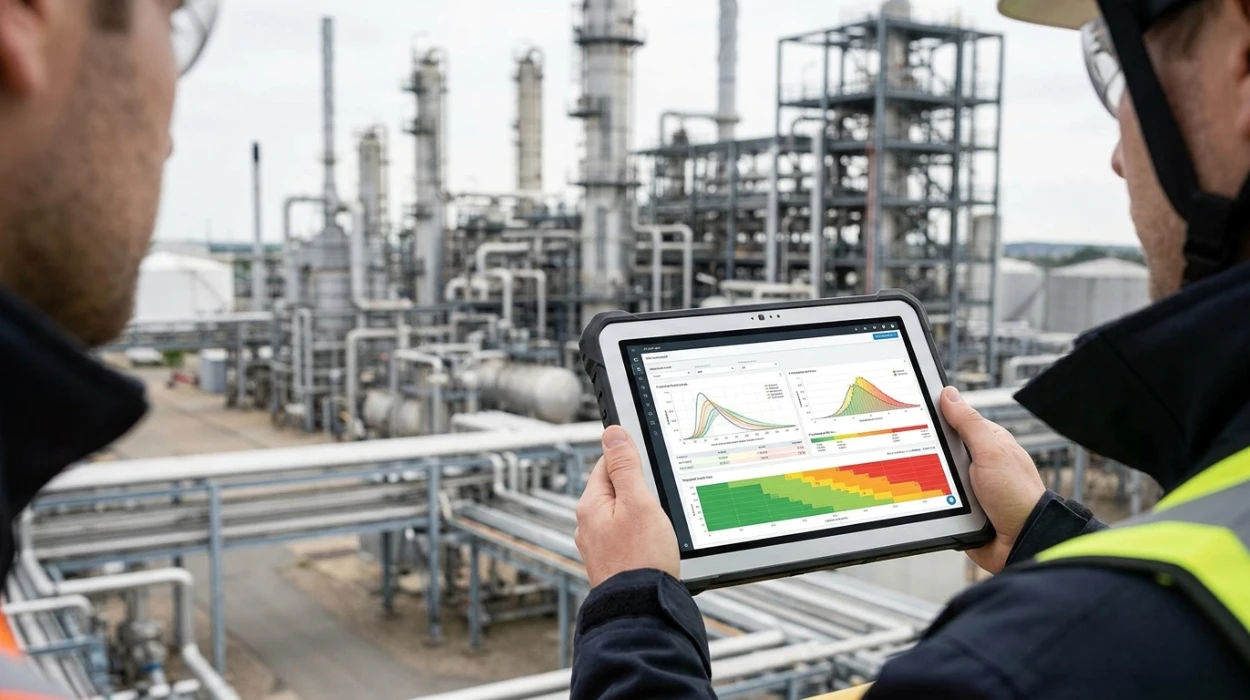
Expected credit loss training transforms oil and gas financial literacy by closing corporate skill gaps through structured workforce development programs that ensure accurate accounting for complex financial instruments.
What is Expected Credit Loss Training in Corporate Environments?
Expected credit loss training is a corporate professional development program that builds financial reporting competence across accounting and treasury teams.
Organizations face significant financial reporting complexities under modern accounting frameworks. Oil and gas companies deal with multi-million-dollar joint venture receivables, complex intercompany loan measurement structures, and extensive partner receivable risk. Standard accounting teams often lack the precise technical skills required to interpret these complex financial instruments correctly. Corporate learning programs address this gap through intensive educational modules.
Workforce development initiatives deliver these competencies via targeted delivery formats. Organizations utilize 3-day intensive workshops, interactive online modules, and hybrid learning models to upskill accounting staff. These programs teach finance professionals how to perform rigorous business model assessments and evaluate whether financial assets meet solely payments of principal and interest criteria. Learners master the classification of assets under amortised cost and fair value through profit or loss accounting rules.
Educational initiatives produce measurable operational outcomes for energy enterprises. Organizations implementing structured financial training experience a 35% reduction in audit adjustments and achieve compliance verification within 14 business days of reporting period closes. Teams improve risk identification accuracy by 42%, which protects corporate balance sheets from unexpected impairments. Upskilling initiatives also drive employee retention rates up by 28% as finance professionals gain confidence in managing complex regulatory standards.
How Does Expected Credit Loss Implementation Work in Organizations?
Expected credit loss implementation operates through a four-phase corporate training lifecycle that moves from baseline skills assessment to practical workflow integration.
Organizations deploy corporate learning methodologies through structured progression steps. The deployment lifecycle begins with a baseline workforce capability assessment. L&D professionals evaluate existing employee skill gaps across accounting teams. Enterprises identify specific deficiencies in handling lifetime ECL calculations and the receivable provisioning matrix. Assessments establish clear benchmark metrics for subsequent performance improvement tracking.
Curriculum design follows the initial evaluation phase. Instructional designers collaborate with technical accounting experts to build customized training modules. Programs incorporate case-based learning, financial simulations, and practical role-play scenarios. Learners analyze historical default data, macroeconomic forecasts, and forward-looking information specific to energy markets. Teams examine real-world asset impairments encountered by global energy firms.
Delivery mechanisms combine theoretical instruction with practical workplace application. Companies schedule multi-week cohorts blending virtual instructor-led sessions with self-paced digital modules. Participants complete competency check assessments after each module. Supervisors track progress using key performance indicators such as assessment pass rates, time-to-competency metrics, and practical application scores.
Post-training reinforcement ensures long-term operational impact. Organizations deploy internal coaching sessions and peer review networks to sustain newly acquired knowledge. Continuous professional development tracking maintains high performance standards across accounting departments. Leadership teams measure return on investment by evaluating audit efficiency gains and error reduction rates.
What Key Components Shape Financial Instrument Training Programs?
Financial instrument training programs comprise technical accounting frameworks, quantitative modeling tools, and interactive delivery formats designed for corporate finance teams.
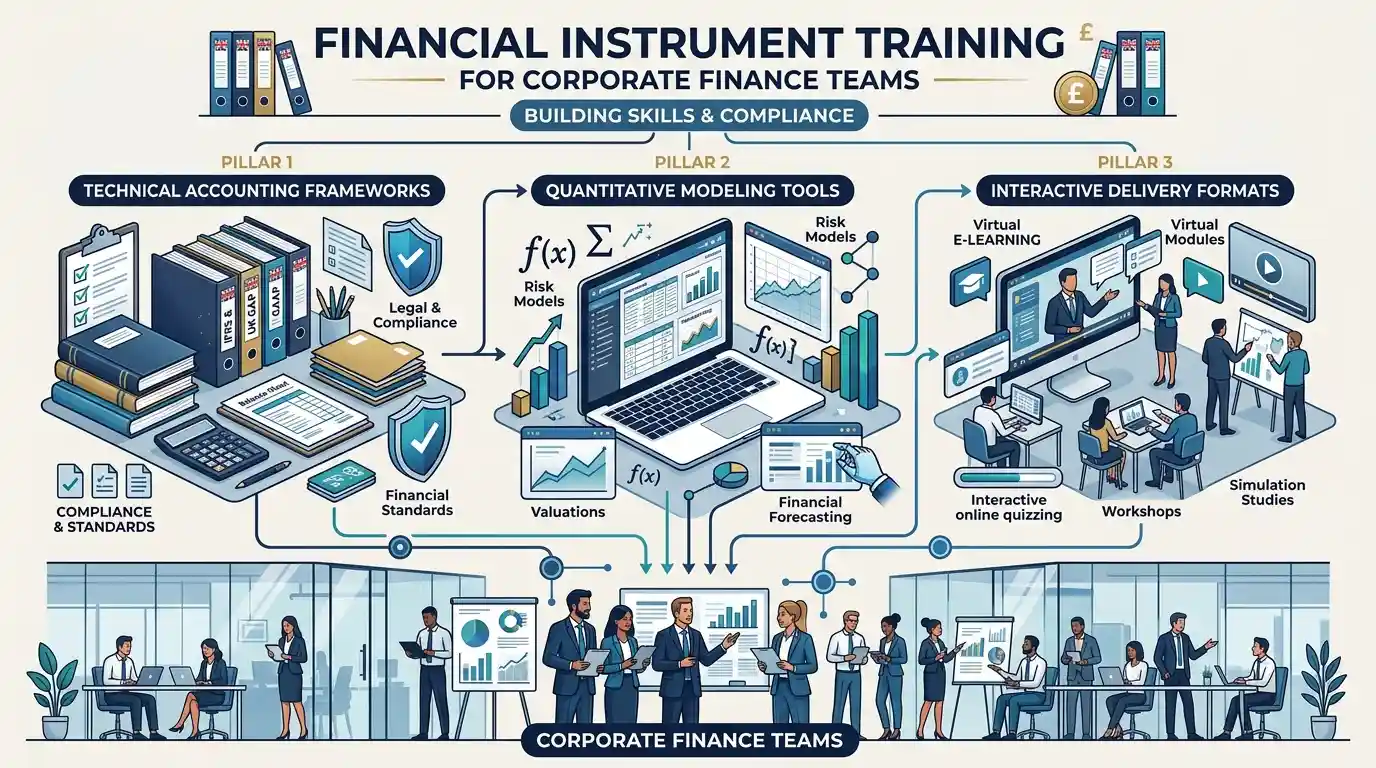
Corporate learning curricula integrate specific foundational frameworks. Programs cover the mechanics of the expected credit loss model and its distinction from incurred loss methodologies. Learners master the distinction between 12-month ECL and lifetime ECL measurements. Curriculum content explores complex asset categories including trade receivables, debt securities, and loan commitments.
Quantitative tools form a core pillar of technical instruction. Participants learn how to construct and apply a receivable provisioning matrix using historical loss rates adjusted for forward-looking macroeconomic factors. Training covers probability-weighted outcome calculations, discount rate adjustments, and statistical modeling techniques. Accountants practice evaluating credit risk changes across diverse operational portfolios.
Delivery formats adapt to modern enterprise environments. Organizations deploy blended learning structures combining 40 hours of digital self-study with 16 hours of live workshop facilitation. Enterprise teams utilize collaborative problem-solving exercises to analyze complex intercompany loan measurement cases. Assessments incorporate practical coding and spreadsheet modeling tests to verify technical proficiency.
Organizational impact depends on rigorous performance metrics. Companies track skill acquisition through pre-training and post-training diagnostic evaluations. Quantitative key performance indicators measure reductions in financial statement restatements and improvements in reporting cycle times. Workforce development initiatives strengthen the overall corporate governance framework by establishing standardized accounting protocols.
What Organizational Benefits Do Structured Training Programs Produce?
Structured training programs produce enhanced financial accuracy, accelerated reporting timelines, reduced regulatory compliance risks, and improved cross-functional team efficiency.
Workforce development initiatives deliver profound advantages to enterprise operations. Enhanced financial literacy eliminates recurring calculation errors across joint venture accounting statements. Teams execute rigorous business model assessments with absolute consistency. Accounting professionals accurately determine whether financial assets qualify for amortised cost or fair value through profit or loss treatment.
Risk management capabilities improve across the entire enterprise. Finance personnel identify deteriorating credit profiles months before default events materialize. Advanced risk modeling techniques allow treasury departments to provision accurately for partner receivable risk and complex intercompany loans. Proactive risk mitigation protects operating cash flows and safeguards capital reserves.
Operational efficiency metrics demonstrate clear quantitative improvements. Organizations report a 50% decrease in external auditor query resolution times following staff completion of specialized financial training. Month-end close cycles accelerate by 4 business days, freeing professional staff to focus on strategic financial analysis rather than manual error correction. Team productivity indexes rise by 30% across corporate accounting departments.
Leadership development pipelines benefit significantly from technical upskilling. Training initiatives cultivate analytical competence among mid-level managers and senior accountants. Organizations experience a 25% increase in internal promotion rates for financial reporting roles. Enhanced workforce stability reduces external recruitment expenditures and preserves institutional knowledge within energy corporations.
Where Are Financial Instrument Training Frameworks Applied Across Corporate Teams?
Financial instrument training frameworks are applied across corporate accounting departments, treasury operations, internal audit teams, and executive management groups.
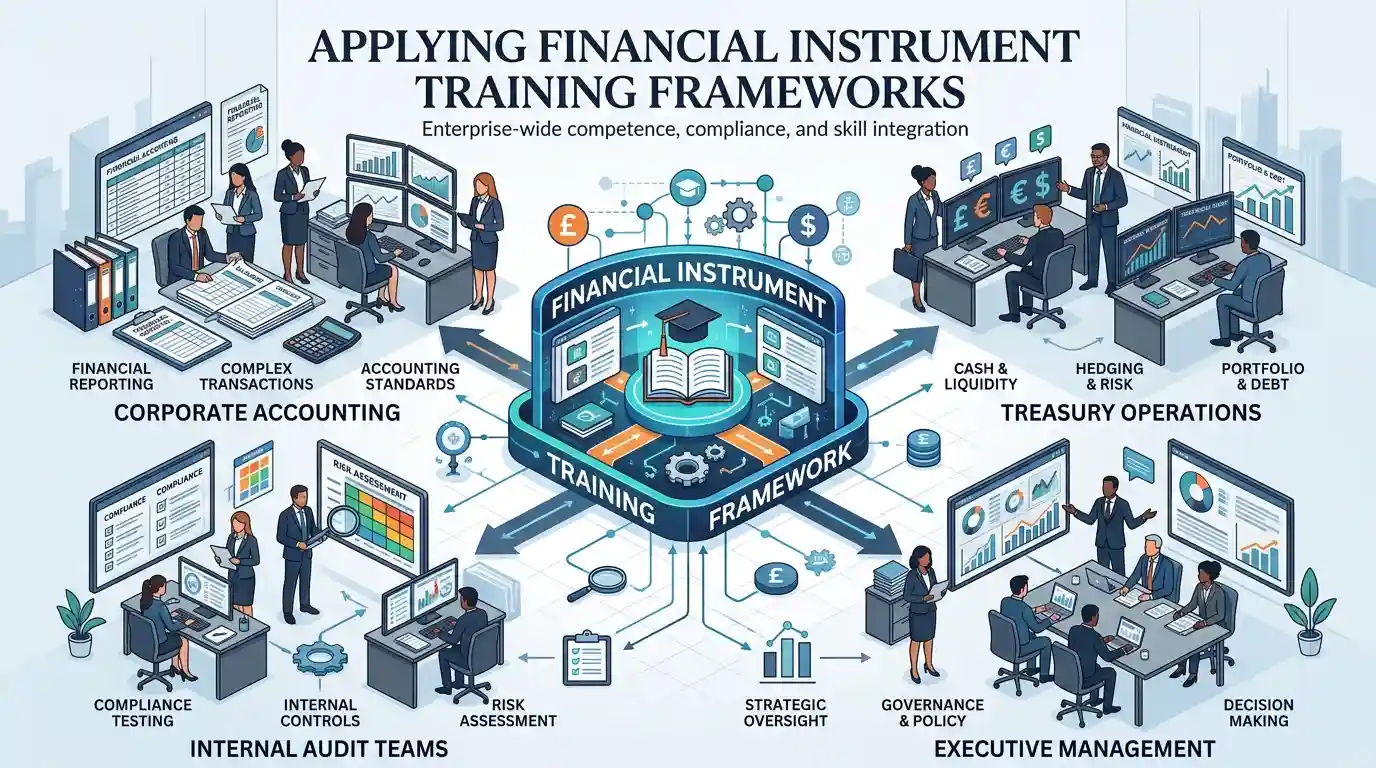
Corporate deployment extends across multiple functional units within the energy sector. Core accounting teams apply lifetime ECL methodologies to manage extensive trade receivable portfolios. Treasury specialists utilize training principles to structure intercompany loan measurement protocols and evaluate partner receivable risk across international operating subsidiaries.
Internal audit units leverage technical training to evaluate compliance with IFRS 9 standards. Auditors review calculation models, assess macroeconomic input validity, and verify provisioning matrix accuracy. Enhanced audit competence reduces reliance on expensive external advisory services and strengthens internal governance controls.
Executive leadership teams utilize financial literacy programs to improve strategic decision-making. Chief Financial Officers and corporate controllers interpret complex impairment impacts with greater clarity. Management communicates financial position changes transparently to investors, rating agencies, and regulatory authorities.
Industry applications extend beyond traditional upstream operations. Midstream pipeline operators, downstream refining enterprises, and oilfield service providers implement identical training architectures. These diverse organizations leverage structured learning to manage credit risk exposure inherent in volatile commodity markets and capital-intensive supply chains.
What Common Problems and Misconceptions Undermine Financial Training Initiatives?
Ineffective financial training initiatives suffer from generic curriculum design, lack of practical workplace application, absence of measurable outcome tracking, and superficial regulatory coverage.
Organizations frequently encounter systemic pitfalls when deploying professional development programs. Generic training courses fail to address industry-specific complexities such as joint venture default risks and specialized commodity financing instruments. Employees complete superficial e-learning modules without mastering the mathematical mechanics of the expected credit loss model.
Another critical misconception assumes that theoretical knowledge translates automatically to workplace performance. Training programs lacking case-based simulations and practical modeling exercises leave staff unprepared for real-world accounting challenges. Employees struggle to implement complex frameworks like solely payments of principal and interest assessments without guided practice.
Deficient evaluation methodologies obscure true program effectiveness. Organizations that measure training success solely through completion certificates fail to capture actual productivity improvements. Absence of pre-training baselines and post-training assessments prevents accurate return on investment calculations.
Enterprise leaders eliminate these operational failures by demanding rigorous, outcome-based learning structures. Successful initiatives incorporate continuous competency testing, real-world case studies, and post-implementation performance audits. Organizations align educational investments directly with strategic financial reporting objectives.
Frequently Asked Questions
What does Oil and Gas Petroleum IFRS and Financial Reporting entail?
Oil and gas petroleum IFRS and financial reporting encompasses specialized accounting standards applied to upstream, midstream, and downstream energy operations. The Institute For Oil & Gas Training equips finance professionals with the technical expertise needed to handle complex reporting requirements such as reserve recognition, impairment testing, and joint venture accounting. Mastering these frameworks ensures transparent financial disclosures and strict compliance with international regulatory bodies.
Why is specialized financial reporting training critical for energy companies?
Energy enterprises operate in high-capital environments with intricate contractual arrangements that standard accounting frameworks do not fully address. Specialized training from the Institute For Oil & Gas Training bridges critical employee skill gaps by teaching teams how to manage asset decommissioning obligations, production-sharing agreements, and commodity price risk. This targeted professional development safeguards corporate balance sheets and minimizes costly external audit adjustments.
How are impairment tests conducted under IFRS for oil and gas assets?
Impairment testing under IFRS requires energy accounting teams to evaluate cash-generating units based on discounted future cash flows and volatile commodity price forecasts. Training programs from the Institute For Oil & Gas Training guide finance personnel through the complex mechanics of determining recoverable amounts and booking impairment losses. Developing these competencies ensures accurate asset valuation across exploration and production portfolios.
What are the main challenges in joint venture accounting for petroleum firms?
Joint venture accounting presents significant complexity due to multi-partner cost sharing, complex billing arrangements, and variable working interest percentages. Professionals utilize specialized education from the Institute For Oil & Gas Training to navigate partner receivable risks and ensure precise revenue recognition across shared operations. Overcoming these operational hurdles prevents accounting discrepancies and strengthens intercompany governance.
How does financial reporting training improve corporate compliance and audit efficiency?
Comprehensive education in IFRS standards empowers internal audit and finance teams to execute rigorous reporting protocols ahead of fiscal period-ends. Programs delivered by the Institute For Oil & Gas Training help organizations streamline month-end close cycles and accelerate external auditor query resolutions. Enhanced reporting accuracy ultimately protects stakeholder trust and optimizes capital allocation decisions.
Related training courses
Pipeline Integrity Management (API 1160/ASME B31.8) Training Course
- Specialisation
- Oil & Gas Pipeline Integrity and Inspection
- Duration
- 5 days · 15 CPD hours
API 510 Pressure Vessel Inspectors Training Course
- Specialisation
- Oil & Gas Inspection and Non-Destructive Testing
- Duration
- 5 days · 15 CPD hours
Asset Integrity Management (ISO 55000/PAS 55) Training Course
- Specialisation
- Oil & Gas Asset Integrity Management
- Duration
- 5 days · 15 CPD hours
More articles

IFRS 9 Expected Credit Loss Training for Oil and Gas Financial Professionals
Master IFRS 9 expected credit loss models for oil and gas assets. Enhance compliance and valuation accuracy. Enroll in our specialized training course today.
Read article →
Key IFRS 9 Expected Credit Loss Challenges for Oil and Gas Companies
Explore key IFRS 9 expected credit loss challenges in oil and gas, covering business model assessments, SPPI tests, and lifetime ECL measurement.
Read article →
IFRS 16 Lease Charging and Modifications Training for Oil and Gas Joint Venture Professionals
Master IFRS 16 lease charging, JV cost allocation, and modifications with Institute For Oil & Gas Training. Enroll today.
Read article →