

Liquidity and solvency evaluation forms the bedrock of capital management within energy exploration, production, and refining businesses. Financial teams must rigorously test capital structures against extreme market volatility, shifting supply-demand dynamics, and geopolitical turmoil.
Evaluating liquidity and solvency risks requires systematic capital modeling to determine how severe operational shocks impact corporate cash reserves, debt covenants, and long-term capital viability. Organizations often struggle to quantify systemic exposure until commodity prices slump, making Why Cash Flow Stress Testing Matters for Oil and Gas Liquidity and Solvency a vital foundational concept for risk managers, corporate treasurers, and financial controllers who need to protect solvency.
How Does Cash Flow Stress Testing Identify Liquidity and Solvency Risks?
Cash flow stress testing identifies liquidity and solvency risks by modeling capital inflows and fixed operational outflows against extreme commodity price drops, production outages, and rising funding costs to pinpoint exact cash shortfalls, covenant breaches, and capital depletion points.
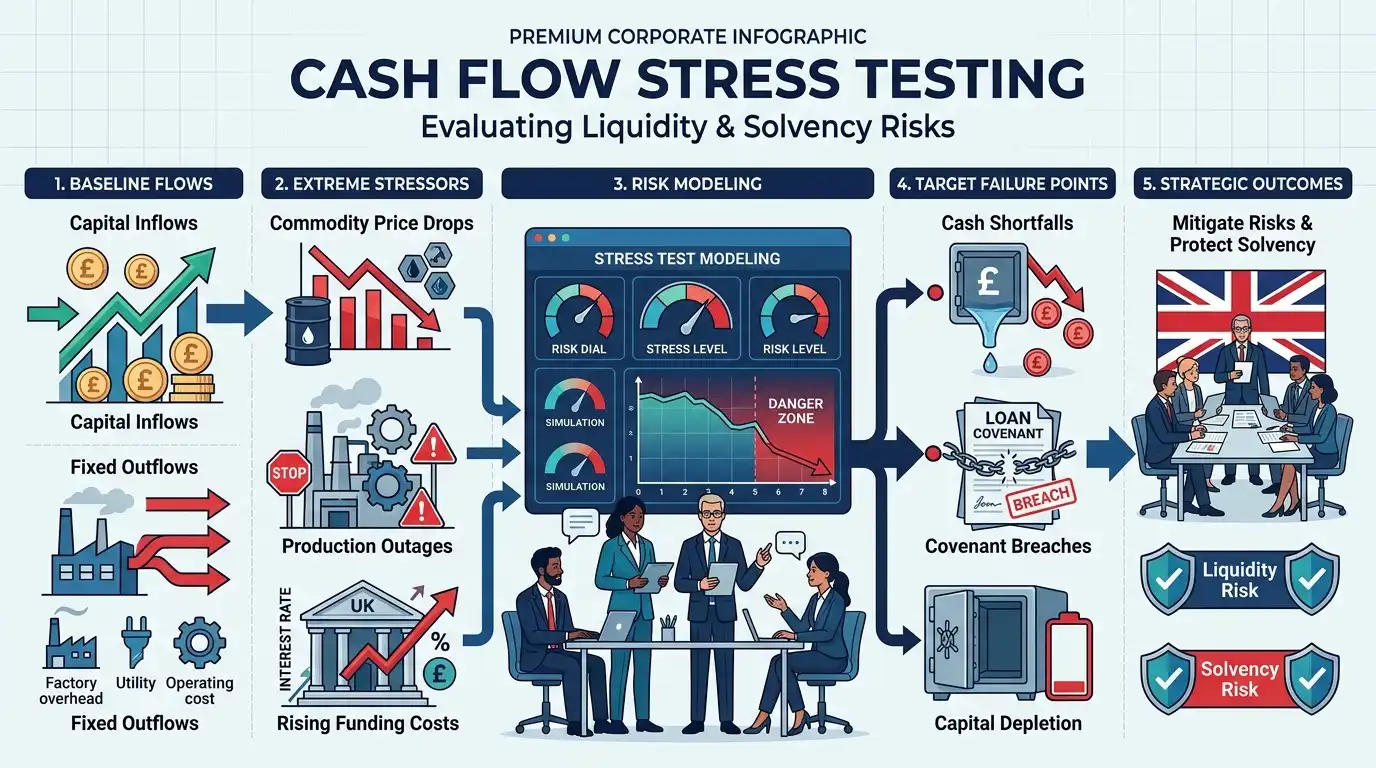
Financial analysis professionals evaluate risk by isolating key cash flow drivers within dynamic financial models. The process maps projected earnings before interest, taxes, depreciation, and amortisation (EBITDA) against fixed debt service commitments, minimum capital expenditure (CapEx) requirements, and operational working capital needs.
Solvency evaluation measures long-term debt sustainability, whereas liquidity assessment focuses on short-term obligations. A company maintains solvency when total asset value exceeds total liabilities, yet it faces immediate bankruptcy if short-term liquidity vanishes.
Stress testing bridges these two metrics. It forces risk managers to simulate adverse operational events across specific timeframes to discover how quickly balance sheet erosion leads to default.
What Scenarios Must Oil and Gas Financial Teams Model?
Oil and gas financial teams must model market price collapses, unexpected production delays, severe operational cost inflation, credit rating downgrades, and supply chain bottlenecks to ensure comprehensive risk coverage across short-term liquidity horizons and long-term corporate debt structures.
Scenario selection determines stress testing accuracy. Financial professionals run deterministic, stochastic, and historical models to capture multi-variable market disruptions.
Market Commodity Shock
An oil price shock represents the primary variable in upstream financial modeling. Teams model crude price declines of 30 percent to 50 percent lasting over 12 to 24 months.
These scenarios incorporate price realization differentials, pipeline tariff adjustments, and counterparty default risks on unhedged volumes.
Operational Disruption and Cost Overruns
Operational risk models simulate major field shutdowns, offshore platform outages, and deferred drilling schedules. These events reduce cash generation while maintenance CapEx increases.
Financial teams also model inflationary pressures on lease operating expenses (LOE), oilfield services rates, and regulatory compliance obligations.
Macroeconomic and Credit Shocks
Financial risk analysis models interest rate hikes on variable-rate debt alongside credit rating downgrades. A lower credit rating increases borrowing margins, reduces trade credit terms from suppliers, and triggers margin calls on derivative hedging positions.
How Do Financial Analysts Structure Stress Testing Methodologies?
Financial analysts structure stress testing methodologies by combining forward-looking scenario analysis, sensitivity testing, and reverse stress testing to establish quantitative thresholds for cash burn, debt covenant compliance, liquidity headroom, and emergency capital deployment.

Methodological precision guarantees actionable output for corporate decision-makers. Financial analysis teams move sequentially through specialized testing frameworks to quantify balance sheet vulnerabilities.
Forward-Looking Scenario Analysis
Analysts construct multi-period financial statements incorporating custom operational inputs. They apply a severe but plausible scenario to assess baseline projections against macroeconomic distress.
This approach models joint occurrences, such as low oil prices coinciding with reduced refining margins and higher capital costs, revealing compounding financial damage.
Reverse Stress Testing
Reverse testing works backward from a terminal state, such as insolvency or a covenant breach point. Analysts adjust operational variables until the business model fails.
Reverse stress testing identifies the exact break-even oil price or production volume drop that causes systemic failure, allowing executive leadership to set clear risk boundaries.
Core Quantitative Metrics
Analytical frameworks track precise metrics to measure financial strain across the corporate balance sheet:
Survival Horizon: The total number of days or months an energy enterprise operates under severe stress before running out of cash.
Liquidity Headroom: Total available cash reserves plus undrawn committed credit facilities, minus operational working capital buffer requirements.
Funding Gap Analysis: The net variance between projected cash inflows and mandatory capital obligations during a market disruption.
How Do Organizations Compare Approaches to Stress Testing Capability Development?
Organizations compare stress testing capability development approaches by evaluating internal modeling building, external consultancy interventions, and structured corporate team upskilling across cost efficiency, implementation speed, skill retention, and contextual alignment with unique asset portfolios.
Corporate treasury departments and HR learning directors evaluate three primary delivery pathways to build advanced stress testing competencies across energy finance teams.
In-House Model Development
Internal teams build custom spreadsheets and financial software integrations independently. While this approach tailors models strictly to internal asset structures, it requires substantial internal time, increases operational error risks, and lacks standard industry benchmarking.
External Advisory and Consulting
Corporations hire external audit or advisory firms to execute stress tests. This approach delivers immediate compliance outputs, but it carries premium consultancy fees, provides zero long-term skill retention, and leaves internal teams reliant on external experts during live market crises.
Structured Corporate Upskilling
Upskilling existing corporate finance, risk, and accounting professionals through targeted training balances cost, speed, and capability retention. Internal teams acquire market-aligned financial modeling capabilities while applying structured frameworks directly to their company's balance sheet assets.
When energy leadership prioritizes in-house analytical competency, enrolling key personnel in specialized Cash Flow Stress Testing Training for Oil and Gas Financial Analysis Professionals equips finance departments with advanced risk modeling tools.
How Do Leadership Teams Select the Right Analytical Framework for Risk Evaluation?
Leadership teams select the right analytical framework by matching operational asset complexity, capital structure leverage, market exposure, and regulatory reporting mandates against established evaluation models to maximize capital protection and corporate governance.
Selecting a framework requires aligning organizational capital structures with risk management objectives. HR managers and finance executives use systematic criteria to choose training frameworks and evaluation models.
Asset Class and Operational Exposure
Upstream exploration and production businesses prioritize commodity price shock models and reserve depletion dynamics. Midstream and downstream operators require frameworks centered on throughput volumes, refining margin compressions, and storage capacity constraints.
Balance Sheet Structure and Debt Covenants
Enterprises with high debt loads focus heavily on debt service coverage ratio (DSCR) calculations and covenant breach modeling. Companies relying on revolving credit facilities prioritize liquidity headroom and trade credit lines.
Action Plan Integration
A robust stress testing framework must directly yield a mitigation action plan. The model must define clear operational triggers for:
Reducing discretionary exploration CapEx
Restructuring dividend payout policies
Executing commodity hedging contracts
Drawing down emergency liquidity lines
What Impact Does Financial Stress Testing Skills Development Have on Enterprise Performance?
Financial stress testing skills development directly improves enterprise performance by reducing covenant breach risks, accelerating strategic executive decision-making during oil price downturns, optimizing capital allocation efficiency, and protecting shareholder value during prolonged industry contractions.
Investing in advanced financial modeling capabilities yields measurable financial returns across corporate treasury, corporate development, and financial planning and analysis (FP&A) departments.
Quantifiable Performance Improvements
Organizations with trained financial stress testing teams demonstrate superior capital management across industry downturns:
Strategic Alignment for HR and Corporate Finance
Corporate HR teams and finance directors face ongoing workforce skill gaps in quantitative energy finance. Upskilling internal analysts removes reliance on costly third-party consultants while building an agile finance unit capable of running multi-variable scenario models under tight corporate deadlines.
Executing structured financial stress testing ensures that energy companies maintain robust liquidity buffers, meet debt obligations, and protect operational assets across volatile market cycles. Enrolling team members in the Cash Flow Stress Testing for Liquidity & Solvency Training Course establishes a standardized, high-performance analytical framework across your corporate finance organization.
Frequently Asked Questions
What is oil and gas petroleum financial analysis?
Oil and gas petroleum financial analysis is the systematic evaluation of capital expenditure, cash flow dynamics, reserve valuations, and fiscal regimes within upstream, midstream, and downstream energy operations. Professionals use quantitative financial models to assess investment viability, manage commodity price volatility, and determine corporate solvency. The Institute For Oil & Gas Training provides practical instruction in these analytical techniques to support strategic decision-making across global energy enterprises.
What key metrics are evaluated in petroleum financial analysis?
Petroleum financial analysis focuses on energy-specific performance indicators, including net present value (NPV), internal rate of return (IRR), earnings before interest, taxes, depreciation, and amortisation (EBITDA), lease operating expenses (LOE), and cash flow break-even prices per barrel. Financial teams also calculate debt service coverage ratios and liquidity headroom to evaluate capital structures and creditworthiness under market stress scenarios. Organizations utilize corporate programs from the Institute For Oil & Gas Training to master these core metrics and standardize financial reporting.
Why is petroleum financial analysis critical for energy companies?
Accurate financial analysis enables oil and gas companies to allocate capital efficiently, evaluate asset acquisitions, navigate volatile commodity cycles, and manage complex production sharing contracts (PSCs). By assessing project cash flows against operational and geopolitical risks, organizations mitigate covenant breach points and protect balance sheet solvency. Corporate training through the Institute For Oil & Gas Training equips finance managers and corporate planners with the skills required to protect capital liquidity.
What are the main methods used in oil and gas project evaluation?
Energy sector evaluation relies on discounted cash flow (DCF) modeling, stochastic price simulation, reverse stress testing, and sensitivity analysis across reserve categories. Analysts incorporate field decline curves, tax regimes, and capital expenditure overruns into multi-scenario models to project enterprise value. Through dedicated courses at the Institute For Oil & Gas Training, corporate teams learn to construct robust financial models adapted to complex exploration and production operations.
Who should take an oil and gas petroleum financial analysis course?
An oil and gas petroleum financial analysis program is designed for financial analysts, corporate treasurers, investment bankers, HR learning managers, and commercial managers seeking specialized industry knowledge. The curriculum benefits professionals responsible for corporate budgeting, risk management, and capital asset management within energy companies. The Institute For Oil & Gas Training delivers tailored corporate training solutions that bridge skill gaps and align workforce capabilities with business performance objectives.
Related training courses
Failure Mode and Effects Analysis (FMEA) Training Course
- Specialisation
- Oil & Gas Reliability and Maintenance Management
- Duration
- 5 days · 15 CPD hours
API Standard 1163 In-line Inspection Systems Qualification Training Course
- Specialisation
- Oil & Gas Pipeline Integrity and Inspection
- Duration
- 5 days · 15 CPD hours
BPVC Section V Non-Destructive Testing Training Course
- Specialisation
- Oil & Gas Inspection and Non-Destructive Testing
- Duration
- 5 days · 15 CPD hours
More articles

Cash Flow Stress Testing Training for Oil and Gas Financial Analysis Professionals
Evaluate financial risks with Cash Flow Stress Testing for Liquidity & Solvency Training Course by Institute For Oil & Gas Training. Enroll now.
Read article →
Why Cash Flow Stress Testing Matters for Oil and Gas Liquidity and Solvency
Discover why cash flow stress testing is vital for oil and gas liquidity and solvency. Learn how workforce training strengthens corporate financial resilience.
Read article →
Energy Transition and Carbon Cost Scenario Planning Training for Oil and Gas Professionals
Evaluate and enroll in the scenario planning for energy transition and carbon cost training course designed for oil and gas professionals.
Read article →