

Petroleum operations in developing economies face severe macroeconomic volatility driven by local currency fluctuations, stringent regulatory frameworks, and liquidity constraints. Evaluating foreign exchange risk management strategies requires financial executives and risk management teams to assess how well a framework protects capital while preserving operational continuity. A structured evaluation mechanism ensures that energy firms safeguard cash flows against sudden devaluations and central bank interventions.
Understanding the fundamental macro drivers behind currency volatility provides necessary context before comparing complex financial instruments and mitigation frameworks. To establish a baseline understanding of these financial exposures, energy leaders often examine Why Foreign Exchange Risk Matters for Oil and Gas Companies in Emerging Markets, which details the broader economic catalysts impacting cross-border energy investments. Once these macroeconomic threats are identified, corporate leaders must shift from passive awareness to rigorous comparative evaluation of operational, financial, and strategic hedging mechanisms.
What Are the Primary FX Risk Categories in Emerging Petroleum Markets?
Emerging petroleum markets expose energy operations to three main FX risk categories: transaction exposure affecting immediate cash flows, translation exposure altering balance sheet values during financial consolidation, and economic exposure impacting long-term competitive positioning and future revenue streams.
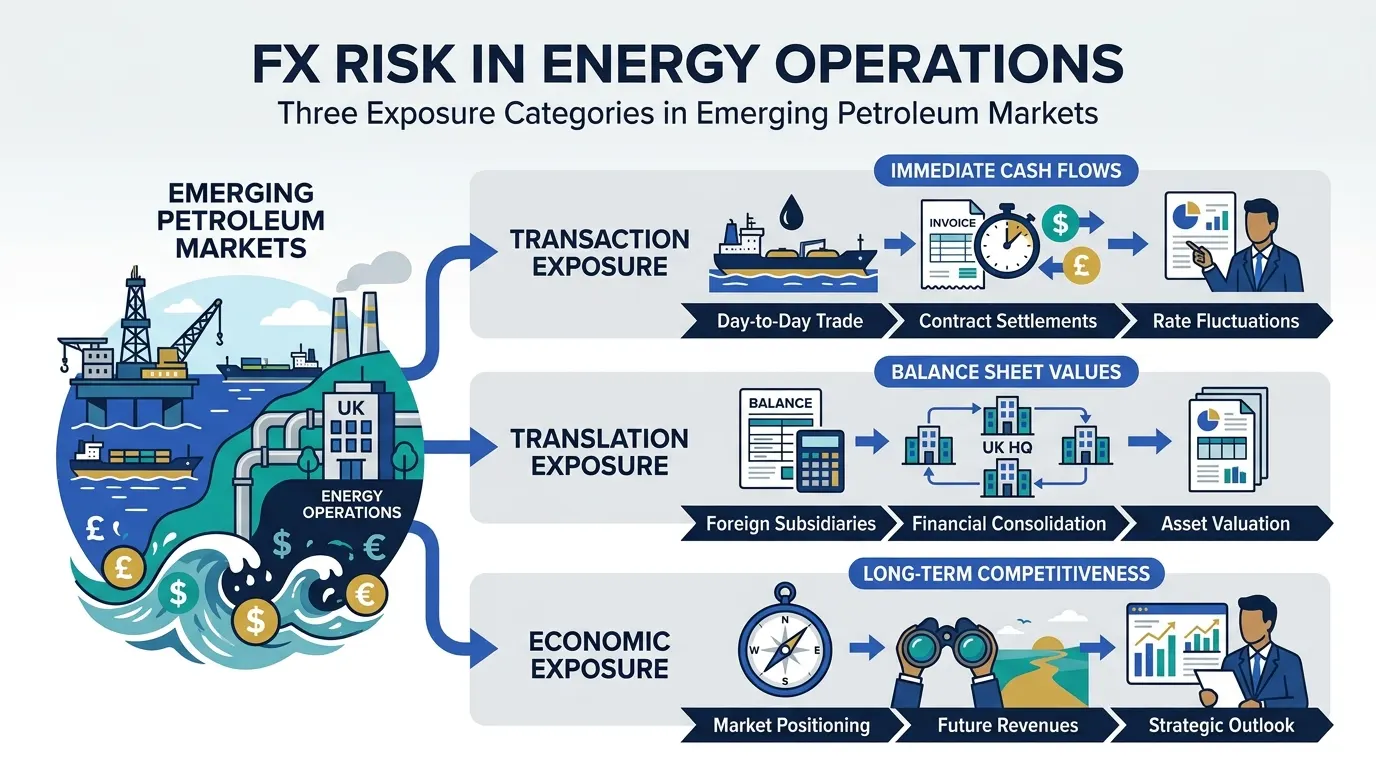
Transaction exposure occurs when contractual obligations settle in a currency other than the operating currency of the entity. Petroleum companies incur local operating expenses such as payroll and local vendor contracts while generating revenue denominated in hard currencies like United States Dollars. Currency mismatches create immediate cash flow volatility when local payments convert at fluctuating market rates.
Translation exposure arises when foreign subsidiary financial statements consolidate into the parent company's functional currency. The periodic FX revaluation of monetary items on balance sheets introduces non-cash earnings volatility. Significant currency depreciations erode reported corporate equity even if local operational throughput remains stable.
Economic exposure measures the long-term impact of macroeconomic volatility on the present value of future cash flows. Petroleum producers operating under long-term concessions face altered cost structures when local inflation accelerates following currency shocks. Unhedged economic exposure undermines project internal rates of return and alters capital allocation decisions across international portfolios.
How Do Regulatory Constraints Impact FX Risk Management Options?
Regulatory constraints restrict capital movement, enforce compulsory currency conversions, and mandate local currency settlements, directly limiting the availability and efficacy of traditional financial derivatives while forcing petroleum operators to adopt adaptive operational hedging strategies.
Exchange control regulations imposed by central banks in developing oil-producing nations restrict offshore transfers and limit derivative availability. Energy enterprises operating under strict foreign exchange controls face sovereign intervention in commercial currency transactions. Central bank policies often require immediate conversion of export earnings into local currencies at official, artificially maintained rates.
Severe repatriation restrictions create trapped liquidity within host countries, preventing joint venture partners from distributing dividends or servicing parent-company debt. These capital controls force financial officers to evaluate alternative treasury structures to preserve capital value. Companies accumulate large local currency balances that face continuous devaluation risk while waiting for regulatory clearance to purchase foreign currency.
Central bank interventions frequently trigger divergence between official bank rates and parallel market rates. Energy operators evaluating strategy effectiveness must calculate the real economic cost of executing transactions across split-exchange regimes. Relying on official exchange rates for financial forecasting distorts project feasibility analyses and creates operational deficits when actual procurement occurs at market clearing rates.
How Should Energy Firms Evaluate Financial Versus Operational Hedging?
Energy firms evaluate financial versus operational hedging by comparing counterparty risk, execution liquidity, regulatory compliance flexibility, and capital overhead to determine which method delivers optimal risk mitigation under specific market conditions.
Financial Hedging Mechanisms
Financial hedging relies on derivative contracts including forward commitments, option contracts, and cross-currency swaps. These instruments locked in future exchange rates to eliminate cash flow uncertainty for predictable foreign currency transactions. In deep, liquid markets, financial derivatives provide precise risk mitigation with minimal operational disruption.
Emerging petroleum markets frequently lack deep liquid derivative markets for local currencies. Offshore banks demand substantial credit risk premiums or decline to quote forward rates for illiquid currencies entirely. Financial hedges in these markets often carry high transaction costs that diminish net margins on upstream petroleum production.
Evaluating financial hedging requires continuous measurement of basis risk and counterparty risk. When local banking systems face liquidity freezes, financial hedge counterparties may fail to settle derivative contracts. Treasury teams must assess whether counterparty exposure offsets the risk reduction achieved through financial contracts.
Operational Hedging Mechanisms
Operational hedging restructures commercial agreements and supply chain contracts to balance currency inflows and outflows naturally. Petroleum companies utilize dollar linked contracts for local vendor procurement to align expense structures with dollarized crude oil revenues. Structuring vendor terms in hard currency shifts exchange volatility directly to local contractors.
National petroleum legislations often enforce mandatory local content payment obligations, requiring operators to settle specific percentages of procurement in domestic currencies. Operational strategies must balance local content compliance with corporate risk tolerance. Managing local payment mandates involves staging local currency purchases to match precise vendor payment schedules rather than holding idle cash reserves.
Companies address devaluation risk by accelerating local currency disbursements or delaying hard currency conversions until obligations mature. Incorporating price adjustment clauses into long-term supply contracts allows automatic re-indexing when local exchange rates breach predetermined bands. Operational hedging provides permanent risk reduction without recurring financial derivative costs.
How Do Currency Convertibility and Repatriation Risks Alter Strategy Selection?
Currency convertibility and repatriation risks force energy firms to pivot from standard derivative-based hedging toward asset-backed structures, structured trade finance, local debt issuance, and strategic reinvestment models designed to protect offshore value.
Currency convertibility risk materializes when central banks exhaust foreign exchange reserves, preventing commercial entities from exchanging domestic notes for foreign currencies. Upstream oil producers operating under these conditions cannot secure foreign exchange to import capital equipment or pay international technical contractors. Standard corporate hedging models fail during convertibility freezes because liquid execution channels close entirely.
Evaluating risk management approaches under convertibility constraints requires assessing non-standard treasury structures. Companies utilize local currency revenues to purchase physical commodities or local equity assets that retain value against inflation. Strategic local procurement reduces net currency exposure by converting excess paper liquidity into tangible operational inputs.
Repatriation obstacles compel finance teams to utilize structured trade finance and pre-export credit facilities. Borrowing local currency from domestic banks allows foreign operators to fund local capital expenditures while keeping parent company equity offshore. Local currency debt acts as a natural hedge, as local revenues service local liabilities directly, neutralizing devaluation impacts on foreign equity.
What Framework Measures the Organizational Effectiveness of FX Risk Training?
A robust evaluation framework measures organizational effectiveness by analyzing workforce competency acquisition, reduction in unhedged cash flow variance, speed of regulatory risk adaptation, and long-term return on investment from corporate capability building.
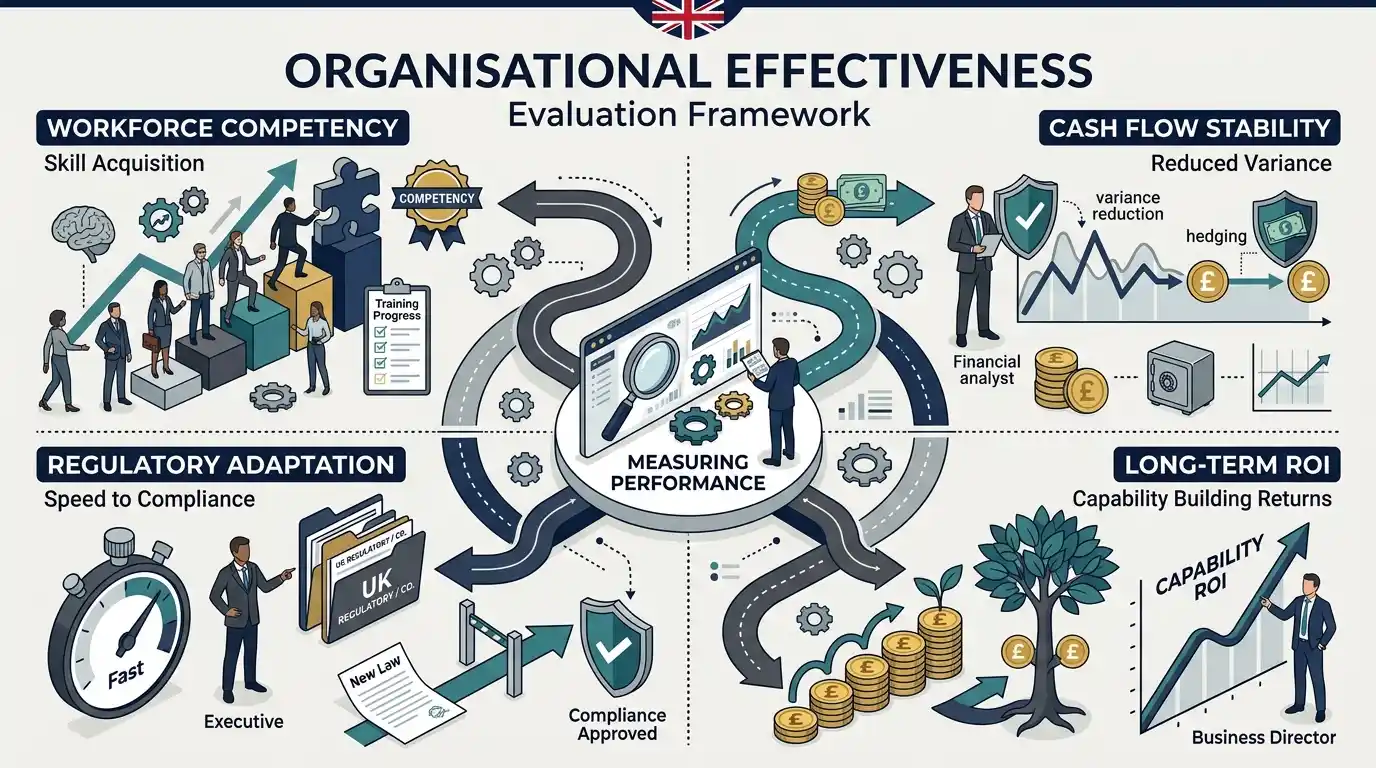
Mitigating complex foreign exchange threats requires organizational competence across corporate treasury, legal, procurement, and commercial leadership teams. Without targeted capability building, financial professionals fail to navigate shifting regulatory rules or execute advanced operational hedges. Evaluating institutional readiness involves assessing whether key personnel possess the technical skills required to hedge frontier market exposures effectively.
To build structured technical capabilities across multidisciplinary teams, enterprise risk leads evaluate specialized solutions such as Foreign Exchange Exposure Management Training for Oil and Gas Companies in Emerging Markets. Enterprise workforce development ensures that procurement leads, treasury specialists, and finance directors share a unified framework for identifying, quantifying, and mitigating currency risks before commitment decisions occur.
Evaluating capability building programs requires clear performance metrics that connect educational interventions to financial risk outcomes. Organizations track specific key performance indicators to measure how effectively training programs reduce financial vulnerability in volatile markets.
Organizations measure training return on investment by comparing the cost of structured capability building against avoided currency losses and optimized transaction fees. Building internal competency enables treasury teams to negotiate better derivative pricing with local financial institutions and avoid costly reliance on external financial consultants.
Long-term strategy execution depends on continuous alignment between workforce capabilities and evolving macroeconomic realities. Corporate leaders who combine operational hedging, structured trade finance, and targeted workforce capability building establish resilient financial architectures capable of navigating volatile petroleum markets.
Finance, HR, and risk leadership teams looking to upskill their workforce in complex financial risk management can enroll in the comprehensive Foreign Exchange (FX) Exposure Management in Emerging Markets Training Course to establish institutional competence across international operations.
Frequently Asked Questions
What does oil and gas petroleum treasury, cash, and banking management involve?
Oil and gas petroleum treasury, cash, and banking management involves overseeing corporate liquidity, foreign exchange exposure, cash flow forecasting, and banking relationships within energy companies. The Institute For Oil & Gas Training delivers practical instruction on managing complex international accounts, local currency volatility, and working capital requirements. This specialization ensures capital preservation and smooth financial operations across volatile petroleum supply chains.
Why is specialized cash and treasury training essential for oil and gas enterprises?
Energy operations face unique financial challenges, including high capital expenditure, complex joint-venture accounting, and strict central bank regulations in developing markets. Specialized training provided by the Institute For Oil & Gas Training equips finance teams with advanced strategies for cash pooling, hedging foreign exchange risks, and mitigating liquidity bottlenecks. This expertise directly protects corporate margins and optimizes short-term investment yields.
How do petroleum firms manage foreign exchange risk and cash flow volatility?
Petroleum enterprises manage cash flow volatility by using a combination of financial hedging instruments, operational dollar-linked contracts, and strategic liquidity buffers. Through the Oil & Gas Petroleum Treasury, Cash and Banking program at the Institute For Oil & Gas Training, finance professionals learn to structure local debt, navigate repatriation restrictions, and maintain real-time visibility over international banking facilities.
What are the key regulatory challenges in petroleum banking and treasury management?
Key regulatory challenges include central bank exchange control regulations, mandatory currency conversions, and strict anti-money laundering compliance across cross-border petroleum transactions. The Institute For Oil & Gas Training addresses these compliance frameworks within its Oil & Gas Petroleum Treasury, Cash and Banking curriculum to help organizations avoid regulatory penalties and trapped onshore cash reserves.
Who should attend the Oil & Gas Petroleum Treasury, Cash and Banking course?
The Oil & Gas Petroleum Treasury, Cash and Banking course is designed for treasury managers, corporate finance professionals, energy auditors, and risk management specialists operating in the energy sector. Delivered by the Institute For Oil & Gas Training, this program prepares financial leaders to evaluate banking partners, build resilient treasury operations, and support strategic corporate growth.
Related training courses
API 580 Risk Based Inspection Training Course
- Specialisation
- Oil & Gas Asset Integrity Management
- Duration
- 5 days · 15 CPD hours
Corrosion Control by Material Selection Training Course
- Specialisation
- Oil & Gas Corrosion Management and Control
- Duration
- 5 days · 15 CPD hours
Acoustic Emission Testing Training Course
- Specialisation
- Oil & Gas Inspection and Non-Destructive Testing
- Duration
- 5 days · 15 CPD hours
More articles

Bank Relationship Management Training for Petroleum Company Treasury Professionals
Master bank evaluation, RFPs, and fee analysis. Enroll in the Bank Relationship Management Training by Institute For Oil & Gas Training.
Read article →
How to Evaluate Banking Partners and Treasury Services for Oil and Gas Businesses
Evaluate banking partners and treasury services for oil and gas firms with structured criteria, RFP models, and counterparty credit frameworks.
Read article →
Why Bank Relationship Management Matters for Petroleum Companies
Learn how structured bank relationship management training mitigates liquidity risk, lowers financing costs, and improves treasury performance.
Read article →