
Joint venture and production sharing contract reporting automation replaces manual petroleum accounting workflows with standardized digital systems, eliminating human calculation errors, accelerating financial close cycles, ensuring regulatory compliance, and establishing real-time operational transparency across multi-operator exploration assets.
Joint Venture (JV) and Production Sharing Contract (PSC) reporting automation represents the systematic digitization of complex financial data flows between petroleum asset partners and host governments. In upstream oil and gas operations, joint operating agreements govern shared capital expenditures, operating expenses, and revenue distribution among non-operating partners. Production sharing contracts dictate the exact allocation of cost recovery petroleum and profit petroleum between national oil companies and international operators. Traditional reporting relies on static spreadsheets, manual data entries, and custom ledger reconciliations. Automation replaces these error-prone touchpoints with structured enterprise data pipelines, unified master data models, and automated calculation engines.
Organisations operating within high-capital energy sectors encounter severe administrative bottlenecks when managing non-operated joint ventures and state-level compliance mandates. Manual accounting processes force finance teams to spend 60% of their operational hours aggregating transactional data rather than performing strategic variance analysis. Automated joint venture systems establish automated data validation protocols that process thousands of monthly line items in seconds. The financial governance framework ensures every joint interest billing cycle and cost recovery schedule strictly aligns with specific accounting and financial procedure standards, such as COPAS guidelines or international petroleum accounting norms.
At a capability level, automated reporting transforms workforce focus from data entry to analytical verification. Upstream financial specialists trained in automated workflows evaluate variance exceptions, monitor entitlement shifts, and manage audit queries through unified dashboards. Establishing automated JV and PSC reporting protects operating cash flows, reduces audit dispute settlement times from 180 days to 14 days, and provides senior executive teams with immediate visibility into net asset performance.
How Does JV and PSC Reporting Automation Work in Corporate Environments?
Automated reporting functions by integrating core enterprise resource planning systems with dedicated calculation engines that execute partner cost allocations, apply contract rules automatically, publish standardized financial statements, and surface transactional discrepancies through exception-based monitoring dashboards.
Corporate implementation of JV and PSC reporting automation relies on a multi-tiered data architecture. The core accounting layer pulls raw transactional data directly from enterprise resource planning systems, such as SAP, Oracle NetSuite, or enterprise joint venture accounting engines. The automated validation engine verifies incoming costs against approved Authorizations for Expenditure (AFEs) and Joint Operating Agreement (JOA) voting thresholds. If a transaction violates predefined accounting parameters or exceeds budget limits by more than 5%, the system routes the entry to an exception queue for managerial approval, preventing unapproved costs from entering partner statements.
The automated calculation engine applies specific Production Sharing Contract clauses to revenue and expenditure streams. It calculates monthly cost recovery caps, computes sliding-scale profit petroleum splits based on daily production tiers or R-factor metrics, and generates precise entitlement schedules. This automation eliminates manual spreadsheet logic, which accounts for 45% of historical accounting adjustments during joint venture audits. The output layer automatically compiles partner-ready Joint Interest Billing (JIB) statements, cash call notifications, and government compliance filings into standardized digital templates.
Corporate finance departments execute this automated workflow through five distinct operational phases:
Data Extraction: Connectors ingest transaction ledgers, volumetric production logs, and crude lift records on fixed schedules.
Rule Execution: Programmed business logic applies joint operating agreement terms, overhead formulas, and cost recovery caps.
Exception Flagging: Built-in validation algorithms flag unbudgeted expenses, missing joint venture codes, or abnormal cost allocations.
Partner Distribution: Automated communications modules generate and deliver encrypted cash call statements and JIB packages to venture partners.
Audit Logging: Every calculation step, approval signature, and data modification records to an immutable audit trail for internal and external verification.
What Key Components Make Up an Automated Reporting Framework?
An automated reporting framework incorporates integrated data pipelines, dynamic calculation engines, template-driven reporting modules, exception-handling protocols, and continuous skill development programs designed to align corporate workforce capabilities with modern financial technology infrastructure.
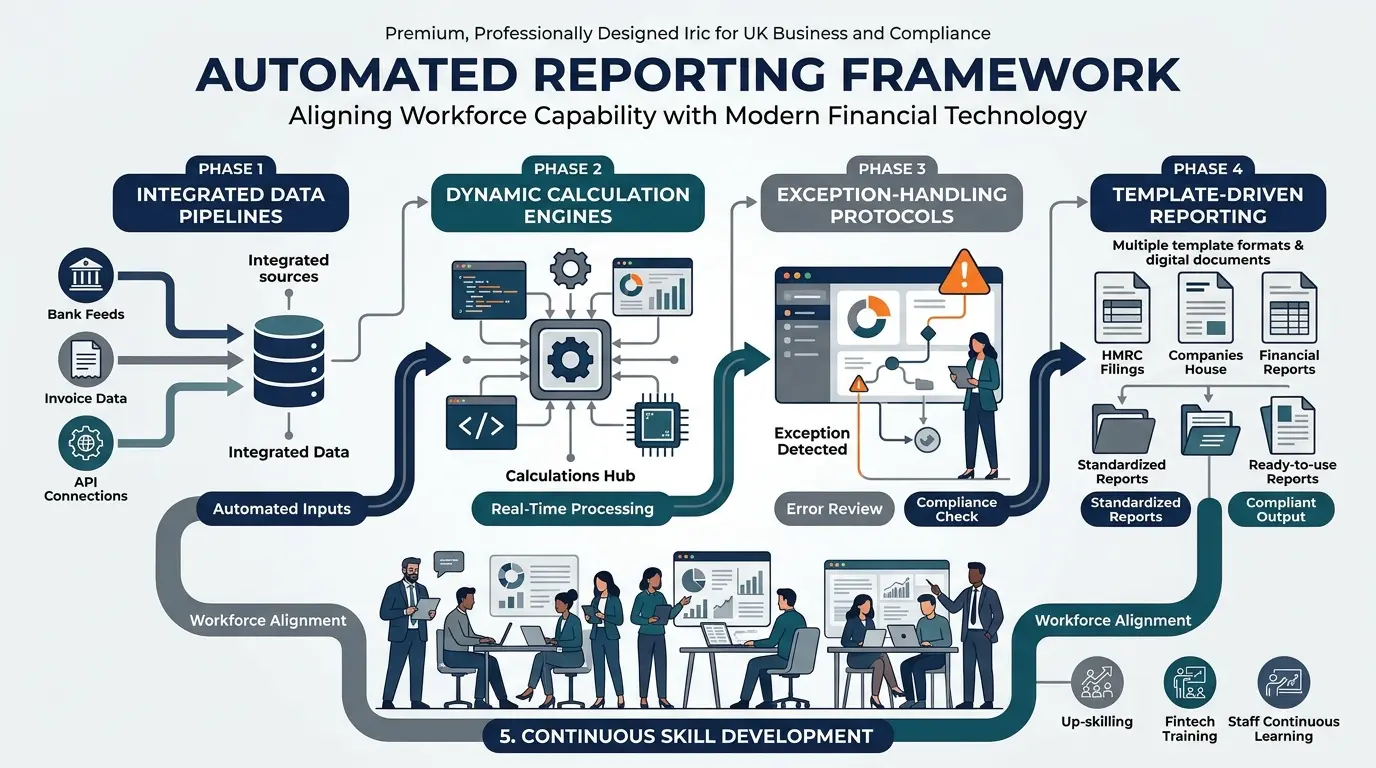
Acomplete JV and PSC reporting framework spans technical software systems and organizational competency structures. Missing any core component degrades output reliability, forcing financial teams to return to manual spreadsheet interventions.
Technical Infrastructure Components
Integrated Data Connectors: Automated application programming interfaces (APIs) move financial records, asset operating costs, and volumetric data between field systems, joint interest sub-ledgers, and general accounting software.
Dynamic Entitlement Engines: Specialized logic processors store complex contractual terms, including sliding-scale PSC metrics, tax-oil offsets, and joint venture overhead calculation rules (such as COPAS combined fixed-rate overheads).
Template-Driven Output Modules: Standardized statement generators build identical, partner-compliant formats for cash call statements, joint interest billings, and monthly cost recovery filings.
Exception-Based Monitoring Portals: Centralized analytical interfaces display real-time flags for unapproved expenditure overruns, missing vendor codes, or ledger discrepancies.
Organizational Competency Components
Advanced Financial Automation Skills: Proficiency in configuring low-code process flows, managing enterprise reporting engines, and performing structural variance analyses.
Contractual Interpretation Mastery: Deep technical knowledge required to translate complex JOA, PSC, and concession terms into digital business rules.
Audit and Compliance Governance Protocols: Standard operating procedures governing authorization chains, statement sign-offs, and external joint venture audit defences.
Organisations must pair technical infrastructure investments with targeted workforce upskilling. Equipping corporate finance teams with structured training ensures employees transition seamlessly from manual data entry roles to high-value financial controllership positions.
What Are the Organizational Benefits of Automating Petroleum Financial Reporting?
Automating petroleum financial reporting reduces month-end closing timelines by 70%, lowers joint venture audit dispute costs by 85%, guarantees absolute contractual compliance with host governments, and frees upstream accounting talent to execute strategic financial analysis.
Transitioning from legacy manual spreadsheets to automated joint venture reporting platforms delivers immediate operational advantages across upstream oil and gas enterprise operations.
Accelerated Financial Closing Cycles
Manual assembly of joint interest billing statements and cost recovery schedules extends monthly closing timelines, often taking 15 business days following month-end. Automated data ingestion and calculation engines reduce this timeline to 4 business days. Accelerating statement generation speeds up cash call collections, ensuring operating partners receive accurate billing packages promptly and maintaining asset liquidity.
Mitigation of Joint Venture Audit Exposure
Un-partnered cost allocations, incorrect overhead charges, and unapproved AFE line items generate costly joint venture audit exceptions. Non-operating partners routinely hire specialized accounting firms to audit operator books, holding back millions in disputed cash calls. Automated reporting engines run continuous, pre-configured validation checks on every transaction prior to statement publication, eliminating systemic billing errors and reducing audit dispute settlements by 85%.
Flawless Production Sharing Contract Compliance
Host government energy ministries enforce rigid reporting standards for cost recovery accounts and profit petroleum sharing. Submitting inaccurate cost recovery schedules risks severe financial penalties, cost disallowances, or legal challenges to concession rights. Automation standardizes every calculation formula, maintains complete historical lineage, and ensures every filed cost recovery document matches audited general ledger entries.
Enhanced Workforce Productivity and Talent Retention
Requiring qualified upstream petroleum accountants to manually copy numbers across detached spreadsheets damages team morale and drives professional burnout. Automating transactional routines shifts employee workloads toward variance interpretation, asset portfolio modeling, and strategic contract negotiations. Elevating the technical nature of corporate accounting roles increases workforce retention rates in finance departments by 35%.
How Do Enterprise Teams Implement JV and PSC Reporting Automation Step by Step?
Organisations implement JV and PSC reporting automation through a five-phase execution methodology: process auditing, data standardization, workflow automation configuration, pilot asset deployment, and structured workforce upskilling.
Successful corporate adoption requires a structured implementation roadmap that integrates technology software configurations with employee learning frameworks.
Phase 1: Process Auditing and Workflow Mapping
The implementation team audits existing accounting workflows across all operated and non-operated joint ventures. Financial leaders map every data path, spreadsheet dependency, approval gate, and manual calculation step. This initial audit identifies structural inefficiencies, data silos, and calculation bottlenecks across asset accounting teams.
Phase 2: Master Data Standardization and Rule Definition
Data integration engineers establish unified chart of accounts mappings, standard AFE structures, and consistent joint venture cost centers across enterprise ERP systems. Legal and petroleum accounting specialists review active Joint Operating Agreements and Production Sharing Contracts to codify contractual terms, overhead formulas, and sliding-scale entitlement logic into explicit business rules.
Phase 3: Technical Configuration and System Integration
Software architects deploy automated data pipelines connecting financial ledgers, production databases, and Joint Interest Billing engines. Technical specialists configure dynamic statement generation templates for cash call statements, joint interest billings, and monthly cost recovery returns.
When evaluating financial operations for digitization, leadership teams must analyze existing workflows to select appropriate candidates for automation. Identifying high-volume, rules-based tasks ensures maximum return on software investment. To evaluate asset workflows effectively, leaders refer to How to Identify Joint Venture and PSC Reporting Processes Suitable for Automation.
Phase 4: Pilot Asset Deployment and Parallel Testing
The enterprise deploys the automated reporting engine across a single representative oil and gas asset. The financial team runs the automated platform in parallel with legacy manual spreadsheet workflows for two consecutive monthly closing cycles. Testing teams verify data reconciliation, statement formatting, and calculation outputs down to the exact cent, verifying absolute system accuracy before full deployment.
Phase 5: Enterprise-Wide Rollout and Workforce Upskilling
Following successful pilot validation, the organization scales the platform across all operational assets, non-operated ventures, and international subsidiaries. Simultaneously, Human Resources and Learning and Development leaders execute comprehensive training programs to transition accounting personnel into certified workflow automation managers.
To maximize technology adoption, organizations enroll key finance personnel in the Automation of JV & PSC Reporting: Process Candidates Training Course, building internal capability to identify candidate processes, configure exception logic, and manage automated reporting pipelines independently.
What Use Cases Demonstrate the Practical Impact of Reporting Automation?
Automation transforms operations across multi-operator joint ventures, complex international production sharing contracts, non-operated asset management offices, and government compliance departments.
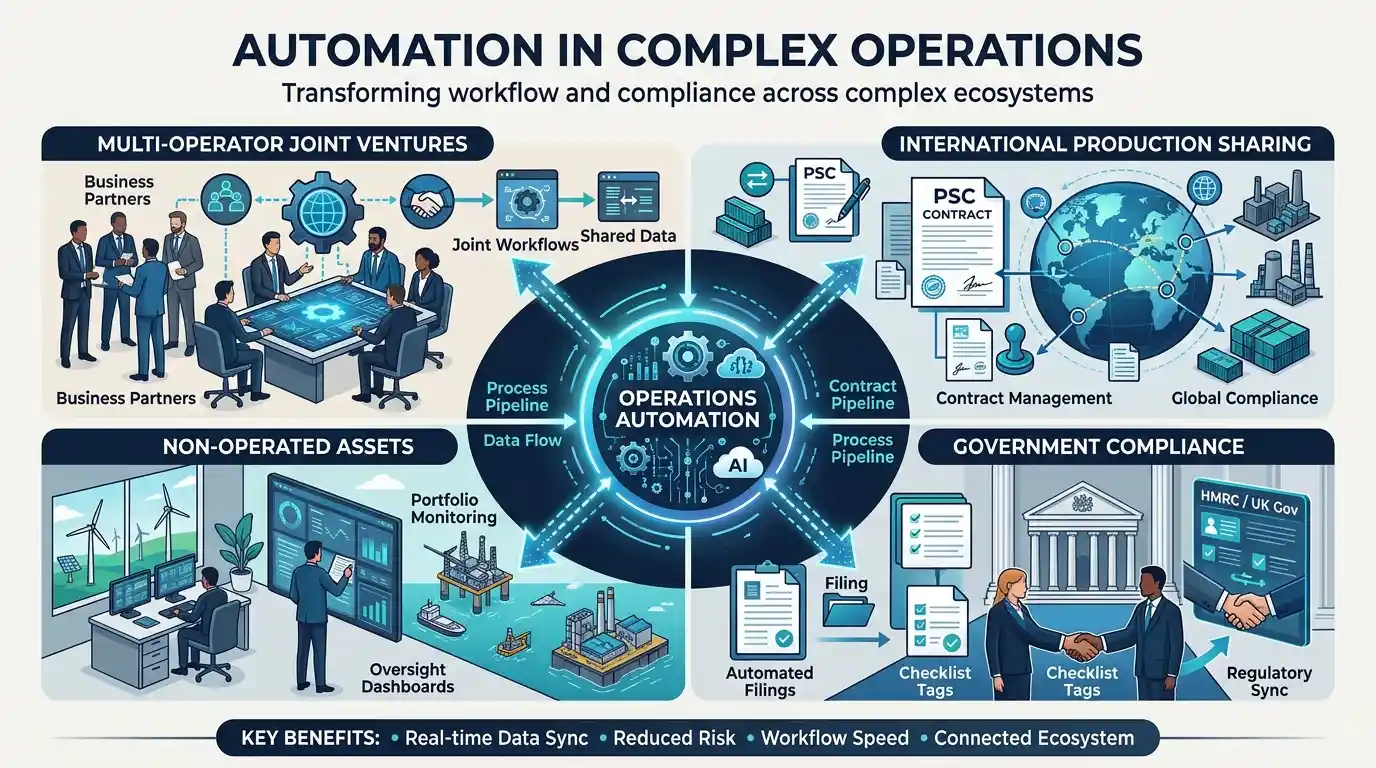
Practical applications across diverse petroleum operating environments demonstrate how reporting automation solves specific corporate challenges.
Multi-Operator Offshore Joint Ventures
Offshore deepwater developments involve billions of dollars in shared capital expenditure distributed among three to five international energy partners. Operating in multi-currency environments with complex AFE structures creates administrative complexity. Automated reporting systems process thousands of monthly field invoices, apply exact working interest percentages (such as 40% Operator, 30% Partner A, 30% Partner B), calculate overhead allowances, and generate partner cash calls automatically, preventing cash flow delays on major capital projects.
International Production Sharing Contracts
Energy companies operating under host-country PSC agreements face strict fiscal rules governing cost recovery petroleum limits (such as a 60% annual revenue cap) and profit petroleum splits calculated on cumulative production indices. Automated reporting engines track real-time cost recovery balances, compute monthly entitlement splits accurately, and generate standardized compliance reports for host government energy ministries, eliminating costly regulatory disputes.
Non-Operated Asset Portfolio Management
Companies holding non-operating equity positions in dozens of joint ventures receive hundreds of Joint Interest Billing statements monthly from different asset operators. Manually reviewing these incoming billings for unapproved costs or incorrect allocations requires substantial staff capacity. Automated incoming invoice verification platforms scan partner billings, cross-reference charges against approved AFE limits and JOA terms, and flag billing anomalies instantly before cash call payments are released.
National Oil Company (NOC) Regulatory Filings
National oil companies managing dozens of foreign operating partners require uniform reporting formats to audit national hydrocarbon resources accurately. Implementing template-driven reporting modules allows state regulators to mandate standardized digital statement submissions from all operating companies, streamlining national energy accounting and auditing processes.
What Misconceptions and Failures Hinder Reporting Automation Initiatives?
Automation initiatives fail when leadership treats digital transformation purely as an IT installation project, relies on generic enterprise tools lacking domain logic, neglects workforce training, or attempts to digitize broken accounting processes without prior standardization.
Organisations attempting to modernize joint venture financial operations frequently encounter implementation hurdles due to core strategic misconceptions.
Treating Automation as a Pure Software Purchase
Executive teams often assume purchasing enterprise automation software instantly resolves financial reporting bottlenecks. Software platforms are merely tools; system efficacy depends entirely on how effectively human teams define business rules, monitor exception queues, and analyze output variances. Failing to invest in structured corporate training programs results in underutilized software platforms, with accounting teams continuing to export automated data back into manual spreadsheets.
Relying on Generic Enterprise Automation Tools
Attempting to automate petroleum joint venture accounting using standard, off-the-shelf corporate workflow software introduces operational risk. Upstream oil and gas accounting requires specialized domain logic to handle complex calculations, such as COPAS overhead adjustments, joint interest sub-ledger reconciliations, sliding-scale R-factor profit splits, and multi-currency crude lifting entitlements. Generic automation platforms lack native energy-sector logic, leading to calculation errors and system failure.
Automating Unstandardized, Flawed Processes
Applying automation to fragmented, poorly documented accounting workflows amplifies existing operational flaws. If individual asset accounting teams employ inconsistent cost-center definitions, manual approval workarounds, or ambiguous AFE tracking methods, automating these steps simply accelerates error propagation across corporate ledgers. Organisations must standardize baseline master data, charts of accounts, and joint venture governance protocols before building automated workflows.
Neglecting Change Management and Skill Development
Introducing automated reporting systems alters daily employee responsibilities, creating anxiety among traditional accounting staff who fear technology replacement. Without clear change management strategies and practical upskilling pathways, staff may resist adoption, bypass automated approval gates, or maintain parallel spreadsheet records. Forward-thinking organisations combine technology deployments with outcome-based corporate learning programs, equipping employees to succeed in modern, automated financial environments.
Frequently Asked Questions
What is oil and gas petroleum digital finance and automation?
Oil and gas petroleum digital finance and automation is the integration of digital workflows, automated calculation engines, and specialized reporting software into upstream financial operations. Programs delivered by the Institute For Oil & Gas Training focus on digitizing joint venture accounting, joint interest billing, and production sharing contract calculations. This approach eliminates manual data entry, reduces financial closing cycles, and ensures regulatory compliance across complex energy assets.
How does automation improve joint venture accounting in petroleum operations?
Automating joint venture financial management establishes standardized data validation rules that check operational expenses against approved Authorizations for Expenditure. The Oil & Gas Petroleum Digital Finance & Automation methodology provided by the Institute For Oil & Gas Training streamlines cash call statement generation and joint interest billing cycles. This reduces joint venture audit disputes, speeds up cash collection, and improves cash flow visibility for operating and non-operating partners.
What key skills are covered in oil and gas petroleum digital finance training?
Oil & Gas Petroleum Digital Finance & Automation programs cover process candidate selection, automated entitlement logic configuration, and variance management through exception dashboards. Participants learning with the Institute For Oil & Gas Training develop skills in automated cost recovery schedule generation, template-driven reporting, and COPAS accounting compliance. These skills allow finance teams to move from transactional spreadsheet entry to strategic financial analysis.
Why is digital finance automation essential for production sharing contracts?
Production sharing contracts involve intricate fiscal terms, cost recovery caps, and sliding-scale profit petroleum splits that create audit risks when managed manually. Upstream training solutions from the Institute For Oil & Gas Training teach energy professionals to automate entitlement models and cost accounting workflows. Implementing Oil & Gas Petroleum Digital Finance & Automation guarantees complete alignment with host government regulations and prevents costly revenue disallowances.
How do energy companies implement petroleum digital finance and automation programs?
Organisations implement digital finance workflows by auditing existing accounting processes, standardizing master data structures, and deploying automated tools like Power Automate. The Institute For Oil & Gas Training supports this transition through structured workforce upskilling that prepares accounting teams to run automated reporting systems efficiently. This corporate training approach ensures smooth system adoption, minimizes operational risk, and maximizes return on technology investments.
Related training courses
ERP Systems for Oil & Gas: Access Controls Training Course
- Specialisation
- Oil & Gas Petroleum Digital Finance & Automation
- Duration
- 5 days · 13 CPD hours
Data Governance & Master Data: Ownership & Standards Training Course
- Specialisation
- Oil & Gas Petroleum Digital Finance & Automation
- Duration
- 5 days · 15 CPD hours
Data Governance & Master Data: Vendor & Well Training Course
- Specialisation
- Oil & Gas Petroleum Digital Finance & Automation
- Duration
- 5 days · 15 CPD hours
More articles

Automation of JV and PSC Reporting Data Integration Training by Institute For Oil & Gas Training
Master automated JV and PSC reporting data integration. Review course modules, delivery formats, and learning outcomes to enroll with confidence.
Read article →
How to Integrate Financial and Operational Data for Automated JV and PSC Reporting
Learn how to integrate financial and operational data for automated JV and PSC reporting. Compare methods, architectures, and implementation frameworks.
Read article →
Why Data Integration Is Essential for Automated JV and PSC Reporting
Learn why data integration automates JV and PSC reporting in petroleum finance, closing skill gaps, reducing reconciliation errors, and driving efficiency.
Read article →