

The Automation of JV and PSC Reporting Process Candidates Training by Institute For Oil & Gas Training solves manual accounting bottlenecks by training finance teams to evaluate, standardise, and select high-impact joint venture and production sharing contract reporting workflows for automation.
Joint venture (JV) and Production Sharing Contract (PSC) accounting in the upstream oil and gas sector involves complex data reconciliation across joint operators, non-operating partners, and host governments. Upstream asset management requires precise execution of joint interest billing, cash call statement generation, cost recovery schedule tracking, and government entitlement calculations. Manual management of these financial workflows using disconnected spreadsheets introduces severe operational risks. Discrepancies in joint account allocations delay financial close, increase audit friction between operating partners, and consume hundreds of staff hours every reporting cycle. Organizations often attempt to solve these inefficiencies by deploying advanced workflow automation software without first evaluating whether their underlying reporting workflows are standardized. Automating flawed or inconsistent joint account workflows simply accelerates error generation across partner reporting networks.
To build a foundational understanding of operational inefficiencies in non-operated and operated accounting before structuring system changes, review Why Automating Joint Venture and PSC Reporting Matters in Oil and Gas.
The Institute For Oil & Gas Training designed the Automation of JV & PSC Reporting: Process Candidates Training Course to address this structural skill gap. This specialized professional development syllabus equips petroleum accountants, joint venture analysts, and finance managers with technical methodologies to audit existing reporting frameworks. Participants learn to isolate repetitive, rule-based data tasks from non-standard commercial arrangements. The course establishes systematic evaluation criteria to identify high-yield process candidates before writing code or deploying automation systems. By replacing ad-hoc manual data entry with standardized candidates for digital workflows, joint venture finance departments reduce month-end close duration, eliminate calculation errors, and establish audit-ready financial records.
Why is the Institute For Oil & Gas Training curriculum structured this way?
The curriculum follows a decision-stage pedagogical framework that progresses from process mining and candidate selection to workflow architecture, validation controls, and governance, ensuring participants build enterprise-ready automation frameworks that deliver verifiable operational accuracy.
Corporate finance training requires a logical progression from baseline process analysis to technical design and execution controls. The Institute For Oil & Gas Training structures this syllabus around the real-world operational lifecycle of joint venture and PSC financial management. Upstream reporting environments contain complex legal agreements, fluctuating oil and gas production volumes, and rigid joint operating agreement (JOA) compliance mandates. A premature attempt to build automated reporting templates without robust candidate assessment leads to broken workflows, unhandled exceptions, and unbudgeted software refactoring.
The course structure opens with process mining and candidate selection. Participants learn to map end-to-end data pipelines, evaluate transactional volume, measure rule stability, and establish candidate viability metrics. Once target candidates are selected, the syllabus shifts to data normalization and template driven reporting architectures. Participants structure raw accounting feeds into standardized formats capable of feeding automated engines. The final phase focuses on execution controls, covering exception based review protocols, audit trail generation, and partner reporting governance.
This structural progression guarantees that participants gain practical skill in both the analytical selection of workflows and the technical design of automated financial controls. The Institute For Oil & Gas Training enforces this practical focus through hands-on technical labs, real-world case studies, and industry-standard upstream joint venture accounting scenarios.
What specific technical skills and modules will participants learn?
Participants learn process mining, joint interest billing automation, cash call statement generation, cost recovery schedule automation, entitlement calculation automation, template driven reporting design, Power Automate workflows buildout, and exception based review system configuration.
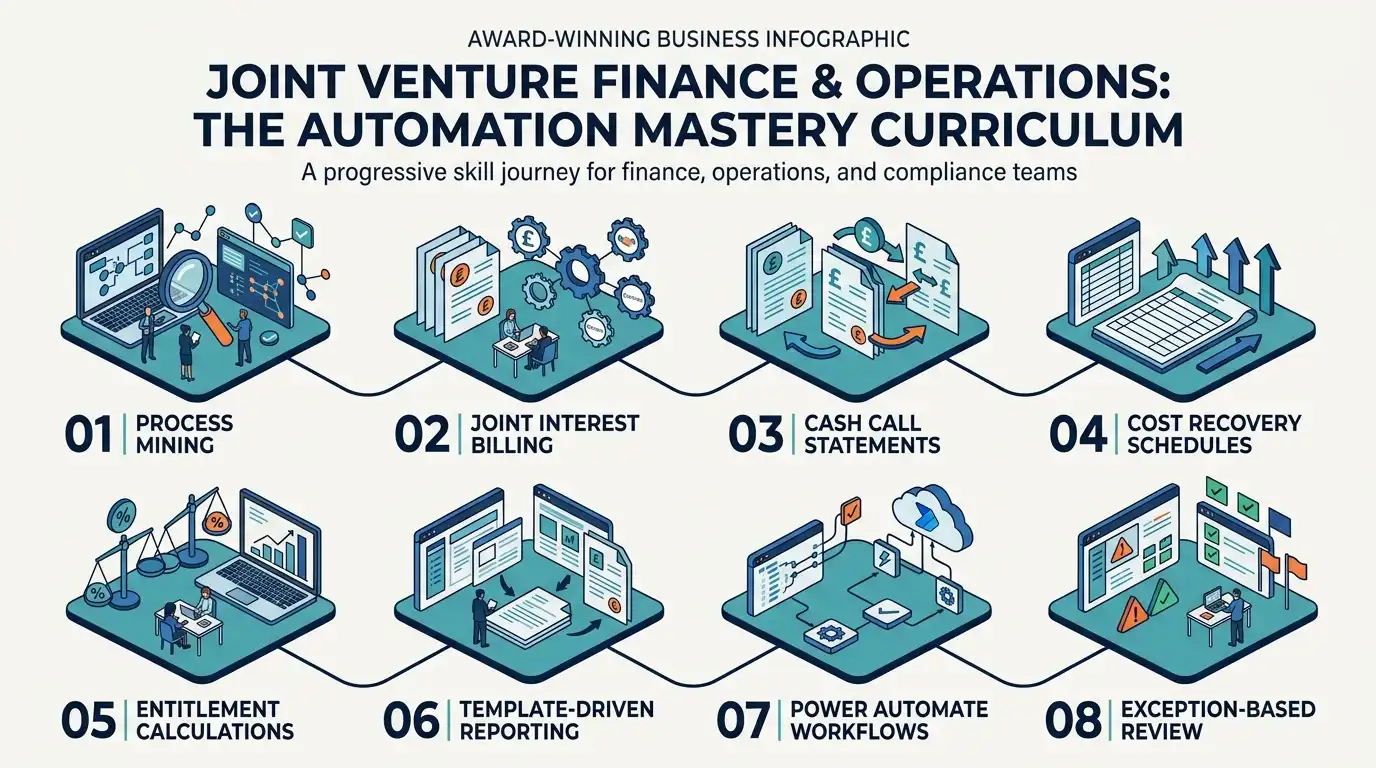
The Automation of JV & PSC Reporting: Process Candidates Training Course delivers comprehensive instruction across six core modules. Every module focuses on specific functional competencies required to modernize financial operations in upstream joint ventures and PSC arrangements.
To evaluate organizational readiness and criteria for selecting suitable reporting workflows prior to technical deployment, read How to Identify Joint Venture and PSC Reporting Processes Suitable for Automation.
Module 1: Process Mining and Candidate Selection for Upstream Accounting
Principles of process mining in petroleum accounting environments.
Frameworks for candidate selection based on volume, rule stability, and data structure.
Calculating Automation Return on Investment (ROI) and cycle time reduction.
Mapping data dependencies across Joint Interest Billing (JIB), Cash Calls, and PSC Statements.
Module 2: Joint Interest Billing Automation and Data Standardisation
Standardising operator cost allocation sheets and non-operator billing schedules.
Automating data ingestion from Enterprise Resource Planning (ERP) databases into billing templates.
Configuring automated validation rules for Joint Operating Agreement (JOA) overhead rates.
Establishing automated multi-currency conversion routines for international assets.
Module 3: Cash Call Statement Generation and Cost Recovery Schedule Automation
Designing automated workflows for monthly cash call statement generation.
Integrating joint venture cash call calculations with corporate treasury schedules.
Automating PSC cost recovery schedules under complex production sharing terms.
Reconciling cost pools, eligible expenditures, and unrecovered cost carry-forwards.
Module 4: Entitlement Calculation Automation and Government Share Processing
Automating physical and financial entitlement calculation models.
Applying automated sliding-scale formulas based on daily production rates and R-factors.
Generating standardized government take reports and partner net-entitlement schedules.
Automating liftings reconciliation against contractual entitlement balances.
Module 5: Template-Driven Reporting and Power Automate Workflows Construction
Designing robust, template driven reporting structures for executive and partner distribution.
Building end-to-end Power Automate workflows to route schedules, collect approvals, and trigger exports.
Connecting Microsoft Power Platform components to upstream accounting databases and cloud storage.
Configuring automated data transformation rules without breaking audit trails.
Module 6: Exception-Based Review Systems, Audit Compliance, and Governance
Establishing exception based review thresholds to catch accounting anomalies automatically.
Configuring alert triggers for unmapped cost centers, JOA threshold breaches, and PSC cap violations.
Maintaining SOX compliance and international joint-venture audit trails within digital workflows.
Designing operational governance frameworks for long-term automation maintenance.
Through this module breakdown, the Institute For Oil & Gas Training provides petroleum finance professionals with deep technical capabilities, enabling them to transition from manual spreadsheet processing to automated financial engineering.
How is the Automation of JV and PSC Reporting Process Candidates Training delivered?
The Institute For Oil & Gas Training delivers this training through instructor-led live online workshops, on-site corporate programs, and blended learning models featuring practical software labs, simulation projects, and formal skill assessments.
Flexible delivery formats ensure corporate clients and individual practitioners can access technical instruction without disrupting month-end reporting schedules. The Institute For Oil & Gas Training offers four distinct delivery modes engineered for maximum operational relevance and practical skill transfer.
Instructor-Led Live Online Workshops: Delivered over four weeks in intensive three-hour modules. Participants access interactive virtual classrooms, engage in live instruction, and execute real-time software configurations under expert guidance.
On-Site Corporate Training Programs: Customized for enterprise accounting departments and joint venture asset teams. The Institute For Oil & Gas Training deploys expert instructors to corporate offices, tailoring practical exercises around the company's specific Joint Operating Agreements, PSC terms, and internal ERP systems.
Blended Learning Framework: Combines self-paced technical lectures with weekly live coaching labs. Participants master foundational process mining concepts independently before attending hands-on technical sessions focused on building Power Automate workflows and template driven reporting assets.
Interactive Simulation Labs and Capstone Projects: Every learning format incorporates practical technical labs. Participants receive real-world upstream financial datasets containing intentional anomalies, unallocated joint interest expenses, and complex PSC entitlement splits.
To earn formal certification from the Institute For Oil & Gas Training, candidates must pass a practical technical examination and successfully complete a capstone automation project. The capstone project requires participants to evaluate a manual joint venture reporting process, select valid automation candidates, design automated validation workflows, and configure an exception based review interface.
What measurable operational results and business impact can organizations expect?
Organizations completing this training achieve up to 70% reduction in reporting cycle times, complete elimination of manual spreadsheet errors, faster joint interest billing clearance, and total joint operating agreement compliance.
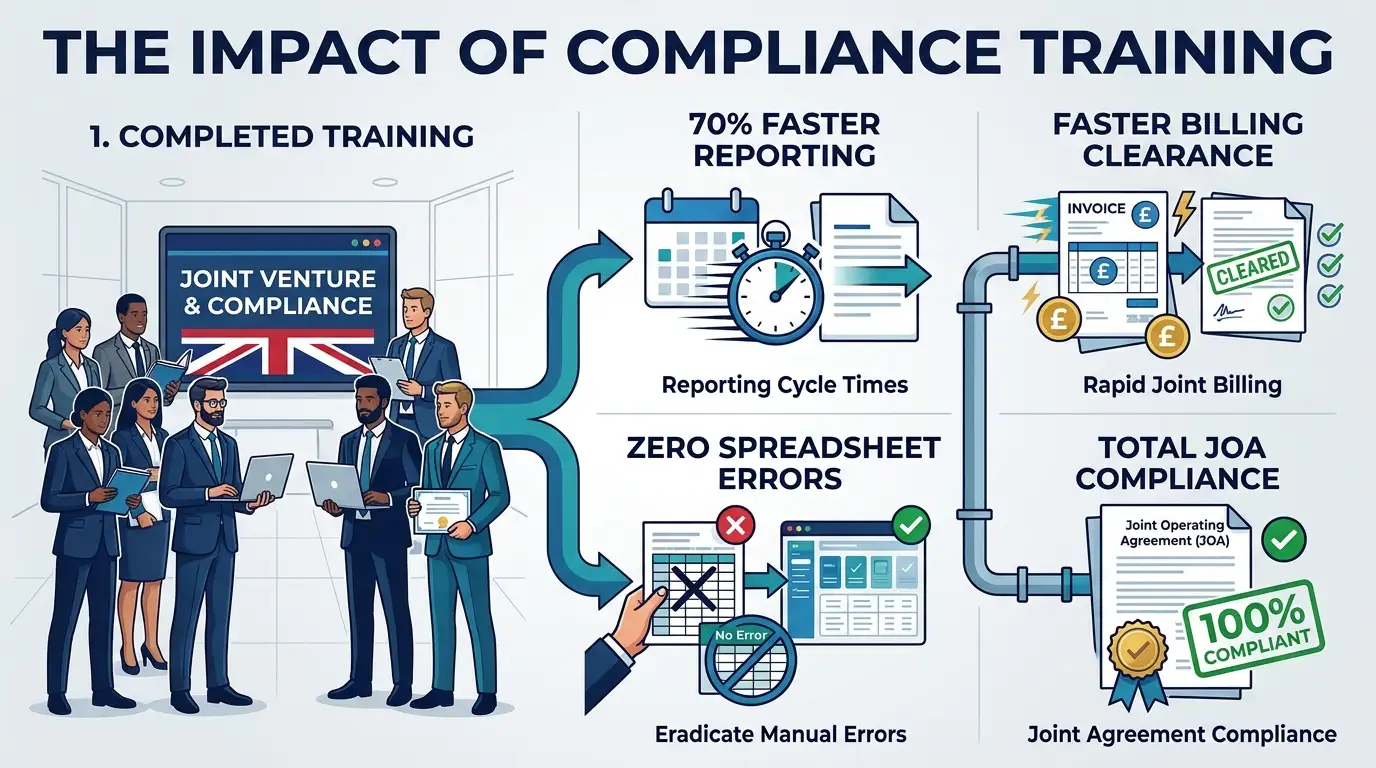
Training finance and joint venture accounting teams through the Institute For Oil & Gas Training yields immediate, measurable improvements across upstream financial operations. Manual financial reporting slows down close schedules and exposes operating companies to financial audit adjustments. By establishing technical mastery over candidate selection and workflow automation, organizations transform their financial accounting units into streamlined operational centers.
Measurable Performance Impact
Reduced Financial Close Duration: Automated joint interest billing automation and cash call statement generation reduce month-end close timelines from weeks to days.
Elimination of Processing Errors: Standardized template driven reporting eliminates manual data copy-pasting, preventing calculation errors in complex cost recovery schedule automation models.
Faster Cash Flow Realisation: Accelerated cash call generation and automated partner billing ensure operating funds are requested, validated, and collected without delay.
Audit Readiness and Partner Transparency: Embedded exception based review systems preserve step-by-step audit logs, eliminating friction during joint venture partner audits and government compliance reviews.
Optimized Workforce Allocation: Finance professionals spend less time on manual data entry and more time on strategic joint venture commercial analysis and contract negotiation.
Enterprise Application Scenarios
Upstream Joint Venture Accounting Teams: Apply process mining and candidate selection frameworks to automate monthly non-operator billing runs, reducing partner dispute rates.
PSC Finance & Commercial Asset Managers: Deploy entitlement calculation automation routines to calculate complex state-share splits accurately under fluctuating oil price scenarios.
Human Resources & L&D Directors: Build enterprise-wide digital capabilities, establishing structured training pathways that equip accounting staff to manage modern digital accounting infrastructure.
By aligning individual skill development with enterprise performance goals, the Institute For Oil & Gas Training delivers verified returns on corporate learning investments.
How does course enrollment work and what are the entry requirements?
Enrollment requires a background in petroleum accounting or joint venture finance, followed by candidate profile review, delivery format selection, and corporate registration through the Institute For Oil & Gas Training.
The Automation of JV & PSC Reporting: Process Candidates Training Course is structured for corporate teams and experienced oil and gas professionals. To maintain high instructional standards, participants must fulfill foundational prerequisite requirements before registration approval.
Participant Prerequisites
Professional Background: Minimum of two years of experience in oil and gas accounting, joint venture administration, PSC finance management, or financial systems analysis.
Technical Familiarity: Baseline competency in spreadsheet financial modeling, enterprise accounting software (such as SAP, Oracle, or P2 Energy Solutions), and basic relational data concepts.
Required Tooling: Access to a modern desktop environment with Microsoft Power Automate, Microsoft Excel, and enterprise connectivity for lab exercises.
Step-by-Step Enrollment Pathway
Candidate Profile Submission: Submit professional credentials or corporate team training requirements to the admissions board.
Prerequisite Evaluation: Instructional specialists review candidate experience to ensure alignment with advanced workflow automation concepts.
Delivery Format Selection: Choose between live online open-enrollment cohorts or customized corporate on-site workshops.
Technical Environment Setup: Complete pre-course technical readiness checks, installing necessary software licenses and accessing lab environments.
Course Execution and Certification: Complete all six training modules, pass practical software labs, and submit the final capstone automation project to receive professional certification from the Institute For Oil & Gas Training.
To modernize your corporate accounting operations and build enterprise skills in digital joint venture reporting, apply for course access.
Frequently Asked Questions
What is Oil & Gas Petroleum Digital Finance & Automation training?
Oil & Gas Petroleum Digital Finance & Automation training provided by the Institute For Oil & Gas Training is a specialized professional development program designed for energy sector accounting and finance teams. It focuses on transforming manual financial workflows—such as joint venture reporting, cash calls, and entitlement calculations—into standardized, automated processes using modern enterprise technologies.
Who should enroll in an Oil & Gas Petroleum Digital Finance & Automation course?
This course is engineered for petroleum accountants, joint venture analysts, upstream finance managers, and corporate audit teams seeking to modernize their financial operations. The Institute For Oil & Gas Training tailors the curriculum for professionals working within operating companies, non-operating partners, and host government regulators responsible for complex commercial assets.
How does digital finance automation improve joint venture and PSC reporting?
Digital finance automation replaces time-consuming manual data entry with standardized, rule-based workflows that process financial datasets automatically. Through the Oil & Gas Petroleum Digital Finance & Automation framework at the Institute For Oil & Gas Training, organizations reduce month-end closing cycles, eliminate spreadsheet calculation errors, and ensure audit-ready compliance across joint operating agreements.
What tools and methodologies are covered in digital finance automation for energy companies?
The training covers process mining, candidate selection criteria, template-driven reporting, and low-code workflow builders such as Microsoft Power Automate. Participants learning Oil & Gas Petroleum Digital Finance & Automation with the Institute For Oil & Gas Training gain practical experience configuring exception-based review systems and multi-currency billing reconciliations tailored to upstream petroleum accounting.
How do corporate teams implement digital finance automation across energy assets?
Enterprise implementation begins with mapping accounting workflows to isolate standardized, high-volume data candidates from complex contract exceptions. By completing Oil & Gas Petroleum Digital Finance & Automation instruction with the Institute For Oil & Gas Training, corporate finance teams gain the technical skills required to build scalable governance models, automate entitlement calculations, and integrate automated reporting pipelines across global energy portfolios.
Related training courses
ERP Systems for Oil & Gas Implementation Training Course
- Specialisation
- Oil & Gas Petroleum Digital Finance & Automation
- Duration
- 5 days · 15 CPD hours
Microsoft Copilot for Oil & Gas Finance Governance Training Course
- Specialisation
- Oil & Gas Petroleum Digital Finance & Automation
- Duration
- 5 days · 15 CPD hours
Automation of JV & PSC Reporting: Process Candidates Training Course
- Specialisation
- Oil & Gas Petroleum Digital Finance & Automation
- Duration
- 5 days · 15 CPD hours
More articles

Automation of JV and PSC Reporting Data Integration Training by Institute For Oil & Gas Training
Master automated JV and PSC reporting data integration. Review course modules, delivery formats, and learning outcomes to enroll with confidence.
Read article →
How to Integrate Financial and Operational Data for Automated JV and PSC Reporting
Learn how to integrate financial and operational data for automated JV and PSC reporting. Compare methods, architectures, and implementation frameworks.
Read article →
Why Data Integration Is Essential for Automated JV and PSC Reporting
Learn why data integration automates JV and PSC reporting in petroleum finance, closing skill gaps, reducing reconciliation errors, and driving efficiency.
Read article →