
Upstream accounting departments managing shared asset portfolios face severe operational friction due to manual data consolidation, complex contractual compliance, and strict partner deadlines. Identifying the correct workflows for digital transformation requires a structured audit of operational complexity, data standardization, and transactional volume. Finance leaders and human resource development teams must establish clear criteria to evaluate which accounting workflows yield the highest return on investment when automated.
To understand the core financial and compliance risks that make manual processes unsustainable, review Why Automating Joint Venture and PSC Reporting Matters in Oil and Gas before establishing an enterprise automation strategy. Modern upstream financial operations require a shift from labor-intensive spreadsheet manipulation to scalable, rule-based execution. Evaluating candidates for automation involves assessing task repeatability, human error frequency, and the degree of system integration required across non-operated and operated ventures.
Which Joint Venture and PSC Reporting Tasks Are Best Suited for Automation?
Process candidates best suited for automation are highly repetitive, rule-based, data-intensive tasks with standardized inputs, predictable calculation logic, and low variance, including joint interest billing, cash call statement generation, cost recovery schedule preparation, and entitlement calculation workflows across upstream operations.
Joint venture (JV) and production sharing contract (PSC) accounting environments operate under strict legal guidelines dictated by Joint Operating Agreements (JOAs) and Accounting Procedures. Upstream operators handle massive volumes of transactional data across multiple general ledgers, sub-ledgers, and external partner systems. Manual execution of these repetitive tasks consumes high-value accounting capacity and exposes organisations to audit exceptions, delayed billing, and contractual non-compliance.
Targeting specific functional areas allows accounting managers to achieve immediate operational improvements while minimizing implementation risks:
Joint interest billing automation: Automates the extraction, allocation, and posting of joint venture expenses across working interest partners according to pre-defined JOA ownership percentages.
Cash call statement generation: Standardizes the monthly creation and distribution of operational and capital cash advance requests, tracking collections against actual expenditure.
Cost recovery schedule automation: Streamlines the calculation of recoverable operating and capital costs under PSC terms, ensuring strict adherence to contractual cost bank caps and revenue sharing formulas.
Entitlement calculation automation: Reconciles physical liftings against equity entitlements, automatically generating over-lift and under-lift adjustments based on realized prices and contractual fiscal regimes.
How Do Finance Teams Evaluate Process Suitability Using Technical Criteria?
Finance teams evaluate process suitability by measuring structured data availability, task standardization, transaction frequency, rule clarity, and system stability through process mining and candidate selection frameworks to quantify complexity and potential return on investment for workflow automation.
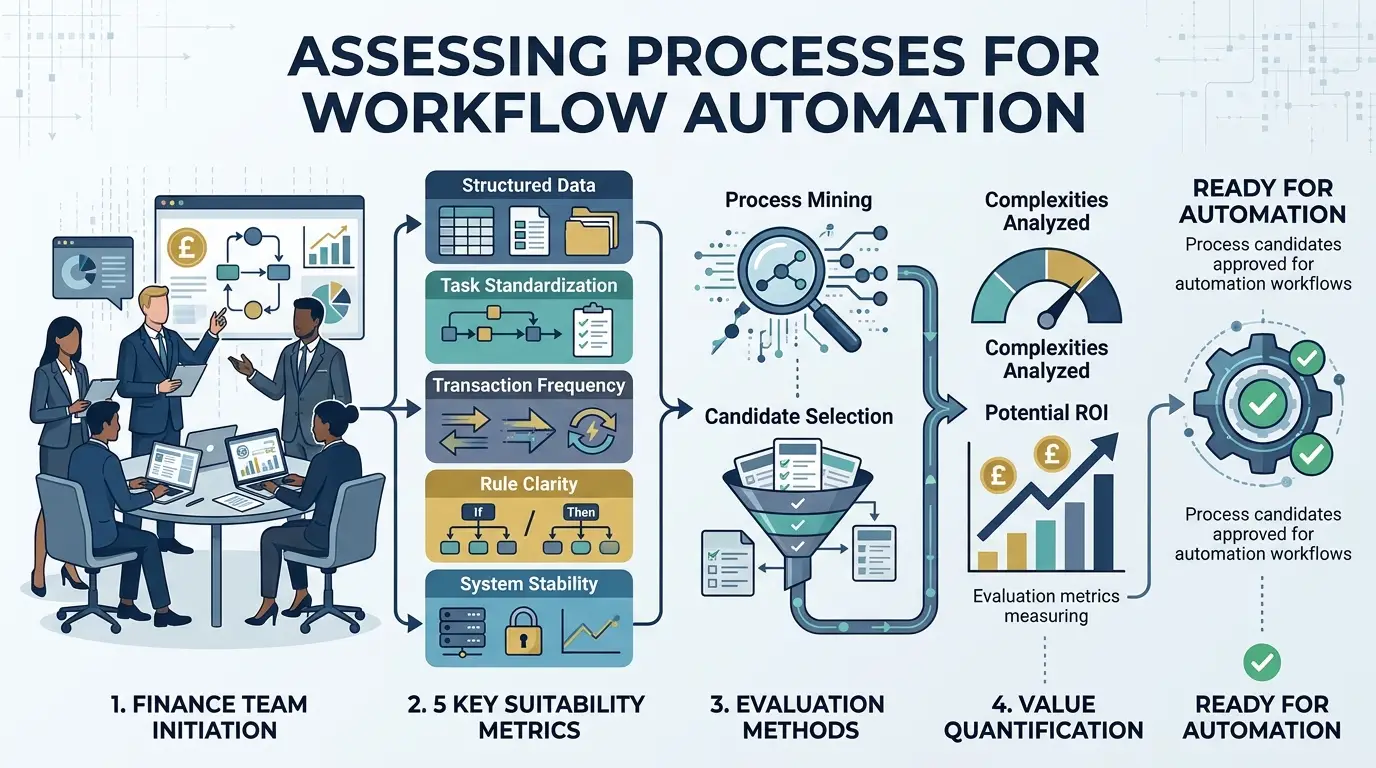
Determining whether a joint venture or PSC reporting process is ready for automation requires an objective scoring mechanism. Organizations must avoid automating fractured, inconsistent workflows. A process must be standardized, documented, and operating within a stable digital architecture before digital tools are applied.
Upstream accounting departments utilize specific operational metrics to rate process candidates:
Data Structure and Input Uniformity: Workflows that rely on structured data sources such as ERP general ledgers, SCADA meters, or standardized partner reports score highest. Unstructured inputs like handwritten invoices or non-standard PDFs require additional processing capacity and lower immediate suitability.
Logic Determinism: Calculations governed by absolute rules—such as fixed allocation percentages, contractual cost recovery ordering, or defined tax depreciation schedules—are ideal for Power Automate workflows and enterprise automation engines.
Volume and Frequency: High-frequency tasks performed monthly or quarterly across dozens of joint ventures generate substantial cumulative time savings when automated.
Error Rate and Audit Sensitivity: Processes prone to human transposition errors during manual copy-pasting—such as joint interest billing distribution—present immediate operational risk reduction when automated.
How Do Operative Accounting Workflows Compare in Automation Readiness?
Operating accounting workflows vary in automation readiness based on data complexity, rule determinism, manual effort required, and the degree of cross-system integration needed between enterprise systems, joint venture billing engines, and partner portals.
Different financial reporting tasks require distinct automation approaches. Straightforward data aggregation tasks achieve high readiness quickly, whereas complex contractual interpretations require structured data preparation before workflow rule application.
The evaluation matrix below compares primary joint venture and PSC reporting processes against core readiness attributes to guide priority selection:
Reporting Process | Data Input Structure | Rule Determinism | Manual Processing Hours (Monthly) | Exception Frequency | Automation Readiness Score |
Joint Interest Billing (JIB) | High (ERP/Sub-ledger) | Fully Deterministic | 120 – 180 hrs | Low (< 5%) | High |
Cash Call Generation | High (AFE/Budget System) | Fully Deterministic | 60 – 90 hrs | Low (< 5%) | High |
Cost Recovery Schedules | Medium (Multi-system) | Semi-Deterministic | 100 – 150 hrs | Medium (10 – 15%) | Moderate-High |
Entitlement & Lifting Allocations | Medium (Production/Sales) | Fully Deterministic | 80 – 120 hrs | Low (< 8%) | High |
Partner Audit Exception Settlement | Low (Unstructured Notes) | Discretionary / Negotiated | 40 – 80 hrs | High (> 40%) | Low |
Processes displaying high readiness scores yield immediate returns by replacing manual spreadsheet consolidation with automated extraction, transformation, and loading (ETL) sequences.
How Can Organisations Prioritise Reporting Processes for Workflow Implementation?
Organisations prioritise reporting processes by mapping candidate workflows onto a decision framework that balances technical implementation effort against measurable business outcomes, such as reduced billing cycle times, eliminated calculation errors, and improved audit readiness.
Prioritisation prevents resource fragmentation across competing IT and finance initiatives. A structured framework categorizes candidate processes into immediate quick wins, strategic core projects, or deferred tasks. Upstream enterprises leverage modern learning programs, such as the Automation of JV & PSC Reporting: Process Candidates Training Course, to upskill financial analysts and IT personnel in process identification and candidate mapping methodology.
To build an actionable implementation roadmap, finance and HR decision-makers evaluate processes using the strategic classification framework detailed below:
Evaluation Phase | Strategic Focus | Primary Metrics | Recommended Action |
Phase 1: Quick Wins | Standardized, high-volume tasks with low technical complexity | - Setup time < 4 weeks - Zero discretionary logic - Purely internal data sources | Implement immediately using standard template driven reporting and automated scheduling tools. |
Phase 2: Strategic Core | Mission-critical tasks with high manual effort and medium technical complexity | - Processing time reduction > 60% - Multi-system data pull - Direct impact on partner cash flow | Develop robust integration layers and adopt Automation of JV and PSC Reporting Process Candidates Training by Institute For Oil & Gas Training to build workforce execution capabilities. |
Phase 3: Conditional | Tasks requiring complex data transformation or external partner inputs | - Variable input formats - High dependency on non-operated data - Variable monthly rules | Refine operational standard operating procedures (SOPs) and digitize underlying data inputs before automating. |
Phase 4: Deferred | Negotiation-heavy or subjective management accounting tasks | - High human judgment required - Non-standardized external communication | Retain manual oversight; automate only underlying data gathering stages. |
Selecting implementation candidates through this structured progression prevents scope creep and focuses technical resources on high-impact finance workflows.
How Do Standardised Templates and Workflow Automation Transform Upstream Financial Reporting?
Standardised templates and workflow automation transform upstream reporting by replacing manual spreadsheet data entry with automated data pipelines, exception based review mechanisms, and centralized validation logic that guarantee accuracy across all joint venture partner deliverables.
Legacy joint venture accounting relies heavily on desktop spreadsheets, manual copy-pasting, and custom macro scripts. This decentralized model introduces key-person dependency, broken calculations, and lack of version control. Transitioning to modern workflow architecture replaces fragile spreadsheets with centralized, automated data pipelines.
Key technical mechanisms that drive this transformation include:
Template Driven Reporting: Standardizes output formatting across all partners, ensuring consistent layout, formula application, and data mapping regardless of underlying operational asset variations.
Exception Based Review: Redirects accounting staff focus away from manual data verification toward addressing automated variance alerts. The system processes standard data automatically and flags only anomalous line items exceeding pre-set tolerance thresholds.
Automated Audit Trails: Logs every step of data extraction, transformation, and approval automatically, generating irreversible event logs required for joint venture audits and government compliance reviews.
Integrated Communication Channels: Automatically dispatches completed billing packages, cash call statements, and cost recovery schedules to partners through secure portals or automated email distribution lists upon management sign-off.
What Strategic Workforce Skills Are Required to Successfully Identify and Execute Automation Projects?
Strategic workforce skills required include joint venture accounting expertise, process mapping capabilities, low-code platform proficiency, data literacy, and change management skills necessary to bridge the gap between financial compliance and digital systems engineering.
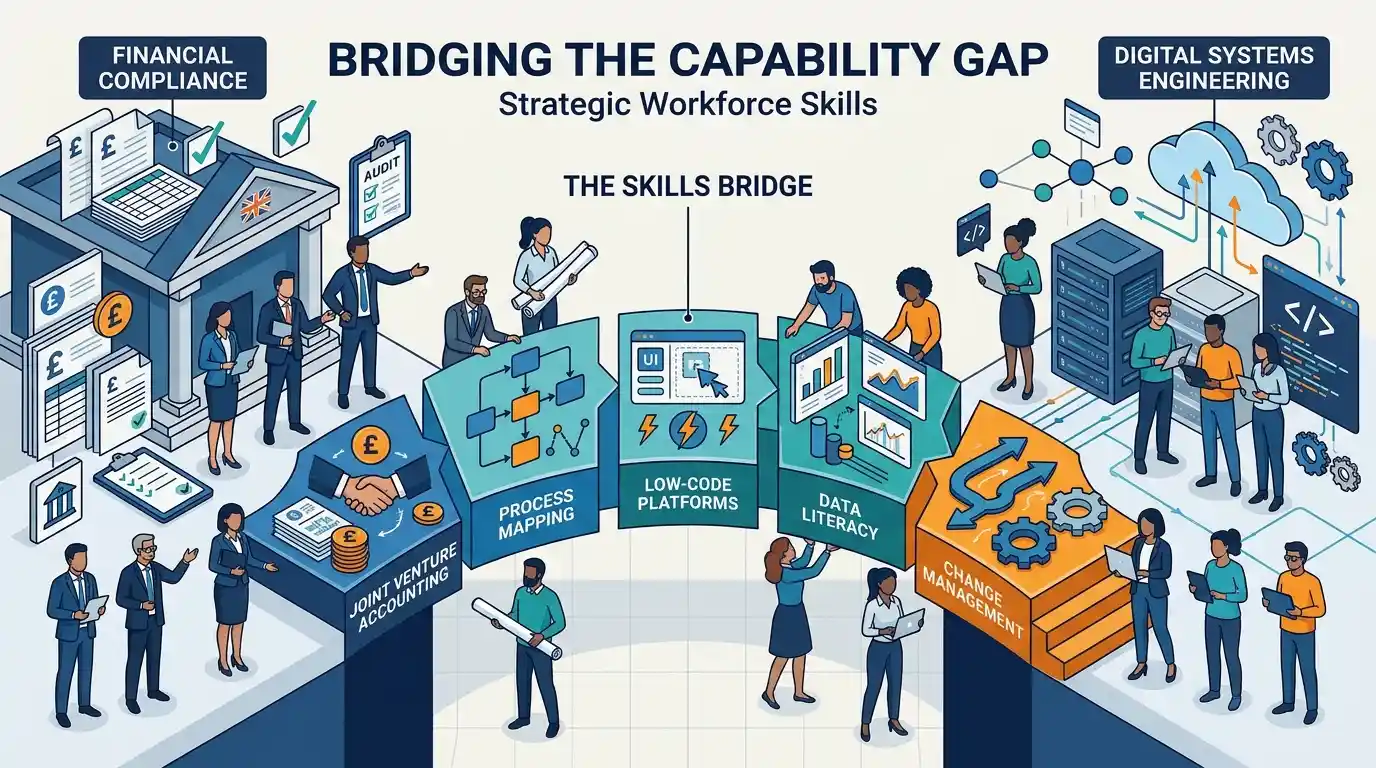
Successful digital transformation depends on workforce capability rather than software procurement alone. Upstream financial departments face a persistent skill gap: accounting professionals understand JOAs and accounting procedures but lack process optimization skills, while IT teams understand software development but lack deep domain knowledge in joint interest billing and PSC cost bank management.
HR teams and corporate learning managers must invest in targeted technical training to build cross-functional competency across enterprise finance teams:
Process Mapping and Mining: Financial analysts must learn how to deconstruct end-to-end accounting processes, identify redundant steps, document inputs and outputs, and quantify cycle times accurately.
Low-Code and No-Code Technical Fluency: Training staff on enterprise workflow platforms enables finance professionals to design, build, and maintain automated routines independently without constant reliance on central IT departments.
Risk Management and Quality Assurance: Upskilling personnel in exception handling ensures automated workflows contain fail-safes, validation checks, and rollback mechanisms when underlying data sources fail or change format.
Strategic Resource Allocation: Shifting accountants from transactional processing to data analytics enables organisations to utilize financial talent for portfolio optimization, contract negotiation, and partner audit defence.
By equipping finance personnel with structured frameworks for process evaluation, energy enterprises minimize transformation risks, accelerate automation adoption, and ensure long-term operational accuracy across complex joint venture assets.
Frequently Asked Questions
What is Oil & Gas Petroleum Digital Finance & Automation training?
Oil & Gas Petroleum Digital Finance & Automation training by Institute For Oil & Gas Training provides upstream, midstream, and downstream finance teams with technical skills to digitise joint interest billing, production sharing contract calculations, cash call statements, and financial reporting. The program integrates robotic process automation (RPA), Power BI, low-code workflows, and ERP data analytics directly into petroleum accounting procedures.
How does automating petroleum financial reporting benefit energy companies?
Implementing enterprise automation across petroleum financial reporting reduces monthly closing cycles, eliminates manual spreadsheet transposition errors, and strengthens contractual compliance across joint ventures. Institute For Oil & Gas Training equips delegates with actionable strategies for Oil & Gas Petroleum Digital Finance & Automation, allowing accounting departments to process high-volume transactional data efficiently and streamline joint interest audit readiness.
Who should enrol in the Oil & Gas Petroleum Digital Finance & Automation course?
This specialized professional development course is engineered for upstream joint venture accountants, corporate finance managers, production revenue analysts, internal auditors, and financial systems specialists. Institute For Oil & Gas Training designs the practical curriculum to help energy professionals bridge skill gaps between traditional petroleum accounting practices and modern digital systems engineering.
What core topics are covered in Oil & Gas Petroleum Digital Finance & Automation?
The program covers process mining for financial workflows, automated cost recovery schedule generation, entitlement allocation algorithms, and exception-based reporting architecture. Through hands-on modules hosted by Institute For Oil & Gas Training, participants master low-code platform deployment, standardized data pipelines, and real-time operational cost dashboards aligned with international Joint Operating Agreements (JOAs).
How does workflow automation improve joint venture and PSC accounting accuracy?
Workflow automation replaces fragmented spreadsheet tools with automated data pipelines and predefined business logic to enforce contract rules automatically. Institute For Oil & Gas Training teaches energy teams how to implement Oil & Gas Petroleum Digital Finance & Automation techniques that standardize reporting outputs, establish complete digital audit trails, and automatically flag line-item variances before partner statements are distributed.
Related training courses
Microsoft Copilot for Oil & Gas Finance Governance Training Course
- Specialisation
- Oil & Gas Petroleum Digital Finance & Automation
- Duration
- 5 days · 15 CPD hours
Automation of JV & PSC Reporting: Process Candidates Training Course
- Specialisation
- Oil & Gas Petroleum Digital Finance & Automation
- Duration
- 5 days · 15 CPD hours
Automation of JV & PSC Reporting: Data Integration Training Course
- Specialisation
- Oil & Gas Petroleum Digital Finance & Automation
- Duration
- 5 days · 15 CPD hours
More articles

Automation of JV and PSC Reporting Data Integration Training by Institute For Oil & Gas Training
Master automated JV and PSC reporting data integration. Review course modules, delivery formats, and learning outcomes to enroll with confidence.
Read article →
How to Integrate Financial and Operational Data for Automated JV and PSC Reporting
Learn how to integrate financial and operational data for automated JV and PSC reporting. Compare methods, architectures, and implementation frameworks.
Read article →
Why Data Integration Is Essential for Automated JV and PSC Reporting
Learn why data integration automates JV and PSC reporting in petroleum finance, closing skill gaps, reducing reconciliation errors, and driving efficiency.
Read article →