

Petroleum organisations face acute financial volatility driven by fluctuating commodity prices, capital-intensive exploration schedules, and strict regulatory compliance requirements. Technical managers and departmental heads frequently possess deep engineering or operational expertise yet lack formal training in financial governance, leading to cost overruns and misaligned capital allocation. Bridging this capability gap requires structured corporate learning that connects operational decision-making directly to balance sheet performance and enterprise value.
Understanding Why Strategic Budgeting and Financial Performance Management Matter in Oil and Gas provides the foundational context for executive teams evaluating training investments. Once leadership recognises the operational risks of disconnected financial planning, the focus shifts toward selecting a rigorous, specification-driven training curriculum that equips staff with practical analytical methodologies.
What is the Strategic Budgeting, Financial Control and Performance Management Course and What Problem Does it Solve?
The Strategic Budgeting, Financial Control and Performance Management course is an intensive corporate training programme designed to equip petroleum managers with rigorous financial planning, capital allocation, and cost governance skills, directly solving the problem of disconnected operational and financial decision-making.
In upstream, midstream, and downstream petroleum enterprises, financial slippage rarely originates in the accounting department. It occurs when asset managers, drilling superintendents, and project engineers make daily operational commitments without evaluating their impact on multi-year capital budgets or unit operating costs. Traditional accounting workshops fail to address the specific economic structures of energy projects, such as joint venture billing, production sharing agreements, and long-cycle asset depreciation.
The Strategic Budgeting, Financial Control and Performance Management programme delivered by Institute For Oil & Gas Training addresses this exact operational deficiency. The curriculum translates complex corporate finance frameworks into actionable decision tools tailored for energy sector workflows. Participants learn to evaluate project economics before committing resources, establish transparent expenditure controls, and link departmental key performance indicators directly to corporate profitability targets.
Core Organisational Challenges Addressed
Uncontrolled Capital Expenditure Drift: Engineering teams often underestimate geological and supply chain contingencies during initial Authorisation for Expenditure (AFE) submissions, resulting in late-stage capital overruns that erode project net present value.
Reactive Operating Cost Management: Field supervisors frequently monitor expenditure through historical accounting reports rather than predictive cost drivers, delaying corrective action when maintenance or logistics expenses escalate.
Siloed Performance Metrics: Operational departments optimise for physical output metrics such as barrel volume or uptime percentages while overlooking capital efficiency, return on capital employed, and cash conversion cycles.
Inconsistent Variance Reporting: Departmental heads often struggle to separate volume variances from price or efficiency variances during monthly financial reviews, obscuring the true root causes of budget deviations.
Why is This Course Structured Around Integrated Financial Governance?
This course is structured around integrated financial governance because effective petroleum cost management requires connecting long-term capital allocation with daily expenditure control and continuous performance measurement, ensuring managers master foundational planning before advancing to complex variance diagnostics and strategic forecasting.
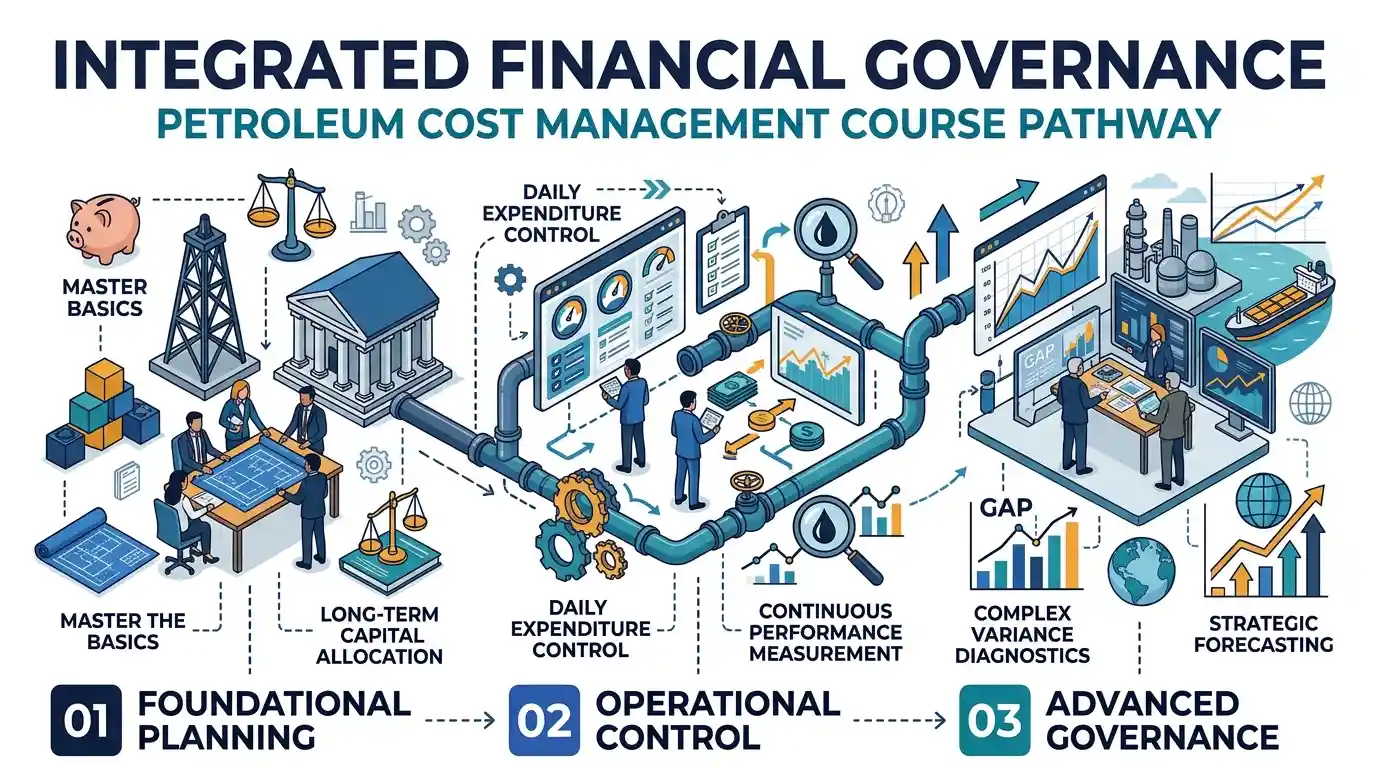
Corporate training fails when instructional modules present budgeting, cost accounting, and performance appraisal as isolated administrative exercises. In real petroleum operations, an approved capital budget establishes the baseline for financial control, while ongoing variance data feeds back into rolling forecasts and executive performance reviews. Institute For Oil & Gas Training engineered the syllabus sequence to mirror this exact operational lifecycle.
When HR directors and department heads evaluate curriculum architectures, knowing How to Align Strategic Budgets Financial Controls and Performance Management in Petroleum Operations clarifies why sequential skill progression is essential. Participants begin by mastering top-down strategic resource allocation, transition into transactional expenditure controls, and conclude by building integrated performance scorecards. This logical progression prevents cognitive overload and ensures every analytical framework builds directly upon previously validated competencies.
Pedagogical Progression Framework
Stage One: Strategic Resource Formulation: Learners establish technical fluency in petroleum budget planning, capital rationing, and multi-year financial modelling under commodity price uncertainty.
Stage Two: Operational Expenditure Governance: Instruction shifts to real-time CAPEX and OPEX management, commitment accounting, procurement controls, and joint venture audit readiness.
Stage Three: Diagnostic Performance Evaluation: Participants master budget variance analysis, balanced scorecard design, and corrective forecasting techniques to sustain financial discipline across operational cycles.
What Will Participants Learn Across the Core Curriculum Modules?
Participants will master six core technical modules covering petroleum budget planning, CAPEX and OPEX management, oil and gas financial control, budget variance analysis, and petroleum cost management, gaining measurable proficiency in building defensible budgets and executing disciplined financial reviews.
Each module within the Strategic Budgeting, Financial Control and Performance Management syllabus combines quantitative financial principles with petroleum-specific operational scenarios. Institute For Oil & Gas Training updates these technical modules continuously to reflect current industry accounting standards, energy transition capital allocation pressures, and modern enterprise resource planning workflows.
Module 1: Strategic Petroleum Budget Planning and Capital Allocation
This module establishes the strategic link between corporate five-year business plans and annual departmental budgets. Participants examine zero-based budgeting, activity-based budgeting, and incremental rolling forecasts within upstream and downstream operating environments.
Capital Rationing Methodologies: Evaluating competing field development and refinery upgrade proposals using Net Present Value (NPV), Internal Rate of Return (IRR), and Profitability Index metrics.
Scenario and Sensitivity Modelling: Constructing dynamic budget models that stress-test departmental cash flows against crude oil price swings, exchange rate fluctuations, and supply chain inflation.
Authorisation for Expenditure (AFE) Governance: Structuring rigorous AFE justification packages, establishing contingency thresholds, and managing multi-tier executive approval workflows.
Module 2: CAPEX and OPEX Management in Energy Operations
Distinguishing between capitalised development costs and expensed operational maintenance is critical for accurate financial reporting and tax optimisation. This module trains managers to classify, forecast, and control both expenditure streams throughout the asset lifecycle.
Lifecycle CAPEX Tracking: Monitoring drilling, well completion, and facility construction commitments against milestone completion schedules to prevent unapproved scope creep.
Unit Operating Cost Optimisation: Analysing lifting costs per barrel and refining margins per throughput unit to identify structural cost reduction opportunities without compromising safety integrity.
Working Capital and Inventory Control: Managing spare parts warehousing, drilling tubular inventories, and contractor payment terms to minimise trapped operational liquidity.
Module 3: Oil and Gas Financial Control Frameworks
Strong internal controls protect corporate assets from contractual leakage, billing errors, and regulatory non-compliance. Participants learn to implement preventative and detective control mechanisms across field operations and corporate procurement.
Commitment Accounting Systems: Tracking purchase orders and service contracts at the point of commitment rather than invoice receipt to maintain real-time visibility into remaining budget headroom.
Joint Venture and Partner Accounting Controls: Auditing operator cash calls, verifying overhead recovery rates, and ensuring compliance with Joint Operating Agreement (JOA) accounting procedures.
Delegation of Authority (DoA) Compliance: Enforcing financial approval limits, segregation of duties, and anti-fraud verification protocols across remote field locations.
Module 4: Budget Variance Analysis and Rolling Forecasts
Identifying a budget discrepancy is insufficient unless managers can isolate its operational driver and project its full-year financial impact. This module equips learners with structured diagnostic tools for monthly and quarterly performance reviews.
Multi-Dimensional Variance Decomposition: Separating total budget variances into price variances, volume variances, activity mix variances, and operational efficiency variances.
Root Cause Investigation Protocols: Conducting structured variance review meetings with engineering and procurement leads to document actionable mitigation plans.
Dynamic Rolling Forecast Execution: Replacing static annual budget comparisons with quarterly rolling re-forecasts that reflect updated production profiles and market conditions.
Module 5: Petroleum Cost Management and Value Engineering
Sustaining profitability during low-price cycles requires structural cost discipline rather than arbitrary across-the-board budget cuts. Participants apply value engineering and total cost of ownership frameworks to major operational contracts.
Activity-Based Costing (ABC) in Field Operations: Allocating shared logistics, marine support, and power generation expenses accurately across producing wells or processing units.
Contractor and Supply Chain Cost Benchmarking: Evaluating service rig rates, chemical treatment contracts, and maintenance outsourcing agreements against industry cost indices.
Decommissioning and Asset Retirement Provisioning: Incorporating end-of-life abandonment liabilities into mid-life operational budgeting and cash flow planning.
Module 6: Enterprise Performance Management and KPI Alignment
The final module integrates financial metrics with operational execution through structured performance management frameworks. Managers learn to translate corporate financial objectives into clear departmental accountabilities.
Balanced Scorecard Architecture: Designing departmental scorecards that balance financial returns with health, safety, environmental (HSE) compliance, and asset reliability targets.
Leading vs. Lagging Financial Indicators: Establishing operational leading indicators—such as non-productive drilling time and preventive maintenance compliance—that predict future financial performance.
Executive Financial Communication: Presenting budget performance, capital requests, and variance explanations clearly to chief financial officers, audit committees, and joint venture partners.
How is the Course Delivered and Assessed for Working Professionals?
The course is delivered through instructor-led workshops, live virtual classrooms, or customised onsite corporate cohorts spanning five intensive days, utilizing practical financial simulations, petroleum case studies, and competency assessments to validate real-world analytical application.
Institute For Oil & Gas Training structures its delivery methodologies to accommodate the demanding shift rotations and operational schedules of energy sector personnel. Rather than relying on passive lectures, instructors facilitate applied working sessions where participants manipulate financial models, audit sample joint venture statements, and defend capital budget proposals.
Training Delivery Formats
Public In-Person Workshops: Scheduled cohorts hosted at major energy hubs, enabling cross-company peer benchmarking and intensive face-to-face facilitation by senior petroleum finance practitioners.
Live Virtual Instructor-Led Training (VILT): Interactive online sessions delivered via enterprise collaboration platforms, incorporating digital breakout rooms, cloud-based spreadsheet labs, and real-time instructor feedback.
Customised Onsite Corporate Delivery: Tailored training deployments conducted at a client organisation's headquarters or field facility, integrating the company's actual chart of accounts, AFE templates, and internal KPIs.
Hybrid Modular Cohort Format: A blended schedule combining pre-course quantitative self-study modules with live diagnostic workshops, ideal for geographically dispersed asset teams.
Rigorous Assessment and Competency Verification
To ensure measurable skill acquisition for corporate sponsors, Institute For Oil & Gas Training evaluates every participant through structured, multi-stage assessments rather than simple attendance tracking.
Pre-Course Diagnostic Baseline: An initial quantitative evaluation measuring baseline familiarity with financial statements, capital budgeting metrics, and cost classification rules.
Applied Spreadsheet Modelling Labs: Timed practical exercises requiring participants to construct a field development budget, calculate NPV sensitivity tables, and perform multi-variable variance analysis.
Capstone Financial Simulation: A team-based simulation where cohorts manage a fictional upstream asset across four fiscal quarters, responding to unexpected equipment failures, oil price drops, and partner audit queries.
Post-Course Competency Examination: A comprehensive final assessment verifying mastery of financial control terminology, variance formulas, and governance procedures, culminating in formal certification.
What Measurable Results and Workplace Outcomes Can Organisations Expect?
Organisations sponsoring staff can expect measurable reductions in unbudgeted capital overruns, faster monthly variance reporting cycles, improved accuracy in AFE forecasting, and stronger cross-functional alignment between technical engineers and corporate finance teams.
Training investments must demonstrate tangible operational return on investment. When technical and commercial personnel complete the Strategic Budgeting, Financial Control and Performance Management course, human resources and finance leaders observe immediate improvements in the quality of financial documentation and budget discipline across operational departments.
Real-World Workplace Applications
Asset Management and Drilling Teams: Drilling managers apply commitment accounting and AFE contingency controls to track daily spread rates against well budgets, identifying cost creep mid-well rather than post-completion.
Human Resources and Learning & Development Teams: HR business partners use the course's competency framework to establish clear financial literacy benchmarks within leadership development pipelines for newly promoted technical superintendents.
Refinery and Midstream Operations Managers: Plant managers utilise unit cost decomposition and activity-based costing to evaluate maintenance turnaround schedules, balancing reliability investments against quarterly operating margin targets.
Procurement and Supply Chain Departments: Category managers apply total cost of ownership models and contract rate benchmarking during vendor negotiations, preventing hidden escalation clauses from eroding operating budgets.
Quantifiable Organisational Performance Indicators
Forecast Accuracy Improvement: Departmental budget submissions exhibit tighter alignment with actual quarterly expenditure, reducing late-year capital reallocation requests.
Accelerated Variance Resolution: Monthly financial review meetings shift from debating accounting data accuracy to executing documented operational corrective actions.
Enhanced Audit Readiness: Field personnel maintain complete AFE justifications, service entry sheets, and partner billing records, reducing joint venture audit exceptions and financial write-offs.
Leadership Pipeline Readiness: Technical specialists gain the commercial fluency required to transition successfully into general management, asset director, and vice president roles.
Who Should Enroll and How Does the Enrollment Process Work?
Ideal participants include asset managers, project engineers, operations superintendents, finance analysts, and departmental heads within energy organisations, who can enroll individually through scheduled public sessions or register corporate teams via dedicated cohort scheduling.
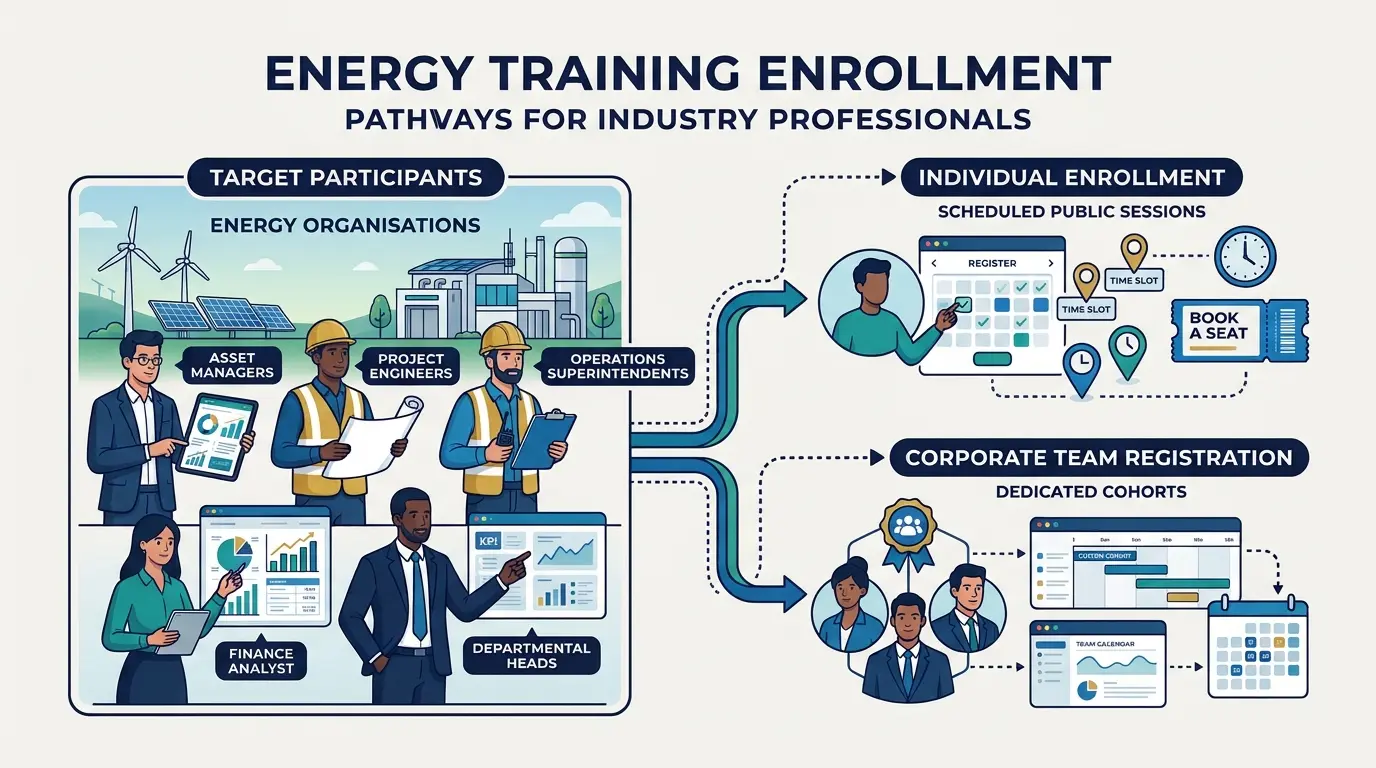
Institute For Oil & Gas Training designs its admission criteria and registration workflows to provide clear decision paths for both individual professionals advancing their commercial credentials and corporate HR teams executing departmental upskilling initiatives.
Target Audience and Eligibility Specifications
Technical and Operational Leaders: Field superintendents, drilling managers, refinery operations leads, and maintenance managers responsible for departmental budgets and capital projects.
Project and Commercial Professionals: Project controls engineers, procurement leads, contract administrators, and joint venture coordinators seeking formal financial control methodologies.
Early-to-Mid Career Finance Staff: Management accountants, cost engineers, and financial analysts transitioning into upstream or downstream energy operations who require industry-specific budgeting context.
Prerequisites: Participants should possess at least two years of professional experience in an operational, engineering, commercial, or financial role, along with basic working proficiency in Microsoft Excel. No prior formal accounting degree is required.
Step-by-Step Enrollment and Onboarding Path
Syllabus and Format Selection: Review the detailed module specifications and select between public in-person workshops, live virtual dates, or a private corporate cohort delivery.
Participant Registration Submission: Submit candidate details, role profiles, and preferred session dates through the official course registration portal, or submit a corporate group roster via HR procurement.
Pre-Course Diagnostic and Materials Access: Upon confirmation, enrolled participants receive access to the digital learning portal, pre-reading primers, Excel financial modelling templates, and the baseline diagnostic assessment.
Live Course Participation and Assessment: Attend all scheduled instructional modules, complete the practical spreadsheet labs, and participate in the capstone asset simulation.
Certification and Post-Training Transfer: Successful completion of the final competency evaluation awards an official certificate of achievement from Institute For Oil & Gas Training, accompanied by an action plan template for immediate workplace implementation.
Corporate Group Enrollment Specifications
For organisations registering five or more participants, Institute For Oil & Gas Training provides consolidated corporate billing, pre-training alignment consultations with departmental directors, and post-course cohort competency reports for HR training records. Customised onsite cohorts can be scheduled within four to six weeks of curriculum confirmation.
To review upcoming session dates, download the full technical syllabus, or secure seats for your operational team, enroll in this program.
Frequently Asked Questions
What is Oil & Gas Petroleum Budgeting & Cost Control training?
Oil & Gas Petroleum Budgeting & Cost Control training is a specialised corporate programme designed to equip energy professionals with frameworks for capital allocation, expenditure tracking, and variance management. Delivered by Institute For Oil & Gas Training, this course bridges the gap between field operations and corporate finance to prevent budget overruns across upstream, midstream, and downstream assets.
Who should attend an Oil & Gas Petroleum Budgeting & Cost Control course?
This training is designed for asset managers, drilling superintendents, project controls engineers, procurement leads, and financial analysts working within the energy sector. Institute For Oil & Gas Training structures the syllabus for technical and commercial professionals who manage departmental budgets, prepare Authorisation for Expenditure (AFE) packages, or oversee joint venture costs.
How are CAPEX and OPEX managed differently in petroleum projects?
In petroleum operations, capital expenditure (CAPEX) covers long-term asset investments like exploration drilling and facility construction, whereas operating expenditure (OPEX) encompasses daily production, maintenance, and logistics costs. Through Oil & Gas Petroleum Budgeting & Cost Control courses at Institute For Oil & Gas Training, managers learn to classify, forecast, and monitor both expenditure streams separately to protect project Net Present Value and optimise unit lifting costs.
Why is budget variance analysis critical in oil and gas financial management?
Budget variance analysis allows energy companies to isolate the specific operational drivers behind financial discrepancies, distinguishing between crude price fluctuations, production volume shifts, and contractor efficiency changes. Institute For Oil & Gas Training teaches participants to execute multi-dimensional variance diagnostics and rolling forecasts so teams can implement corrective cost controls before minor deviations escalate.
Do participants need an accounting background to enrol in petroleum cost control training?
No prior accounting degree is required to enrol in the Oil & Gas Petroleum Budgeting & Cost Control programme, though basic familiarity with Microsoft Excel and at least two years of industry experience are recommended. Institute For Oil & Gas Training delivers practical, step-by-step instruction tailored specifically for engineers and operational leaders who need to apply financial governance to daily field decisions.
Related training courses
CAPEX vs OPEX Impact on Cost Recovery Training Course
- Specialisation
- Oil & Gas Petroleum Budgeting & Cost Control
- Duration
- 5 days · 15 CPD hours
Cost Control for Field Development Projects: Cost Baselines Training Course
- Specialisation
- Oil & Gas Petroleum Budgeting & Cost Control
- Duration
- 5 days · 15 CPD hours
Budget Planning and Cost Optimisation Training Course
- Specialisation
- Oil & Gas Petroleum Budgeting & Cost Control
- Duration
- 5 days · 15 CPD hours
More articles

Borehole Image Logs for Fracture Detection Training by Institute For Oil & Gas Training
Evaluate and enrol in the Borehole Image Logs for Fracture Detection Training Course by Institute For Oil & Gas Training. Master subsurface fracture analysis.
Read article →
How to Identify and Evaluate Natural and Induced Fractures Using Borehole Image Logs
Compare methodologies for natural fracture identification and induced fracture evaluation using borehole image interpretation in carbonate reservoirs to upskill teams.
Read article →
Why Borehole Image Logs Are Important for Fracture Detection
Discover how corporate training in borehole image logs closes subsurface skill gaps, reduces non-productive time, and drives reservoir characterisation ROI.
Read article →