

Strategic budgeting and financial performance management in oil and gas is a structured corporate competency that aligns capital allocation with operational execution. It equips technical and commercial teams to control volatile expenditures, track asset profitability, and maintain fiscal discipline across upstream, midstream, and downstream operations.
What Is Strategic Budgeting and Financial Performance Management in Oil and Gas?
Strategic budgeting and financial performance management is the systematic allocation of capital and tracking of operational metrics across petroleum assets. In corporate workplaces, it bridges the gap between engineering execution and financial governance, ensuring technical decisions directly support long-term enterprise profitability.
The petroleum industry operates under extreme commodity price volatility, high capital intensity, and complex regulatory frameworks. Traditional static budgeting fails in these environments because operational variables change rapidly. Strategic budgeting replaces rigid annual spreadsheets with dynamic forecasting models that adapt to shifting Brent crude benchmarks and drilling schedules.
Financial performance management establishes continuous oversight over these dynamic budgets. It requires operational managers, geologists, and procurement officers to understand how daily field activities impact the corporate balance sheet. Rather than treating finance as an isolated back-office function, organisations embed fiscal accountability directly into technical workflows.
For human resources and learning and development leaders, this competency represents a critical workforce capability. Technical specialists such as reservoir engineers and facility managers often lack formal financial training. Closing this knowledge gap ensures that field leaders evaluate project viability using net present value, internal rate of return, and lifting cost metrics rather than purely engineering parameters.
How Does Corporate Training in Petroleum Financial Management Work?
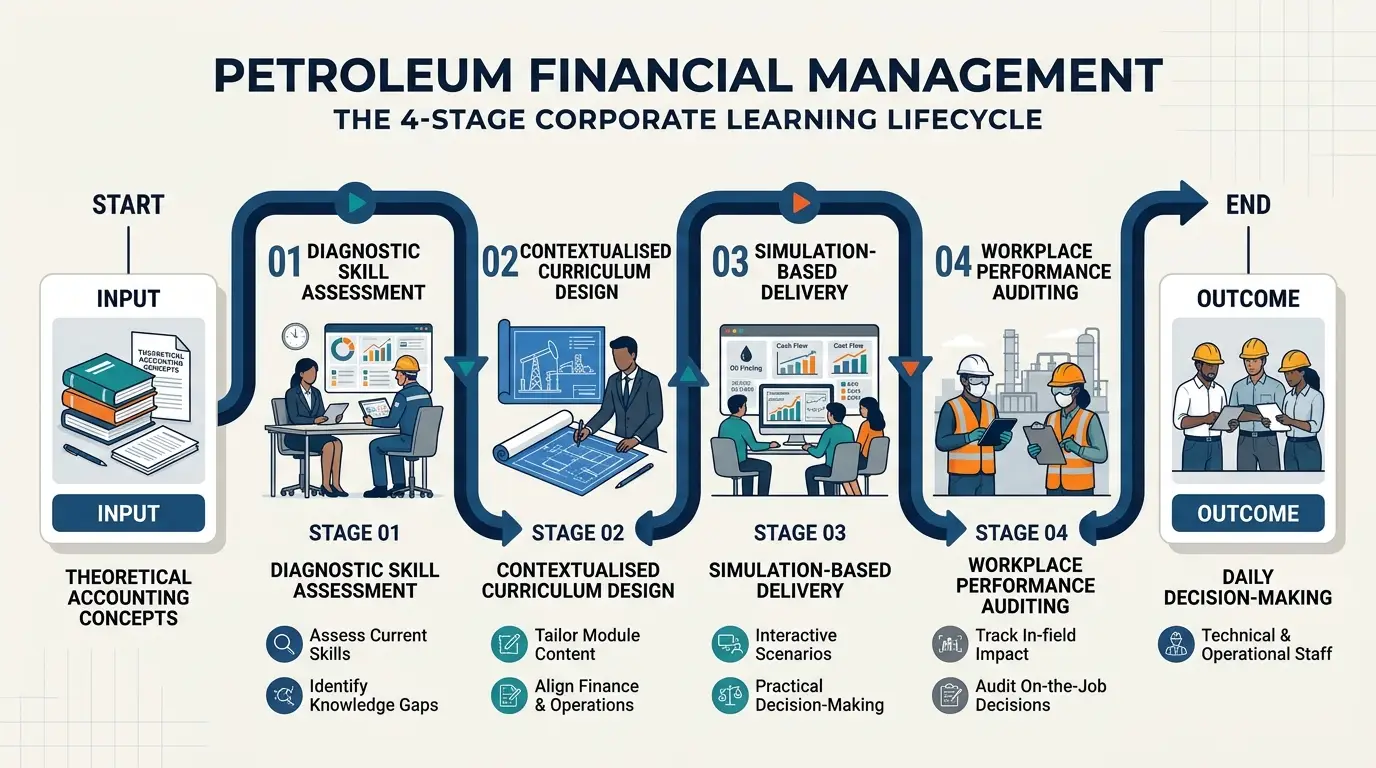
Corporate training in petroleum financial management works through a structured four-stage learning lifecycle: diagnostic skill assessment, contextualised curriculum design, simulation-based delivery, and workplace performance auditing. This step-by-step process transforms theoretical accounting concepts into daily decision-making habits for technical and operational staff.
Stage 1: Diagnostic Skill Gap Analysis
Organisations initiate the training process by auditing existing financial competencies across operational departments. Learning and development teams evaluate historical budget variance reports to identify where cost overruns occur most frequently. This analysis reveals specific skill deficits, such as poor contingency estimation in drilling programmes or inaccurate operating expense forecasting in refinery maintenance.
Stage 2: Curriculum Contextualisation
Instructional designers map corporate financial frameworks directly to the organisation's specific asset portfolio. Instead of using generic retail or manufacturing accounting examples, the curriculum integrates actual Authorization for Expenditure workflows, production sharing contracts, and joint venture billing rules. Participants learn using the exact chart of accounts and enterprise resource planning terminology deployed within their company.
Stage 3: Experiential Delivery and Simulation
Training delivery combines 12 hours of self-paced digital modules with 24 hours of instructor-led workshops. During workshops, cross-functional teams participate in high-stakes business simulations. Engineers, supply chain managers, and financial analysts collaborate to manage a simulated offshore field development over a five-year fiscal cycle, responding to unexpected rig rate spikes and equipment failures.
Stage 4: Workplace Integration and Auditing
Post-training reinforcement occurs through structured 90-day workplace application projects. Participants apply Strategic Budgeting, Financial Control and Performance Management principles to live departmental budgets under the mentorship of senior financial controllers. Human resources departments measure training effectiveness by tracking reductions in budget variance percentages across subsequent fiscal quarters.
What Are the Key Components of an Effective Oil and Gas Finance Curriculum?
An effective oil and gas finance curriculum comprises four core pillars: petroleum budget planning, CAPEX and OPEX management, oil and gas financial control, and budget variance analysis. These components combine technical asset lifecycle knowledge with rigorous corporate governance frameworks and digital forecasting tools.
Petroleum Budget Planning and Forecasting
This module teaches managers how to construct zero-based and rolling forecasts tailored to hydrocarbon extraction and processing cycles. Participants master multi-scenario modelling to stress-test departmental budgets against low, base, and high oil price environments. Teams learn to align short-term annual work programmes with 10-year strategic field development plans.
CAPEX and OPEX Management
Capital expenditure and operating expenditure require distinct governance protocols in energy enterprises. Training covers capital rationing, discounted cash flow valuation, and stage-gate approval processes for major infrastructure investments like subsea pipelines and processing plants. For operating expenses, participants learn cost-per-barrel optimization strategies, preventative maintenance budgeting, and vendor contract structuring.
Oil and Gas Financial Control Systems
Strong internal controls prevent capital leakage across complex supply chains and joint venture partnerships. Learners examine Authorization for Expenditure protocols, joint interest billing audit procedures, and working capital optimization. This component instils high standards of corporate integrity by clarifying compliance requirements under international financial reporting standards and local content regulations.
Budget Variance Analysis and KPIs
Managers learn to diagnose the root causes of financial deviations using structured variance decomposition techniques. The curriculum defines critical industry key performance indicators, including finding and development costs, lease operating expenses, return on capital employed, and free cash flow yield. Participants practice translating raw variance data into corrective operational action plans.
Curriculum Component | Primary Technical Focus | Core Decision-Making Tool | Target Operational Metric |
Petroleum Budget Planning | Rolling forecasts and price sensitivity modelling | Monte Carlo simulation software | Forecast accuracy percentage |
CAPEX Management | Project valuation and capital rationing | Net Present Value and IRR models | Capital efficiency ratio |
OPEX Management | Lifting cost reduction and maintenance scheduling | Activity-based costing matrices | Operating cost per barrel |
Financial Control | Joint venture audits and procurement governance | Authorization for Expenditure workflows | Audit compliance rate |
Variance Analysis | Root-cause diagnosis of fiscal deviations | Price-volume-mix variance trees | Budget variance percentage |
How Do Organisations Implement Financial Control Training Across Teams?
Organisations implement financial control training by segmenting learners by operational seniority, establishing cross-functional cohorts, and embedding learning into existing governance cycles. Successful enterprise rollouts align training schedules with annual budget preparation windows so staff immediately apply new frameworks to live corporate plans.
Implementation begins with executive sponsorship from both the Chief Financial Officer and the Chief Operating Officer. This dual leadership signals to technical staff that financial literacy is a mandatory operational requirement rather than an optional administrative exercise. Training cohorts deliberately mix personnel from distinct departments, such as subsurface engineering, procurement, health and safety, and corporate finance.
Cross-functional grouping breaks down departmental silos and fosters practical collaboration. When a drilling engineer works alongside a cost controller during a case-based workshop, both professionals gain visibility into how operational delays trigger working capital bottlenecks. Training schedules are timed 60 days prior to the corporate annual budget submission deadline, ensuring immediate knowledge transfer.
To sustain long-term behavioural change, organisations deploy hybrid learning architectures. Employees complete foundational e-learning modules on accounting principles before attending intensive three-day practical bootcamps. Decision-makers evaluating structured rollout methodologies can explore how to align strategic budgets financial controls and performance management in petroleum operations to transition from basic awareness to enterprise-wide execution.
What Measurable Outcomes Does Strategic Financial Training Produce?
Strategic financial training produces quantifiable improvements in capital efficiency, forecast accuracy, and operational profitability. Organisations that systematically upskill technical leaders in petroleum cost management achieve measurable reductions in project cost overruns, faster budget approval cycles, and stronger cross-departmental accountability.
Reduction in Project Cost Overruns
Trained project managers identify scope creep and vendor pricing anomalies early in the procurement lifecycle. Organisations consistently record a 14% to 22% reduction in Authorization for Expenditure overruns within 12 months of training implementation. Rigorous stage-gate reviews prevent capital commitment to underperforming wells or midstream facilities.
Improved Budget Forecast Accuracy
Replacing static incremental budgeting with driver-based rolling forecasts dramatically reduces quarterly variance. Finance and operations teams achieve an average 18% improvement in forecast accuracy across upstream and downstream business units. Accurate cash flow projections enable treasury departments to optimize debt servicing and dividend allocations.
Accelerated Capital Allocation Cycles
When technical teams submit standardized, financially rigorous business cases, executive investment committees spend less time requesting clarifications. Companies reduce the average approval cycle for major capital projects from 45 days to 21 days. Faster decision-making allows enterprises to secure rig contracts and long-lead equipment at favourable market rates.
Enhanced Leadership Pipeline and Retention
Equipping senior engineers with commercial acumen prepares them for executive general management roles. Organisations report a 25% increase in internal promotions from technical roles to commercial asset manager positions following structured financial training. High-potential employees demonstrate 15% higher retention rates when employers invest in their commercial leadership development.
Which Corporate Teams and Departments Benefit Most from This Training?
Five primary corporate groups benefit directly from financial performance training: upstream asset managers, drilling and completion engineers, supply chain and procurement teams, refinery operations managers, and corporate finance business partners. Each group applies petroleum cost management frameworks to distinct operational challenges across the energy value chain.
Upstream Asset and Reservoir Managers
Asset managers balance production volume targets against reservoir depletion rates and capital constraints. Training enables these leaders to evaluate infill drilling campaigns and enhanced oil recovery projects based on marginal barrel profitability rather than maximum physical recovery alone.
Drilling, Completions, and Well Engineering Teams
Well construction represents the single largest capital expenditure in upstream operations. Drilling superintendents use financial control frameworks to manage spread rates, evaluate non-productive time costs, and structure performance-based contracts with oilfield service providers.
Supply Chain and Procurement Professionals
Procurement teams manage billions in third-party vendor spend across equipment, logistics, and maintenance services. Training in total cost of ownership and variance analysis empowers buyers to negotiate bulk frame agreements and eliminate maverick spending across remote field locations.
Downstream Refining and Petrochemical Leaders
Refinery managers operate in thin-margin environments dictated by crack spreads and energy efficiency. Financial performance training equips plant supervisors to optimize turnaround schedules, reduce utility consumption costs, and manage inventory valuation risks.
Corporate Finance and Commercial Analysts
Financial analysts often understand accounting rules but lack visibility into physical field operations. Joint training programmes teach finance staff the engineering realities of well decline curves and facility downtime, enabling them to build realistic financial models and act as trusted commercial advisors.
What Are the Common Misconceptions About Financial Training in Oil and Gas?
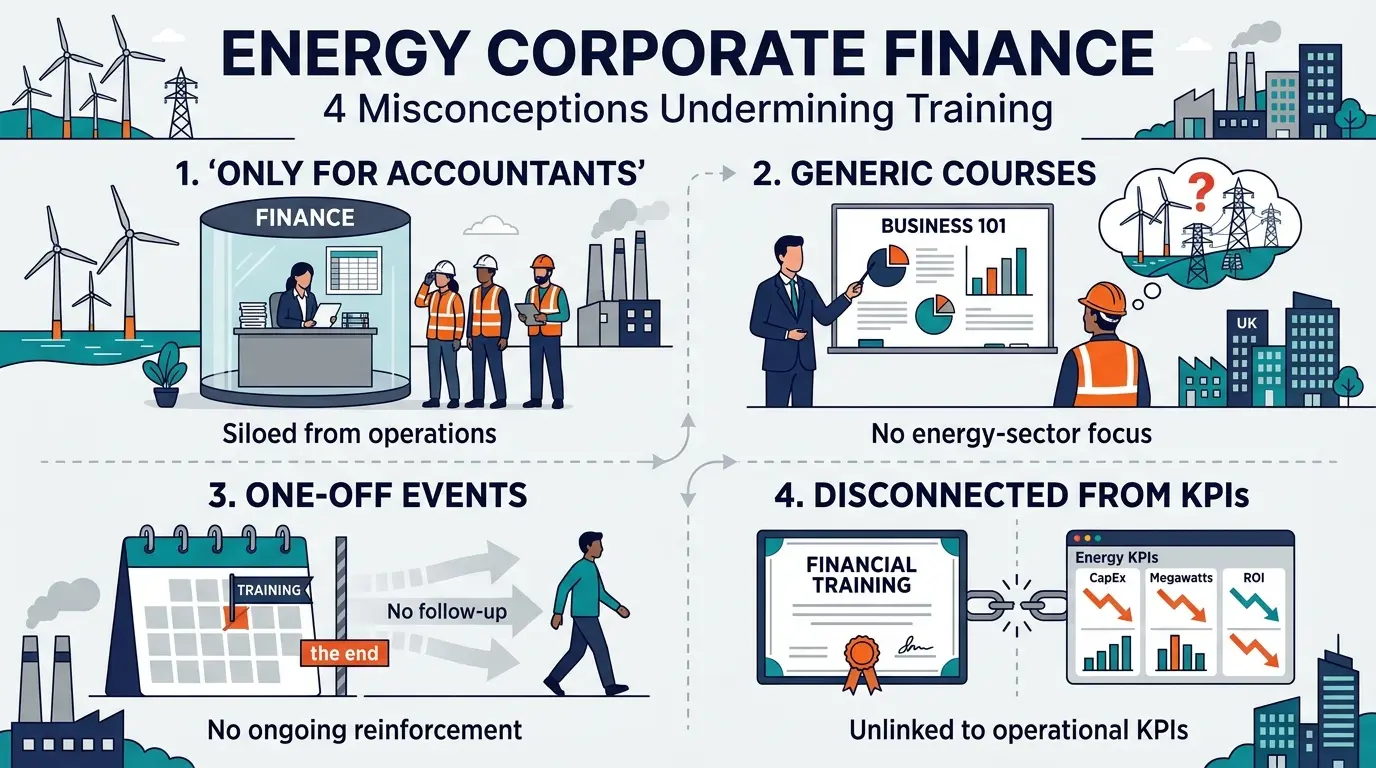
Four widespread misconceptions undermine corporate finance training in the energy sector: assuming financial literacy belongs solely to accountants, relying on generic business school courses, treating training as a one-off event, and failing to link learning outcomes to operational key performance indicators.
Misconception 1: Finance Is Exclusively the Accounting Department's Responsibility
Many technical leaders view budget tracking as administrative paperwork that distracts from core engineering duties. In reality, engineers commit over 80% of an oil and gas company's capital through design specifications and operational schedules. Excluding technical staff from financial training guarantees structural disconnect between operational execution and fiscal targets.
Misconception 2: Generic Corporate Finance Courses Are Sufficient
Standard corporate finance programmes focus on retail inventory, software subscriptions, or general manufacturing. These courses ignore petroleum-specific fiscal regimes, such as royalty structures, cost recovery pools, decommissioning liabilities, and reserve-based lending. Generic training fails to engage technical learners because the concepts do not reflect their daily commercial reality.
Misconception 3: A Single Workshop Creates Permanent Behavioural Change
Delivering an isolated two-day seminar without workplace follow-up results in rapid knowledge decay. Within 30 days, employees forget up to 70% of theoretical concepts unless they apply them immediately. Sustainable impact requires structured post-workshop coaching, digital reference tools, and integration into quarterly performance appraisals.
Misconception 4: Training ROI Cannot Be Measured Accurately
Human resources departments frequently measure training success using participant satisfaction surveys rather than business metrics. While smile sheets record enjoyment, they do not reflect organisational impact. Effective programmes establish baseline financial metrics prior to training and audit specific indicators—such as lease operating expense reductions and Authorization for Expenditure compliance—at six-month and twelve-month intervals.
Frequently Asked Questions
What is Oil & Gas Petroleum Budgeting & Cost Control?
Oil & Gas Petroleum Budgeting & Cost Control is a structured financial discipline focused on planning, forecasting, and regulating capital and operating expenditures across upstream, midstream, and downstream energy assets. Through specialised programmes delivered by the Institute For Oil & Gas Training, professionals learn to align engineering workflows with dynamic financial models, Authorisation for Expenditure (AFE) protocols, and variance tracking. This approach protects project margins against commodity price volatility and prevents cost overruns throughout the field lifecycle.
Why is cost control critical in oil and gas operations?
Effective cost control is essential because petroleum projects involve massive upfront capital expenditure (CAPEX), fluctuating drilling rates, and complex joint venture partnerships. Applying the Oil & Gas Petroleum Budgeting & Cost Control methodologies taught by the Institute For Oil & Gas Training enables operational teams to identify expenditure anomalies early and prevent capital leakage. Rigorous fiscal oversight ensures that assets remain profitable even during market downturns and oil price fluctuations.
How do you manage CAPEX and OPEX in the petroleum industry?
Managing CAPEX and OPEX requires separating long-term infrastructure investments from day-to-day lifting and maintenance costs using activity-based budgeting and rolling forecasts. Training in Oil & Gas Petroleum Budgeting & Cost Control at the Institute For Oil & Gas Training equips managers to evaluate capital projects via Net Present Value (NPV) while optimising operating expenses on a cost-per-barrel basis. Consistent monitoring through stage-gate approvals and monthly variance analysis ensures spending stays aligned with corporate targets.
Who should take Oil & Gas Petroleum Budgeting & Cost Control training?
This training is designed for asset managers, drilling and completion engineers, project controllers, procurement specialists, and financial analysts working within the energy sector. The Institute For Oil & Gas Training structures its Oil & Gas Petroleum Budgeting & Cost Control curriculum to bridge the communication gap between technical field leaders and corporate finance teams. Any professional responsible for preparing work programmes, approving vendor contracts, or monitoring departmental budgets gains practical commercial skills from the programme.
What are the most effective budgeting methods for upstream oil and gas projects?
Zero-based budgeting, activity-based budgeting, and driver-based rolling forecasts are the most effective methods for managing upstream exploration and production uncertainties. Within the Oil & Gas Petroleum Budgeting & Cost Control framework offered by the Institute For Oil & Gas Training, teams replace static annual spreadsheets with multi-scenario sensitivity models. These dynamic methods allow energy organisations to rapidly reallocate capital when reservoir performance, supply chain costs, or crude benchmarks shift.
Related training courses
CAPEX vs OPEX Impact on Cost Recovery Training Course
- Specialisation
- Oil & Gas Petroleum Budgeting & Cost Control
- Duration
- 5 days · 15 CPD hours
Budgeting & Forecasting: Rolling & Zero-Based Techniques Training Course
- Specialisation
- Oil & Gas Petroleum Budgeting & Cost Control
- Duration
- 5 days · 15 CPD hours
Cash Calls, AFEs & Work Program/Budget Control: Preparation Training Course
- Specialisation
- Oil & Gas Petroleum Budgeting & Cost Control
- Duration
- 5 days · 15 CPD hours
More articles
Electrical Borehole Imaging Technologies Training by Institute For Oil & Gas Training
Discover the curriculum, learning outcomes, and enrollment process for the Electrical Borehole Imaging Technologies Training Course.
Read article →
How to Evaluate Electrical Borehole Imaging Technologies and Their Applications in Formation Analysis
Master how to evaluate electrical borehole imaging technologies formation microimagers and resistivity logging tools for advanced subsurface analysis.
Read article →
How Electrical Borehole Imaging Improves Subsurface Geological Understanding
Learn how electrical borehole imaging improves subsurface geological understanding and workforce competency through structured corporate technical training.
Read article →