
Aligning strategic budgets with financial controls and performance management in petroleum operations requires linking long-term capital allocation directly to daily asset-level expenditure and operational key performance indicators (KPIs). Upstream, midstream, and downstream enterprises operate within volatile commodity price cycles where disconnected planning creates immediate margin erosion. When corporate strategy sits apart from field-level cost tracking, engineering teams over-allocate resources to low-yield wells while finance departments lack real-time visibility into drilling overruns. Achieving full alignment integrates corporate capital planning, granular Authorization for Expenditure (AFE) governance, and balanced scorecard metrics into a single operational workflow.
Before selecting an operational alignment framework or workforce capability programme, finance leaders and human resources (HR) managers must establish a shared baseline across technical and commercial units. Understanding why strategic budgeting and financial performance management matter in oil and gas establishes the foundational case for connecting reservoir development targets with fiscal discipline. Without this baseline, cross-functional teams treat budgeting as an annual compliance exercise rather than an active operational steering mechanism. Moving from isolated departmental spreadsheets to integrated financial governance demands evaluating specific planning methodologies, control architectures, and corporate upskilling pathways.
Which Budgeting Frameworks Best Connect Corporate Strategy to Petroleum Operations?
Zero-Based Budgeting (ZBB), Activity-Based Budgeting (ABB), and Rolling Forecasts outperform static incremental budgeting in petroleum operations by tying capital and operating allocations directly to asset productivity, well intervention schedules, and real-time Brent or WTI crude price sensitivities.
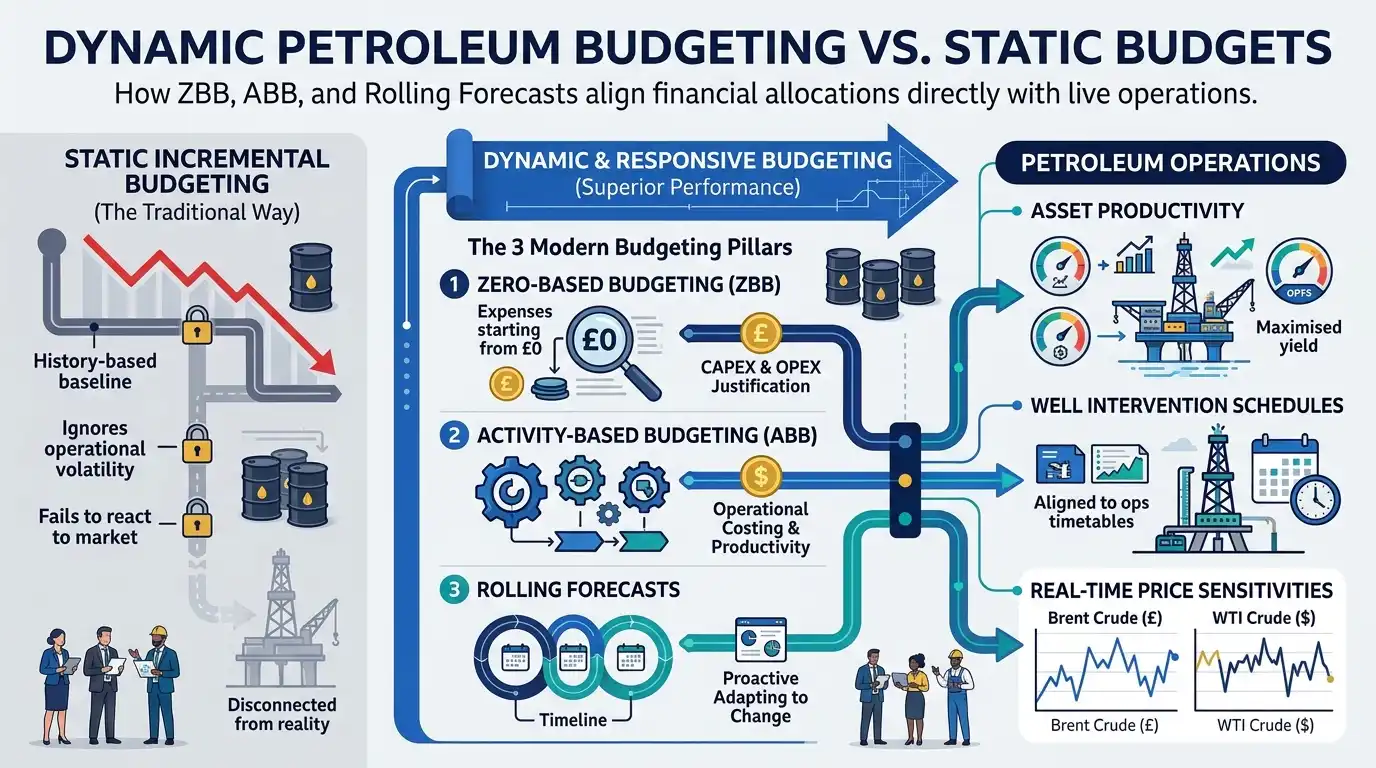
Selecting the appropriate methodology for Petroleum Budget Planning determines how rapidly an organisation adapts to reservoir decline rates and supply chain inflation. Traditional incremental budgeting adds a fixed percentage to prior-year expenditure, which institutionalises historical inefficiencies across mature fields and masks rising lifting costs. Consideration-stage decision-makers evaluate three primary alternatives based on asset maturity, operational volatility, and enterprise resource planning (ERP) maturity.
Zero-Based Budgeting for Mature and Late-Life Assets
Zero-Based Budgeting requires asset managers to justify every dollar of expenditure from a zero baseline at the start of each planning cycle. In late-life brownfield operations, ZBB strips away legacy maintenance contracts and non-essential well workovers that persist in incremental budgets. Implementing ZBB typically reduces controllable operating expenditure (OPEX) by 10% to 18% within the first two fiscal quarters. The methodology demands high analytical effort from subsurface engineers and cost controllers, making it ideal for mature basins where margin preservation outweighs rapid production expansion.
Activity-Based Budgeting for Drilling and Field Development
Activity-Based Budgeting calculates financial requirements from the specific operational activities driving costs, such as rig days, metres drilled, fracturing stages, and barrel-of-oil-equivalent (BOE) processing volumes. ABB bridges the communication gap between petroleum engineers and corporate accountants because budgets are built using physical operational drivers rather than abstract general ledger codes. When rig day-rates fluctuate by 15%, ABB automatically recalculates total drilling capital expenditure (CAPEX) without manual spreadsheet overrides. Organisations executing multi-well development campaigns rely on ABB to maintain strict unit-cost accountability across service contractors.
Rolling Forecasts for Commodity Price Volatility
Rolling forecasts replace fixed 12-month calendar budgets with continuous four-to-six-quarter projections updated monthly or quarterly. As crude oil and natural gas forward curves shift, rolling forecasts enable executive committees to reallocate discretionary capital between exploration, infill drilling, and debt reduction. Companies utilizing quarterly rolling forecasts reduce budget variance by up to 25% compared to peers locked into static annual cycles. This approach requires integrated Enterprise Performance Management (EPM) software capable of ingesting live production data from Supervisory Control and Data Acquisition (SCADA) systems.
Budgeting Methodology | Primary Operational Fit | Implementation Timeline | Variance Reduction Impact | Key Resource Requirement |
Zero-Based Budgeting (ZBB) | Mature brownfields and cost-restructuring phases | 4 to 6 months | 10% to 18% OPEX reduction | Granular activity cost data and strong cost-controller governance |
Activity-Based Budgeting (ABB) | Active drilling campaigns and upstream field development | 3 to 5 months | 15% to 22% unit-cost accuracy gain | Engineering-to-finance driver mapping and ERP integration |
Rolling Forecasts | Integrated operations exposed to high commodity volatility | 2 to 4 months | Up to 25% reduction in forecast variance | Automated EPM software and monthly cross-functional review cycles |
How Do CAPEX and OPEX Management Systems Enforce Oil and Gas Financial Control?
Effective Oil and Gas Financial Control separates long-term capital deployment from daily operating expenditure through strict Authorization for Expenditure (AFE) stage-gates, joint venture (JV) audit protocols, and real-time commitment accounting across procurement and field operations.
Financial control mechanisms prevent approved strategic budgets from eroding during field execution. In capital-intensive exploration and production (E&P) projects, multi-million-dollar commitments occur rapidly at the wellsite before supplier invoices reach corporate accounts payable. Evaluating control architectures requires examining how CAPEX and OPEX Management frameworks govern spending authority, joint interest billing, and procurement compliance.
Authorization for Expenditure (AFE) Governance
An Authorization for Expenditure serves as the binding financial contract between executive leadership and project managers for specific capital projects, such as drilling a new development well or upgrading a compressor station. Robust AFE governance enforces multi-tier approval thresholds, automated ERP commitment tracking, and mandatory supplemental AFE triggers whenever projected costs exceed approved baselines by 10%. Without automated commitment accounting, project managers track actual paid invoices rather than open purchase orders, discovering cost overruns only after capital is spent. Integrating AFE workflows directly into procurement systems halts unapproved service orders before field execution begins.
Joint Venture and Production Sharing Contract Controls
Petroleum operations frequently operate under Joint Operating Agreements (JOAs) or Production Sharing Contracts (PSCs), where non-operating partners and host governments scrutinise every expenditure line. Oil and Gas Financial Control systems must segregate recoverable costs from non-recoverable overheads in strict compliance with Council of Petroleum Accountants Societies (COPAS) accounting procedures. Automated JV billing validation prevents cost disallowances during partner audits, which otherwise cost operators 2% to 5% of total project CAPEX. Standardising chart-of-accounts structures across joint ventures accelerates partner cash calls and eliminates working capital bottlenecks.
OPEX Lifting Cost Containment
Operating expenditure control focuses on direct lifting costs per barrel, encompassing well servicing, chemical injection, power generation, and surface facility maintenance. High-performing operators implement zero-tolerance variance thresholds on recurring vendor contracts and track maintenance spend against asset reliability metrics. Establishing a dedicated Petroleum Cost Management baseline allows field superintendents to evaluate whether preventive maintenance spend lowers unscheduled downtime. Separating fixed facility overhead from variable production costs clarifies true break-even economics at the individual wellhead level.
What Role Does Budget Variance Analysis Play in Operational Performance Management?
Budget Variance Analysis translates financial deviations into actionable operational diagnostics by decomposing spending discrepancies into price variances, volume variances, and efficiency variances across specific wells, facilities, and business units.
Recording a budget overrun at month-end provides zero operational value unless finance and engineering teams isolate the root cause. Structured Budget Variance Analysis connects financial accounting directly to operational performance management by distinguishing external market shifts from internal execution failures.
Decomposing Price, Volume, and Efficiency Variances
Effective variance analysis splits total budget deviations into three distinct analytical buckets:
Price Variance: Measures cost changes driven by external market rates, such as steel tubular inflation, marine vessel charter spikes, or fuel price increases. Price variances require procurement renegotiation or hedging adjustments rather than field engineering intervention.
Volume Variance: Captures spending shifts caused by changes in production throughput, water cut increases, or altered drilling footage targets. Volume variances reflect reservoir behaviour and schedule adjustments rather than cost-control failures.
Efficiency Variance: Isolates operational execution performance, such as excessive non-productive time (NPT) during drilling, higher-than-planned chemical dosage rates, or delayed rig mobilisation. Efficiency variances sit directly under the control of operational managers and trigger immediate technical corrective actions.
Linking Variance Metrics to Balanced Scorecards
Operational performance management aligns individual and departmental incentives with strategic financial targets through structured KPIs. When engineering managers are evaluated solely on production volume targets, they frequently overspend on high-cost well interventions that destroy net present value (NPV). Balanced scorecards pair production metrics—such as barrels of oil equivalent per day (BOEPD)—with financial discipline indicators including Finding and Development (F&D) costs, Return on Capital Employed (ROCE), and lifting cost per barrel. Tying annual performance bonuses to both capital efficiency and safety compliance eliminates the historical friction between operations and corporate finance.
Which Corporate Training Models Close Financial Alignment Skill Gaps in Energy Teams?
Blended cohort-based corporate training combining industry-specific financial simulations, real-world AFE case studies, and cross-functional finance-engineering workshops closes alignment skill gaps faster than generic accounting courses or self-paced e-learning libraries.
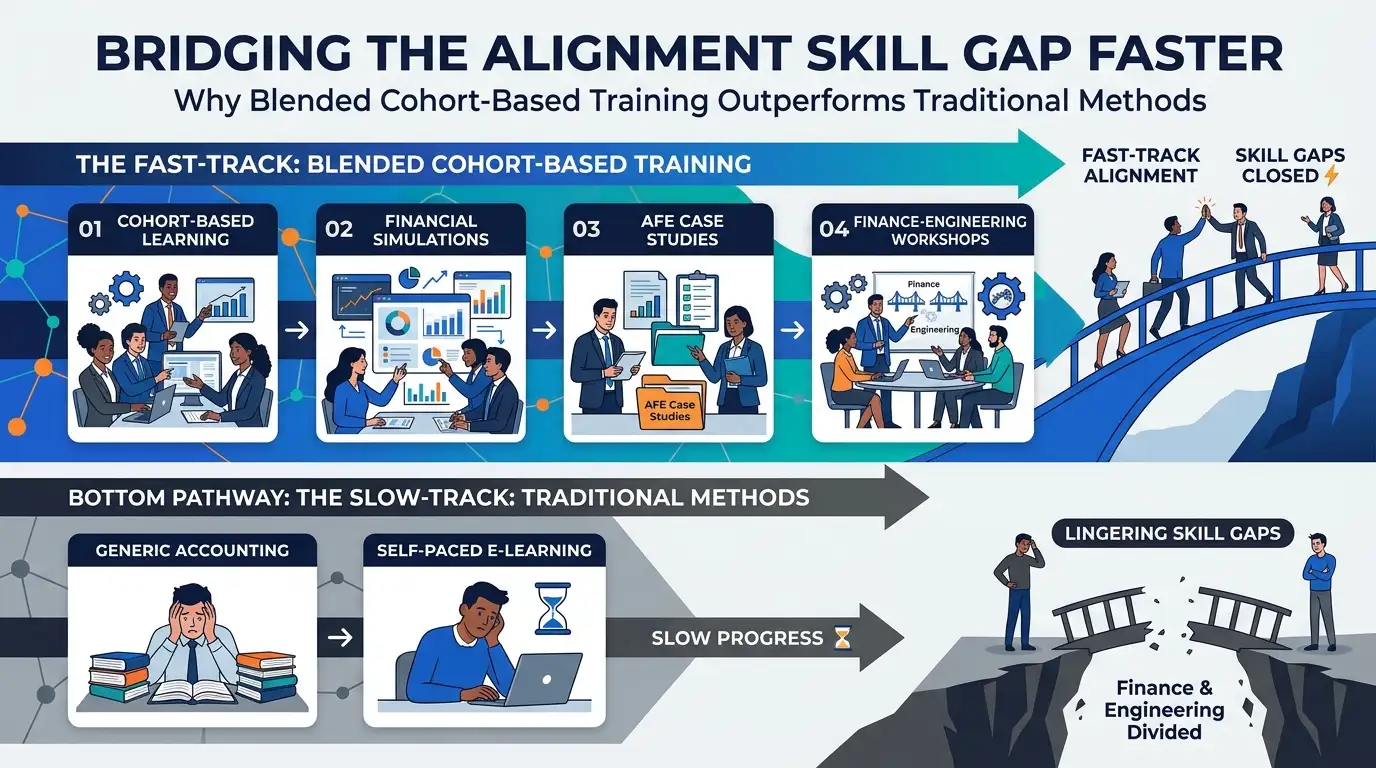
Even the most sophisticated ERP systems and budgeting frameworks fail when technical managers lack financial literacy or finance professionals misunderstand subsurface risk. HR directors and Learning and Development (L&D) leaders evaluating workforce capability solutions must compare delivery models based on knowledge retention, behavioural transfer, and measurable return on investment (ROI).
Addressing Workforce Skill Gaps Across Technical and Finance Roles
Cross-functional misalignment stems from predictable capability gaps on both sides of the business:
Technical and Engineering Managers: Petroleum engineers, drilling superintendents, and facility managers often view financial controls as administrative bureaucracy. They frequently lack training in discounted cash flow (DCF) modelling, AFE variance attribution, and working capital impacts of inventory stockpiling.
Finance and Cost Control Analysts: Corporate accountants and FP&A analysts frequently struggle to interpret geological uncertainty, decline curve analysis, and operational non-productive time. Without technical context, finance teams apply rigid budget cuts that compromise asset integrity and long-term recovery factors.
Evaluating Learning Delivery Models for Energy Enterprises
HR leaders typically evaluate three primary training formats when building corporate capability in petroleum financial management:
Self-Paced Generic E-Learning: Off-the-shelf video libraries offer low upfront costs per learner ($150 to $400 per seat) and flexible scheduling. However, completion rates average below 20%, and generic manufacturing or retail accounting examples fail to resonate with upstream and downstream personnel.
Academic Executive Education: University-led finance programmes deliver strong theoretical grounding over 6 to 12 months at high tuition costs ($8,000 to $20,000 per participant). While valuable for senior vice presidents, academic courses rarely incorporate company-specific PSC rules, AFE templates, or operational ERP workflows.
Applied Industry-Specific Corporate Training: Practitioner-led workshops tailored to oil and gas operations bridge theory and immediate workplace execution over intensive 3-to-5-day cohorts or modular hybrid sprints. Participants work directly with realistic upstream/downstream financial models, drilling AFE scenarios, and variance decomposition exercises. Organisations seeking an established, practitioner-led curriculum evaluate Strategic Budgeting Financial Control and Performance Management Training by Institute For Oil & Gas Training to benchmark how applied corporate programmes structure these exact operational exercises.
Training Delivery Model | Typical Duration | Knowledge Retention & Application | Customisation to Oil & Gas | Primary B2B Use Case |
Self-Paced Generic E-Learning | 4 to 10 hours (asynchronous) | Low (15% to 20% completion; minimal field transfer) | Minimal (generic corporate finance examples) | Broad onboarding awareness for junior administrative staff |
Academic Executive Programmes | 6 to 12 months (part-time) | Moderate (high theoretical depth; slow operational transfer) | Low to Moderate (broad energy economics focus) | C-suite succession planning and long-term leadership development |
Applied Corporate Cohort Training | 3 to 5 days intensive or 4-week hybrid | High (75%+ active application in next budget cycle) | High (tailored to upstream/downstream AFE, PSC, and KPI workflows) | Upskilling asset managers, engineers, and FP&A teams for immediate alignment |
Selecting and Measuring Corporate Financial Training Solutions
When HR teams and operations directors transition from evaluating delivery models to selecting a specific capability partner, selection criteria must focus on operational transferability and measurable business impact. Enrolling cross-functional pairs—such as an asset manager alongside their assigned cost controller—in Strategic Budgeting, Financial Control and Performance Management establishes a shared operational vocabulary during live budget cycles.
Decision-makers evaluate training effectiveness across four quantitative operational benchmarks within six months of programme completion:
AFE Forecast Accuracy: Reduction in supplemental AFE requests and narrowing of final project cost variance to within ±5% of approved baselines.
Budget Cycle Compression: Reduction in the number of weeks required to consolidate, review, and approve annual or quarterly rolling budgets across asset teams.
Audit Disallowance Reduction: Decrease in joint venture partner billing disputes and host-government cost-recovery exceptions.
Cross-Functional KPI Adoption: Percentage of operational managers actively tracking unit lifting costs and ROCE alongside daily production volumes during monthly performance reviews.
Establishing these measurement criteria before programme rollout ensures HR investments directly reinforce corporate financial governance and capital discipline across every operational tier.
Frequently Asked Questions
What is Oil & Gas Petroleum Budgeting & Cost Control?
Oil & Gas Petroleum Budgeting & Cost Control is the specialised financial discipline of planning, forecasting, and regulating capital expenditure (CAPEX) and operating expenditure (OPEX) across upstream, midstream, and downstream operations. Through structured programmes delivered by the Institute For Oil & Gas Training, energy professionals master Authorization for Expenditure (AFE) governance, joint venture cost recovery, and variance analysis to protect profit margins against commodity price volatility.
Why is specialised budgeting and cost control critical in the petroleum industry?
Petroleum operations involve long-term capital cycles, geological uncertainty, and fluctuating crude oil prices that render standard corporate accounting inadequate. Applying dedicated Oil & Gas Petroleum Budgeting & Cost Control methodologies enables operators to track real-time commitment costs, prevent drilling overruns, and maintain strict compliance with Production Sharing Contracts (PSCs).
Which budgeting methods are most effective for upstream and downstream energy projects?
Activity-Based Budgeting (ABB), Zero-Based Budgeting (ZBB), and rolling forecasts are the most effective frameworks for managing volatile energy assets. The Institute For Oil & Gas Training equips finance and engineering teams to apply these models by linking financial allocations directly to physical operational drivers, such as rig days, metres drilled, and lifting costs per barrel.
Who should attend training in Oil & Gas Petroleum Budgeting & Cost Control?
Training in Oil & Gas Petroleum Budgeting & Cost Control is designed for project managers, petroleum engineers, cost controllers, financial analysts, and joint venture accountants. Cross-functional participation aligns technical field personnel with corporate finance teams, ensuring that operational decisions support measurable return on capital employed (ROCE) and enterprise-wide cost discipline.
How does budget variance analysis improve operational performance in oil and gas?
Budget variance analysis breaks down financial discrepancies into price, volume, and efficiency variances across individual wells and processing facilities. By isolating controllable operational issues—such as non-productive rig time or excess chemical consumption—from external market shifts, managers can execute immediate corrective actions and improve project viability.
Related training courses
CAPEX vs OPEX Classification & Decision Rules Training Course
- Specialisation
- Oil & Gas Petroleum Budgeting & Cost Control
- Duration
- 5 days · 13 CPD hours
Budgeting & Forecasting for the Annual Budget Cycle Training Course
- Specialisation
- Oil & Gas Petroleum Budgeting & Cost Control
- Duration
- 5 days · 15 CPD hours
Budget Management and Management Control in the Oil & Gas Industry
- Specialisation
- Oil & Gas Petroleum Budgeting & Cost Control
- Duration
- 5 days · 15 CPD hours
More articles

Borehole Image Logs for Fracture Detection Training by Institute For Oil & Gas Training
Evaluate and enrol in the Borehole Image Logs for Fracture Detection Training Course by Institute For Oil & Gas Training. Master subsurface fracture analysis.
Read article →
How to Identify and Evaluate Natural and Induced Fractures Using Borehole Image Logs
Compare methodologies for natural fracture identification and induced fracture evaluation using borehole image interpretation in carbonate reservoirs to upskill teams.
Read article →
Why Borehole Image Logs Are Important for Fracture Detection
Discover how corporate training in borehole image logs closes subsurface skill gaps, reduces non-productive time, and drives reservoir characterisation ROI.
Read article →