

What operational vulnerabilities emerge when procurement workflows extend across isolated, highly regulated assets? Supply chains operating within isolated offshore rigs, remote extraction sites, and deepwater production platforms encounter distinct logistical, compliance, and financial bottlenecks. Standard commercial purchasing models degrade rapidly under offshore operational pressures, leading to unbudgeted transit delays, regulatory non-compliance, and costly production downtime. The Institute For Oil & Gas Training provides structured commercial education designed to eliminate these systematic supply chain failures. Understanding Why Remote and Offshore Operations Require Effective Procure to Pay Processes is essential for corporate supply chain teams seeking to stabilize field logistics and prevent costly asset idle times.
The Procure-to-Pay (P2P) for Remote & Offshore Operations Training Course by Institute For Oil & Gas Training provides a comprehensive operational framework for technical buyers, logistics coordinators, field engineers, and commercial finance specialists. This decision-grade specification outlines the exact curriculum structure, delivery mechanisms, measurable skill competencies, and corporate enrollment pathways required to optimize commercial execution across remote oil and gas assets.
What is the Procure-to-Pay (P2P) for Remote & Offshore Operations Training Course and what operational challenges does it resolve?
The Procure-to-Pay (P2P) for Remote & Offshore Operations Training Course by Institute For Oil & Gas Training is a specialized professional development program designed to bridge operational supply chain gaps. It systematically eliminates unapproved field purchases, transit delays, customs clearance holds, and invoice matching errors.
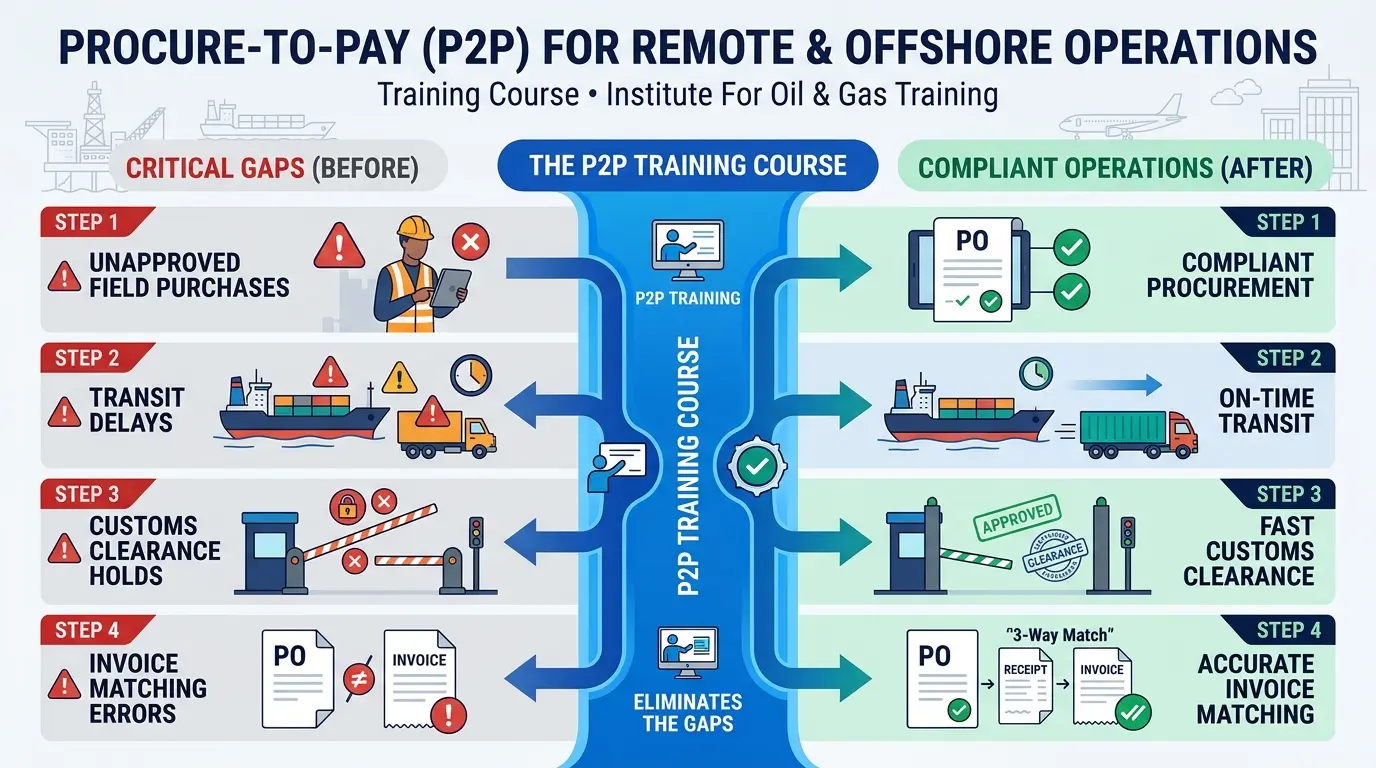
Addressing systemic field procurement breakdown
Remote asset management requires balancing urgent maintenance needs with strict financial compliance. In offshore environments, standard procurement lead times are frequently disrupted by weather conditions, maritime transport schedules, and strict international border requirements. When field personnel bypass standard purchasing channels to avoid operational delays, organizations experience financial leakage, unvetted vendor risk, and compliance penalties.
This program addresses the technical disconnect between central procurement offices and remote site operations. It equips personnel to execute purchasing activities within verified governance structures, ensuring field requirements do not compromise commercial controls.
Resolving retrospective purchase order misuse
A primary financial control risk in upstream operations is the overuse of unauthorized purchasing workarounds. Field managers facing machinery downtime often order parts verbally, generating a retrospective purchase order long after goods are delivered and consumed.
The course addresses the root causes of this practice by introducing structured requisition workflows. Participants master legally sound emergency purchasing protocols that provide immediate operational flexibility while preserving auditing trails, authorization limits, and budget allocations.
Aligning logistics management with financial settlement
Inland base stations, offshore supply vessels, and helidecks represent complex intermediate nodes in the supply chain. Standard P2P models assume direct delivery to a central warehouse, whereas remote operations involve multi-modal transit legs, intermediate staging areas, and specialized handling requirements.
The Institute For Oil & Gas Training aligns commercial purchasing steps with physical logistics checkpoints. The curriculum details how materials expediting, freight cost tracking, and receiving verification operate across isolated worksites, ensuring financial processing accurately reflects actual physical asset receipts.
Why is the curriculum of the Procure-to-Pay for Remote & Offshore Operations Training structured in this sequence?
The course follows a linear commercial workflow, moving from strategic governance and field requisitioning to logistics coordination, receiving validation, and financial reconciliation. This sequential structure ensures participants build foundational compliance skills before applying complex financial tools to remote operational scenarios.
Stage 1: Establishing governance, authorization limits, and requisition controls
The training begins by establishing the regulatory, legal, and organizational parameters governing upstream purchasing. Remote operations require distinct delegation of authority matrices due to distance and time-zone separations between field assets and corporate headquarters.
Participants analyze financial authority tiers, compliance mandates, and audit requirements. Learning How to Adapt Procure to Pay Processes for Remote and Offshore Oil and Gas Operations requires establishing rigorous front-end controls before addressing downstream logistics and financial settlement challenges.
Stage 2: Deploying framework agreements and structured purchasing instruments
Once governance parameters are defined, the program transitions to strategic purchasing mechanisms designed for remote assets. Standard spot purchasing creates unacceptable administrative delays and unpredictable shipping costs for isolated sites.
The curriculum covers the operational setup and execution of long-term commercial contracts, including:
Call-off orders against framework agreements for immediate release of standardized technical spares.
Blanket purchase agreements with predefined pricing caps to minimize recurring commercial negotiations.
Pre-negotiated commercial terms for specialized offshore services and logistics support.
Stage 3: Integrating logistics interfaces, customs clearance, and physical receiving
The middle modules focus on the physical transit and receipt of goods. Commercial transactions regularly stall at international borders or marine logistics bases due to inaccurate documentation, incorrect tariff classifications, or missing safety declarations.
Participants study the operational interfaces between purchasing systems, freight forwarders, and border agencies. The training outlines methods for tracking materials across transit hubs, managing specialized export-import documentation, and recording precise inventory receipts at isolated sites.
Stage 4: Financial reconciliation, retrospective review, and audit compliance
The final phase covers the financial reconciliation phase of the P2P lifecycle. Offshore operations generate complex invoice discrepancies due to additional freight charges, demurrage fees, and fluctuating currency rates across international supply routes.
This section covers automated three-way matching, discrepancy resolution, and retrospective audit protocols. Participants evaluate financial reporting methods that highlight supply chain bottlenecks, measure vendor performance, and maintain complete audit compliance for internal and external reviews.
What specific technical modules and operational competencies will participants master during the course?
Participants master eight specialized competencies, including emergency purchasing rules, framework order management, materials expediting, logistics cost control, customs integration, remote goods receiving, invoice matching, and retrospective purchasing audits. These modules deliver practical, job-ready skills designed for complex corporate operational environments.
Module 1: Emergency purchasing and authorization governance
Implementation of an emergency purchase authorisation framework for high-priority operational outages.
Setting clear financial spending limits based on operational roles, asset safety levels, and risk thresholds.
Creating audit trails for field requests made outside standard business hours.
Developing compliance matrices that balance rapid site procurement with corporate spending governance.
Module 2: Field requisition management and order generation
Designing a streamlined field requisition process tailored for remote platform and rig operations.
Converting field material requests into accurate, technically sound commercial requisitions.
Enforcing standard catalog adoption to prevent duplicate or off-spec material requests.
Integrating mobile and satellite requisition approvals across isolated production assets.
Module 3: Framework agreements and commercial purchasing tools
Managing call-off orders against framework agreements to reduce lead times for core operational supplies.
Structuring blanket purchase agreements to simplify high-frequency, low-value asset purchases.
Establishing fixed pricing models for marine chartering, aviation logistics, and specialized field services.
Evaluating supplier compliance against pre-agreed service level agreements (SLAs) for offshore delivery.
Module 4: Materials expediting and supply chain visibility
Standardizing materials expediting techniques across international vendor bases and transit hubs.
Tracking long-lead-time capital equipment from manufacturing facilities to final offshore sites.
Establishing milestone tracking points for high-consequence spare parts and critical drilling components.
Resolving vendor manufacturing delays through structured escalation protocols.
Module 5: Freight, logistics costs, and transport interface management
Calculating total landed costs, incorporating freight and logistics costs into initial purchase evaluations.
Allocating multi-modal transport expenses accurately across multiple operating units and asset budgets.
Managing port handling fees, vessel demurrage charges, and specialized offshore container rentals.
Structuring supply chain contracts to reduce unexpected transit and storage costs.
Module 6: Customs clearance interface and regulatory compliance
Managing the customs clearance interface for cross-border movement of drilling machinery and operational spares.
Applying temporary import-export mechanisms (such as Carnets and bonded warehousing) for offshore equipment.
Ensuring compliance with international trade regulations, country-of-origin rules, and tariff schedules.
Reducing customs clearance delays through standardized manifest and invoice documentation.
Module 7: Physical goods receipt at remote operational locations
Establishing formal protocols for goods receipt at remote locations with limited warehouse infrastructure.
Conducting physical inspections, dangerous goods checks, and technical specification reviews upon receipt.
Managing damage reports, short-shipment documentation, and return-to-vendor workflows from offshore sites.
Updating enterprise resource planning (ERP) systems via remote data synchronization.
Module 8: Invoice reconciliation and retrospective PO governance
Executing three-way matching (PO, receiving report, invoice) under variable offshore delivery conditions.
Eliminating unauthorized retrospective purchase orders through strict financial review controls.
Managing vendor payment disputes, currency variations, and additional freight charges.
Conducting post-procurement audits to identify system inefficiencies and update corporate P2P guidelines.
How is the Procure-to-Pay for Remote & Offshore Operations Training delivered to corporate teams?
The Institute For Oil & Gas Training delivers this program through instructor-led live online classrooms, intensive onsite corporate workshops, and flexible hybrid formats. Every format uses practical industry simulations, real-world case studies, and hands-on ERP workflow exercises.
Available delivery models and scheduling options
Organizations can select the training format that best aligns with operational schedules, field shift rotations, and corporate learning objectives:
Instructor-led live online training: Interactive digital classrooms delivered across flexible schedules. Ideal for geographically distributed teams working across different time zones or shift rotations.
Onsite corporate workshops: Dedicated in-person programs conducted directly at client facilities, operational headquarters, or supply chain staging bases.
Hybrid learning architecture: Combines self-paced digital preparatory modules covering P2P fundamentals with intensive live workshops focused on advanced case studies and operational problem-solving.
Practical methodology and applied assessment framework
The Institute For Oil & Gas Training uses realistic training methodologies that simulate actual field supply chain challenges. Theory is limited; the focus is on functional execution.
Learning progress is measured using practical skill evaluations rather than basic memorization tests:
Practical scenario evaluations: Participants analyze complex field situations—such as a critical platform part failure—and generate compliant purchasing actions under tight time constraints.
ERP workflow simulations: Hands-on exercises simulating requisition creation, approval routing, call-off tracking, and receipt validation within corporate systems.
Regulatory compliance checks: Case-based tests evaluating accurate customs documentation, freight cost allocation, and audit trail preparation.
Capstone P2P process audit: A comprehensive final project where teams review an unoptimized supply chain scenario, correct procedural flaws, and present a fully compliant P2P workflow.
What measurable operational results and performance improvements does this course deliver to organizations?
This training delivers measurable operational improvements, including up to 40% shorter purchasing lead times, a 75% reduction in retrospective purchase orders, near-zero customs documentation delays, and total alignment between field logistics and corporate accounting.
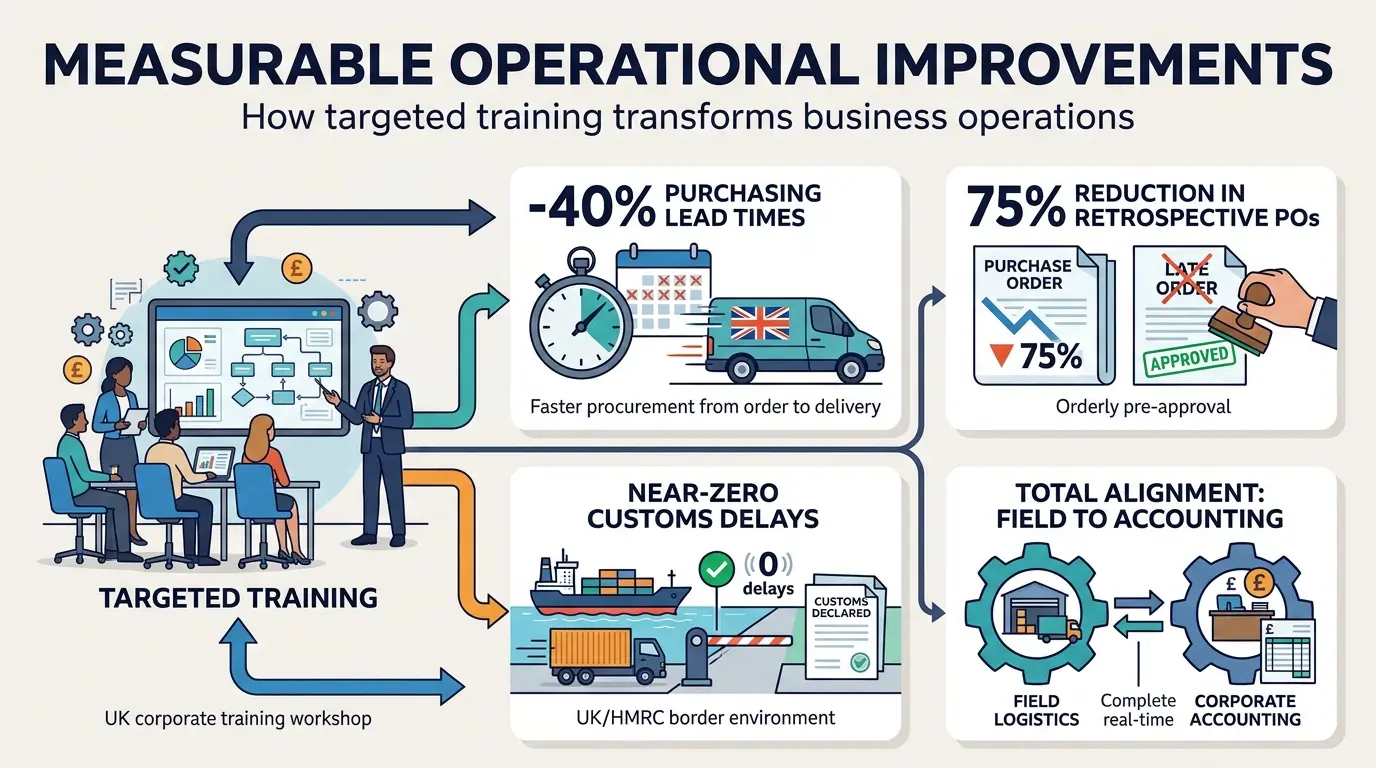
Optimizing procurement timelines and reducing asset downtime
Downtime on offshore production platforms or remote drilling rigs can cost hundreds of thousands of dollars per day. By standardizing request approval paths and making full use of existing framework agreements, field teams eliminate unnecessary administrative delays during emergency part replacements.
Graduates learn to prepare valid requisitions correctly the first time, ensuring purchasing teams can issue binding commercial orders immediately. This systematic speed reduces asset downtime caused by missing or misdirected spare parts.
Strengthening corporate governance and financial compliance
Improper purchasing practices expose oil and gas companies to regulatory fines, internal control failures, and financial audit adjustments. Training corporate teams through the Institute For Oil & Gas Training establishes consistent procurement practices across all operating regions.
Standardizing emergency purchasing steps and eliminating unvetted vendor orders helps organizations pass internal and external financial audits with zero compliance findings. Transparency is maintained across all purchasing activities, regardless of operational location.
Maximizing logistics efficiency and landed cost visibility
Uncontrolled transport fees, unplanned air freight, and untracked container rentals significantly increase operational budgets. Program participants acquire the analytical skills needed to evaluate total landed costs during initial sourcing decisions.
By coordinating purchasing schedules with marine and aviation transport manifests, procurement teams reduce expedited shipping surcharges. This logistics integration delivers direct cost savings across ongoing exploration and production operations.
How does corporate enrollment and team onboarding work for this program?
Corporate enrollment follows a four-step process: pre-training needs analysis, curriculum customization, cohort scheduling, and program execution. Individual professionals and corporate teams can register through the Institute For Oil & Gas Training application portal.┘
Eligibility requirements and target audience profiles
This program is structured for industry professionals involved in the planning, approval, execution, or financial settlement of remote supply chain activities:
Procurement and purchasing specialists: Technical buyers, category managers, and sourcing analysts seeking to master remote asset logistics.
Logistics and materials coordinators: Field warehouse supervisors, freight forwarders, and inventory controllers managing remote site receipts.
Field engineers and operations managers: Rig superintendents, platform managers, and maintenance planners requiring rapid, compliant access to operational spares.
Finance and accounts payable personnel: Corporate accountants and internal auditors responsible for invoice matching, budget verification, and vendor payments.
HR and corporate development teams: Learning officers mapping structured career development paths for supply chain talent.
Step-by-step corporate enrollment process
Organizations enrolling team cohorts follow a clear implementation pathway:
Initial operational assessment: The Institute For Oil & Gas Training works with corporate HR and supply chain leaders to identify specific organizational bottlenecks and training targets.
Curriculum tailoring: Modules are adjusted to reflect the client's internal enterprise management systems, approval workflows, and regional regulatory environment.
Cohort scheduling: Delivery dates are mapped around operational shift schedules, offshore rotation patterns, and corporate availability.
Execution and certification: Participants complete the training modules, practical evaluations, and capstone project to earn their professional certification credentials.
To review upcoming course schedules, request a corporate team proposal, or evaluate syllabus details, submit an application to enroll in this program today.
Frequently Asked Questions
What is Oil & Gas Petroleum Procurement training?
Oil & Gas Petroleum Procurement training by the Institute For Oil & Gas Training is a structured professional development program focused on commercial supply chain strategies, vendor negotiations, and material sourcing for upstream, midstream, and downstream operations. It equips corporate buyers, logistics managers, and supply chain specialists with practical tools to manage high-value contracts, mitigate market volatility, and maintain regulatory compliance across international operations.
How does effective petroleum procurement reduce operational costs in oil and gas projects?
Effective petroleum procurement minimizes expenditure by leveraging strategic framework agreements, optimizing landed cost calculations, and eliminating unapproved field purchases. The Institute For Oil & Gas Training teaches delegates how to streamline inventory holding levels and integrate customs clearance controls, ensuring project schedules remain intact without incurring unexpected freight or transit surcharges.
What are the essential skills required for Oil & Gas Petroleum Procurement managers?
Petroleum procurement professionals require expertise in contract drafting, legal compliance, international trade finance, vendor performance auditing, and risk management. Through training delivered by the Institute For Oil & Gas Training, practitioners master the end-to-end procure-to-pay cycle, enabling them to evaluate supplier bids effectively, streamline field requisitions, and manage multi-modal logistics across complex operational assets.
Why is specialized procurement training necessary for remote and offshore oil operations?
Remote and offshore environments present unique logistical barriers, including cross-border customs interfaces, multi-stage maritime transit, and strict emergency authorization controls. The Institute For Oil & Gas Training designs specialized Oil & Gas Petroleum Procurement modules that address these specific operational constraints, ensuring materials expediting and site receiving protocols prevent expensive asset downtime.
Who should enroll in an Oil & Gas Petroleum Procurement course?
This course is designed for technical buyers, supply chain specialists, logistics coordinators, commercial managers, and HR development teams seeking measurable workforce skill improvement. Organizations partner with the Institute For Oil & Gas Training to upskill cross-functional teams, ensuring aligned financial settlement, robust audit compliance, and consistent procurement governance across corporate operations.
Related training courses
Procure-to-Pay (P2P) End-to-End Process for Oil & Gas Training Course
- Specialisation
- Oil & Gas Petroleum Procurement
- Duration
- 5 days · 15 CPD hours
Procure-to-Pay (P2P) for Remote & Offshore Operations Training Course
- Specialisation
- Oil & Gas Petroleum Procurement
- Duration
- 5 days · 15 CPD hours
3-Way Matching & Invoice Verification for Day-Rate Contracts Training Course
- Specialisation
- Oil & Gas Petroleum Procurement
- Duration
- 5 days · 15 CPD hours
More articles

Vendor Management and Local Content Requirements Onboarding Training by Institute For Oil & Gas Training
Enroll in the Vendor Management and Local Content Requirements Onboarding Training by Institute For Oil & Gas Training. Master procurement compliance.
Read article →
How to Evaluate Vendor Onboarding Processes and Local Content Requirements in Oil and Gas
Learn how to evaluate vendor onboarding processes and local content requirements in oil and gas to reduce supply chain risk and maintain compliance.
Read article →
Why Effective Vendor Onboarding Matters in Oil and Gas Procurement
Discover why vendor onboarding drives supply chain compliance, risk mitigation, and local content success in oil and gas procurement.
Read article →