

A procure to pay process in remote and offshore environments is an end-to-end operational framework that governs requisitioning, purchasing, logistics clearance, and supplier payment across isolated sites to eliminate supply chain disruptions and maintain financial control.
In isolated operational environments, supply chains face unique geographic and logistical barriers. Distance from central warehouses, complex transport networks, and stringent regulatory controls increase supply chain risks. Offsite facilities cannot resolve inventory shortages by visiting local suppliers. A breakdown in requisition accuracy stops offshore platforms, drilling rigs, or remote processing facilities.
Organizations structure procure to pay (P2P) systems to connect field operations directly with procurement teams, logistics handlers, and accounts payable departments. The frameworkstandardises how site personnel identify requirements, verify inventory levels, authorise expenditure, track shipments, and reconcile invoices. Effective P2P execution removes operational friction by replacing ad-hoc field purchasing with structured purchasing channels.
Workforce competence directly governs P2P performance in isolated locations. Misclassifying a spare part requisition delays maintenance schedules by 14 days and inflates freight expenses by 35%. L&D professionals build targeted training programs to bridge skill gaps between field operators and finance teams. Training ensures field personnel execute requisition protocols correctly, reducing emergency order rates by 40% across remote operational sites.
Why Do Remote and Offshore Operations Face Procure to Pay Challenges?
Remote and offshore operations face procure to pay challenges because geographical isolation, communication latency, complex customs regulations, and unpredictable field emergencies disrupt traditional purchasing routines and inflate operational operating costs.
Isolated industrial facilities operate under strict safety standards and continuous operational timelines. Downtime on an offshore oil platform costs up to £300,000 per day in lost production. Traditional purchasing workflows fail in these environments because standard approval cycles take 7 to 10 working days. Field engineers bypass slow central systems, initiating unofficial purchases that cause reconciliation errors in accounts payable.
Logistics complexities compound operational delays. Moving materials to offshore platforms requires coordination across multiple transport modes, including road haulage, port storage, supply vessels, and helicopter flights. Custom clearances introduce legal barriers that halt shipments at international borders. Without specialized P2P skills, site teams fail to manage the customs clearance interface correctly, resulting in port demurrage charges and extended vessel charter fees.
L&D teams address these operational vulnerabilities by implementing targeted technical skill training. Organizations structure learning interventions to align field behavior with corporate governance standards.
Operational Challenge | Root Cause in Remote Environments | Impact on Business Operations | Targeted Training Intervention |
Field Requisition Errors | Incorrect material codes and vague technical descriptions | 14-day average shipment delays; 25% order error rate | Technical cataloguing and SAP/ERP requisition workshops |
Uncontrolled Freight Costs | Excessive reliance on air freight and ad-hoc transport | 35% inflation in logistics and transport budgets | Expediting strategies and logistics optimization modules |
Customs Border Holds | Incomplete tariff classifications and shipping documentation | 5 to 8 days port demurrage; regulatory fines | Customs clearance interface and compliance training |
Unmatched Emergency Orders | Widespread use of retrospective purchase orders | 30% increase in invoice processing backlogs | Emergency spend governance and audit control simulations |
How Do Organizations Implement Effective Procure to Pay Processes?
Organizations implement effective procure to pay processes by establishing clear governance frameworks, integrating enterprise software, standardizing field requisition workflows, and delivering structured workforce development programs to all operational stakeholders.
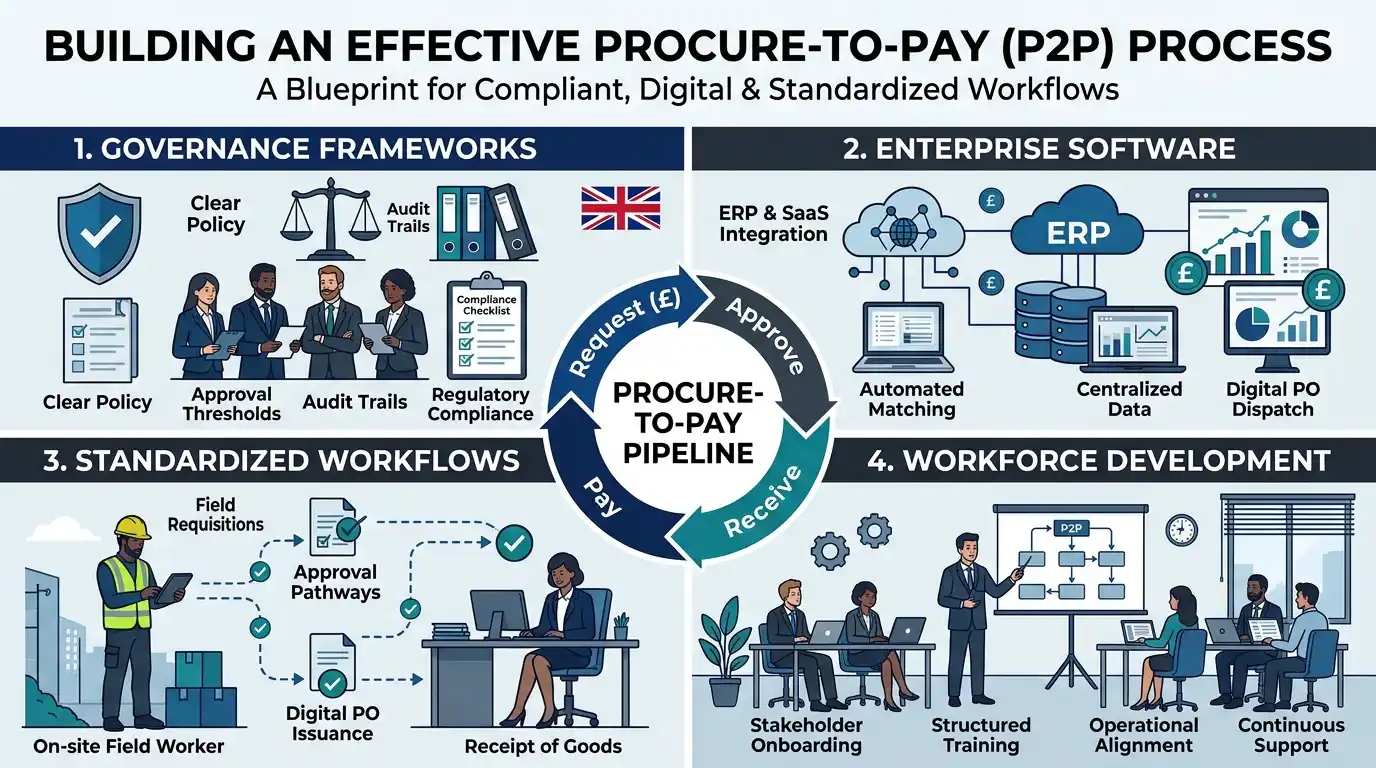
Standardizing the field requisition process forms the foundation of offshore P2P execution. Field personnel must submit digital requisitions containing verified part numbers, accurate cost codes, and complete technical specifications. Standardized inputs prevent procurement teams from buying incorrect items. Digital workflows route requisitions automatically based on financial authority thresholds, reducing approval times from 96 hours to 4 hours.
Commercial agreements streamline execution. Procurement divisions negotiate call-off orders against framework agreements and set up blanket purchase agreements with primary vendors. These pre-negotiated contracts fix unit prices, establish delivery timeframes, and eliminate repetitive vendor evaluations. Field buyers call off materials directly against established agreements, reducing purchase order processing cycles by 60%.
Corporate training guarantees consistent implementation across dispersed teams. Companies deploy hybrid learning formats combining self-paced online modules with interactive virtual workshops. Training modules teach operators how to handle critical supply chain handoffs. Participants learn to manage materials expediting, track global shipments, navigate the customs clearance interface, and execute goods receipt at remote locations using mobile ERP interfaces.
What Key Components Define a Modern Offshore Procure to Pay Framework?
A modern offshore procure to pay framework comprises emergency purchase authorizations, commercial framework agreements, active materials expediting, customs interface management, and rigorous retrospective purchase order governance.
Five core operational components sustain supply chain integrity across offshore networks:
Emergency Purchase Authorisation Protocols: Clear spending limits and override workflows allow offshore installation managers to secure critical parts instantly without compromising financial accountability.
Framework Agreements & Blanket Purchase Agreements: Long-term supply contracts pre-define commercial terms, enabling fast call-off orders against framework agreements without repeating procurement cycles.
Materials Expediting & Logistics Controls: Active tracking protocols monitor component movements across supplier factories, transit hubs, supply bases, and offshore helipads to control freight and logistics costs.
Customs Clearance Interface Management: Standardized documentation procedures align shipping manifests with national import regulations, preventing border delays and tariff penalties.
Remote Goods Receipt & Reconciliation: Digital verification protocols confirm receipt of physical goods at remote locations, triggering automatic three-way matching in accounts payable.
Workforce capability development links these five components together. Training programs use practical case-based learning to teach operators how individual errors ripple through the financial chain. Learners evaluate real-world scenarios where missing shipping documents caused customs delays, or incomplete receipt logs stalled vendor payments. Simulated exercises build technical proficiency in managing retrospective purchase orders, ensuring emergency spending gets reconciled within 48 hours of field delivery.
How Does Training Improve Procure to Pay Efficiency in Isolated Worksites?
Training improves procure to pay efficiency in isolated worksites by aligning cross-functional teams, reducing manual administrative errors, accelerating cycle times, and establishing strict adherence to corporate governance rules.
Workforce performance directly impacts supply chain velocity. When organizations upskill staff through structured learning programs, operational metric gains follow:
Procurement Cycle Speed: Requisition-to-order turnaround decreases from 7 days to 24 hours.
Maverick Spend Reduction: Unauthorized purchases drop by 80% as teams adopt established blanket purchase agreements.
Three-Way Match Rates: Automated invoice matching increases from 55% to 92% due to accurate remote goods receipt entries.
Logistics Budget Adherence: Expedited freight expenses decline by 30% through improved inventory planning.
Professional development programs deliver measurable returns on investment. L&D leaders evaluate training success using business KPIs such as first-time invoice match rates, order accuracy percentages, and average shipment clearance times. Companies in industries like oil and gas, mining, marine transport, renewable energy, and offshore construction rely on systematic training to protect operating margins.
Organizations interested in expanding operational skills across remote teams should evaluate specialized learning solutions. Professional programs like the Procure-to-Pay (P2P) for Remote & Offshore Operations Training Course provide structured curricula covering emergency purchasing, supply chain logistics, and ERP data management.
What Misconceptions Surround Remote Procure to Pay Optimization?
Misconceptions surrounding remote procure to pay optimization include believing digital tools solve operational bottlenecks without training, assuming standard corporate P2P workflows fit offshore environments, and treating P2P purely as a finance function.
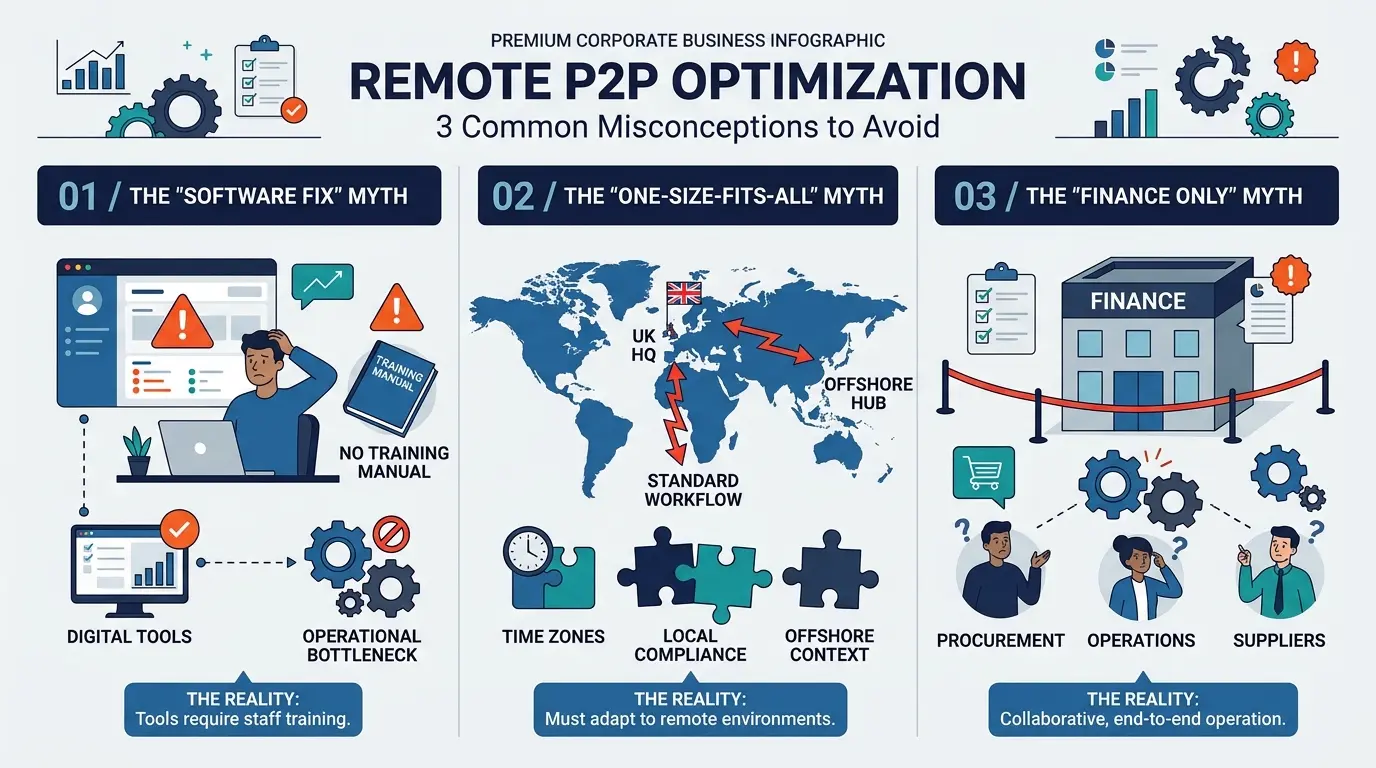
Software Alone Solves Supply Chain Friction
Technology deployments fail when organizations neglect workforce capability. Installing an advanced Enterprise Resource Planning (ERP) platform does not guarantee process adherence. Field operators who lack system training input incorrect part details, select improper cost centers, and bypass digital approval paths. Technology acts as an enabler; employee competence determines execution speed and data accuracy.
Standard Onshore Workflows Work Offshore
Applying standard corporate procurement rules to remote worksites creates operational bottlenecks. Onshore workflows assume continuous internet connectivity, short transit distances, and local supplier availability. Remote platforms require customized procedures that account for satellite connection drops, multi-modal freight handoffs, and strict helicopter payload limits. Adapting processes for remote sites requires specialized training that accounts for operational constraints.
Procure to Pay Is Exclusively a Finance Responsibility
Viewing P2P as a back-office financial process isolates the department from field realities. P2P is a cross-functional business workflow driven by offshore engineers, logistics handlers, customs clearance agents, base managers, and accounts payable specialists. Effective training programs break down functional silos, teaching technical operators how field actions impact corporate cash flow, working capital, and vendor relations.
How Do Leading Companies Execute P2P Training Programs?
Leading companies execute P2P training programs by utilizing role-based curricula, real-world case simulations, cross-departmental workshops, and continuous performance assessments.
Effective corporate training avoids generic business theory. L&D teams collaborate with supply chain subject matter experts to design practical learning journeys aligned with real job functions.
Role-Based Curriculum Design: Training content matches everyday operational tasks. Field technicians learn cataloguing precision, logistics managers focus on expediting freight and logistics costs, and finance teams practice resolving retrospective purchase order variances.
Interactive Simulation & Case Studies: Learners analyze real historical operational breakdowns. Participants review case studies where poor material documentation caused offshore rig shutdowns, identifying root causes and developing preventive strategies.
Cross-Functional Learning Workshops: Field operators, logistics officers, and finance professionals attend joint workshops. Collaborative learning builds mutual understanding of process dependencies, reducing inter-departmental friction by 50%.
Competency Assessments & KPIs: Post-training evaluation measures practical skill adoption. Managers track employee performance using error-rate reductions, ERP processing speed, and compliance scores over 30, 60, and 90 days.
Comprehensive workforce development transforms supply chain management into a strategic advantage. Organizations that upskill remote operations teams build resilient supply chains, eliminate expensive field downtime, and maintain strict financial control across isolated global assets.
Frequently Asked Questions
What is oil and gas petroleum procurement?
Oil and gas petroleum procurement is the strategic process of sourcing, purchasing, and managing materials, equipment, and services required for upstream, midstream, and downstream energy operations. The Institute For Oil & Gas Training provides professional development programs that cover end-to-end supply chain management, contract negotiation, vendor evaluation, and compliance. Effective oil & gas petroleum procurement ensures continuous field operations, reduces supply chain risks, and maintains cost control in capital-intensive projects.
Why is specialized procurement training necessary in the energy sector?
Petroleum supply chains involve high operational risks, complex logistics, strict regulatory standards, and volatility in global commodity pricing. The Institute For Oil & Gas Training delivers targeted oil & gas petroleum procurement modules that equip supply chain professionals with technical sourcing frameworks, risk mitigation techniques, and commercial contract management skills. Specialized training eliminates costly inventory downtime and ensures field requisitions align with corporate governance.
How does effective petroleum procurement impact operational costs?
Streamlining procurement workflows reduces lead times, prevents maverick spending, and optimizes inventory holding costs across offshore and onshore assets. Structured oil & gas petroleum procurement training from the Institute For Oil & Gas Training teaches professionals how to leverage framework agreements, manage freight expediting, and execute accurate three-way invoice matching. These strategic practices directly lower capital expenditure and enhance working capital efficiency.
What core skills are covered in oil and gas procurement courses?
Key skills include international supply chain compliance, blanket purchase agreement management, vendor performance auditing, customs clearance protocols, and strategic sourcing strategies. The Institute For Oil & Gas Training incorporates real-world case studies and ERP workflow simulations into its oil & gas petroleum procurement courses to bridge technical knowledge gaps between field teams and finance departments.
How do organizations implement sustainable procurement in petroleum operations?
Organizations integrate environmental, social, and governance (ESG) criteria into vendor selection, local content policies, and lifecycle cost analysis. Through training programs at the Institute For Oil & Gas Training, procurement specialists learn how to incorporate ethical sourcing frameworks and decarbonization standards into modern oil & gas petroleum procurement strategies without compromising operational reliability.
Related training courses
Vendor Management & Local Content Requirements: Onboarding Training Course
- Specialisation
- Oil & Gas Petroleum Procurement
- Duration
- 5 days · 15 CPD hours
Vendor Management & Local Content Requirements: ICV Compliance Training Course
- Specialisation
- Oil & Gas Petroleum Procurement
- Duration
- 5 days · 15 CPD hours
Financial Evaluation of Suppliers & Contractors: Tender Evaluation Training Course
- Specialisation
- Oil & Gas Petroleum Procurement
- Duration
- 5 days · 15 CPD hours
More articles

Procure to Pay for Remote and Offshore Operations Training by Institute For Oil & Gas Training
Evaluate the Procure to Pay for Remote and Offshore Operations Training syllabus, delivery formats, skill outcomes, and corporate enrollment steps.
Read article →
How to Adapt Procure to Pay Processes for Remote and Offshore Oil and Gas Operations
Learn how to adapt procure to pay processes for remote and offshore oil and gas operations through structured frameworks and targeted workforce training.
Read article →
Procure to Pay Controls and Automation Workflow Design Training by Institute For Oil & Gas Training
Master P2P workflow design, automation, and internal controls with Institute For Oil & Gas Training. Enroll now for measurable operational gains.
Read article →