

Managing supply chain mechanics across isolated energy assets presents severe logistical and financial challenges. When procurement frameworks fail to account for satellite communication delays, complex customs interfaces, and extreme transport constraints, operating costs inflate rapidly.
Supply chain leaders must modernise their operational models to maintain inventory visibility and financial compliance across hostile environments. Understanding Why Remote and Offshore Operations Require Effective Procure to Pay Processes provides the foundational context required to diagnose structural bottlenecks and establish resilient financial control mechanisms before attempting process overhauls.
How Do Remote Environments Distort Standard Procure to Pay Processes?
Standard procure to pay processes fail in remote environments due to communication latency, severe transport constraints, fragmented material tracking, and complex customs requirements. These factors cause stockouts, unauthorised spot purchases, and significant operational downtime across offshore production platforms and land-based drilling rigs.
Conventional procure to pay workflows rely on real-time system connectivity, immediate vendor access, and predictable logistics routes. On offshore installations and isolated onshore facilities, these assumptions collapse completely. Satellite connection dropouts stall digital approvals, forcing site engineers to bypass standard channels. Transport schedules depend heavily on weather windows, marine vessel availability, and helicopter flight capacities. When material requests stall in administrative queues, field personnel risk total operational shutdown, which costs operators hundreds of thousands of pounds per day.
To mitigate operational risk, field personnel frequently resort to off-system purchasing. This creates widespread retrospective purchase orders, where documentation is generated long after goods arrive on site. Consequently, accounts payable teams face massive invoice matching backlogs, missed early-payment discounts, and compromised financial audits.
Managing remote material requests requires a fundamental shift from sequential, central approvals to hybrid control frameworks. Local site managers need clear financial thresholds to authorize critical requisitions while keeping central systems fully updated.
What Key Mechanisms Streamline the Field Requisition Process?
Streamlining the field requisition process requires implementing offline-capable digital forms, automated delegation of authority rules, standardized item catalogues, and pre-approved vendor frameworks. These mechanisms reduce requisition approval cycles from weeks to hours while maintaining total governance and spend visibility.
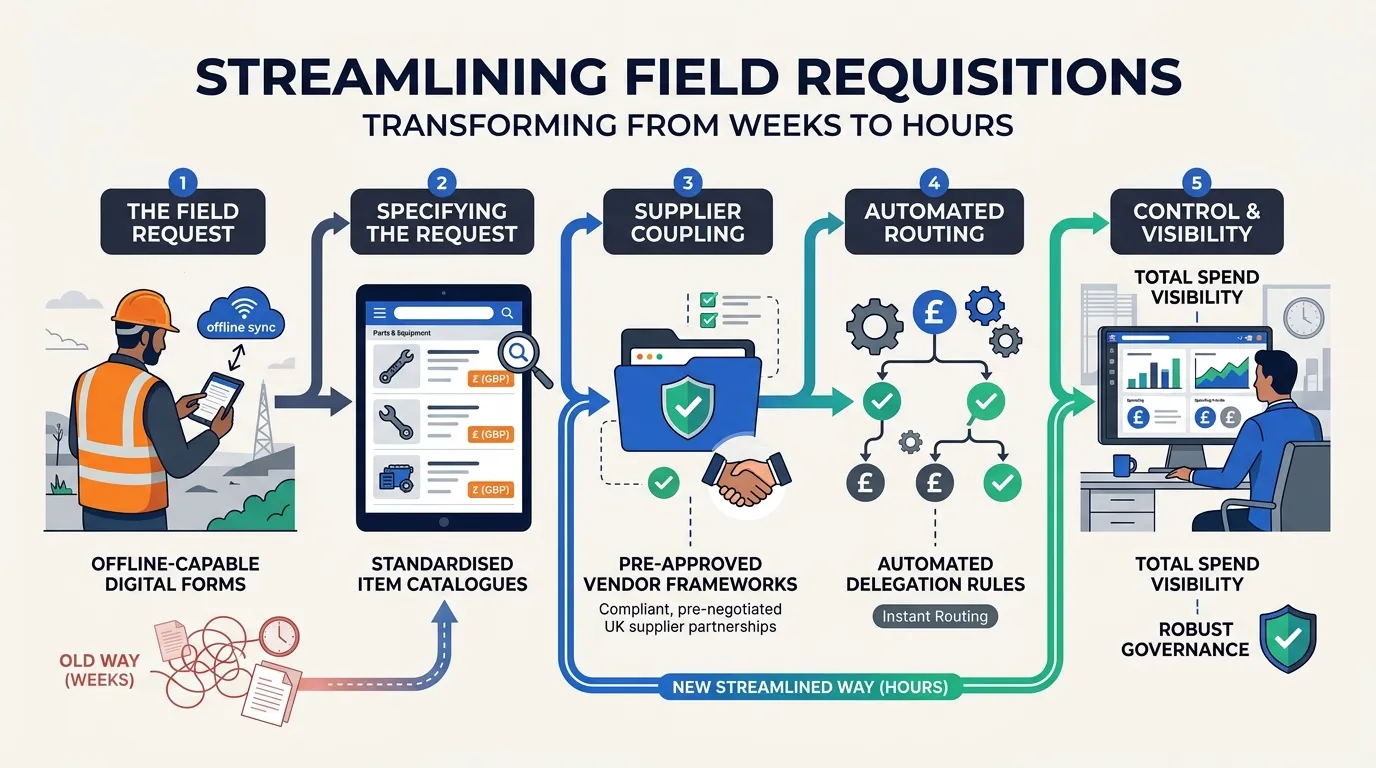
The field requisition process acts as the primary interface between offshore operations and corporate supply chain management. When requisitions lack standard part numbers or technical specifications, procurement officers waste critical days clarifying requirements with offshore crews. Implementing offline-capable requisition platforms allows field engineers to compile accurate material requests at sea, which sync automatically with the central enterprise resource planning system once network connectivity resumes.
Structuring pre-approved commercial arrangements eliminates redundant sourcing exercises for routine maintenance items. Operating companies deploy two main contractual mechanisms to accelerate material movement:
Call-off orders against framework agreements: Contractual mechanisms that allow field units to draw down goods and services against master agreements at pre-negotiated rates and terms.
Blanket purchase agreements: Long-term arrangements with suppliers to handle recurring orders, reducing administrative processing costs and lead times.
By leveraging call-off orders against framework agreements, procurement teams shorten order lead times significantly. Combining these agreements with blanket purchase agreements ensures that high-consumption consumables remain available without generating individual purchase orders for every delivery. Additionally, formalising an emergency purchase authorisation protocol grants offshore installation managers the legal power to buy critical safety components immediately, maintaining compliance while preventing costly downtime.
How Do Logistics, Customs, and Receiving Operations Integrate into P2P Systems?
Logistics, customs, and receiving operations integrate into procure to pay systems by syncing transport tracking, customs clearance documentation, and remote goods receipt entries into a central data environment. This integration ensures full financial reconciliation and prevents costly freight delays at marine supply bases.
Material movement across international borders to offshore supply bases involves multiple handoffs. Specialized procurement systems must interface directly with freight forwarders and customs brokers to track transit milestones in real time.
Integrating a dedicated customs clearance interface within the procurement workflow prevents high-value shipments from stalling at ports of entry. This system automatically flags missing certificates of origin or tariff codes before goods reach customs checkpoints.
Once cargo passes port controls, the focus shifts to controlling freight and logistics costs. Without itemised tracking attached to specific purchase orders, operators frequently overpay for consolidated vessel runs or urgent air freight chartering.
rigorous materials expediting process ensures vendors hit manufacturing milestones and ship components directly to staging yards. Upon arrival at the offshore platform, shore-base crews process the goods receipt at remote locations via mobile handheld scanners. This instantly posts receipt records into central accounting software, triggering invoice processing without manual paperwork delays.
What Framework Evaluates Procurement Adaptation Strategies for Remote Operations?
Evaluating procurement adaptation strategies requires assessing system offline functionality, field user adoption rates, regulatory compliance, and total transaction processing speed. A structured framework helps supply chain executives compare internal process overhauls against targeted capability development.
When evaluating how to modernise supply chain workflows, energy companies face a clear decision between deploying complex software customisations or upskilling their existing logistics and procurement workforce. Software customisation requires extensive capital expenditure and long implementation lifecycles. Specialized competency building delivers immediate operational improvements by teaching personnel how to optimize workflows within their current systems.
Organisations must compare operational capabilities across key performance dimensions:
Decision-makers must evaluate these options based on their current operational maturity. While custom enterprise software provides systemic boundaries, workforce capability determines whether field teams actually follow compliance protocols or return to rogue purchasing habits. Building practical skills in Procure to Pay for Remote and Offshore Operations Training by Institute For Oil & Gas Training helps organisations bridge this execution gap rapidly without interrupting ongoing energy production.
How Does Targeted Workforce Training Resolve Offshore P2P Bottlenecks?
Targeted workforce training resolves offshore procure to pay bottlenecks by standardising field requisition behaviours, teaching advanced expediting techniques, and aligning operational teams with corporate compliance structures. Structured skill development directly reduces material delays, invoice mismatches, and rogue spending.
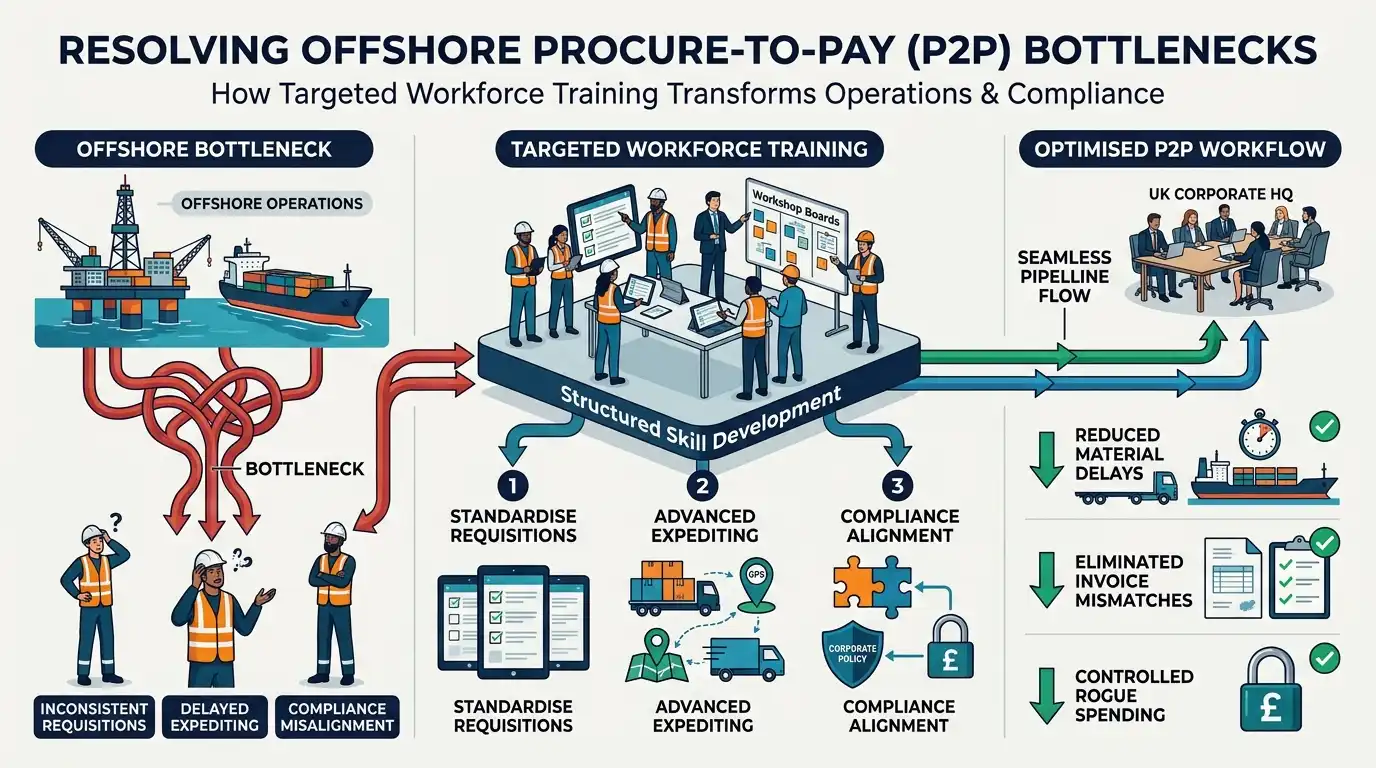
Process engineering alone cannot solve supply chain failures if field personnel lack understanding of commercial controls. Offshore engineers receive extensive technical training but rarely understand the financial consequences of inaccurate requisitions or unrecorded receipts. Upskilling cross-functional teams creates a shared understanding of supply chain interdependencies.
Modern corporate learning models combine technical procurement mechanics with practical scenario analysis. Enrolling operational leaders and supply chain specialists in the formal Procure-to-Pay (P2P) for Remote & Offshore Operations Training Course equips professionals to handle complex supply chain challenges efficiently.
Human resource directors and supply chain executives evaluate training interventions based on measurable business impact and operational risk reduction. The structure below illustrates how targeted capability development converts directly into key performance indicator (KPI) improvements:
Developing internal expertise ensures long-term process sustainability. When site managers understand how to execute requisitions correctly under pressure, remote operations achieve consistent financial governance and seamless material supply.
Frequently Asked Questions
What is oil and gas petroleum procurement?
Oil & gas petroleum procurement encompasses the strategic sourcing, purchasing, expediting, and logistics management of equipment, raw materials, and services required for upstream, midstream, and downstream energy operations. The Institute For Oil & Gas Training delivers specialized programs in Oil & Gas Petroleum Procurement to help supply chain professionals master contract negotiation, vendor evaluation, and risk mitigation. These frameworks ensure continuous operational workflows while maintaining strict financial and regulatory compliance across global supply chains.
Why is specialized procurement training essential in the petroleum industry?
The oil and gas sector operates under volatile market conditions, complex international trade laws, and stringent health, safety, and environmental (HSE) regulations that general purchasing frameworks cannot address. Completing Oil & Gas Petroleum Procurement training through the Institute For Oil & Gas Training equips professionals with sector-specific skills in managing offshore logistics, long-lead equipment sourcing, and emergency field requisitions. This specialized competency reduces costly project downtime and optimizes capital expenditure across complex energy projects.
How does effective procurement improve supply chain management in energy projects?
Effective procurement streamlines the entire procure-to-pay (P2P) cycle by establishing transparent supplier auditing, standardized blanket purchase agreements, and automated inventory tracking. Through Oil & Gas Petroleum Procurement courses at the Institute For Oil & Gas Training, supply chain personnel learn to integrate logistics controls with real-time field requisitions to minimize materials bottlenecks. This strategic alignment minimizes inventory holding costs, eliminates unbudgeted freight spend, and improves overall project delivery timelines.
What key skills are covered in oil and gas procurement courses?
Key competencies covered include strategic sourcing, framework agreement negotiation, international commercial terms (Incoterms), materials expediting, and customs clearance management. The Institute For Oil & Gas Training structures its Oil & Gas Petroleum Procurement curriculum to focus on real-world application, commercial risk management, and ethical vendor management. Participants gain practical experience in structuring robust contracts that protect operating companies from supply chain disruptions and price volatility.
How do professionals manage compliance and risk in petroleum purchasing?
Managing compliance and risk requires rigorous vendor pre-qualification, transparent bidding procedures, and continuous monitoring of anti-bribery and corruption (ABC) standards. The Institute For Oil & Gas Training integrates global compliance standards into its Oil & Gas Petroleum Procurement instruction, teaching delegates how to perform thorough contract audits and supply chain risk assessments. This rigorous approach protects energy organizations against legal liabilities, financial leakage, and operational delays in high-risk operating environments.
Related training courses
Procure-to-Pay (P2P) for Remote & Offshore Operations Training Course
- Specialisation
- Oil & Gas Petroleum Procurement
- Duration
- 5 days · 15 CPD hours
Financial Evaluation of Suppliers & Contractors: Credit Assessment Training Course
- Specialisation
- Oil & Gas Petroleum Procurement
- Duration
- 5 days · 15 CPD hours
Financial Evaluation of Suppliers & Contractors: Tender Evaluation Training Course
- Specialisation
- Oil & Gas Petroleum Procurement
- Duration
- 5 days · 15 CPD hours
More articles

Procure to Pay for Remote and Offshore Operations Training by Institute For Oil & Gas Training
Evaluate the Procure to Pay for Remote and Offshore Operations Training syllabus, delivery formats, skill outcomes, and corporate enrollment steps.
Read article →
Why Remote and Offshore Operations Require Effective Procure to Pay Processes
Discover why remote and offshore operations require effective procure-to-pay processes to eliminate field delays, control logistics costs, and build workforce skills.
Read article →
Procure to Pay Controls and Automation Workflow Design Training by Institute For Oil & Gas Training
Master P2P workflow design, automation, and internal controls with Institute For Oil & Gas Training. Enroll now for measurable operational gains.
Read article →