

Vendor onboarding in the oil and gas sector requires a dual focus on operational efficiency and strict regulatory compliance. Evaluating these systems ensures that operators maintain supply chain integrity while fulfilling mandatory local participation quotas.
Understanding the strategic necessity of robust procurement frameworks forms the foundation of modern supply chain management. Procurement teams must move beyond simple transactional checks to build resilient supply networks. Readers looking to understand the foundational risks of poor supplier integration should explore Why Effective Vendor Onboarding Matters in Oil and Gas Procurement, as early-stage alignment prevents operational disruptions downstream. A structured evaluation strategy allows procurement leaders, contract managers, and HR development teams to assess whether current workflows meet international safety standards, mitigate financial risks, and satisfy legal mandates.
What Are the Core Criteria for Evaluating Vendor Onboarding Processes?
Evaluating vendor onboarding processes requires assessing supplier prequalification protocols, compliance verification speed, risk segmentation accuracy, and system integration. Procurement teams must measure cycle times, data accuracy, regulatory alignment, and administrative overhead to identify workflow bottlenecks and vulnerabilities across the supply chain.
Prequalification and Compliance Standards
Supplier prequalification forms the first line of defence against operational disruption and liability in energy projects. Operators must evaluate whether prequalification questionnaires capture essential metrics, including Health, Safety, and Environment (HSE) records, anti-bribery policies, and financial stability ratings. A thorough evaluation verifies if the prequalification process uses standardized scoring models or relies on subjective manual reviews.
A robust prequalification framework checks third-party certifications, such as ISO 9001 and ISO 45001, alongside historical safety records like Total Recordable Incident Rates (TRIR). Manual screening creates backlogs, often extending onboarding cycle times beyond 45 days. Automated prequalification platforms compress this timeframe to 10 days, allowing qualified vendors to mobilize faster while maintaining audit readiness.
Risk Segmentation and AVL Management
Not all vendors present the same level of operational or regulatory exposure to an oil and gas facility. Effective onboarding systems apply supplier risk segmentation to categorize vendors based on spend volume, operational criticality, and geographic location. High-risk contractors working on offshore rigs require exhaustive technical and safety vetting, whereas low-risk office equipment suppliers need streamlined administrative processing.
Evaluating this phase requires reviewing how contractors transition onto the Approved Vendor List (AVL). A poorly managed AVL contains inactive, unverified, or non-compliant suppliers, exposing projects to unnecessary risk. Procurement systems must maintain dynamic AVL updates, automatically suspending vendors whose safety certifications or insurance policies expire.
How Do You Assess Compliance with Local Content Requirements?
Assessing local content compliance involves auditing domestic workforce participation, local supply chain spend, technology transfer programs, and in-country capacity building. Operators must verify primary documentation, track local value creation against legal mandates, and audit contractor tier-two supplier spending to ensure full statutory compliance.
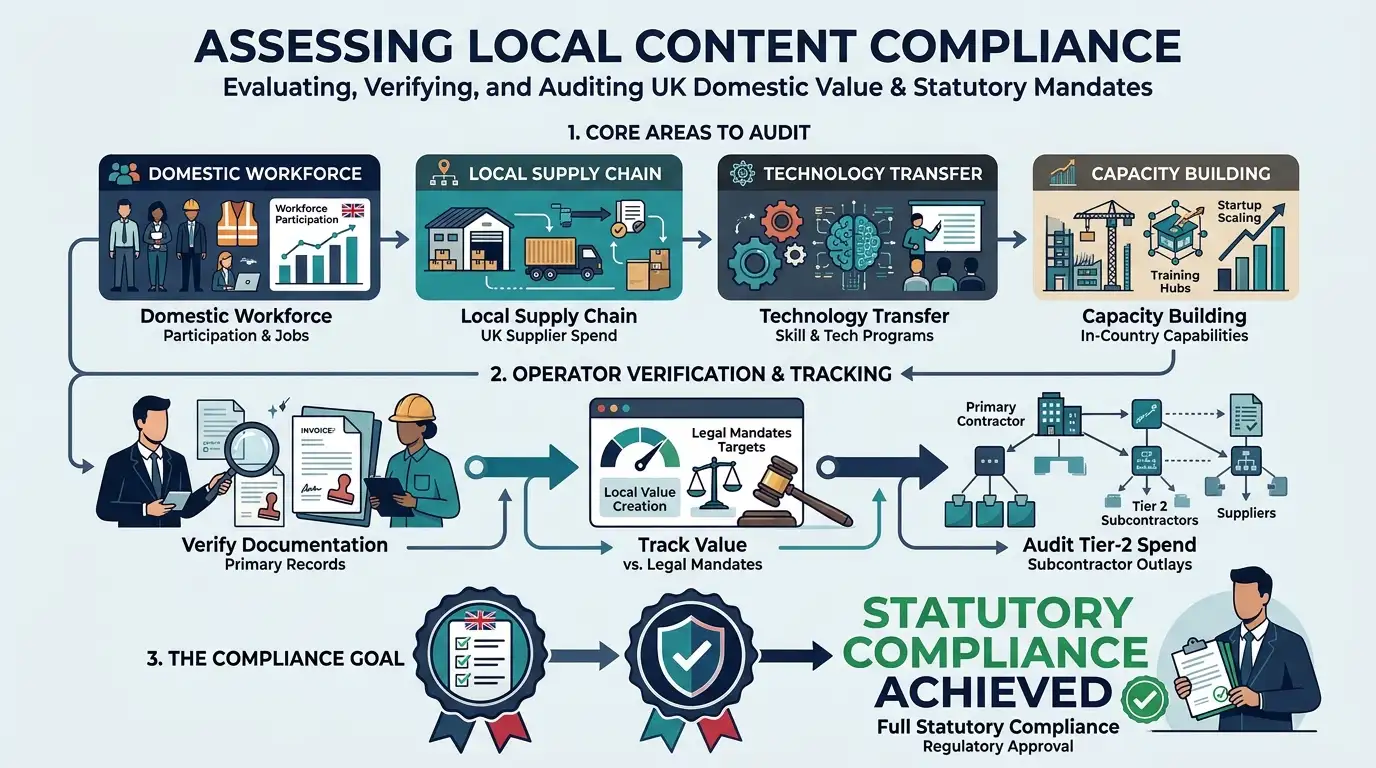
Quantifying Domestic Resource Utilization
Local content regulations demand that foreign and domestic operators prioritize local labor, goods, and services. Evaluating compliance requires a systematic review of how vendors report their local content metrics. Operators cannot rely on self-reported declarations; they must demand verifiable proof such as payroll records, local tax filings, and custom clearance documents for imported materials.
The evaluation process measures the percentage of contract value retained within the host country's economy. This calculation splits into direct labor expenditures, local subcontracting value, and local manufacturing components. Advanced procurement organizations audit these metrics quarterly to prevent year-end non-compliance penalties, which can equal up to 10% of total contract values in strict jurisdictions.
Auditing Knowledge Transfer and Workforce Development
Long-term local content success depends on structured knowledge transfer from international service providers to the local workforce. Evaluating this dimension requires reviewing vendor-led training initiatives, apprenticeship programs, and technical mentorship efforts. Operators must assess whether vendors actively upscale local technical capabilities or rely on temporary expatriate labor for specialized tasks.
HR departments and procurement teams evaluate training commitments by verifying certification completion rates and skill progression metrics. Organizations seeking structured upskilling frameworks to meet these regulatory expectations often enroll procurement teams in specialized professional development. Utilizing the Vendor Management & Local Content Requirements: Onboarding Training Course equips procurement professionals with the auditing methodology required to verify supplier compliance and structure enforceable capacity-building clauses.
How Do Onboarding Processes Impact Supply Chain Performance?
Onboarding processes directly dictate supply chain performance by establishing clear Service Level Agreements, baseline supplier performance scorecards, and transparent contract governance. Efficient onboarding reduces vendor time-to-productivity, minimizes contract disputes, lowers procurement administrative costs, and secures project delivery timelines.
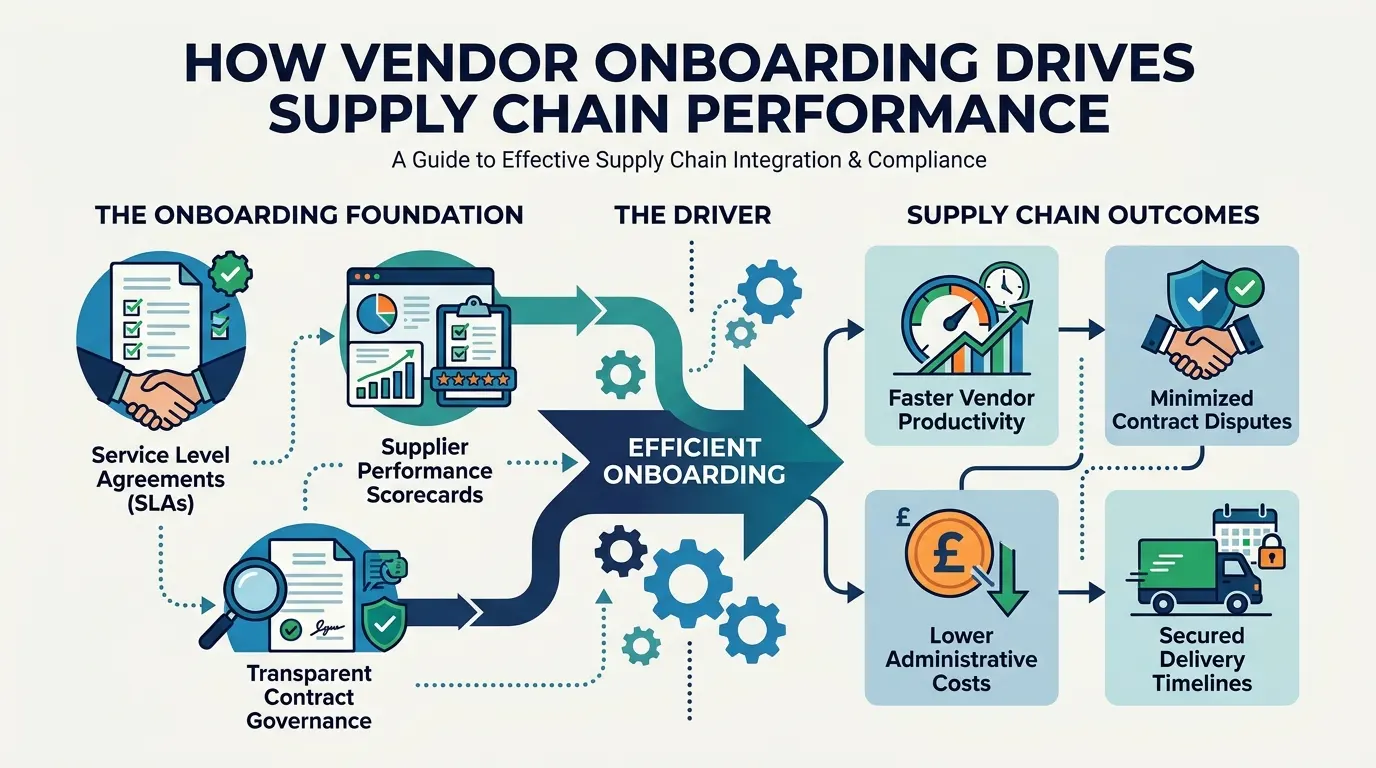
Establishing Service Level Agreements and Performance Metrics
The transition from vendor registration to active operational status requires defining clear expectations through Service Level Agreements (SLAs). Evaluating how SLAs integrate into onboarding ensures that contractors understand key performance indicators (KPIs) before work begins. Key metrics include delivery timeliness, material specification adherence, safety compliance, and dispute resolution turnaround times.
A structured supplier performance scorecard must track these metrics automatically throughout the contract lifecycle. Organizations that incorporate scorecard baselines during onboarding observe up to a 25% increase in vendor contract adherence within the first six months. Continuous performance tracking enables contract managers to address minor service deviations before they escalate into costly project delays.
Streamlining Category Management and Contract Governance
Category management principles ensure that vendor onboarding aligns with broader supply chain strategies across different spend categories. Evaluating category-specific onboarding workflows determines whether procurement teams apply tailored criteria to engineering services, raw materials, or maintenance logistics. Generic onboarding workflows fail to capture specialized risks inherent to distinct procurement categories.
Effective governance extends across the entire lifecycle, connecting onboarding directly to contract renewal and exit strategies. When evaluating governance frameworks, organizations must check whether offboarding protocols protect proprietary data, recover site access credentials, and audit final local content fulfillment figures. Seamless offboarding prevents legal exposure and frees up capital allocations for new AVL entries.
Evaluation Area | Key Metrics & Focus | Impact on Operations | Recommended Audit Frequency |
Prequalification | HSE compliance, ISO standards, financial solvency | Reduces safety incidents and operational downtime | Annual |
Risk Segmentation | Spend volume, operational criticality, exposure level | Prioritizes audit resources on high-risk vendors | Bi-annual |
Local Content | Domestic labor ratio, local spend, technology transfer | Prevents regulatory fines and builds local capacity | Quarterly |
SLA Integration | On-time delivery, specification accuracy, KPI tracking | Improves service delivery and reduces disputes | Continuous |
What Training Frameworks Elevate Vendor Management Competencies?
Elevating vendor management competencies requires targeted workforce training focused on regulatory interpretation, category management, risk analysis, and audit methodologies. Interactive corporate training, practical workshops, and structured procurement frameworks bridge internal skill gaps, ensuring operational teams effectively enforce onboarding standards.
Addressing Workforce Skill Gaps in Procurement Teams
Procurement and contract administration teams frequently encounter skill gaps when interpreting complex local content legislation and dynamic vendor risk profiles. Evaluating internal team capabilities helps identify whether delay issues stem from software tools or a lack of regulatory and analytical expertise. Unprepared teams often approve non-compliant vendor submittals or create unnecessary administrative friction that deters high-quality contractors.
Corporate upskilling programs address these skill gaps by providing actionable training on regulatory compliance frameworks, contract negotiation, and supplier performance evaluation. When procurement teams undergo practical training, contract processing errors drop by up to 40%, and compliance audit pass rates improve significantly. Investment in human capital directly strengthens supply chain resilience.
Selecting the Right Learning Delivery Model
Selecting the appropriate learning delivery model depends on organizational structure, team distribution, and project schedules. Organizations evaluate structured corporate workshops, blended digital learning modules, and intensive executive seminars to determine which format yields the highest learning retention and operational application.
Training Approach | Primary Focus | Best Suited For | Measurable Business Outcome |
Workplace Workshops | Hands-on policy application & audit practice | Local procurement & contract teams | Immediate reduction in onboarding backlogs |
Blended Digital Learning | Regulatory frameworks & compliance standards | Distributed global supply chain staff | Standardized compliance knowledge across sites |
Executive Seminars | Strategic local content & risk segmentation | Supply chain directors & HR leaders | Enhanced strategic alignment and policy design |
Organizations evaluating external training options to build internal capability should consider specialized vendor management programs. Enrolling key personnel in the Vendor Management and Local Content Requirements Onboarding Training by Institute For Oil & Gas Training provides teams with comprehensive frameworks designed to audit supplier prequalification, manage local content quotas, and enforce SLA compliance across complex oil and gas projects.
A well-structured evaluation framework ensures that oil and gas operators maintain operational efficiency, meet statutory local content requirements, and protect their supply chains from compliance failures. Systematically upgrading prequalification standards, risk segmentation protocols, and internal team capabilities transforms vendor onboarding from an administrative burden into a competitive advantage.
Frequently Asked Questions
What is Oil & Gas Petroleum Procurement training?
Oil & Gas Petroleum Procurement training is a specialized professional development program designed for supply chain managers, contract administrators, and procurement professionals in the energy sector. The curriculum offered by the Institute For Oil & Gas Training focuses on strategic sourcing, vendor prequalification, category management, contract administration, and regulatory compliance within upstream, midstream, and downstream operations. Participants learn to mitigate operational risks, optimize inventory lead times, and maintain robust supplier relationships across global energy projects.
Why is specialized procurement training essential in the energy sector?
Petroleum projects involve complex supply chains, stringent health and safety standards, volatile market conditions, and high-capital expenditures. Specialized training provided by the Institute For Oil & Gas Training equips industry professionals with the technical skills to manage Engineering, Procurement, and Construction (EPC) contracts while ensuring local content compliance. This structured expertise prevents costly project delays, ensures regulatory adherence, and enhances cost efficiency throughout the asset lifecycle.
What core skills are covered in the Oil & Gas Petroleum Procurement program?
The Oil & Gas Petroleum Procurement program covers essential competencies including supplier performance evaluation, strategic sourcing, contract negotiation, and supply chain risk management. Professionals trained through the Institute For Oil & Gas Training gain practical knowledge in managing complex logistics, expediting critical materials, auditing vendor compliance, and establishing effective Service Level Agreements (SLAs) tailored to oilfield environments.
How does effective procurement management impact project outcomes in oil and gas?
Effective procurement directly protects project margins by preventing supply disruptions, reducing material waste, and controlling capital expenditure overruns. By implementing standardized sourcing methodologies from the Institute For Oil & Gas Training, organizations streamline vendor onboarding, ensure the delivery of high-specification equipment, and maintain operational continuity across offshore and onshore facilities.
Who should enroll in the Institute For Oil & Gas Training procurement course?
This course is engineered for procurement officers, supply chain specialists, category managers, contract analysts, and project managers working within exploration, production, refining, and distribution sectors. HR leaders, corporate training managers, and energy professionals seeking to upskill their teams in global petroleum supply chain practices will benefit from the practical, industry-driven curriculum offered by the Institute For Oil & Gas Training.
Related training courses
Procure-to-Pay (P2P) End-to-End Process for Oil & Gas Training Course
- Specialisation
- Oil & Gas Petroleum Procurement
- Duration
- 5 days · 15 CPD hours
3-Way Matching & Invoice Verification for JV Chargeability Training Course
- Specialisation
- Oil & Gas Petroleum Procurement
- Duration
- 5 days · 15 CPD hours
Financial Evaluation of Suppliers & Contractors: Tender Evaluation Training Course
- Specialisation
- Oil & Gas Petroleum Procurement
- Duration
- 5 days · 15 CPD hours
More articles

Vendor Management and Local Content Requirements Onboarding Training by Institute For Oil & Gas Training
Enroll in the Vendor Management and Local Content Requirements Onboarding Training by Institute For Oil & Gas Training. Master procurement compliance.
Read article →
Why Effective Vendor Onboarding Matters in Oil and Gas Procurement
Discover why vendor onboarding drives supply chain compliance, risk mitigation, and local content success in oil and gas procurement.
Read article →
Three Way Matching and Invoice Verification for JV Chargeability Training by Institute For Oil & Gas Training
Master joint venture invoice verification with the Institute For Oil & Gas Training. Learn 3-way matching, audit readiness, and cost recovery skills.
Read article →