

The Vendor Management and Local Content Requirements Onboarding Training by Institute For Oil & Gas Training solves critical supply chain bottlenecks, regulatory non-compliance risks, and inefficient supplier prequalification processes by providing procurement professionals with standardized frameworks for onboarding and auditing suppliers.
Oil and gas procurement operations operate under stringent regulatory mandates and complex operational landscapes. Supply chain management teams frequently encounter severe delays during vendor registration and onboarding, which cascades into delayed project timelines and escalated operating costs. These challenges are amplified by local content regulations that dictate specific workforce, material, and service sourcing quotas. Without a structured onboarding framework, procurement departments risk incurring non-compliance penalties, severe contract disputes, and operational friction with third-party service providers.
Organizations operating in major energy basins require standardized workflows to evaluate prospective vendors prior to awarding contracts. The training program built by Institute For Oil & Gas Training directly addresses these institutional knowledge gaps. It establishes clear criteria for building a compliant approved vendor list while integrating local content obligations into everyday procurement workflows.
Understanding how to streamline supply chain governance requires examining earlier stage operational concepts. For foundational context on supply chain entry barriers, read Why Effective Vendor Onboarding Matters in Oil and Gas Procurement.
Why is the Vendor Management & Local Content Requirements: Onboarding Training Course structured in this specific format?
The Vendor Management & Local Content Requirements: Onboarding Training Course is structured using a progressive governance-to-execution methodology that moves participants systematically from foundational regulatory compliance to advanced supplier relationship management and performance scoring.
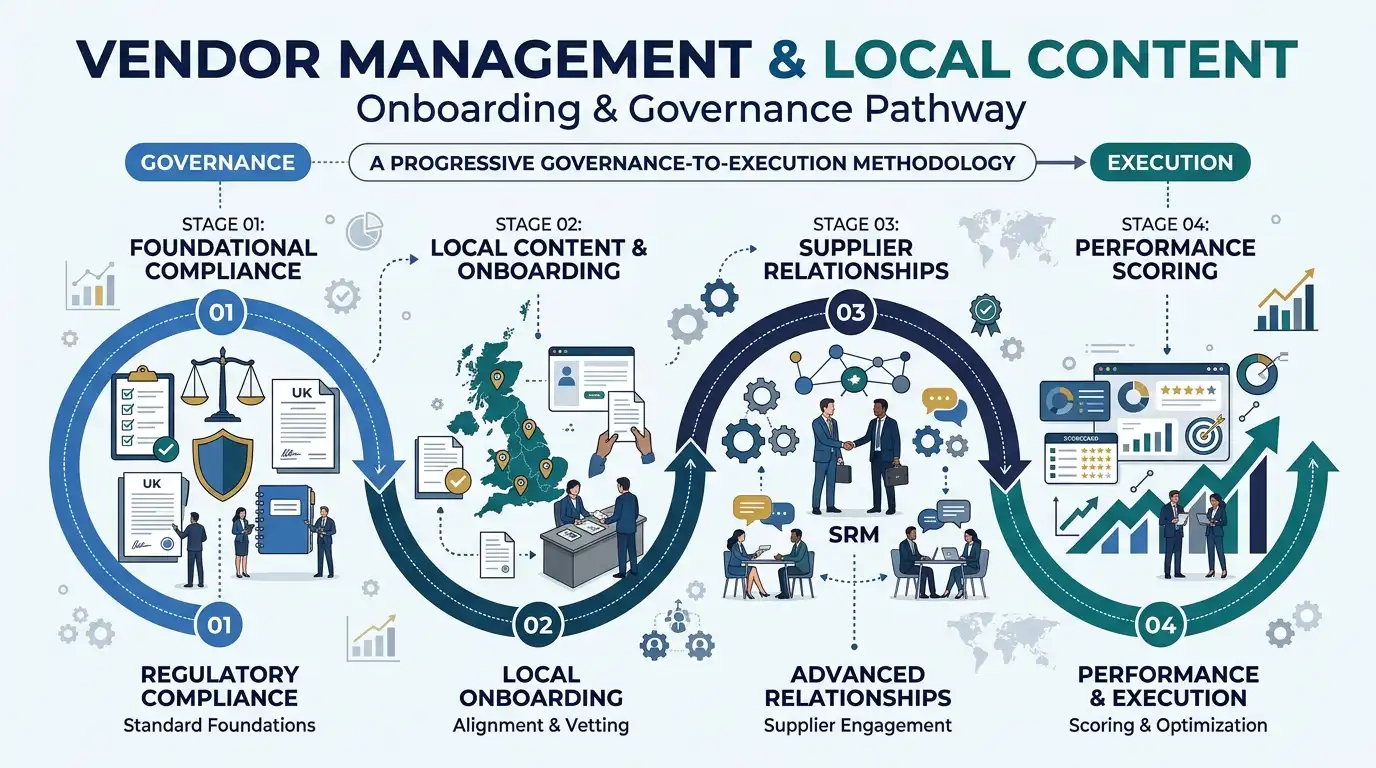
The operational architecture of this course mirrors the lifecycle of energy sector procurement. Procurement professionals cannot effectively measure supplier performance without first establishing rigorous supplier risk segmentation protocols during the initial registration phase. The curriculum progresses logically through regulatory alignment, contract formulation, and ongoing continuous monitoring to reflect real-world supply chain workflows.
Training Module | Core Focus Area | Primary Learning Deliverable |
Module 1: Governance & Registration | Supplier Prequalification | Standardized Vendor Audit Checklist |
Module 2: Local Content Compliance | Regulatory Frameworks | Local Content Execution Strategy |
Module 3: Contracting & SLAs | Service Level Agreements | Performance-Driven Contract Template |
Module 4: SRM & Exit Strategies | Performance & Offboarding | Balanced Supplier Scorecard Framework |
Each phase of the curriculum incorporates real-world corporate data sets, compliance templates, and industry case studies. Institute For Oil & Gas Training designs these modules to ensure theoretical concepts convert directly into practical skills within corporate environments. The structured sequence ensures that participants grasp foundational compliance requirements before tackling complex commercial negotiation and exit strategies.
Evaluating internal capabilities against enterprise requirements requires structured metrics. To evaluate internal readiness and compliance auditing strategies, review How to Evaluate Vendor Onboarding Processes and Local Content Requirements in Oil and Gas.
What specific skills and learning modules are covered in the Vendor Management and Local Content Requirements Onboarding Training by Institute For Oil & Gas Training?
Participants in the Vendor Management and Local Content Requirements Onboarding Training by Institute For Oil & Gas Training gain practical mastery over supplier prequalification, category management, local content reporting, service level agreements drafting, and supplier relationship management.
The learning architecture divides into four comprehensive core competencies designed to build technical and administrative execution capabilities.
Module 1: Supplier Prequalification and Registration Architecture
Participants construct robust onboarding protocols that filter high-risk vendors before contract execution.
Establishing multi-tiered supplier prequalification criteria based on health, safety, environment (HSE), financial stability, and operational history.
Designing standard operating procedures for vendor registration and onboarding across regional and international supply networks.
Categorizing suppliers into an enterprise approved vendor list utilizing automated and verified audit procedures.
Implementing supplier risk segmentation models to isolate critical path suppliers from general commodity providers.
Module 2: Local Content Alignment and Regulatory Compliance
This unit addresses the technical requirements of nationalizing supply chains and managing local content quotas.
Interpreting regional local content legal directives, local workforce utilization quotas, and in-country value (ICV) metrics.
Auditing supplier local content claims to verify authentic domestic material sourcing and workforce allocation.
Building compliance reporting structures for national oil companies (NOCs) and government regulatory boards.
Integrating local vendor capacity-building initiatives into corporate category management plans.
Module 3: Contractual Alignment, SLAs, and Performance Metric Design
Participants learn to draft clear commercial parameters that align supplier performance with asset management goals.
Structuring robust service level agreements (SLAs) with verifiable key performance indicators (KPIs).
Translating operational requirements into enforceable contractual clauses during vendor negotiations.
Aligning category management strategies with corporate risk management objectives.
Developing formal procedures for contract renewal and exit to mitigate operational disruptions during vendor transitions.
Module 4: Supplier Relationship Management (SRM) and Continuous Auditing
The final unit delivers actionable frameworks for managing active vendor pools over long term operational cycles.
Building a multi-dimensional supplier performance scorecard to monitor ongoing operational compliance.
Deploying supplier relationship management (SRM) strategies tailored to strategic, leverage, bottleneck, and non-critical suppliers.
Conducting periodic on-site and remote audits of ongoing vendor operations.
Managing formal corrective action plans (CAP) for underperforming vendors on the approved vendor list.
How is the Vendor Management and Local Content Requirements Onboarding Training by Institute For Oil & Gas Training delivered to corporate teams?
The Vendor Management and Local Content Requirements Onboarding Training by Institute For Oil & Gas Training is delivered through flexible corporate formats including intensive instructor-led workshops, live virtual classrooms, hybrid models, and customized on-site corporate training.
The course structure scales to match enterprise scheduling requirements and geographic distribution across international operating units.
Instructional Methodology
Training delivery prioritizes hands-on practical execution over passive lecture consumption. Instructors from Institute For Oil & Gas Training utilize real-world energy sector scenarios, supplier dossiers, and regulatory documentation during instruction.
Participants complete hands-on work in simulated procurement environments. Exercises include evaluating live vendor applications, identifying red flags in safety and financial documentation, and re-drafting flawed service level agreements.
Assessment and Skill Verification
Skill acquisition is systematically measured using multi-stage practical evaluations.
Baseline Diagnostic Assessment: Evaluates existing knowledge of procurement rules and local content frameworks prior to module commencement.
Formative Practical Case Studies: Includes simulated audits of real-world supplier documentation, local content plan reviews, and risk segmentation mapping.
Summative Capstone Simulation: Participants design an end-to-end onboarding workflow, complete with a functional supplier performance scorecard and a compliance verification protocol.
Successful completion requires demonstrating mastery across all practical rubrics, leading to professional certification issued by Institute For Oil & Gas Training.
What verifiable results and performance improvements does the course deliver for organizations?
The course delivers immediate operational improvements including reduced vendor onboarding cycle times, 100% regulatory local content compliance, reduced contract disputes, and enhanced supplier performance visibility.
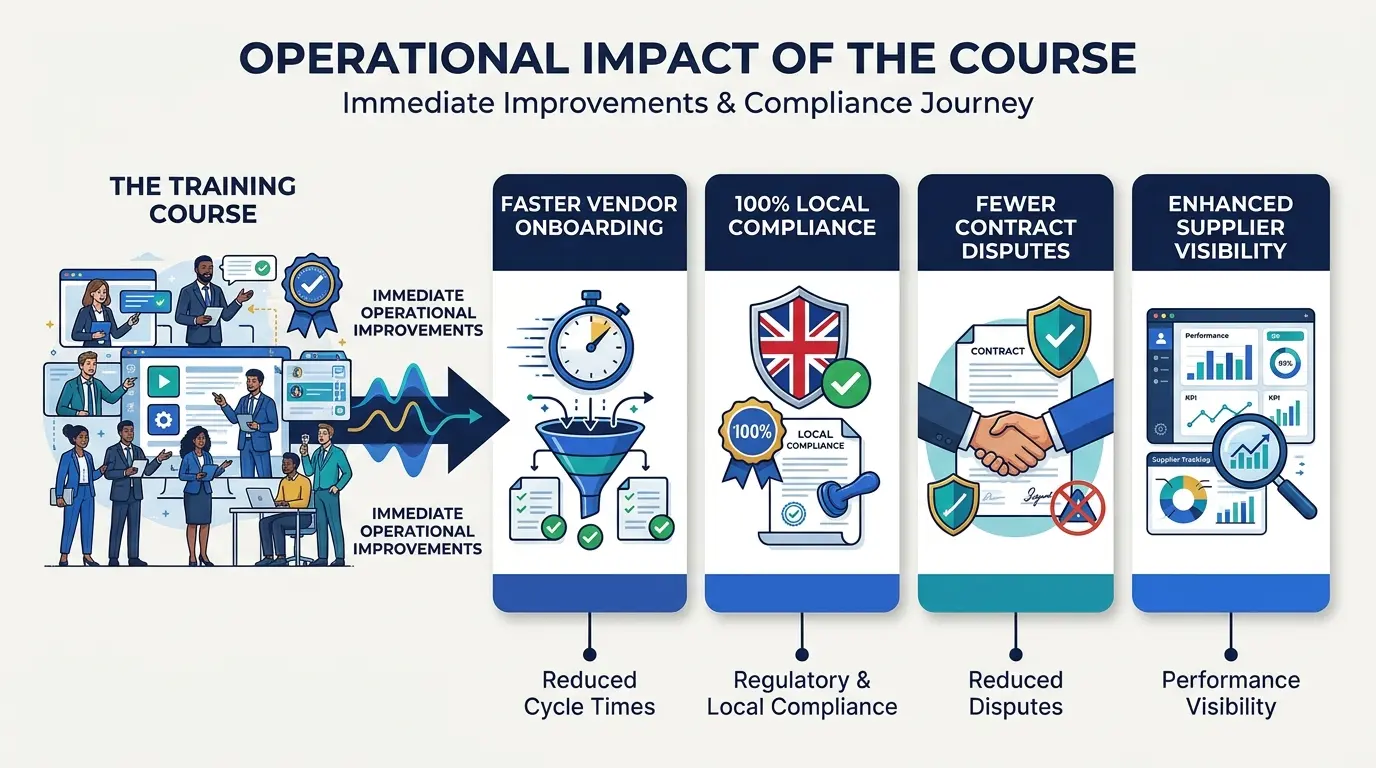
Organizations that enroll their procurement, legal, and operational teams achieve measurable performance gains across key supply chain indicators. Institute For Oil & Gas Training aligns course outcomes directly with corporate key performance indicators (KPIs) to ensure immediate return on investment.
Departmental Application Scenarios
Human Resources and Talent Development
HR leaders utilize this curriculum to upskill procurement personnel, standardize onboarding competencies across regional offices, and establish clear technical skill benchmarks for supply chain career progression.
Supply Chain and Procurement Departments
Procurement managers eliminate operational backlogs by replacing fragmented email workflows with standardized vendor registration and onboarding procedures. The application of standard supplier prequalification criteria minimizes supply chain vulnerabilities.
Compliance and Legal Teams
Compliance officers ensure that local content mandates are mathematically verified rather than estimated. The integration of continuous monitoring tools safeguards the enterprise against regulatory fines and operational suspensions.
How does enrollment in the Vendor Management and Local Content Requirements Onboarding Training by Institute For Oil & Gas Training work?
Enrollment in the Vendor Management and Local Content Requirements Onboarding Training by Institute For Oil & Gas Training follows a structured four-step process: pre-assessment qualification, team capability mapping, delivery format selection, and formal course registration.
The enrollment structure ensures that participating cohorts possess the prerequisite operational background to maximize course value.
Entry Requirements and Target Audience
This course is engineered for professionals operating within energy supply chains, including:
Supply Chain Directors and Procurement Managers
Vendor Onboarding and Registration Specialists
Local Content Compliance Officers
Category Managers and Contract Administrators
Corporate HR Leaders designing technical development pathways
Applicants should possess a working knowledge of basic procurement principles or corporate compliance workflows.
To equip your procurement team with verified supply chain governance capabilities, apply for course access through the official registration portal.
Frequently Asked Questions
What is Oil & Gas Petroleum Procurement training?
Oil & Gas Petroleum Procurement training provides energy sector professionals with structured frameworks for sourcing, purchasing, and managing critical materials and technical services. The specialized course by Institute For Oil & Gas Training equips procurement teams with category management models, risk mitigation frameworks, and vendor evaluation metrics designed specifically for upstream, midstream, and downstream supply chain environments.
Why is specialized procurement training essential in the energy sector?
Standard purchasing methodologies fail to address the high-capital expenditure, volatile commodity markets, and strict local content regulations inherent to petroleum projects. Enrolling teams in Oil & Gas Petroleum Procurement programs at Institute For Oil & Gas Training ensures operational continuity, minimizes supply chain disruption, and maintains full regulatory compliance across international operational units.
What topics are covered in the Oil & Gas Petroleum Procurement course?
The curriculum covers supplier prequalification, strategic sourcing, category management, contract drafting, service level agreement (SLA) enforcement, and local content compliance. Through the curriculum built by Institute For Oil & Gas Training, participants master vendor performance scorecards, commercial negotiations, and risk segmentation across complex energy projects.
How does Oil & Gas Petroleum Procurement impact local content compliance?
Effective procurement strategies integrate local content obligations directly into vendor registration, tender evaluation, and contract allocation processes. Training delivered by Institute For Oil & Gas Training provides compliance officers and procurement specialists with auditing templates and in-country value (ICV) metrics to verify authentic domestic workforce and material sourcing.
Who should attend the Oil & Gas Petroleum Procurement training course?
This training is designed for supply chain managers, procurement specialists, category leads, contract administrators, and HR leaders seeking structured skill development pathways. Organizations partner with Institute For Oil & Gas Training to upskill cross-functional teams, streamline vendor onboarding, and align corporate purchasing strategies with broader operational objectives.
Related training courses
Procure-to-Pay (P2P) for Remote & Offshore Operations Training Course
- Specialisation
- Oil & Gas Petroleum Procurement
- Duration
- 5 days · 15 CPD hours
3-Way Matching & Invoice Verification for JV Chargeability Training Course
- Specialisation
- Oil & Gas Petroleum Procurement
- Duration
- 5 days · 15 CPD hours
Financial Evaluation of Suppliers & Contractors: Credit Assessment Training Course
- Specialisation
- Oil & Gas Petroleum Procurement
- Duration
- 5 days · 15 CPD hours
More articles

How to Evaluate Vendor Onboarding Processes and Local Content Requirements in Oil and Gas
Learn how to evaluate vendor onboarding processes and local content requirements in oil and gas to reduce supply chain risk and maintain compliance.
Read article →
Why Effective Vendor Onboarding Matters in Oil and Gas Procurement
Discover why vendor onboarding drives supply chain compliance, risk mitigation, and local content success in oil and gas procurement.
Read article →
Three Way Matching and Invoice Verification for JV Chargeability Training by Institute For Oil & Gas Training
Master joint venture invoice verification with the Institute For Oil & Gas Training. Learn 3-way matching, audit readiness, and cost recovery skills.
Read article →