

Effective vendor onboarding in oil and gas procurement is the structured process of qualifying, registering, and integrating external suppliers into operational workflows. It ensures compliance with HSE standards, anti-corruption laws, financial stability requirements, and regional local content mandates.
Vendor onboarding forms the foundational gatekeeping mechanism within capital-intensive energy operations. In international and domestic oil and gas operations, onboarding transforms raw contractor proposals into verified, actionable capabilities. The process establishes clear expectations across technical execution, commercial terms, and governance protocols before a supplier steps foot on an operational site or receives project funds.
Without a standardized onboarding system, operators face severe exposure to operational downtime, regulatory penalties, and reputational damage. A structured onboarding protocol incorporates supplier prequalification to evaluate financial health, technical capacity, and safety records. This system feeds into an approved vendor list, creating a verified repository of suppliers eligible for contract awards across major exploration and production initiatives.
From an organizational learning and workforce development perspective, onboarding serves as the structural interface where internal procurement teams align third-party personnel with company standards. HR managers, L&D professionals, and supply chain leaders utilize targeted corporate training to ensure procurement officers master risk assessment models, regulatory frameworks, and auditing methodologies. Standardized training programs equip procurement specialists with the competencies required to manage complex vendor interactions, mitigate operational friction, and secure supply chain resilience.
How Does Vendor Onboarding Work in Corporate Environments?
Vendor onboarding operates through a systematic four-phase framework comprising initial screening, due diligence, system integration, and performance enablement. Corporate supply chain teams execute these steps using standardized workflows, digital intake platforms, and cross-departmental reviews.
The corporate execution of vendor onboarding relies on structured governance and sequential execution across distinct operational stages:
Information Collection and Prequalification: Suppliers submit corporate records, safety performance data, financial audits, and technical certifications through centralized digital portals.
Multi-Disciplinary Assessment: Cross-functional teams evaluate submitted documentation. Health, Safety, and Environment (HSE) specialists review safety records, finance teams conduct liquidity and debt assessments, and legal officers verify anti-bribery compliance.
Approval and Registration: Verified suppliers receive formal registration on the enterprise approved vendor list (AVL), enabling them to participate in active tenders.
Contractual Integration and Enablement: Procurement officers issue service level agreements, establish baseline metrics, and integrate vendor systems into corporate Enterprise Resource Planning (ERP) networks.
Organisations implement these workflows by combining digital software tools with structured human expertise. Procurement personnel must possess precise operational competencies to interpret vendor metrics and execute audits correctly. Corporate training delivery models support this implementation through practical, structured formats:
Simulations: Workforce teams practice reviewing real-world vendor dossiers, identifying red flags in safety statistics, or calculating liquidity ratios under realistic time constraints.
Case-Based Workshops: Cross-functional groups analyze past supply chain disruptions in energy projects to trace root causes back to onboarding oversights.
Role-Playing Exercises: Procurement specialists participate in structured negotiation scenarios to practice setting stringent service level agreements and local participation targets with international contractors.
Continuous professional development ensures that internal supply chain personnel maintain standard application of prequalification guidelines across all regional business units.
What Key Components Make Up an Effective Vendor Onboarding Framework?
An effective vendor onboarding framework comprises rigorous risk segmentation, regulatory verification, strategic category management, and dynamic performance evaluation. These core elements establish operational safety, financial transparency, and contract compliance across all procurement activities.
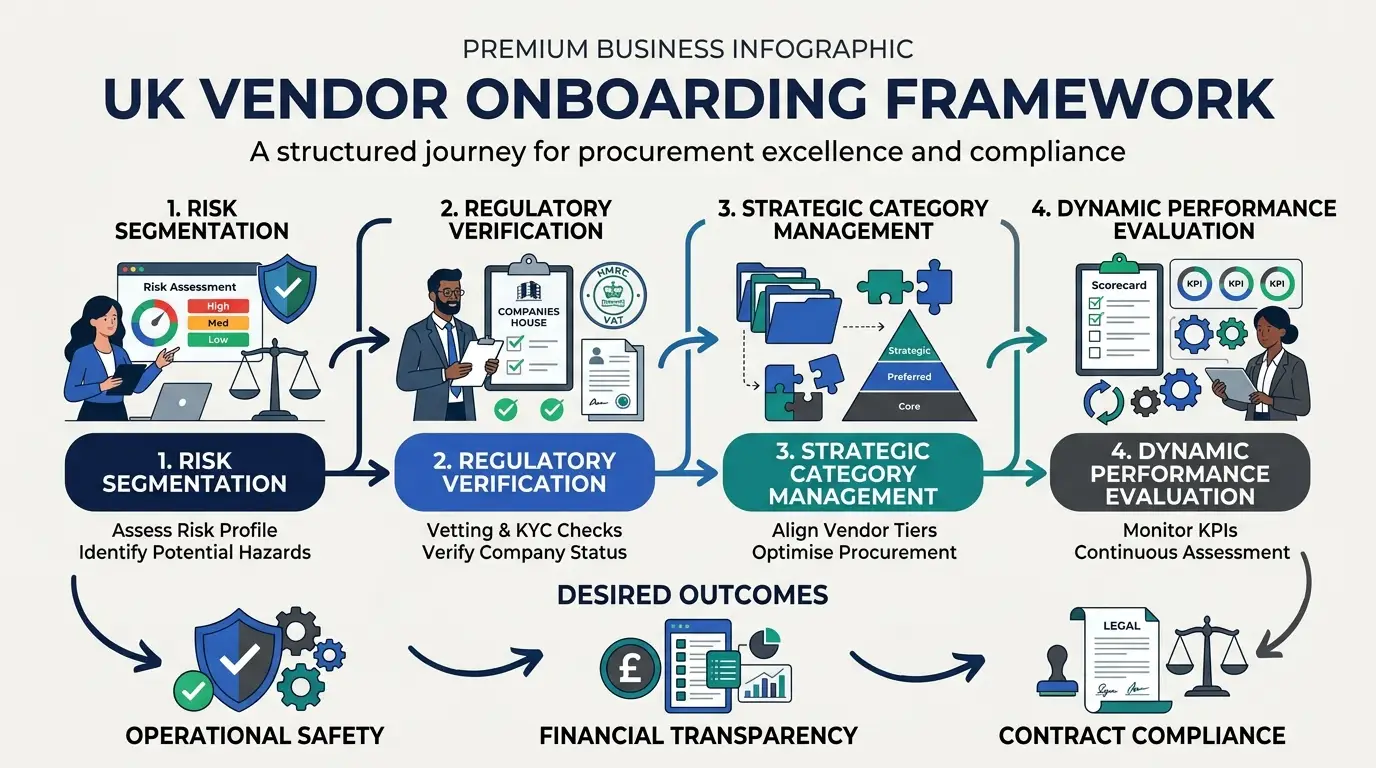
A resilient onboarding structure requires clear integration of specialized operational components:
Supplier Risk Segmentation: Procurement teams classify suppliers into distinct risk categories—low, medium, or high—based on operational exposure, spend volume, and geographical location. High-risk vendors, such as offshore drilling contractors, undergo exhaustive third-party audits, while low-risk off-the-shelf suppliers follow streamlined approval routes.
Local Content Verification: Operating companies evaluate contractors on their commitment to regional workforce participation, local sub-contracting, and in-country capacity building. Onboarding frameworks assess compliance with national legislative percentages before contract execution.
Category Management: Supply chain structures organize procurement items into specific operational categories, such as subsea equipment, engineering services, or logistics. Category managers customize onboarding criteria to match the specific technical and regulatory requirements of each group.
Supplier Performance Scorecard: Procurement systems establish quantifiable baselines during onboarding to track ongoing performance. Indicators measure delivery timelines, safety incidents, cost variances, and quality compliance throughout the contract lifecycle.
Developing these components within an organization requires targeted workforce training. Procurement teams learn to construct structured risk models, implement scorecard tracking systems, and enforce rigorous governance standards. Structured professional development builds organizational capability, ensuring supply chain teams can build, adjust, and maintain these components against changing market conditions and legal demands.
Why Do Organisations Need to Implement Structured Onboarding Systems?
Organisations require structured vendor onboarding systems to prevent costly operational downtime, avoid legal penalties, eliminate financial fraud, and guarantee project safety. Standardized workflows ensure supply chain transparency, commercial predictability, and full alignment with national regulatory mandates.
The energy sector operates under extreme environmental, safety, and financial constraints. Unqualified vendors introduce systemic vulnerabilities that impair capital expenditure projects. Systematic vendor registration and onboarding mitigates these threats through preventative validation:
Operational Risk Area | Unstructured Onboarding Impact | Structured Onboarding Solution |
HSE & Safety | Unverified safety protocols leading to site accidents and operational stoppages. | Pre-site verification of Lost Time Injury Frequency (LTIF) rates and safety systems. |
Regulatory Compliance | Non-compliance with local participation laws leading to heavy fines or license revocation. | Mandatory audit of local workforce percentages and regional material sourcing during intake. |
Supply Chain Continuity | Financial collapse of critical contractors mid-project due to unverified balance sheets. | In-depth stress-testing of vendor balance sheets, credit ratings, and operational cash flow. |
Cost Control | Uncontrolled price variances and project delays caused by mismatched technical expectations. | Clear baseline definition through binding service level agreements prior to work authorization. |
Organisations that invest in comprehensive corporate learning build resilient internal capability. Training procurement officers to enforce systematic onboarding protocols reduces project delay risks by 35% and eliminates non-compliant vendor entries into active project tenders.
How Do Corporations Train Teams to Master Vendor Onboarding and Local Content?
Corporations train procurement teams through outcome-based learning programs using case studies, regulatory audit simulations, and KPI design workshops. These practical initiatives align internal competencies with national local content regulations and international procurement standards.
Executing compliant onboarding across complex regulatory landscapes requires specialized skill sets. Procurement personnel must evaluate technical capability while verifying adherence to local labor and sourcing legislation. Organizations build these capabilities by implementing structured professional development initiatives.
Standard learning pathways combine theoretical foundations with practical application:
Regulatory and Legal Training: Staff master national energy frameworks, anti-bribery statutes, and local content laws. Learners practice interpreting regulatory documentation to ensure absolute legal compliance during vendor intake.
Audit and Risk Assessment Workshops: Teams learn structured methodologies for evaluating supplier financial reports, operational safety logs, and quality management systems.
Applied Local Content Strategy: Supply chain personnel learn how to assess national value-addition metrics, verify local workforce payrolls, and calculate in-country expenditure accurate percentages.
Performance Governance & Exit Execution: Training covers tracking vendor performance using a supplier performance scorecard, managing standard contract renewals, and executing structured contract renewal and exit strategies when vendors fail to meet baseline standards.
To evaluate how your organization's supply chain processes align with national legislative requirements, decision-makers must continuously review internal auditing protocols. Understanding How to Evaluate Vendor Onboarding Processes and Local Content Requirements in Oil and Gas allows supply chain leaders to benchmark current operational procedures against evolving industry compliance standards.
Organizations utilizing the Vendor Management & Local Content Requirements: Onboarding Training Course ensure their procurement teams gain practical, hands-on exposure to these governance tools. Through structured role-playing, practical scenario modeling, and interactive audit frameworks, workforce personnel transition from theoretical awareness to real-world execution mastery.
What Common Problems Occur with Ineffective Vendor Onboarding Training?
Ineffective vendor onboarding training leads to regulatory non-compliance, unmitigated supply chain risks, high administrative costs, and poor local content execution. Flawed training programs fail to build practical risk assessment capabilities within procurement teams.
Corporate learning initiatives frequently fail when programs rely on generic materials unaligned with energy sector realities. Common organizational failure points include:
Generic, Unfocused Content: Training modules that cover general procurement concepts without addressing oil and gas realities—such as joint venture structures, offshore HSE codes, and national content quotas—leave teams unprepared for real-world risk management.
Lack of Measurable ROI: Standard lecture-based training fails to deliver quantifiable improvements in key operational metrics, such as vendor approval cycle times, audit error rates, or contractor safety compliance.
Failure to Embed Local Content Verification: Outdated training programs treat local content as a secondary administrative step rather than a core onboarding gate, resulting in regulatory fines and project approval delays.
Inadequate Risk Segmentation Capability: Without practical training on supplier risk segmentation, procurement staff apply identical, slow onboarding steps to all vendors, creating administrative backlogs for low-risk suppliers while under-auditing high-risk contractors.
Addressing these challenges requires moving away from abstract theory. High-impact corporate learning relies on practical, outcome-based curricula designed specifically for energy supply chain operations. Training must build practical decision-making skills, enabling teams to evaluate complex vendor applications efficiently while maintaining strict governance standards.
What Measurable Outcomes Does Effective Vendor Onboarding Training Produce?
Effective vendor onboarding training delivers quantifiable outcomes, including reduced vendor approval cycles, increased local content compliance percentages, lower supply chain disruption rates, and improved project cost predictability. Standardized training generates clear, trackable ROI across energy operations.
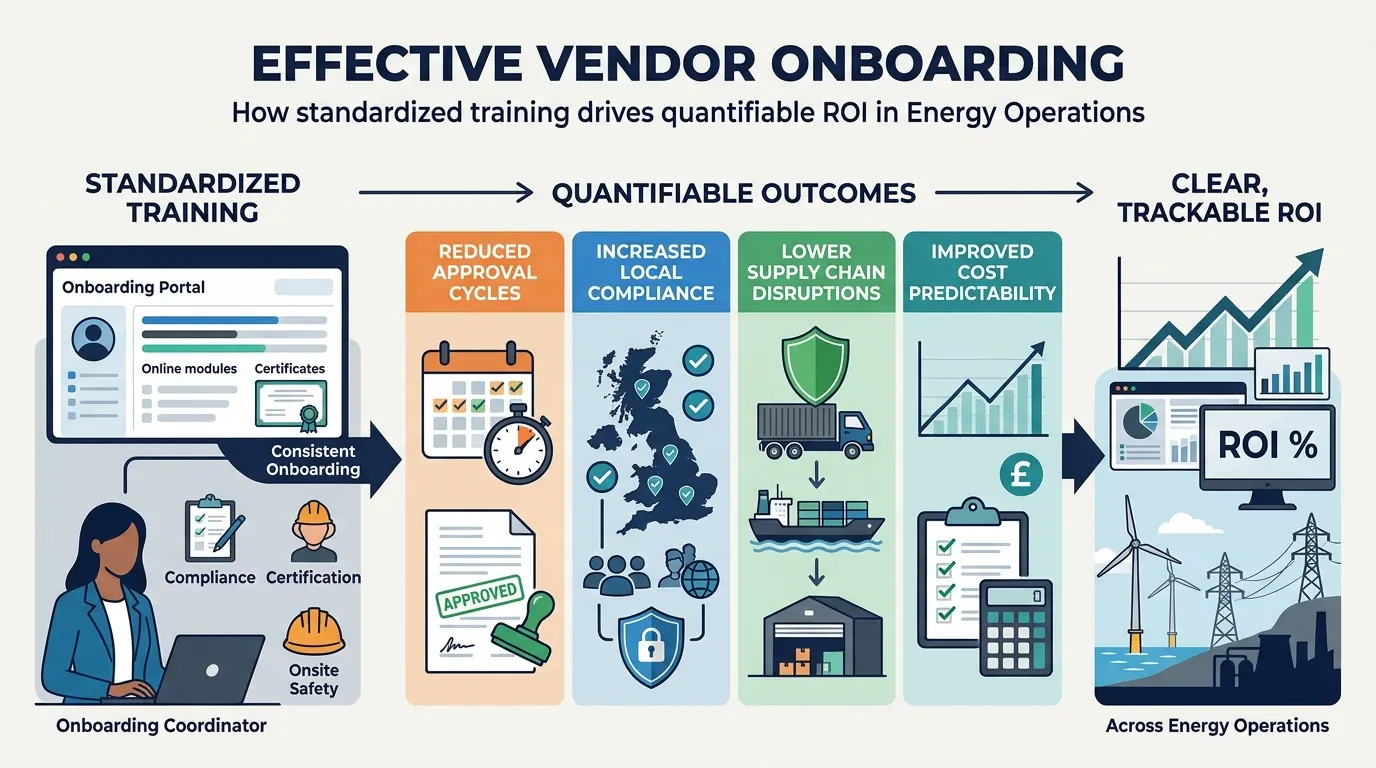
Investing in targeted workforce development produces clear, measurable performance metrics across supply chain and project execution departments:
Approval Cycle Efficiency: Standardized evaluation skills reduce vendor onboarding processing time by 40%, eliminating tender delays without compromising risk screening standards.
Local Content Compliance: Well-trained teams accurately verify in-country value creation, achieving 100% compliance with national regulatory mandates and avoiding legal penalties.
Supplier Quality and Safety Improvement: Enforcing strict prequalification standards during intake reduces site-level HSE incidents involving third-party contractors by over 25%.
Supply Chain Cost Optimization: Structured evaluation of vendor pricing models during onboarding prevents scope creep and unexpected contract variations, reducing total procurement cost variance by 12% to 18%.
Improved Vendor Alignment: Establishing clear service level agreements during initial onboarding improves on-time delivery rates for critical materials to over 95%.
When procurement specialists, supply chain managers, and HR development leads align training initiatives with operational business goals, vendor onboarding transforms from an administrative hurdle into a strategic competitive advantage. Continuous workforce training secures project timelines, protects corporate reputation, and maximizes local economic value creation.
Frequently Asked Questions
What is oil and gas petroleum procurement?
Oil and gas petroleum procurement is the strategic process of sourcing, purchasing, and managing materials, equipment, and services required for upstream, midstream, and downstream energy operations. The Institute For Oil & Gas Training provides professional workforce development in Oil & Gas Petroleum Procurement to help supply chain specialists master vendor selection, risk management, and contract negotiation. This operational function ensures energy projects maintain continuous material flow while meeting strict regulatory standards.
Why is training in oil and gas petroleum procurement important for supply chain professionals?
Specialised training equips procurement personnel with the technical competencies required to manage high-value contracts, complex international supply chains, and stringent health and safety requirements. Through structured education in Oil & Gas Petroleum Procurement at the Institute For Oil & Gas Training, professionals learn to mitigate vendor risks, control project expenditure, and ensure full compliance with regional local content laws. This targeted capability development reduces operational downtime and improves overall project profit margins.
What core skills are covered in oil and gas petroleum procurement training?
Training covers key supply chain competencies, including supplier prequalification, category management, service level agreement (SLA) drafting, and strategic sourcing methodologies. The Institute For Oil & Gas Training structures its Oil & Gas Petroleum Procurement curriculum around real-world industry scenarios, enabling learners to master compliance auditing, tender evaluation, and supplier performance scorecards. Participants gain practical experience in balancing cost efficiency with operational safety and supply continuity.
How does oil and gas procurement differ from general corporate procurement?
Procurement in the energy sector involves significantly higher operational risks, extreme capital expenditure, and strict adherence to environmental and national local content regulations. Oil & Gas Petroleum Procurement programs at the Institute For Oil & Gas Training focus on these unique industry challenges, preparing professionals to handle complex subsea, onshore, and offshore equipment sourcing. Unlike standard purchasing, energy procurement directly impacts site safety, regulatory licensing, and long-term asset integrity.
How do organisations measure ROI from oil and gas petroleum procurement courses?
Organisations evaluate return on investment by tracking improvements in vendor approval cycle times, local content compliance rates, and total cost variance reductions. Up-skilling teams through Oil & Gas Petroleum Procurement programs at the Institute For Oil & Gas Training directly decreases contract management errors and third-party supply disruptions. These quantifiable performance gains enhance operational efficiency and protect corporate capital expenditure across major energy projects.
Related training courses
Procure-to-Pay (P2P) End-to-End Process for Oil & Gas Training Course
- Specialisation
- Oil & Gas Petroleum Procurement
- Duration
- 5 days · 15 CPD hours
Vendor Management & Local Content Requirements: Onboarding Training Course
- Specialisation
- Oil & Gas Petroleum Procurement
- Duration
- 5 days · 15 CPD hours
Financial Evaluation of Suppliers & Contractors: Tender Evaluation Training Course
- Specialisation
- Oil & Gas Petroleum Procurement
- Duration
- 5 days · 15 CPD hours
More articles

Vendor Management and Local Content Requirements Onboarding Training by Institute For Oil & Gas Training
Enroll in the Vendor Management and Local Content Requirements Onboarding Training by Institute For Oil & Gas Training. Master procurement compliance.
Read article →
How to Evaluate Vendor Onboarding Processes and Local Content Requirements in Oil and Gas
Learn how to evaluate vendor onboarding processes and local content requirements in oil and gas to reduce supply chain risk and maintain compliance.
Read article →
Three Way Matching and Invoice Verification for JV Chargeability Training by Institute For Oil & Gas Training
Master joint venture invoice verification with the Institute For Oil & Gas Training. Learn 3-way matching, audit readiness, and cost recovery skills.
Read article →