

Managing operational expenditure in heavy industries requires precise control over contract billing mechanisms. Day rate contracts present distinct administrative challenges due to variable service durations, fluctuating equipment usage, and complex rate structures. Organisations process high volumes of contractor claims monthly, making automated and manual verification protocols critical for financial integrity.
A structured verification workflow ensures that every submitted charge reflects actual work performed, contracted commercial rates, and approved operational timelines. Establishing robust financial controls prevents overpayments, reduces billing disputes, and streamlines accounts payable processing across complex projects. To understand the foundational mechanics of overbilling protection, review Why Three Way Matching Matters in Day Rate Contracts before configuring control parameters.
What Is Invoice Verification in Day Rate Contracts?
Invoice verification in day rate contracts is the systematic cross-referencing of a vendor invoice against an authorized purchase order and an approved service confirmation. This process confirms that billed day rates, service durations, and equipment charges match contractual terms.
Contractual billing verification establishes a formal validation gate within accounts payable workflows. Day rate contracts operate differently from lump-sum agreements because financial commitments fluctuate based on daily operational activity. Organizations establish three primary verification baseline anchors: commercial terms, authorization artifacts, and field activity logs.
Commercial terms originate from master service agreements and localized rate cards. The purchase order converts these master terms into financial commitments within the enterprise resource planning system. Service confirmations provide physical proof of delivery, validated by site supervisors through daily work logs and timesheet signatures.
Accounts payable teams execute verification by aligning line items across all three document types. Discrepancies at this stage trigger immediate hold mechanisms to prevent unauthorized cash outflows. Effective verification balances rigorous financial compliance with efficient vendor payment timelines.
Verification Element | Primary Source Document | Validation Responsibility | Key Risk Mitigated |
Commercial Rates | Master Service Agreement / Rate Card | Procurement / Contract Admin | Rate inflation and unapproved surcharges |
Commitment Limit | Approved Purchase Order | Finance / Accounts Payable | Unfunded spend and scope creep |
Work Execution | Daily Work Report / Timesheet | Field Supervisor / Operations | Billing for idle days or unworked hours |
Final Claim | Contractor Tax Invoice | Accounts Payable Specialist | Duplicate payments and mathematical errors |
How Does Three-Way Matching Function for Variable Rate Billings?
Three-way matching functions by programmatically or manually linking the vendor invoice, purchase order, and service confirmation. The control mechanism checks rate card compliance, validates daily logs, and enforces financial tolerance limits before releasing payments.
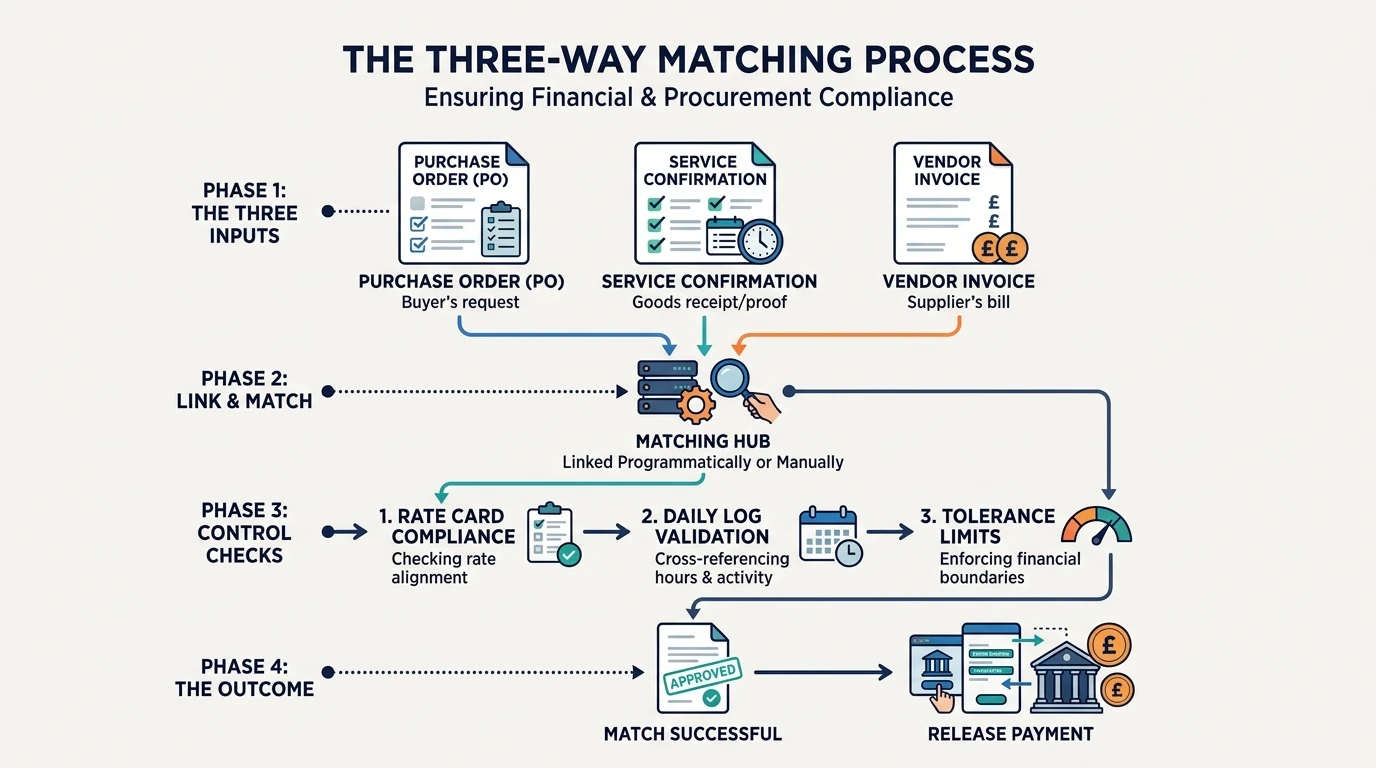
Executing purchase order to receipt to invoice matching requires specific adjustments when handling variable day rate billing. Standard product-based matching validates fixed item quantities against physical receipts. Day rate matching must validate time increments, operational status classifications, and equipment standby rates.
The verification sequence begins when the contractor submits a billing package containing the invoice, daily work records, and signed field logs. Enterprise resource planning systems match the line-item rates against the line items on the purchase order. System rules ensure that the total billed value does not exceed the line-item ceiling established during procurement.
Discrepancy identification focuses on three primary variance categories: unit price, billable quantity, and service scope. Price variance occurs when billed day rates deviate from agreed schedule rates. Quantity variance occurs when claimed operating days exceed field-approved counts. Scope variance involves unapproved mobilization, demobilization, or auxiliary equipment charges added to standard daily rates.
Organizations set tolerance limits to handle minor administrative differences without halting operational payments. Minor rounding differences pass through automatically within predefined threshold boundaries. Discrepancies exceeding defined tolerance limits trigger immediate automated holds, routing the package back to field managers for explicit re-validation.
What Are the Steps to Match Purchase Orders to Receipts and Invoices?
Matching purchase orders to receipts and invoices involves validating line-item rate cards, verifying site-approved timesheets, checking financial tolerance boundaries, and resolving variance exceptions before final ledger posting.
Extract and Validate Purchase Order Line Items
Retrieve the approved purchase order within the enterprise software. Confirm that the financial ceiling remains sufficient for the incoming claim. Verify that the line item descriptions match the specific personnel classifications, equipment types, and daily rates billed by the contractor.
Cross-Reference Timesheet and Day Rate Verification Records
Compare contractor timesheets against official daily operations reports. Verify that daily rates reflect actual operational states, including operating rate, standby rate, repair rate, or zero-rate downtime. Require verified field supervisor signatures on all supporting service documentation.
Perform Rate Card Validation
Check billed unit costs directly against contractual rate cards. Ensure that premium rates, such as night shifts or emergency call-outs, possess pre-authorization artifacts. Confirm that equipment consumables or fuel surcharges strictly follow agreed contractual pass-through formulas.
Apply Financial Tolerance Limits
Pass the calculated line items through automated system tolerance controls. Allow processing if price and quantity variance stays within approved corporate boundaries. Flag any absolute currency or percentage deviation for secondary management authorization.
Execute Invoice Hold and Release Protocols
Apply an automated system block if the invoice fails matching criteria. Issue a formal exception ticket to the vendor and field operations manager detailing the exact variance. Release the invoice for payment processing only after receiving formal written correction or credit notes.
Organizations seeking to standardise these operational controls across financial teams implement Three Way Matching and Invoice Verification for Day Rate Contracts Training by Institute For Oil & Gas Training to establish consistent baseline competencies. Structured capability development ensures that finance, procurement, and field operations staff execute verification protocols using unified technical standards.
How Do Two-Way, Three-Way, and Four-Way Matching Models Compare?
Two-way, three-way, and four-way matching models compare across validation complexity, operational risk mitigation, and processing effort. Three-way matching provides the optimal control balance for complex day rate contract verification.
Selecting the appropriate verification framework depends on risk profile, transaction volume, and operational complexity. Two-way matching links only the purchase order and the vendor invoice. This model functions adequately for low-value, fixed-fee professional services, but leaves high-value day rate contracts exposed to unverified field billings.
Three-way matching adds mandatory service confirmation artifacts to the validation stream. Requiring field-approved daily logs ensures that financial disbursement directly matches verified site activity. This model represents the industry standard for managing day rate contracts across exploration, production, and field maintenance environments.
Four-way matching introduces an additional mandatory inspection or quality sign-off phase. The process requires purchase order, service receipt, quality verification report, and vendor invoice alignment. While offering maximum financial protection, four-way matching increases administrative processing overhead and can delay contractor payment cycles if quality inspections bottleneck.
Model Type | Key Verification Inputs | Control Level | Operational Suitability | Administrative Overhead |
Two-Way Matching | Purchase Order + Invoice | Low | Fixed-fee retainers and simple subscriptions | Minimal |
Three-Way Matching | Purchase Order + Receipt/Confirmation + Invoice | High | Day rate service contracts and equipment hire | Moderate |
Four-Way Matching | Purchase Order + Receipt + Technical Inspection + Invoice | Maximum | Critical capital equipment and high-spec technical services | High |
How Do Teams Execute Service Confirmation and Timesheet Validation?
Teams execute service confirmation and timesheet validation by matching daily site logs against contractor claims, verifying operational state classifications, checking supervisor sign-offs, and validating equipment logbooks.
Field-level validation forms the foundation of day rate verification. Administrative errors at the job site propagate through the accounting system, creating downstream financial leakages. Finance teams rely on field managers to execute rigorous day-by-day record verification before transmitting operational data to accounts payable.
Timesheet validation requires checking five core operational parameters:
Personnel Attendance: Cross-referencing physical site security access logs with claimed contractor man-hours.
Operational Status: Distinguishing between active working hours, standby time caused by company delays, and zero-rate downtime caused by contractor equipment failure.
Equipment Utilization: Reviewing hour-meter logs, engine run charts, and maintenance record books for heavy equipment claims.
Consumable Pass-Throughs: Verifying third-party material invoices attached to day rate claims against pre-agreed markup percentages.
Authorization Sign-Offs: Confirming that field approvals originate from authorized delegates holding appropriate financial authority limits.
Integrating 3-Way Matching & Invoice Verification for Day-Rate Contracts Training Course modules into internal finance workflows helps teams standardise validation checklists across operational departments. Training equips staff with structured techniques to detect billing anomalies, audit daily logs, and communicate discrepancies professionally to service providers.
What Are the Most Common Discrepancy Scenarios and Their Root Causes?
The most common discrepancy scenarios include incorrect operational rate application, unapproved standby claims, mathematical timesheet errors, missing field signatures, and unauthorized pass-through expense markups.
Identifying root causes enables organizations to correct systematic billing failures rather than handling recurring discrepancies on an ad-hoc basis. Discrepancies usually stem from unclear contract definitions, poor communication between field operations and accounting, or manual data entry mistakes.
Unmatched invoice resolution strategies require systematic classification of errors:
Incorrect Operational Rate Stacking
Contractors bill full operational day rates during periods when equipment operated on standby or reduced capacity. Root cause: Field supervisors approve generic daily sheets without marking operational status codes correctly.
Unbilled or Excess Standby Claims
Standby rates apply when contractor operations halt due to operator-side delays. Root cause: Disagreements over weather downtime liability versus operator delay liability.
Purchase Order Value Exhaustion
Invoices match rate cards and daily logs but exceed total purchase order financial ceilings. Root cause: Scope changes executed in the field without processing formal purchase order amendments.
Missing Service Confirmation Documentation
Vendor invoices arrive at accounts payable before field supervisors upload signed daily work reports. Root cause: Disconnected vendor billing schedules and internal operational reporting cycles.
How Should Organisations Establish Tolerance Limits and Exception Workflows?
Organisations establish tolerance limits by defining absolute currency and percentage boundaries for price and quantity variances. Exception workflows automatically route non-compliant invoices to designated contract managers for formal resolution.
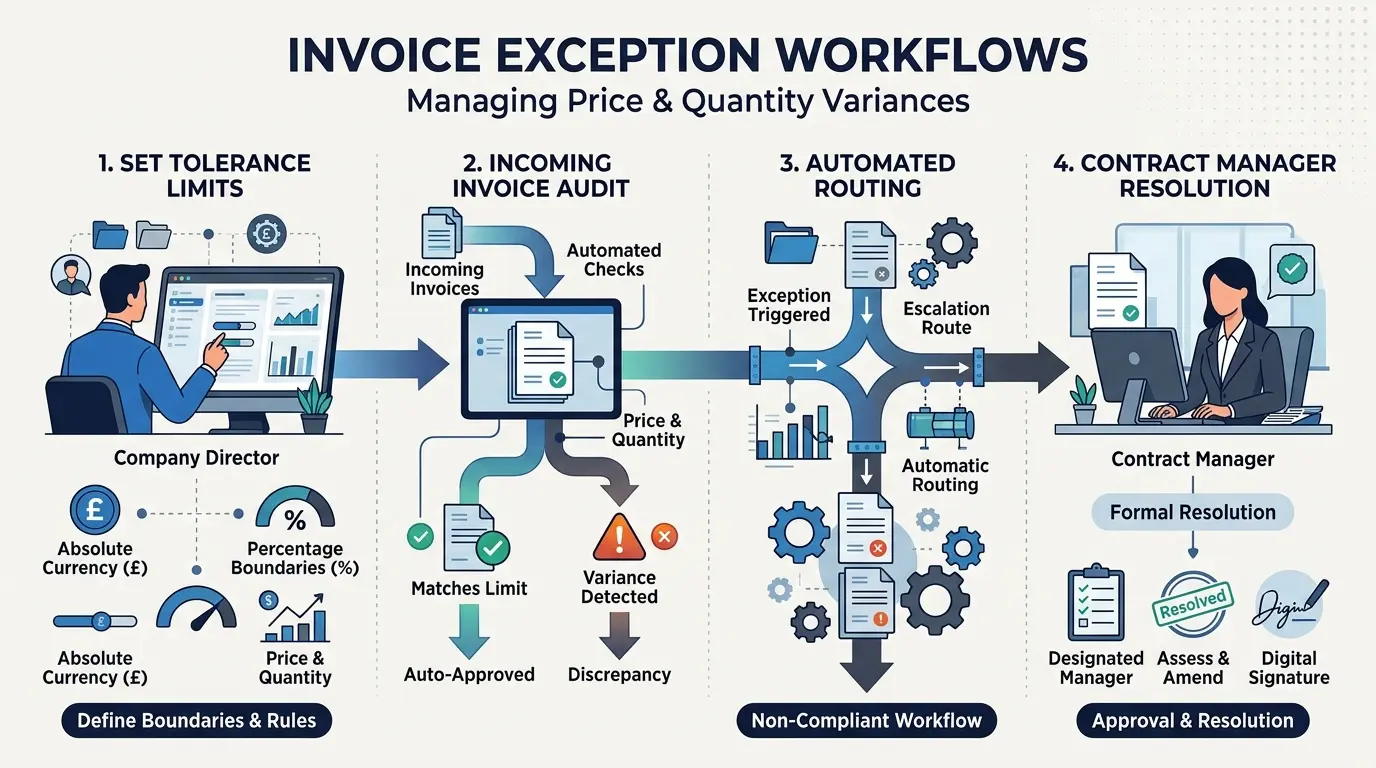
Tolerance limits prevent minor administrative discrepancies from halting corporate payment pipelines. Finance leadership configures tolerance thresholds within enterprise accounting systems based on historical transaction volumes and risk parameters.
Two primary tolerance categories apply to day rate processing:
Price Variance Tolerances: Percentage bounds applied to unit rate differences. Given that day rates follow fixed contractual schedules, price tolerances remain tight, typically setting zero-percent allowance for base rate variations.
Quantity Variance Tolerances: Thresholds applied to total billed units or hours. Quantity tolerances accommodate minor shifts in operational hours caused by rounding shifts across long project durations.
When an invoice breaches defined limits, automated system rules apply an immediate invoice hold. The system generates an exception record detailing the variance type, monetary impact, and source line items.
The resolution workflow follows a strict escalation matrix:
Level 1 Exception: Minor line-item variance within minor monetary boundaries. Accounts payable contacts the vendor to request a corrected invoice or credit note.
Level 2 Exception: Field-level discrepancy regarding operational status or days worked. System routes the exception to the site supervisor for explicit written confirmation or adjustment.
Level 3 Exception: Commercial dispute regarding rate interpretation or contract scope. Escalates to procurement and contract administration teams for legal and commercial review.
Clear tolerance frameworks reduce invoice processing cycle times while maintaining absolute control over financial disbursements.
How to Choose the Right Invoice Verification Model for Day Rate Contracts
Choosing the right invoice verification model requires evaluating contract risk, monthly transaction volume, internal system capabilities, and field authorization workflows.
Selecting a verification approach depends on balancing governance control with operational throughput. High-value day rate contracts demand multi-layered validation, whereas routine service agreements require streamlined processing to avoid administrative bottlenecks.
Decision-makers evaluate four strategic selection criteria:
Financial Risk Exposure: High daily expenditure rates warrant strict three-way or four-way matching frameworks with zero-percent price tolerances.
Operational Environment: Remote field operations require mobile-enabled service confirmation tools to capture digital signatures and reduce processing delays.
ERP Infrastructure: Advanced enterprise systems support automated rate card validation and rules-based exception routing, reducing manual processing effort.
Workforce Capability: Effective execution relies on staff across accounting, procurement, and site operations possessing practical skills in contract mechanics, variance analysis, and audit trail maintenance.
Organizational Criterion | Low-Complexity Model | Structured Three-Way Match | Enterprise Four-Way Match |
Contract Value Range | Low daily rates / Low total spend | Medium to high total contract value | High-risk, capital-intensive projects |
Field Log Integration | Manual paper signatures | Digital timesheet cross-referencing | Independent technical inspection sign-off |
Tolerance Tightness | Flexible percentage boundaries | Strict rate checks / Narrow quantity limits | Zero tolerance for unapproved scope |
Target Processing Time | 1 to 3 Business Days | 3 to 7 Business Days | 7 to 14 Business Days |
Implementing clear verification methodologies ensures that corporate expenditure remains controlled, transparent, and aligned with contractual agreements.
Frequently Asked Questions
What is Oil & Gas Petroleum Procurement?
Oil & Gas Petroleum Procurement is the strategic acquisition of machinery, raw materials, technical services, and specialized equipment required across upstream, midstream, and downstream operations. Programs from the Institute For Oil & Gas Training focus on managing high-value supply chains, vendor selection, commercial rate structures, and international contract compliance to ensure uninterrupted energy production.
Why is specialized procurement training essential in the petroleum industry?
Petroleum supply chains involve volatile commodity markets, complex regulatory frameworks, and significant operational risks that general purchasing practices cannot address. Training from the Institute For Oil & Gas Training equips industry professionals with targeted expertise in risk mitigation, day-rate contract verification, and total cost of ownership analysis tailored to energy operations.
How does oil and gas procurement differ from standard supply chain management?
Oil & Gas Petroleum Procurement differs from standard supply chain management due to strict HSE safety standards, high capital expenditure, and long lead times for specialized engineering assets. Additionally, energy sector sourcing relies heavily on strategic vendor relationship management, localized content requirements, and complex three-way matching frameworks.
What core skills are taught in an oil and gas procurement course?
A comprehensive Oil & Gas Petroleum Procurement curriculum covers strategic sourcing, international commercial terms (INCOTERMS), vendor pre-qualification, and contract negotiations. Courses delivered by the Institute For Oil & Gas Training also emphasize purchase order management, price variance controls, and inventory management for offshore and onshore environments.
How does effective procurement improve profitability for energy companies?
Effective Oil & Gas Petroleum Procurement minimizes project delays, reduces equipment downtime, and eliminates overbillings through rigorous invoice verification and supplier auditing. By optimizing contract terms and controlling purchase order commitments, energy companies preserve operational capital and maintain predictable project budgets.
Related training courses
3-Way Matching & Invoice Verification for Day-Rate Contracts Training Course
- Specialisation
- Oil & Gas Petroleum Procurement
- Duration
- 5 days · 15 CPD hours
Vendor Management & Local Content Requirements: Onboarding Training Course
- Specialisation
- Oil & Gas Petroleum Procurement
- Duration
- 5 days · 15 CPD hours
Financial Evaluation of Suppliers & Contractors: Tender Evaluation Training Course
- Specialisation
- Oil & Gas Petroleum Procurement
- Duration
- 5 days · 15 CPD hours
More articles

Vendor Management and Local Content Requirements Onboarding Training by Institute For Oil & Gas Training
Enroll in the Vendor Management and Local Content Requirements Onboarding Training by Institute For Oil & Gas Training. Master procurement compliance.
Read article →
How to Evaluate Vendor Onboarding Processes and Local Content Requirements in Oil and Gas
Learn how to evaluate vendor onboarding processes and local content requirements in oil and gas to reduce supply chain risk and maintain compliance.
Read article →
Why Effective Vendor Onboarding Matters in Oil and Gas Procurement
Discover why vendor onboarding drives supply chain compliance, risk mitigation, and local content success in oil and gas procurement.
Read article →