

Three way matching in day rate contracts is a financial verification process that reconciles purchase orders, service confirmations, and vendor invoices before payment authorization to eliminate billing errors, prevent overpayment, and ensure contractual compliance across capital-intensive enterprise operations.
Capital-intensive industries like oil and gas, construction, and IT consulting rely heavily on contingent workforces. Contractors in these sectors charge daily service fees rather than fixed project fees. Managing day rate contracts introduces operational complexity due to fluctuating work volumes, varying shift lengths, and site-specific rate cards. Without structured oversight, organisations experience financial leakage through duplicate billing, incorrect day rates, and unverified hours.
Three way matching addresses this vulnerability by creating an unbroken chain of authorization. The process compares three core documents:
The original Purchase Order (PO) detailing agreed terms and commercial rate cards.
The Service Confirmation (such as approved timesheets, field tickets, or job logs signed by operational managers).
The contractor's Vendor Invoice.
Payment processing occurs only when all three data points align within defined parameters.
Enterprise training in invoice verification equips finance and procurement teams with the analytical skill set required to audit complex contractor billings. Workforces trained in systematic reconciliation identify price variance, quantity variance, and unauthorized scope additions before disbursements leave corporate accounts. This financial safeguard mitigates operational risk, strengthens internal controls, and protects operating margins.
Why Do Organisations Experience Financial Leakage in Day Rate Contract Management?
Organisations experience financial leakage in day rate contract management because manual approval workflows, fragmented timesheet systems, lack of rate card validation, and poor cross-departmental communication between field operations and accounts payable allow unverified contractor invoices to bypass internal audits.
Managing contingent labour costs across large-scale projects presents significant structural challenges. Disconnects between field supervisors approving site work and accounts payable personnel processing payments create systemic vulnerabilities.
Skill gaps in vendor management exacerbate these challenges. Field managers frequently focus on operational milestone delivery rather than financial compliance. Consequently, site supervisors routinely sign off on incomplete timesheets without cross-referencing master service agreement rate structures. When these unvalidated timesheets arrive at accounts payable, processors lack site-level context and process payments based solely on operational signatures.
Corporate training addresses these skill gaps directly. Structured learning programs educate cross-functional teams on invoice risk identification, contract interpretation, and automated verification systems. Upskilling employees in audit methodologies standardizes invoice review procedures across all operational sites.
How Does Three Way Matching Work in Corporate Environments?
Three way matching works in corporate environments through an automated, multi-stage workflow that ingests purchase order terms, validates field-approved service confirmations, cross-checks invoice line items, enforces tolerance limits, and routes variance exceptions to management for resolution prior to payment.
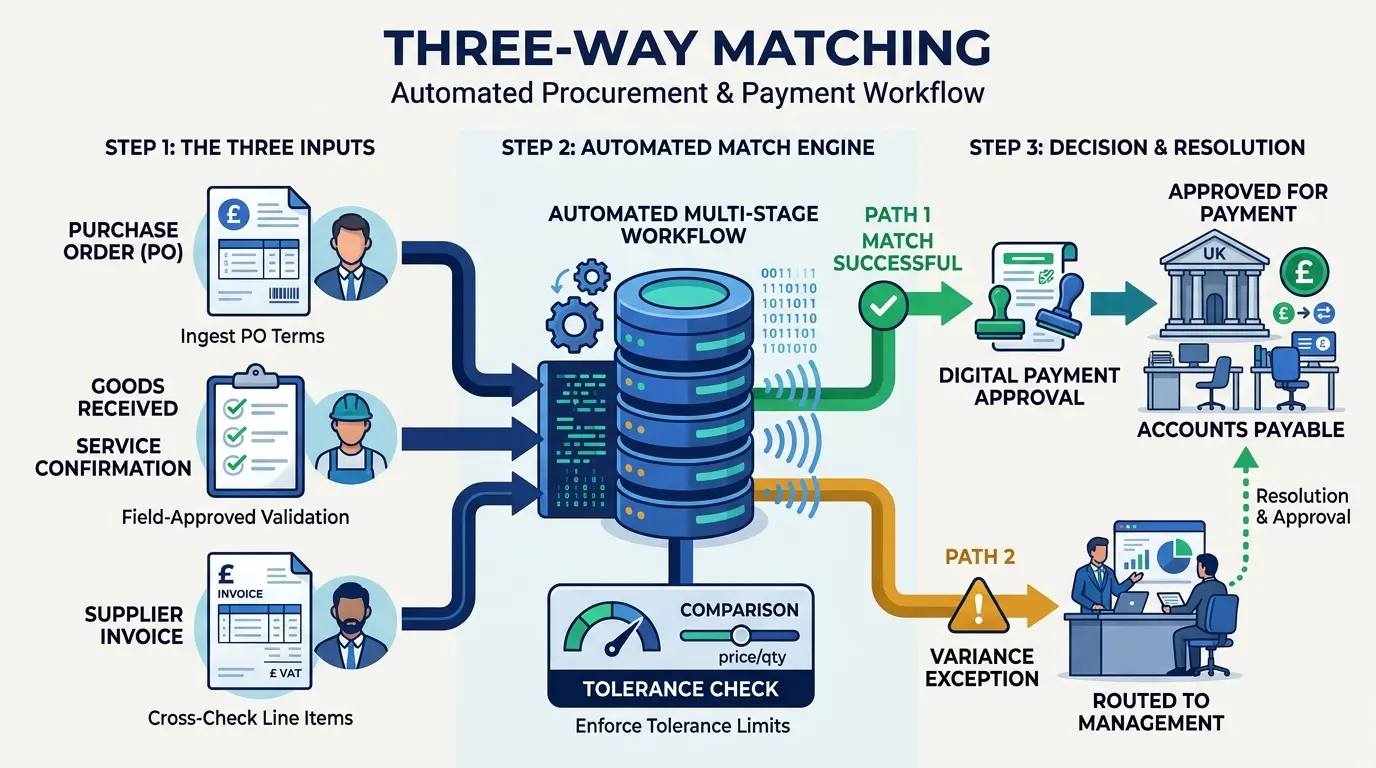
The operational execution of three way matching relies on clear integration between procurement, field management, and financial operations.
Stage 1: Purchase Order Establishment
Procurement teams negotiate master service agreements detailing rate cards, daily shift expectations, equipment allowances, and expense re-bill rules. The Enterprise Resource Planning (ERP) system generates a tracked purchase order capturing these exact line-item parameters.
Stage 2: Service Execution and Field Confirmation
Contractors perform daily operational duties on site. Field supervisors log attendance, hours, and daily output through field tickets or digital timesheet systems. Upon completing the work cycle, operational managers verify the log, producing a formal service confirmation.
Stage 3: Invoice Submission and Automated Verification
The contractor submits a commercial invoice referencing the specific purchase order number. Enterprise financial software ingests the document using Optical Character Recognition (OCR) and compares three primary variables:
Unit prices billed against contractual PO rate cards (price variance).
Total days or hours claimed against approved service confirmations (quantity variance).
Line-item expense claims against pre-approved allowance rules.
If the invoice matches within strict financial tolerance limits (often set at 0.00% for day rates), the ERP system schedules automated payment release.
Stage 4: Exception Handling and Invoice Resolution
When discrepancies occur—such as an unapproved weekend surcharge or an incorrect day rate calculation—the system places an invoice hold and release flag on the transaction. Accounts payable specialists then investigate the discrepancy, requiring vendor correction or contract adjustment before releasing funds.
Structured workforce training ensures that procurement personnel, field managers, and financial controllers execute each step of this workflow without operational friction.
What Core Components Define a Robust Invoice Verification Framework?
A robust invoice verification framework comprises four core components: standardized rate card validation rules, strict price and quantity variance controls, defined tolerance limit thresholds, and clear invoice hold and release protocols supported by continuous workforce training.
Organizations building internal capabilities must structure their contract audit frameworks around specific operational pillars:
Rate Card Validation
Rate cards establish baseline pricing for personnel categories, shift patterns, standby periods, and specialized machinery. Effective frameworks store digital rate cards within ERP databases, preventing contractors from submitting invoices based on updated or unapproved pricing sheets.
Variance Detection Metrics
System controls must isolate two distinct financial deviations:
Price Variance: Discrepancies between the rate specified on the PO and the rate billed on the invoice.
Quantity Variance: Discrepancies between the days confirmed on field logs and the days billed by the vendor.
Separating these variances helps financial auditors pinpoint whether leakage stems from operational misreporting or vendor billing errors.
Matching Methodologies
Organizations select matching controls based on transaction risk profiles:
For comprehensive guidance on operationalizing these reconciliation steps within complex contracts, teams should review how to verify invoices against purchase orders and service confirmations in day rate contracts to streamline audit efficiency.
Tolerance Limits and Hold Protocols
Tolerance limits define permissible thresholds for automated clearing. While physical goods procurement may tolerate small shipping weight variances (e.g., 1.5%), day rate service contracts typically require 0.00% price tolerance. When line items breach parameters, automated holds freeze payment queues, protecting corporate liquidity while initiating formal unmatched invoice resolution procedures.
How Do Organisations Implement Three Way Matching Training Across Workforces?
Organisations implement three way matching training across workforces by conducting role-based skills assessments, designing blended learning programs incorporating realistic case simulations, establishing cross-functional audit standards, and tracking competency retention through practical verification assessments.
Corporate implementation requires structured educational frameworks tailored to enterprise operating models.
Step 1: Training Needs Analysis (TNA) and Capability Mapping
Organisations evaluate existing financial oversight capabilities across departments like finance, procurement, site management, and internal audit. The analysis identifies specific operational knowledge gaps, such as incorrect ERP coding, failure to verify field logs, or poor understanding of contract liability clauses.
Step 2: Curriculum Architecture and Learning Design
L&D professionals design targeted learning tracks tailored to specific operational roles:
Accounts Payable Specialists: Advanced ERP exception handling, optical data extraction audit, variance analysis, and tolerance management.
Field Managers and Engineers: Contractually compliant timesheet logging, daily work scope verification, and vendor field ticket oversight.
Procurement Managers: Structure of clear PO rate cards, contract clause design, and vendor dispute management.
Step 3: Hybrid Delivery Methodologies
Modern corporate training integrates multiple delivery modalities over a 4 to 8-week learning schedule:
Interactive Workshops: Instructor-led sessions focusing on complex contract scenarios, legal liability, and dispute negotiation.
Simulated ERP Scenarios: Hands-on practice using sandbox financial environments where participants process live invoice exceptions, apply tolerance rules, and resolve line-item discrepancies.
Case-Based Learning: Group analysis of real-world corporate billing audits, identifying overpayment patterns and root causes.
To build structured invoice control competencies across procurement and accounts payable teams, corporate decision-makers enroll staff in the 3-Way Matching & Invoice Verification for Day-Rate Contracts Training Course.
Step 4: Assessment and Certification
Participants complete practical assessments requiring them to audit complex, multi-day contractor submissions containing deliberate errors—such as incorrect shift multipliers, unapproved equipment charges, and mismatched PO line items. Competency certification requires a minimum 95% error-detection rate.
What Measurable Business Outcomes Does Three Way Matching Produce?
Three way matching produces measurable business outcomes by reducing financial overpayments by up to 12%, shortening invoice processing cycle times, decreasing vendor billing disputes, improving audit compliance, and maximizing cash flow visibility across corporate operations.
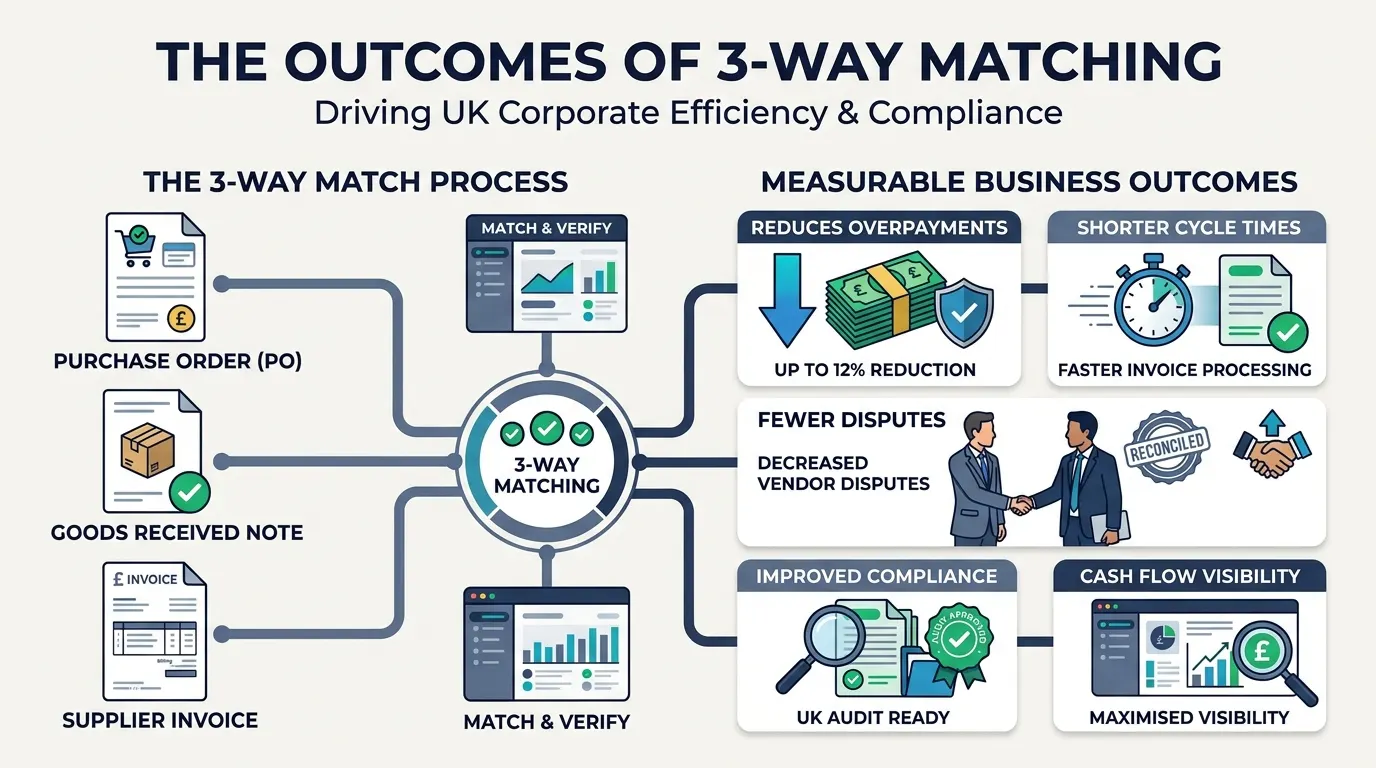
Investing in structured workforce development yields quantifiable improvements across key performance indicators (KPIs) in finance, supply chain, and operations.
Financial Overpayment Elimination
Standardized verification training stops unearned cash leakage. Organisations auditing contingent workforce invoices using automated three way matching routinely recover between 8% and 12% in misallocated annual operating budget.
Accelerated Processing and Operational Efficiency
Manual invoice handling creates processing bottlenecks, resulting in missed vendor payment terms and late payment penalties. Standardizing matching procedures speeds up verification workflows. Automated routing clears compliant invoices instantly, allowing accounts payable teams to focus exclusively on exception handling.
Strengthened Governance and Audit Readiness
Regulatory frameworks like Sarbanes-Oxley (SOX) and international financial accounting standards require verifiable internal controls over corporate expenditures. Three way matching establishes a clear, auditable trail for every transaction. Internal and external auditors can trace any invoice line item directly back to its approving field ticket and foundational purchase order.
Enhanced Contractor Relationships
Unclear approval workflows result in delayed payments, strained vendor relationships, and project delivery friction. Clear verification procedures set transparent billing expectations for suppliers. Vendors receiving fast, consistent payments offer better commercial terms, prioritize resource allocation, and collaborate closely on project deliverables.
What Common Problems Cause Invoice Verification Training to Fail?
Invoice verification training fails when programs rely on generic theoretical concepts, lack hands-on ERP system practice, train departments in isolation, ignore real-world contract complexity, and fail to track post-training financial performance metrics.
Corporate decision-makers must avoid common pitfalls when designing or purchasing workforce development programs:
1. Separation of Finance and Operational Teams
Training accounts payable staff without involving site managers creates an operational mismatch. Field supervisors continue signing ambiguous timesheets, while finance processors reject invoices without understanding site conditions. Effective training brings finance, procurement, and field operations into shared workshops to align on verification standards.
2. Over-Reliance on Theoretical Frameworks
Informational lectures detailing accounting definitions do not build audit capability. Learners require hands-on practice analyzing ambiguous contract clauses, verifying fragmented field logs, and identifying intentional vendor over-billing tactics.
3. Ignoring Systemic ERP Workflows
Theoretical training fails if employees cannot translate verification principles into their daily enterprise software interface. Training must incorporate practical exercises within real or simulated ERP environments (such as SAP, Oracle, or Microsoft Dynamics 365) to build functional software competency.
4. Absence of Post-Training Performance Tracking
Organisations frequently measure success based solely on training completion rates rather than financial accuracy outcomes. Without tracking post-training invoice error rates, cycle time reductions, and variance capture, decision-makers cannot assess program Return on Investment (ROI) or identify areas requiring ongoing coaching.
By implementing outcome-based, role-tailored training programs, organisations transform invoice verification from a reactive administrative burden into a proactive financial control mechanism that protects corporate profitability and optimizes workforce productivity.
Frequently Asked Questions
What is oil and gas petroleum procurement?
Oil & Gas Petroleum Procurement is the strategic process of sourcing, purchasing, and managing materials, equipment, and specialized services required for upstream, midstream, and downstream energy operations. The Institute For Oil & Gas Training provides comprehensive professional development programs that equip supply chain personnel with the skills needed to manage complex international vendor networks and mitigate financial risk.
What are the main components of the oil and gas procurement lifecycle?
The petroleum procurement lifecycle encompasses demand forecasting, vendor pre-qualification, contract negotiations, purchase order creation, and post-award contract management. Through specialized training at the Institute For Oil & Gas Training, logistics and supply chain professionals learn to execute these stages while ensuring compliance with stringent safety regulations and commercial quality standards.
How does specialized procurement training improve energy sector supply chain management?
Specialized procurement training addresses critical workforce skill gaps in inventory control, price variance analysis, global sourcing, and risk assessment tailored to capital-intensive energy projects. Professionals upskilled through the Institute For Oil & Gas Training gain practical experience in streamlining acquisition workflows, reducing supply lead times, and optimizing operational expenditure.
Why is vendor management critical in petroleum industry procurement?
Effective vendor management ensures suppliers adhere to strict technical specifications, international safety codes, and contractual delivery timelines in demanding operating environments. The Institute For Oil & Gas Training teaches procurement specialists how to conduct rigorous performance audits, manage contractor rate cards, and prevent financial leakage across complex day-rate and service-level agreements.
How do procurement teams control costs in capital-intensive oil and gas projects?
Procurement teams control costs by utilizing structured financial verification frameworks, such as three-way matching, alongside automated spend analytics and strategic contract negotiation. The Institute For Oil & Gas Training trains procurement and finance teams to validate rate structures against service receipts, minimizing price and quantity variances across major energy exploration and production operations.
Related training courses
Procure-to-Pay (P2P) End-to-End Process for Oil & Gas Training Course
- Specialisation
- Oil & Gas Petroleum Procurement
- Duration
- 5 days · 15 CPD hours
3-Way Matching & Invoice Verification for JV Chargeability Training Course
- Specialisation
- Oil & Gas Petroleum Procurement
- Duration
- 5 days · 15 CPD hours
Financial Evaluation of Suppliers & Contractors: Credit Assessment Training Course
- Specialisation
- Oil & Gas Petroleum Procurement
- Duration
- 5 days · 15 CPD hours
More articles

Financial Evaluation of Suppliers and Contractors Tender Evaluation Training by Institute For Oil & Gas Training
Evaluate commercial bids effectively. Join the Financial Evaluation of Suppliers & Contractors: Tender Evaluation Training Course today.
Read article →
How to Evaluate Supplier and Contractor Financial Proposals During Tendering
Learn how to evaluate supplier and contractor financial proposals during tendering through structured cost modeling and risk analysis.
Read article →
Why Financial Evaluation Is Critical in Oil and Gas Supplier Selection
Learn why financial evaluation of oil and gas suppliers mitigates supply chain risks, ensures financial stability, and improves tender decisions.
Read article →