

Cost coding establishes a structured numerical or alphanumeric taxonomy that maps project expenditures directly to specific work packages, activities, and budget lines. It enables real-time tracking of committed versus incurred costs, simplifies variance analysis, and provides financial visibility across complex engineering, procurement, and construction lifecycles.
In capital-intensive sectors like upstream and downstream energy, financial control breaks down when field expenditures operate in isolation from budget structures. Understanding why cost coding is essential for accurate oil and gas cost control provides the foundation for linking field-level work execution with accounting ledgers. Corporate finance and project management teams must systematically apply cost coding hierarchies to measure performance, forecast final costs, and mitigate budget overruns before they compound.
What Is the Core Structure of an Effective Cost Coding System?
An effective cost coding system relies on a hierarchical framework that mirrors the Work Breakdown Structure (WBS) and Cost Breakdown Structure (CBS). It assigns unique identifiers to every task, resource type, and cost element to deliver granular visibility across project lifecycles.
The backbone of any cost tracking operation is absolute alignment between physical execution and financial accounting. A Work Breakdown Structure decomposes a project into manageable deliverables, while a Cost Breakdown Structure organizes project costs into defined financial categories such as direct labor, equipment, materials, and subcontracting services. Combining these two structures creates a multi-dimensional matrix. In this matrix, every field activity has a matching financial bucket.
Establishing a rigid cost coding discipline ensures that team members enter data consistently across purchase orders, timesheets, and contractor invoices. Without strict rules, field personnel classify expenditures into generic overhead buckets, obscuring true cost drivers. A standardized coding structure requires specific code segments for the location, discipline, asset class, and expense type. This level of detail allows project controls personnel to trace a variance on an invoice directly back to a single work package or subcontractor.
Maintaining coding discipline requires clear rules for code creation and assignment across all operating divisions. Project managers must enforce standard operating procedures so field operations, procurement teams, and corporate accounting use identical code definitions. When coding structures are uniform, organizations easily aggregate data across multiple project portfolios, run comparative benchmark analyses, and eliminate misallocations during monthly financial closes.
How Does Cost Coding Enable Precise Incurred and Committed Cost Tracking?
Cost coding differentiates committed costs from incurred costs by tagging purchase orders and contracts at execution, then linking them to actual work performed. This real-time visibility prevents cash flow surprises and flags potential budget overruns before invoices arrive.
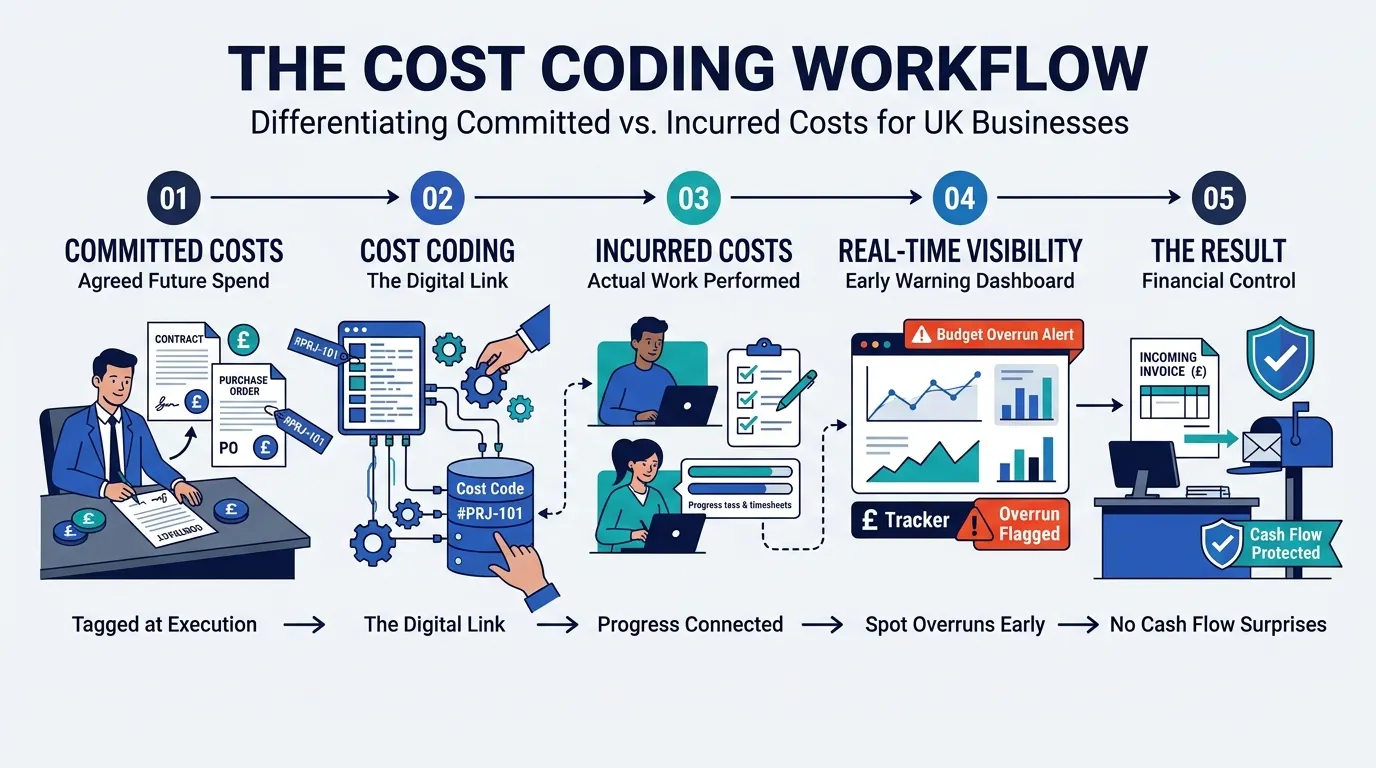
Traditional financial accounting focuses on historical data by recording actual expenditures only when vendor invoices are approved and paid. In contrast, project cost control requires real-time insight into future cash obligations. Committed costs represent legal obligations such as signed contracts, approved purchase orders, and rental agreements where funds are pledged but not yet paid. Incurred costs reflect work actually completed, materials delivered, or services consumed on site regardless of billing status.
By assigning cost codes at the moment a purchase requisition or contract is created, the system locks in the commitment against the designated budget line item. As physical work progresses on-site, project controls teams log the Value of Work Done (VOWD) against the same cost code. Comparing committed costs to actual VOWD highlights pending liabilities and exposes gaps between contract commitments and actual field execution.
Tracking committed and incurred costs side-by-side using unified cost codes gives project managers early warning of budget variances. For example, if a procurement team commits 90% of a work package budget before field installation begins, project controls can immediately investigate scope creep or supplier price increases. This proactive tracking approach shifts project management from reactive historical reporting to active financial stewardship.
How Do You Perform Variance Analysis Using Earned Value Management?
Earned Value Management uses cost-coded performance data to compare Planned Value, Earned Value, and Actual Cost. Calculating key indices like the Cost Performance Index exposes variances, allowing teams to accurately project final costs at completion.
Variance analysis quantifies the difference between planned financial performance and actual project execution. Earned Value Management (EVM) serves as the primary analytical framework for this evaluation. EVM uses three core metrics, all derived from cost-coded field data: Planned Value (PV), which is the authorized budget allocated to scheduled work; Earned Value (EV), which is the budgeted value of work actually completed; and Actual Cost (AC), which is the total cost incurred for the work completed.
Integrating cost codes with EVM allows project managers to calculate the Cost Performance Index ($CPI = EV / AC$) at any level of the project hierarchy. A CPI of 0.85 on a specific cost code indicates that the project is receiving 85 pence of value for every pound spent. Identifying this variance early allows project teams to calculate a realistic Estimate to Complete (ETC) and update the Estimate at Completion (EAC). The calculation ($EAC = Budget / CPI$) projects total costs based on current spending trends.
Accurate cost coding also supports structured contingency drawdown tracking. Unforeseen site conditions, weather delays, and engineering changes require allocations from project contingency reserves. Tagging contingency releases to original work package cost codes helps project directors track why and where reserves are spent. This documentation maintains transparency, supports formal change management, and preserves the baseline budget's integrity.
What Are the Main Approaches to Implementing Cost Coding and Variance Analysis?
Organizations implement cost coding through dedicated project control software, customized ERP modules, or specialized team training. Selection depends on existing software infrastructure, workforce skill levels, and the complexity of project portfolios.
Establishing cost coding and variance analysis across an enterprise requires choosing an execution model that fits organizational capabilities. Companies generally choose between software-driven automation, enterprise resource planning (ERP) integration, or formal workforce competency training.
Comparison of Cost Control Implementation Approaches
Evaluation Attribute | Specialized Project Control Software | Integrated Enterprise ERP System | Structured Team Capability Building |
Primary Focus | Deep EVM modeling and complex field variance analysis | Enterprise-level accounting, ledger consolidation, and procurement | Standardized coding discipline, practical EVM execution, and cross-departmental alignment |
Implementation Timeline | 3 to 6 months | 9 to 18 months | 1 to 3 months |
Data Accuracy Impact | High for field metrics; risks isolation from main accounting ledgers | High for corporate ledgers; often lacks field-level granularity | High across all systems; resolves root-cause data entry errors at the source |
Workforce Adoption Barrier | Moderate; requires specialized software skills | High; complex interfaces often result in field user workarounds | Low; builds direct operational competency using existing software tools |
Capital Investment | Moderate to High recurring software licensing fees | Extremely High initial deployment and maintenance costs | Low to Moderate targeted professional development expenditure |
Organizations often struggle when they rely entirely on software solutions without addressing workforce skill gaps. Software platforms process input data accurately, but if project managers, engineers, and buyers assign incorrect cost codes, output reports remain flawed. Enterprise ERP platforms offer comprehensive ledger management, but their complex interfaces can lead site staff to select incorrect codes just to clear paperwork.
Capability building addresses the human element of cost management. Training teams in cost coding mechanics, EVM calculations, and variance analysis creates consistent discipline across project operations. Teams learn to interpret metrics like CPI, manage contingency drawdowns accurately, and maintain data integrity regardless of the software platform in use.
How Can HR and Operations Leaders Select the Right Implementation Framework?
Selecting an implementation framework requires evaluating internal competency gaps, portfolio complexity, and system integration needs. Organizations must balance software capabilities with targeted training to ensure lasting operational adoption.
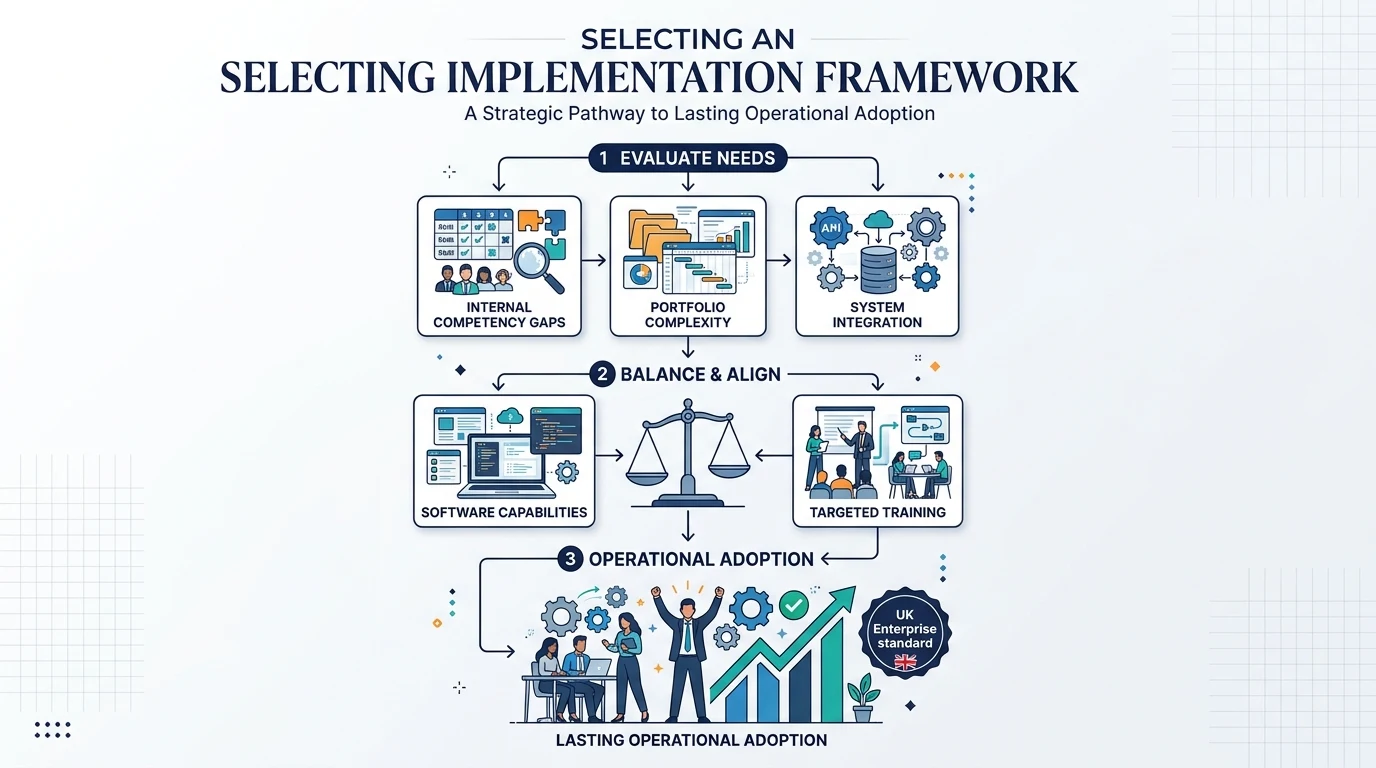
HR leaders and operational directors must evaluate several criteria before choosing a cost control delivery model. Deploying advanced software without a trained workforce leads to poor data quality, misallocated budgets, and inaccurate EAC forecasting.
Decision Framework for Organizational Cost Control Strategy
Organizational Assessment Criterion | Recommended Strategy Option | Strategic Justification and ROI Outcome |
High data error rate from manual entry and miscoding | Integrated Capability Building Program | Resolves operational skill gaps, enforces coding discipline at the field level, and improves data accuracy by over 40% without new software overhead. |
Complex multi-asset portfolio with custom EVM needs | Specialized Software + Targeted Workforce Upskilling | Combines advanced EVM software features with structured training to maximize software utilization and secure measurable ROI. |
Need for unified financial reporting across regional business units | Integrated Enterprise ERP Implementation | Standardizes chart of accounts and cost breakdown structures across global units, establishing a single source of truth for corporate audit and financial reporting. |
High variance between committed costs and final invoice amounts | Specialized Cost Control & Variance Analysis Using Cost Coding Training Course | Equips procurement, finance, and project leads to establish clear commitment tracking rules, manage VOWD, and standardize contingency drawdown procedures. |
Organizations achieve optimal performance by matching their learning delivery model to operational realities. Short workshops work well for addressing specific process updates, while comprehensive interactive training builds deep competency across cross-functional teams. Training engineers, project controls professionals, and finance managers together breaks down departmental silos and establishes common data standards across the organization.
Measuring the return on investment (ROI) of cost control training involves monitoring operational KPIs over subsequent project cycles. Key performance metrics include lower misallocation rates on invoices, faster monthly variance reporting, and tighter alignment between Estimate at Completion forecasts and actual final costs. Investing in workforce capability ensures that cost coding functions as a strategic financial control system rather than an administrative burden.
How Do Structured Training Delivery Models Compare for Engineering and Project Teams?
Training delivery models range from self-paced online modules to customized corporate workshops. Choosing the right model depends on workforce distribution, operational urgency, and the need for hands-on application to live project data.
When building team competency in cost coding discipline, Earned Value Management, and variance analysis, HR and operational leaders must select a learning framework that fits their operational schedule. Training programs must balance theoretical instruction with practical, industry-specific application.
For organizations managing active capital projects, intensive corporate training tailored to real-world workflows delivers immediate operational improvements. Interactive workshops allow teams to bring current project data, review existing cost breakdown structures, and standardize coding guidelines during the program. This practical approach ensures participants return to work ready to apply earned value metrics and forecast EAC accurately.
Training Program Evaluation Matrix
Successful corporate training programs deliver measurable performance improvements within 30 to 90 days of completion. Organizations routinely report a 35% reduction in cost code misallocations on timesheets and purchase orders, alongside faster monthly reporting cycles. Equipping project teams with standardized frameworks for cost coding, committed cost tracking, and EVM variance analysis transforms project controls into a reliable driver of financial predictability.
To build these competencies across your project, finance, and procurement teams, explore the comprehensive Cost Control and Variance Analysis Using Cost Coding Training by Institute For Oil & Gas Training program. This practical course provides the frameworks, coding rules, and EVM tools required to protect project margins and deliver consistent cost control across your portfolio.
Frequently Asked Questions
What is covered in an oil and gas petroleum budgeting and cost control course?
An oil and gas petroleum budgeting and cost control course covers financial planning, Work Breakdown Structure (WBS) integration, committed cost tracking, and Earned Value Management (EVM). Participants learn how to construct baseline operational budgets, analyze cost variances, and manage financial risks across upstream, midstream, and downstream asset lifecycles. Corporate training from the Institute For Oil & Gas Training provides practical tools to help project controls and finance professionals prevent cost overruns.
Why is cost control critical in petroleum project management?
Cost control is vital in petroleum project management due to high capital expenditures, price volatility, and complex supply chain logistics. Effective cost tracking ensures that field expenditures, contractor commitments, and equipment procurement align with authorized baseline budgets. Utilizing standardized cost coding frameworks enables project leads to spot financial variances early and maintain profit margins on major energy assets.
How does cost coding improve variance analysis in energy sector budgeting?
Cost coding assigns standardized alphanumeric tags to specific work packages, creating a direct link between physical site progress and financial accounting ledgers. This structured taxonomy allows project managers to measure the Value of Work Done (VOWD), calculate the Cost Performance Index (CPI), and forecast accurate Estimate at Completion (EAC) metrics. Through Oil & Gas Petroleum Budgeting & Cost Control instruction, organizations establish consistent coding discipline to streamline monthly financial reporting.
Who should attend petroleum budgeting and cost control training?
Petroleum budgeting and cost control training is designed for project managers, cost engineers, financial analysts, project control specialists, and commercial leads in the energy industry. It is also highly beneficial for HR directors looking to bridge financial competency gaps across engineering and operational teams. Programs delivered by the Institute For Oil & Gas Training equip cross-functional professionals with the tools needed to manage risk and enforce budget accountability.
How do oil and gas companies measure the ROI of financial capability training?
Oil and gas companies evaluate the ROI of financial capability training by tracking key operational metrics, such as reductions in invoice misallocation rates and improved forecasting accuracy. Standardizing budgeting processes leads to faster monthly closes, fewer unapproved contingency drawdowns, and tighter control over committed costs. Implementing Oil & Gas Petroleum Budgeting & Cost Control frameworks directly enhances project profitability and operational efficiency.
Related training courses
CAPEX vs OPEX Classification & Decision Rules Training Course
- Specialisation
- Oil & Gas Petroleum Budgeting & Cost Control
- Duration
- 5 days · 13 CPD hours
Cost Control & Variance Analysis Using Cost Coding Training Course
- Specialisation
- Oil & Gas Petroleum Budgeting & Cost Control
- Duration
- 5 days · 15 CPD hours
Budget Management and Management Control in the Oil & Gas Industry
- Specialisation
- Oil & Gas Petroleum Budgeting & Cost Control
- Duration
- 5 days · 15 CPD hours
More articles

Cost Control for Field Development Projects Overrun Prevention Training by Institute For Oil & Gas Training
Explore the Cost Control for Field Development Projects Overrun Prevention Training Course by Institute For Oil & Gas Training for corporate team skill gain.
Read article →
How to Identify Cost Overrun Risks and Apply Effective Prevention Strategies
Learn how to identify cost overrun risks in field development and apply proven prevention strategies to protect project capital and performance.
Read article →
Why Cost Overruns Occur in Oil and Gas Field Development Projects
Discover why cost overruns occur in oil and gas field development projects and how workforce training mitigates financial risks for energy firms.
Read article →