
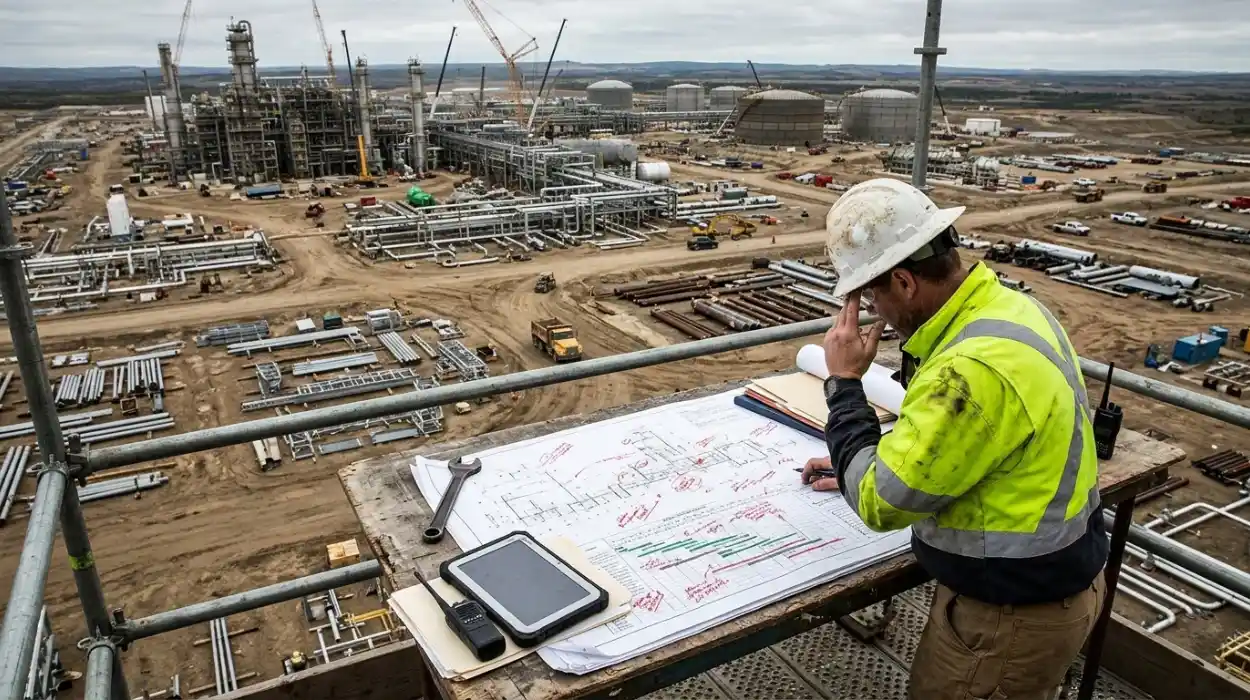
A cost overrun in oil and gas field development projects is an unbudgeted expenditure that exceeds the baseline capital allocation. It impacts organizational profitability, reduces project net present value, and delays financial returns across multi-year asset development lifecycles.
In large-scale energy infrastructure, cost overruns stem from systemic misalignments between technical planning, financial governance, and contractor execution. Field development projects involve high capital expenditure (CAPEX), complex supply chains, and dynamic subsurface environments. When initial financial forecasts fail to reflect these operational realities, budget variance occurs.
Organisations view cost overruns not merely as accounting errors, but as critical indicators of structural workforce skill gaps in project governance. In modern energy firms, addressing project cost control requires structured capability building across cross-functional project management offices (PMOs), procurement departments, and technical engineering units.
From an organizational performance perspective, understanding project expenditure variance requires breaking down technical and commercial drivers across the project lifecycle.
Lifecycle Phase | Primary Cost Overrun Driver | Organisational Risk Impact | Targeted Workforce Skill Area |
Front-End Engineering Design (FEED) | Incomplete scope definition & optimistic cost estimations | Baseline budget inflation up to 40% | Scope definition, engineering economics, feasibility modeling |
Procurement & Contracting | Poor contract drafting & unaligned commercial incentives | Subcontractor claims & unverified rates | Commercial negotiation, reimbursable cost verification |
Execution & Construction | Scope creep, schedule delays & unmanaged design changes | Compounded daily burn rates & standing time charges | Variation management, real-time cost tracking, change control |
Commissioning & Close-Out | Delayed capitalization & poor documentation handover | Deferred revenue generation & unrecovered expenditure | Project capitalisation, asset ledger reconciliation |
Why Do Cost Overruns Occur in Complex Energy Assets?
Cost overruns occur due to incomplete front-end engineering design, inadequate risk identification, ineffective contractor cost reporting, unmanaged design variations, and poor integration between project engineering teams and financial control departments during execution phases.
The root causes of financial slippage in upstream and midstream operations divide into technical, commercial, and human execution factors.
Technical Root Causes
Incomplete engineering definitions during the early decision gates directly trigger cost escalations later in the project schedule.
Front-End Engineering Design (FEED) Incompleteness: Committing capital before achieving 30% to 40% engineering maturity leads to mid-execution design modifications.
Subsurface and Environmental Uncertainties: Unexpected reservoir characteristics or geohazards force structural re-engineering of off-shore platforms or subsea architecture.
Scope Creep: Continuous additions to asset functional requirements without corresponding adjustments to the approved budget baseline increase overall expenditure.
Commercial and Contractual Root Causes
Commercial governance failures exacerbate physical execution delays, transferring financial liabilities back to the asset owner.
Flawed Contractor Cost Reporting: Project sponsors often rely on lagging financial indicators from contractors, obscuring real-time budget burn rates.
Unverified Reimbursable Costs: Without strict auditing procedures, reimbursable contract models lead to over-billing for equipment hire, labor hours, and third-party services.
Variation and Claim Costs: Uncontrolled variation orders submitted by engineering, procurement, and construction (EPC) contractors inflate final project expenditures beyond contingency thresholds.
Workforce and Skill-Based Root Causes
Organizational research highlights that technical expertise alone does not prevent budget variance; financial acumen among technical leads is critical.
Siloed Departmental Operations: Engineering teams often make technical alterations without evaluating the commercial impact with project finance teams.
Lack of Standardised Competencies: Project managers may lack formal training in cost engineering methods like Earned Value Management (EVM) or quantitative risk analysis.
Inadequate Forecast Capabilities: Teams frequently fail to forecast final cost trajectories early enough to apply corrective operational adjustments.
How Does Corporate Training Address Project Cost Control Gaps?
Corporate training addresses cost control gaps by establishing standardized financial governance competencies, teaching real-time cost tracking methodologies, enhancing contract administration capabilities, and aligning technical engineering decisions with commercial project goals.
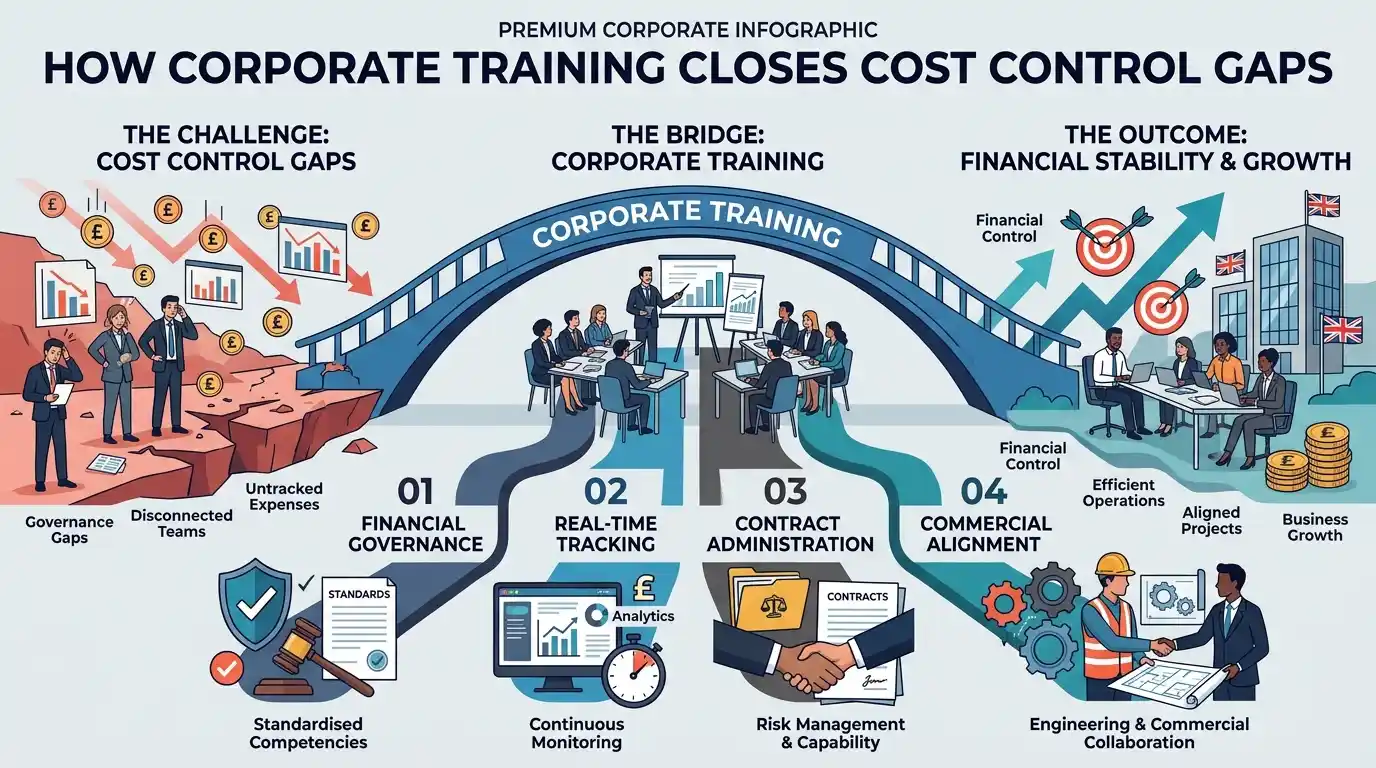
To mitigate financial leakage, energy sector organizations deploy structured learning programs designed for multi-disciplinary project teams. Rather than treating cost management as an isolated accounting function, effective corporate learning integrates financial discipline into daily engineering and operational workflows.
Structured Learning Architecture
Modern workforce development models for project controls follow a blended, outcome-based framework to ensure skill acquisition translates into measurable asset performance.
Diagnostic Assessment: Evaluating current PMO, engineering, and finance capabilities against international cost engineering standards.
Core Knowledge Delivery: Imparting fundamental principles of cost estimation, risk quantification, and contract auditing through interactive modules.
Applied Practical Exercises: Utilizing real-world field development datasets to practice calculating budget variances and analyzing contractor claims.
Governance Integration: Embedding standardized templates, verification checklists, and reporting frameworks directly into daily corporate workflows.
Training delivery formats adapt to organizational structures, utilizing three primary modes:
Executive Strategy Workshops: Concentrated 2-day to 3-day sessions for project directors focusing on capital allocation governance, risk appetite setting, and portfolio-level financial tracking.
Interactive Technical Modules: 4-week to 8-week structured blended learning courses for project engineers, cost control staff, and procurement specialists covering granular analytical methods.
Simulation-Based Cohort Training: Intensive team-based learning where cross-functional units manage a simulated offshore asset development project, navigating mid-project scope changes and budget constraints.
What Key Components Must a Cost Control Training Framework Include?
A cost control training framework must include cost estimation methodologies, contract management protocols, variation handling processes, real-time earned value analysis, reimbursable cost audit techniques, and project capitalization frameworks.
An enterprise-ready training curriculum in field development cost control integrates six core knowledge domains:
1. Cost Overrun Root Cause Analysis & Estimation Controls
Participants learn to identify early warning signs of budget slippage and master parametric, deterministic, and probabilistic cost estimation tools (such as Monte Carlo simulations). Understanding cost overrun root causes allows project leads to establish realistic contingency funds rather than relying on arbitrary percentage additions.
2. Commercial Contract Management & Reimbursable Auditing
Training must equip teams to navigate EPC, Engineering, Procurement, Construction Management (EPCm), and Risk-Reward contract structures. Professionals gain practical skills in reimbursable cost verification, ensuring that contractor invoices align strictly with agreed rate sheets, equipment utilization logs, and verified milestone completions.
3. Variation and Claim Management Systems
Unmanaged change requests destroy project margins. A robust program teaches structured change control processes, enabling engineers to quantify the variation and claim cost impact before approving scope modifications.
4. Forecasting and Earned Value Management (EVM)
Learners master EVM metrics, including Cost Performance Index (CPI), Schedule Performance Index (SPI), and Estimate at Completion (EAC). Establishing these metrics empowers managers to accurately forecast final cost outcomes at 20% project completion, leaving sufficient runway for operational interventions.
5. Cost Recovery and Expenditure Verification
Commercial teams learn strategies for the cost recovery of project expenditure under joint operating agreements (JOAs) and production sharing contracts (PSCs). Training ensures that all eligible operational expenditures are correctly classified and recovered from partner entities or state oil companies.
6. Asset Capitalization and Project Close-Out
The learning framework covers the financial mechanics of project capitalisation and close-out, teaching teams how to transition physical assets into corporate accounting ledgers cleanly, reconcile open purchase orders, and complete post-project financial audits.
How Do Energy Organisations Implement Cost Control Development Programs?
Organisations implement cost control development programs by conducting skill gap analyses, selecting industry-tailored curricula, enrolling cross-functional project cohorts, integrating real-world project data into practical exercises, and auditing post-training financial control applications.
Implementing enterprise-wide learning initiatives requires a structured roll-out model across multiple organizational tiers.
Step 1: Organizational Diagnostics and Cohort Mapping
Learning and Development (L&D) leaders collaborate with business unit heads in upstream and midstream divisions to audit past project performance records. Identifying past financial leakages pinpoints whether skill deficiencies lie in procurement negotiation, engineering scope control, or baseline estimation.
Step 2: Customization and Dataset Integration
Generic training programs fail to yield measurable operational changes. Effective enterprise programs incorporate internal corporate templates, historical cost breakdown structures (CBS), and real-world project case studies from past company assets.
Step 3: Cross-Functional Cohort Enrollment
Instead of training individuals in isolation, organizations enroll complete project teams—comprising project managers, lead discipline engineers, procurement officers, and project accountants. This approach breaks down departmental silos and establishes a shared vocabulary for project governance.
Organisations evaluating their structural risk profile and seeking structured methodologies to protect asset margins rely on targeted learning interventions. To establish proactive governance across field development lifecycles, decision-makers learn [How to Identify Cost Overrun Risks and Apply Effective Prevention Strategies] to build robust internal safeguards.
Step 4: Practical Workshop Execution and Simulation
During execution, participants work through real-world scenarios, analyzing actual contractor claim submissions, auditing complex reimbursable billing files, and recalculating project EACs under simulated scope shifts.
Step 5: Integration with Corporate Governance and Auditing
Post-training, HR and project leadership track how participants apply new verification tools on active field developments. Formal learning leads directly to updated standard operating procedures (SOPs) within the company's project management office.
What Measurable Business Outcomes Does Cost Control Training Produce?
Cost control training produces measurable business outcomes including reduced budget variance percentages, lower contractor claim settlements, improved forecast accuracy, faster project capitalization, and higher overall net present value for energy assets.
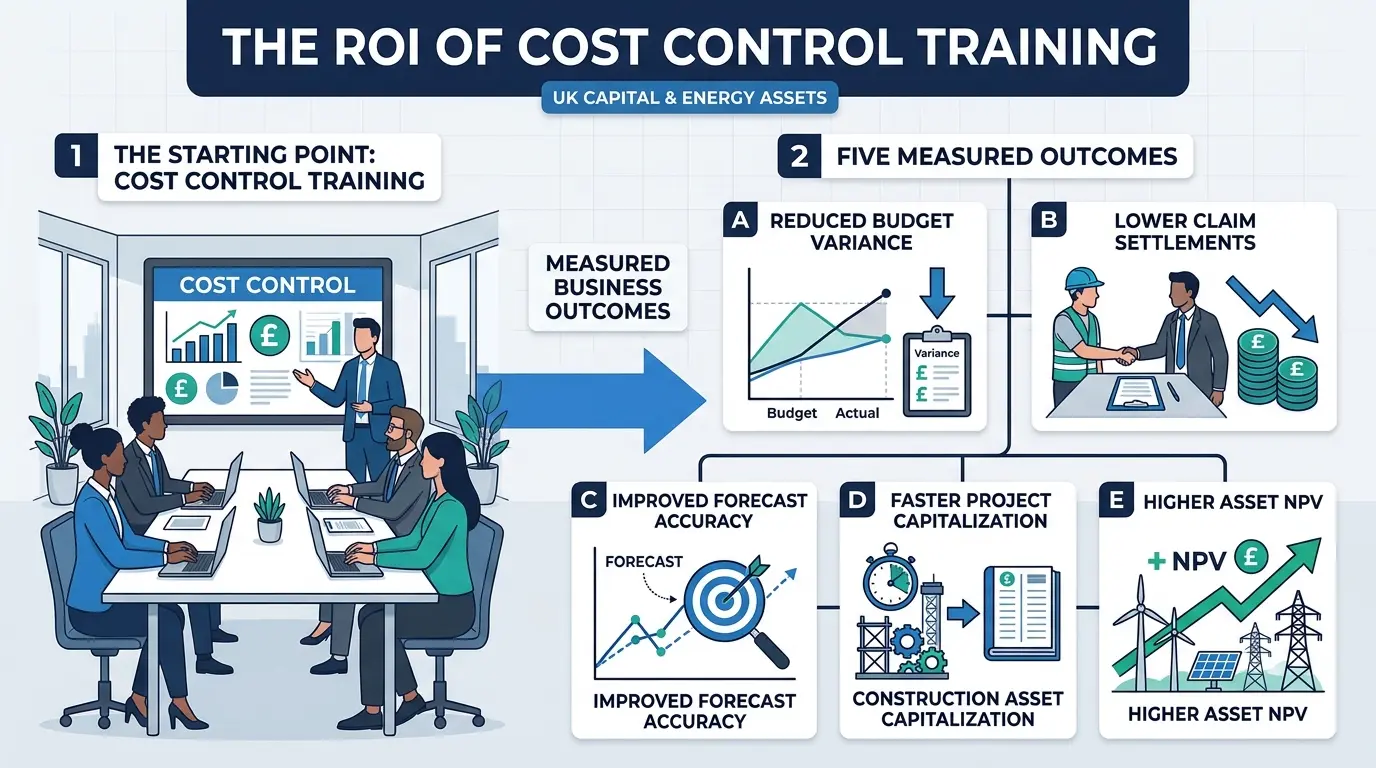
Investing in structured project control capabilities delivers quantifiable financial and operational returns across energy asset portfolios.
Key Performance Indicators (KPIs) Impacted by Training
Budget Variance Reduction: Companies executing targeted project control training report a 15% to 25% reduction in total capital budget variance across major engineering projects.
Contractor Claim Savings: Enhanced capability in reimbursable cost verification and variation analysis reduces unearned contractor claim payouts by up to 30%.
Forecast Accuracy: Trained project controls teams achieve an Estimate at Completion (EAC) accuracy within +/- 5% margin of error as early as the 25% physical execution milestone.
Schedule Integrity: Controlling cost variations directly mitigates associated schedule growth, keeping field development assets on track for first oil or gas deadlines.
Long-Term Organisational Impact
Beyond immediate project metrics, enterprise capability building creates durable corporate advantages:
Enhanced Investor and Partner Confidence: Demonstrating rigorous financial governance attracts joint-venture partners and lowers capital borrowing costs from financial institutions.
Robust Talent Retention: Providing technical professionals with structured career pathways in project management increases employee retention rates in critical engineering functions.
Continuous Knowledge Capture: Establishing formal project close-out practices ensures that lessons learned and post-completion review insights inform future field development baseline estimates, preventing repeat financial mistakes.
For organizations seeking to embed these capabilities within their engineering and project management divisions, enrolling teams in the Cost Control for Field Development Projects: Overrun Prevention Training Course provides the practical tools, analytical frameworks, and financial control methodologies necessary to protect project margins and guarantee asset performance.
Common Problems and Misconceptions in Corporate Cost Control Training
Common misconceptions include viewing cost control as purely an accounting task, relying on generic non-industry training, assuming software tools replace human capability, and treating training as a one-time event rather than continuous workforce development.
Organisations frequently fail to achieve expected ROI from their corporate learning investments due to four recurring structural missteps:
1. Treating Cost Management as an Accounting Responsibility
A frequent error in industrial organizations is assigning budget responsibility solely to finance departments. Accounting teams record historical costs; they do not control physical design choices or field operations. If technical engineers lack financial governance training, scope additions continue unchecked at the site level, rendering retroactive accounting controls ineffective.
2. Relying on Generic, Off-the-Shelf Training Programs
Standard commercial project management training courses cover general concepts like Gantt charts and basic budgeting. However, they lack the specific complexities of energy sector execution—such as joint operating agreements, subsea EPC contracts, FPSO leasing arrangements, and complex concession terms. Training must reflect the specific regulatory and commercial frameworks of the oil and gas sector.
3. Assuming Project Management Software Eliminates Skill Gaps
Deploying advanced enterprise resource planning (ERP) or project control software does not automatically improve financial performance. Software tools merely process inputs; if project engineers submit inaccurate progress estimates or fail to recognize improper contractor billing, the software generates flawed forecasts. Capability building must focus on human analytical reasoning before software automation.
4. Viewing Training as an Isolated Event
Single-day seminars without post-course integration yield rapid skill decay. Sustainable capability development requires structured learning pathways, post-training workplace application, periodic refresher modules, and formal integration into corporate competency management systems (CMS).
Frequently Asked Questions
What is oil and gas petroleum budgeting and cost control?
Oil & Gas Petroleum Budgeting & Cost Control is a financial governance discipline that aligns capital allocation with operational field execution to prevent budget variance. The Institute For Oil & Gas Training provides professional development in this area, teaching project teams how to establish accurate baseline estimates, track real-time expenditure, and control contractor variations across upstream and midstream asset lifecycles.
Why do cost overruns occur in petroleum field development projects?
Cost overruns in field development projects typically stem from incomplete front-end engineering design, scope creep, unverified reimbursable contractor claims, and inaccurate forecasting methods. Through specialized programs like Oil & Gas Petroleum Budgeting & Cost Control, the Institute For Oil & Gas Training equips cross-functional teams with the analytical tools needed to identify early financial warning signs and audit contractor expenditure effectively.
How does cost control training improve project net present value?
Targeted cost control training improves project net present value by reducing unbudgeted capital expenditure, eliminating unearned contractor claim payouts, and accelerating asset capitalization timelines. The Institute For Oil & Gas Training designs its Oil & Gas Petroleum Budgeting & Cost Control curriculum to help energy companies enforce strict variation controls and keep complex offshore and onshore developments within approved financial baselines.
What are the key components of effective petroleum cost control systems?
Effective petroleum cost control systems integrate deterministic and probabilistic estimation tools, Earned Value Management (EVM), structured change management workflows, and rigorous reimbursable cost auditing protocols. The Institute For Oil & Gas Training embeds these core elements into its Oil & Gas Petroleum Budgeting & Cost Control courses to bridge the gap between technical engineering choices and commercial financial performance.
Who should undertake training in oil and gas petroleum budgeting and cost control?
Project directors, cost control engineers, procurement specialists, project accountants, and technical discipline leads responsible for capital project delivery should undertake this professional development. The Institute For Oil & Gas Training delivers Oil & Gas Petroleum Budgeting & Cost Control modules tailored for cross-functional corporate cohorts aiming to standardize financial governance and improve multi-disciplinary team efficiency.
Related training courses
CAPEX vs OPEX Classification & Decision Rules Training Course
- Specialisation
- Oil & Gas Petroleum Budgeting & Cost Control
- Duration
- 5 days · 13 CPD hours
Budgeting & Forecasting for the Annual Budget Cycle Training Course
- Specialisation
- Oil & Gas Petroleum Budgeting & Cost Control
- Duration
- 5 days · 15 CPD hours
Cash Calls, AFEs & Work Program/Budget Control: Overruns Training Course
- Specialisation
- Oil & Gas Petroleum Budgeting & Cost Control
- Duration
- 5 days · 15 CPD hours
More articles

Cost Control for Field Development Projects Overrun Prevention Training by Institute For Oil & Gas Training
Explore the Cost Control for Field Development Projects Overrun Prevention Training Course by Institute For Oil & Gas Training for corporate team skill gain.
Read article →
How to Identify Cost Overrun Risks and Apply Effective Prevention Strategies
Learn how to identify cost overrun risks in field development and apply proven prevention strategies to protect project capital and performance.
Read article →
Cost Control for Field Development Projects Cost Baselines Training by Institute For Oil & Gas Training
Evaluate the Cost Control for Field Development Projects Cost Baselines Training by Institute For Oil & Gas Training. View syllabus and enroll.
Read article →