

Cost coding is a systematic classification framework that assigns unique alphanumeric identifiers to specific project activities, resources, and expenditure categories. It enables real-time expenditure tracking, budget variance analysis, and standardized financial reporting across complex energy assets and operations.
Cost coding establishes a single source of truth for financial control across multi-million-pound upstream, midstream, and downstream projects. Energy sector assets operate under high capital expenditure budgets, fluctuating commodity prices, and strict regulatory compliance requirements. Without a standardized coding structure, organizations experience cost misallocations, delayed financial visibility, and inaccurate forecasting.
In corporate environments, cost coding connects operational field activities directly to financial ledger systems. Every purchase order, contractor invoice, time sheet, and material request contains a specific cost code. This code links the transaction to a designated work package within the master project budget.
Organizations use cost coding to establish precise accountability across engineering, procurement, construction, and maintenance teams. It converts raw financial data into structured managerial insights. This structure allows project controllers, finance directors, and asset managers to monitor capital performance, identify budget slippages early, and maintain governance over complex joint-venture operations.
Why Do Oil and Gas Organizations Face Severe Cost Control Challenges?
Oil and gas organizations face cost control challenges due to decentralized project operations, volatile supply chains, fragmented contractor networks, and manual financial tracking systems. These operational realities create blind spots, leading to unbudgeted cost overruns and inaccurate project forecasting.
Upstream capital projects often exceed initial budget estimates by 20% to 45% due to poor financial visibility. Large-scale energy ventures involve thousands of line items across multiple geographic locations and sub-contractor entities. When field teams utilize inconsistent expenditure categories, project managers cannot determine true financial status until accounting periods close.
Skill gaps in cost management exacerbate these challenges. Operations personnel, project engineers, and procurement specialists frequently lack formal training in financial structures. Engineers focus on technical execution rather than budget alignment, resulting in delayed coding of change orders and scope variations.
Corporate learning programs address these vulnerabilities directly. By building cross-functional capabilities in financial governance, organizations eliminate data siloes between project control offices, procurement divisions, and corporate finance departments.
How Does Cost Coding Function within Corporate Cost Tracking Systems?
Cost coding functions by aligning the Work Breakdown Structure with the Cost Breakdown Structure, establishing direct traceability from line-item field expenditures to general ledger accounts. This alignment enables automated data integration across enterprise resource planning platforms and project control software.
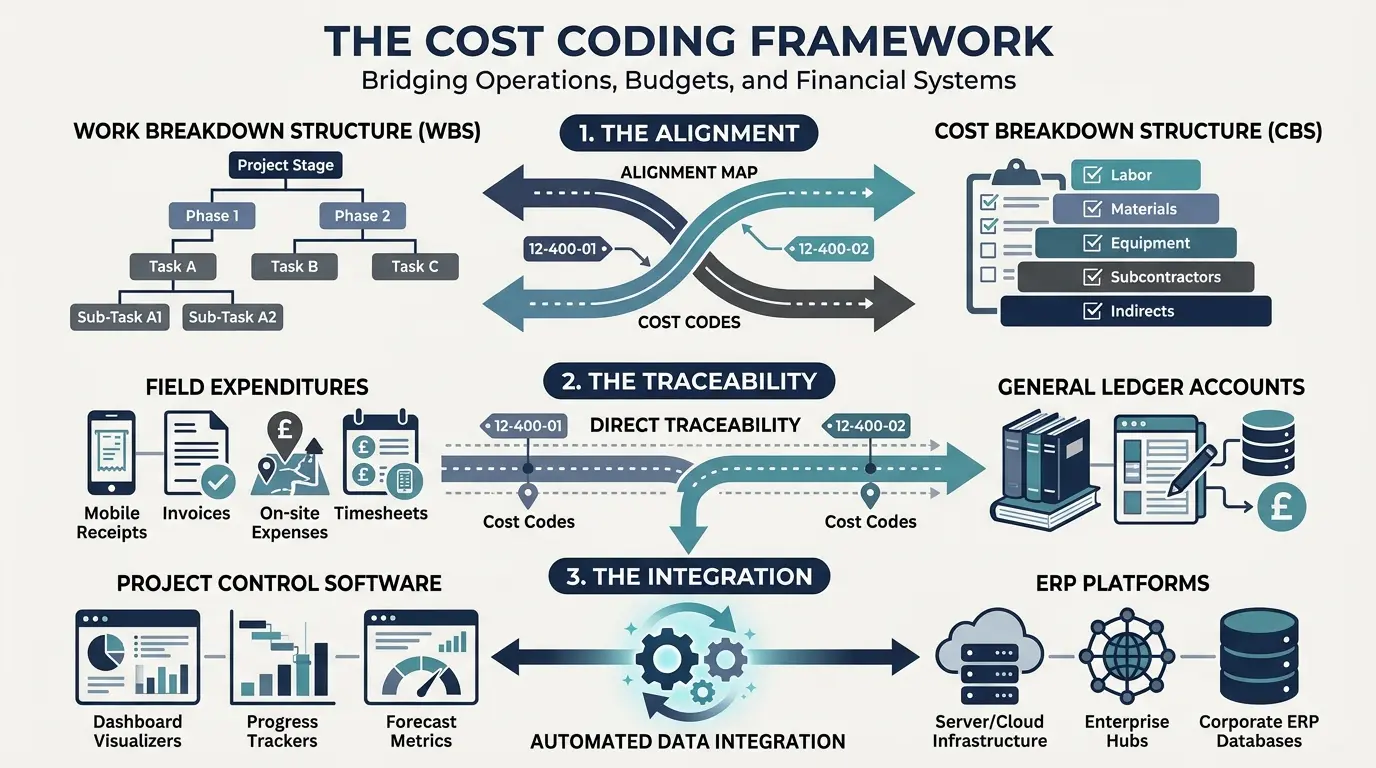
1. Work Breakdown Structure and Cost Breakdown Structure Alignment
The foundation of effective cost coding relies on mapping the physical work scope to financial control accounts. The Work Breakdown Structure defines the tangible deliverables of the project, such as pipeline installation, platform fabrication, or refinery turnaround. The Cost Breakdown Structure defines the resource categories required to complete those deliverables, such as direct labor, heavy equipment rental, specialized materials, and engineering sub-contracts.
2. Standardized Alphanumeric Coding Architecture
A standardized cost code architecture uses logical segments to represent project attributes. A typical code structure includes specific elements:
Project Identifier: Codes the specific asset, field, or facility.
WBS Level: Identifies the phase, sub-system, or physical deliverable.
Discipline/Cost Type: Specifies engineering, procurement, construction, or commissioning.
Resource Element: Pinpoints labor rates, equipment types, consumable supplies, or third-party services.
For instance, code PRJ-084-SUB-CON-4120 instantly informs the cost controller that the expense belongs to Project 084, Subsea Systems, Construction Phase, Piping Labor.
3. Tracking Committed and Incurred Costs versus Value of Work Done
Accurate cost control requires tracking expenditure across three distinct stages:
Committed Costs: Financial obligations established through issued purchase orders and executed contracts.
Incurred Costs: Financial liabilities recognized when goods or services arrive on site.
Value of Work Done (VOWD): The estimated value of physical progress completed on site during a specific period, regardless of invoice status.
Cost coding enables project teams to isolate these three metrics. This differentiation prevents artificial profit inflation and provides early warning signs when commitments outpace physical progress.
What Key Components Form an Effective Cost Coding Framework?
An effective cost coding framework comprises standardized coding taxonomies, clear governance rules, integrated enterprise software tools, and continuous capability development across all project personnel. These components ensure data consistency, rapid variance analysis, and audit readiness across asset lifecycles.
Essential Skills and Frameworks
Developing organizational mastery in cost coding requires technical proficiency across core financial methodologies:
Earned Value Management (EVM): Integrating scope, schedule, and cost metrics to assess project performance and progress objectively.
Cost Performance Index (CPI): Calculating efficiency ratios by dividing Earned Value by Actual Cost to determine budget health.
Schedule Performance Index (SPI): Measuring time efficiency by dividing Earned Value by Planned Value.
Estimate to Complete (ETC): Forecasting the remaining financial outlay required to finish the defined scope.
Estimate at Completion (EAC): Projecting total final project cost based on historical performance trends and remaining risk exposure.
Contingency Drawdown Tracking: Monitoring management reserves against identified project risk events to maintain adequate capital coverage.
Software Integration Tools
Modern energy companies run cost coding structures through enterprise resource planning platforms like SAP, Oracle Primavera P6, and EcoSys. These software applications require strict input validation rules. When cost codes are standardized, system interfaces automatically match field requisitions to approved budget thresholds, preventing unauthorized expenditure.
Corporate Delivery Formats
To imbed cost coding discipline across multi-site teams, organizations utilize structured learning interventions:
How Do Organizations Implement Cost Coding Capabilities Step by Step?
Organizations implement cost coding capabilities through a four-phase rollout strategy: diagnostic capability mapping, framework design, workforce capability building, and governance integration. This structured approach ensures operational alignment, high system adoption rates, and immediate project cost control.
Phase 1: Diagnostic Assessment and Gap Analysis
Organizations begin by auditing existing project control workflows, cost structures, and historic expenditure variance. Learning and development teams work with project controls managers to identify specific skill gaps across engineering, finance, and procurement departments.
Phase 2: Standardized Framework Design
Subject matter experts design a uniform Cost Breakdown Structure aligned with international energy standards. This phase establishes mandatory coding dictionaries, defines rules for change order allocation, and configures ERP validation protocols to prevent invalid code usage.
Phase 3: Workforce Capability Development
Organizations deploy targeted training cohorts across project teams. Technical staff learn to map work scope directly to assigned cost codes.
Effective workforce development utilizes practical instructional methodologies:
Case-Based Learning: Reviewing historic energy project case studies to analyze how miscoded items caused budget overruns.
Role-Play Exercises: Simulating change-board meetings where project engineers must justify cost code allocations for extra work scope.
Practical Assessments: Testing team members on real-time coding accuracy within enterprise software sandboxes.
Understanding How to Use Cost Coding for Effective Cost Tracking and Variance Analysis equips project teams with the analytical tools necessary to detect financial deviations before they threaten asset margins. Developing operational mastery requires structured educational pathways, such as the Cost Control & Variance Analysis Using Cost Coding Training Course, which provides practical exposure to complex project control scenarios.
Phase 4: Governance, Auditing, and Continuous Improvement
The organization establishes cost control governance boards to audit monthly coding compliance. System administrators monitor error rates, track variance reports, and refine training content to address recurring operational mistakes.
What Measurable Business Outcomes Does Cost Coding Discipline Produce?
Cost coding discipline produces measurable business outcomes, including reduced budget variances, improved forecasting accuracy, faster financial period closes, and lower administrative overhead. These improvements enhance capital deployment efficiency and boost return on investment across corporate portfolios.
Organizations that enforce cost coding governance achieve significant operational performance metrics across their project portfolios:
1. Financial Precision and Variance Reduction
Implementing standardized cost coding reduces unallocated project expenditures from over 12% to under 0.5%. Early detection of variance allows project managers to implement corrective measures while remediation costs remain low.
2. Accelerated Reporting Timelines
Standardized coding structures reduce month-end financial reporting cycles from 14 business days down to 3 days. Automated data reconciliation eliminates manual spreadsheet adjustments, allowing executive teams to make timely capital allocation decisions.
3. Increased Team Efficiency and Workforce Retention
Clear cost control frameworks reduce administrative frustration among engineering and operational staff. Clear guidelines eliminate cross-departmental friction regarding budget ownership, leading to a 15% increase in team productivity metrics and improved employee retention rates across technical disciplines.
Which Corporate Teams and Industries Benefit Most from Cost Coding Training?
Corporate teams in project management, finance, procurement, engineering, and asset maintenance benefit directly from cost coding training. Industries with high capital expenditure environments—such as oil and gas, renewable energy, civil infrastructure, mining, and petrochemical processing—derive maximum strategic value.
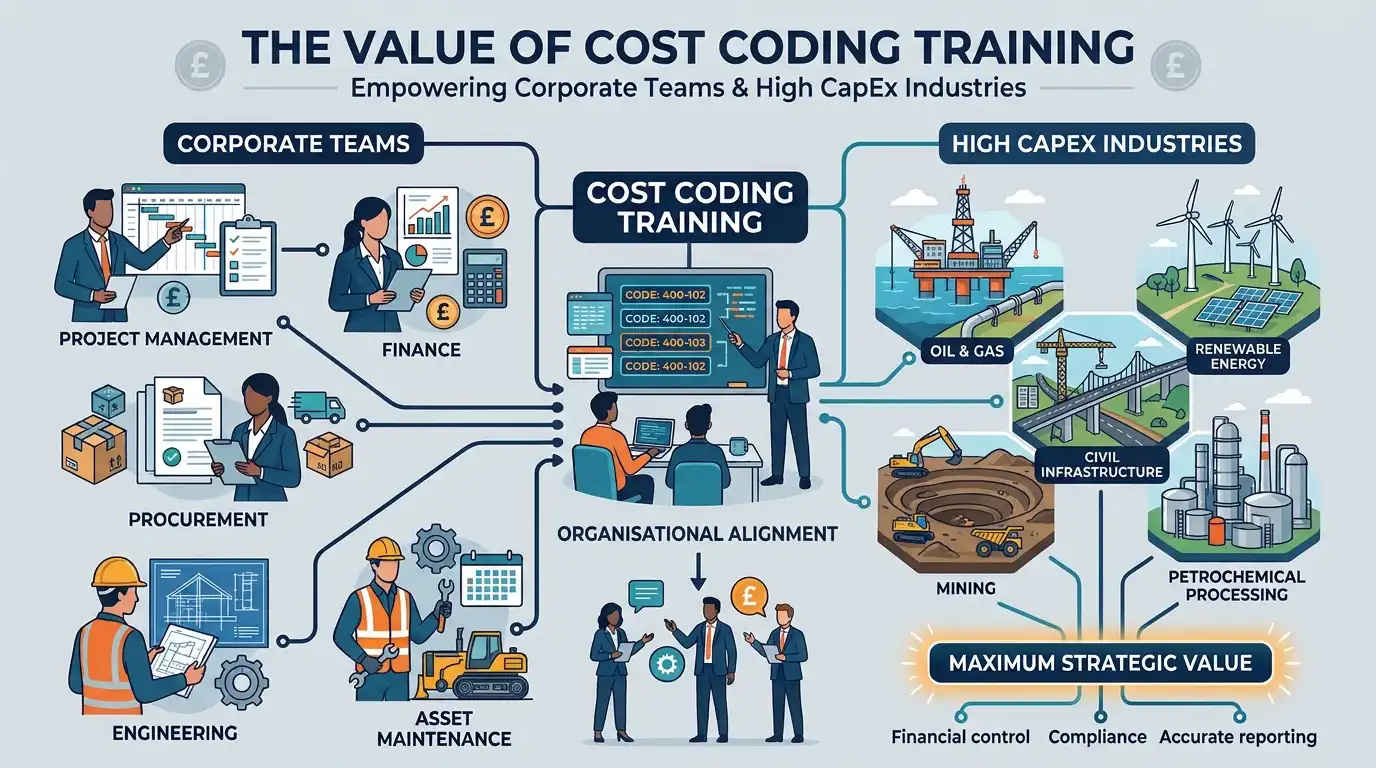
Key Departmental Applications
Project Control Specialists: Gain advanced tools for tracking Cost Performance Index, Schedule Performance Index, and Earned Value Management metrics.
Procurement and Subcontracting Teams: Ensure vendor contracts, service orders, and material requisitions strictly mirror the master project Cost Breakdown Structure.
Field Engineers and Site Supervisors: Learn to assign accurate cost codes to daily work logs, equipment time sheets, and scope variation requests.
Finance Directors and Controllers: Achieve audit readiness, streamline tax asset depreciation tracking, and gain real-time visibility into capital expenditure drawdown.
Industry Applications
Beyond traditional oil and gas operations (such as offshore drilling, pipeline construction, and liquefied natural gas terminal expansion), structured cost coding provides benefits across adjacent capital-intensive sectors:
Renewable Energy: Managing offshore wind farm construction, solar installation programs, and green hydrogen facility development.
Petrochemical Processing: Controlling maintenance turnarounds, safety upgrades, and plant expansion initiatives.
Mining and Extraction: Tracking heavy equipment fleet utilization, site infrastructure development, and environmental remediation funds.
Major Infrastructure: Monitoring large-scale civil works, rail networks, and marine port construction projects.
What Are the Most Common Misconceptions and Failures in Cost Coding Training?
The most common failures in cost coding training stem from treating the methodology as a passive accounting requirement rather than an active operational management system. Generic educational programs, overly complex coding structures, and lack of ongoing governance severely reduce training return on investment.
Misconception 1: "Cost Coding Is Solely an Accounting Function"
Many organizations delegate cost code selection exclusively to finance departments. When field engineers do not understand the rationale behind the cost breakdown structure, they select codes arbitrarily to clear invoice queues. Training must target cross-functional teams to ensure operational alignment.
Misconception 2: "More Complex Codes Yield Better Control"
Designing cost codes with 25 to 30 alphanumeric characters creates confusion and high error rates. Effective frameworks maintain simple, logical structures optimized for user comprehension and quick selection within mobile field applications.
Misconception 3: "Off-the-Shelf Software Eliminates the Need for Capability Development"
Installing enterprise software like SAP or Primavera P6 does not automatically resolve cost control challenges. Without comprehensive training on data discipline, personnel enter incorrect codes into sophisticated software, generating flawed reports faster.
Misconception 4: "One-Off Training Workshops Ensure Permanent Compliance"
Short, standalone lectures without ongoing reinforcement fail to create lasting behavioral change. Sustainable performance improvement requires continuous learning pathways, performance support tools, periodic audit reviews, and practical refresher modules.
Frequently Asked Questions
What is oil and gas budgeting and cost control training?
Oil and gas budgeting and cost control training provides professionals with practical skills to manage capital expenditures, track operational costs, and control project finances in energy operations. Delivered by the Institute For Oil & Gas Training, this specialized Oil & Gas Petroleum Budgeting & Cost Control program covers financial planning, cost breakdown structures, earned value management, and variance analysis. Organizations use this training to reduce budget overruns, streamline reporting cycles, and improve financial governance across upstream, midstream, and downstream assets.
How does cost control training benefit energy sector organizations?
Implementing professional cost control training ensures project teams can accurately track committed, incurred, and forecasted expenditures across complex capital projects. The Institute For Oil & Gas Training equips cross-functional staff through its Oil & Gas Petroleum Budgeting & Cost Control program to eliminate budget misallocations and identify cost variances early. This structured approach improves financial transparency, accelerates month-end reporting, and optimizes overall capital expenditure performance for energy companies.
Who should attend petroleum budgeting and financial management courses?
This training is designed for project controllers, finance managers, cost engineers, procurement specialists, and operational leaders working within energy operations. The Oil & Gas Petroleum Budgeting & Cost Control course at the Institute For Oil & Gas Training caters to both financial and non-financial professionals responsible for project budgets and asset performance. Upskilling these key decision-makers aligns engineering execution with financial management across corporate portfolios.
What core methodologies are covered in oil and gas financial control training?
Key methodologies include Work Breakdown Structures (WBS), Cost Breakdown Structures (CBS), Earned Value Management (EVM), and Estimate at Completion (EAC) forecasting techniques. The Oil & Gas Petroleum Budgeting & Cost Control syllabus at the Institute For Oil & Gas Training emphasizes real-world application, teaching participants how to calculate cost performance indices and monitor contingency drawdowns. These practical tools enable project teams to maintain strict financial compliance and audit readiness.
How do companies integrate budgeting and cost tracking into daily operations?
Organizations integrate budgeting and cost tracking by establishing standardized alphanumeric cost coding architectures across their enterprise resource planning (ERP) platforms. Through targeted programs like Oil & Gas Petroleum Budgeting & Cost Control from the Institute For Oil & Gas Training, operational staff learn to align purchase requisitions and field progress metrics directly with project cost centers. This operational alignment prevents unauthorized spending and provides executive teams with real-time financial visibility.
Related training courses
Budgeting & Forecasting: Rolling & Zero-Based Techniques Training Course
- Specialisation
- Oil & Gas Petroleum Budgeting & Cost Control
- Duration
- 5 days · 15 CPD hours
Cash Calls, AFEs & Work Program/Budget Control: Preparation Training Course
- Specialisation
- Oil & Gas Petroleum Budgeting & Cost Control
- Duration
- 5 days · 15 CPD hours
Cash Calls, AFEs & Work Program/Budget Control: Overruns Training Course
- Specialisation
- Oil & Gas Petroleum Budgeting & Cost Control
- Duration
- 5 days · 15 CPD hours
More articles

Cost Control for Field Development Projects Overrun Prevention Training by Institute For Oil & Gas Training
Explore the Cost Control for Field Development Projects Overrun Prevention Training Course by Institute For Oil & Gas Training for corporate team skill gain.
Read article →
How to Identify Cost Overrun Risks and Apply Effective Prevention Strategies
Learn how to identify cost overrun risks in field development and apply proven prevention strategies to protect project capital and performance.
Read article →
Why Cost Overruns Occur in Oil and Gas Field Development Projects
Discover why cost overruns occur in oil and gas field development projects and how workforce training mitigates financial risks for energy firms.
Read article →