
Capital expenditure in major energy developments frequently exceeds baseline budgets due to systemic control failures, scope growth, and inadequate risk management. Identifying cost overrun risks requires structured auditing of early-stage estimations, robust contract administration, and real-time variance monitoring across all engineering and procurement phases.
Unchecked budget escalation threatens overall asset profitability, making early detection vital for project managers and financial controllers. Organizations evaluating root causes often review Why Cost Overruns Occur in Oil and Gas Field Development Projects to understand how initial planning gaps propagate through execution. Preventing these financial deviations demands systematic risk identification frameworks alongside rigorous cost governance throughout the project lifecycle.
What Are the Primary Cost Overrun Root Causes in Field Development?
Cost overrun root causes stem from optimistic baseline estimates, unmanaged scope creep, inadequate front-end engineering design (FEED), and volatile market dynamics. Failing to account for supply chain disruption, regulatory delays, and weak contractor oversight further compounds budget variance across complex energy developments.
Identifying financial exposure early requires analyzing how initial project assumptions diverge from real-world execution conditions. Energy projects operate under high technical uncertainty, where minor engineering modifications ripple across procurement and construction schedules.
The primary cost overrun root causes generally cluster into distinct operational categories:
Incomplete Scope Definition: Proceeding past final investment decision (FID) with ambiguous engineering specifications guarantees change orders later.
Optimism Bias in Estimation: Project teams routinely underestimate contingency reserves, regional labor rates, and equipment lead times to secure capital approval.
Contractual Misalignment: Using inappropriate contract structures transfers unmanageable risks to contractors, driving up claims and dispute costs.
Weak Project Governance: Fragmented reporting lines between field engineers, procurement specialists, and financial managers delay risk mitigation.
Addressing these root vulnerabilities demands structured intervention prior to capital commitment. Organizations must establish clear cost baseline benchmarks and mandate quantitative risk assessments for every design iteration.
How Does Contractor Cost Reporting Reveal Early Financial Risk?
Contractor cost reporting reveals early financial risk by tracking earned value metrics, commitment logs, and work-in-progress variances against scheduled baselines. Transparent reporting exposes cost trends before line items exceed allocated budgets, allowing managers to execute proactive corrective controls.
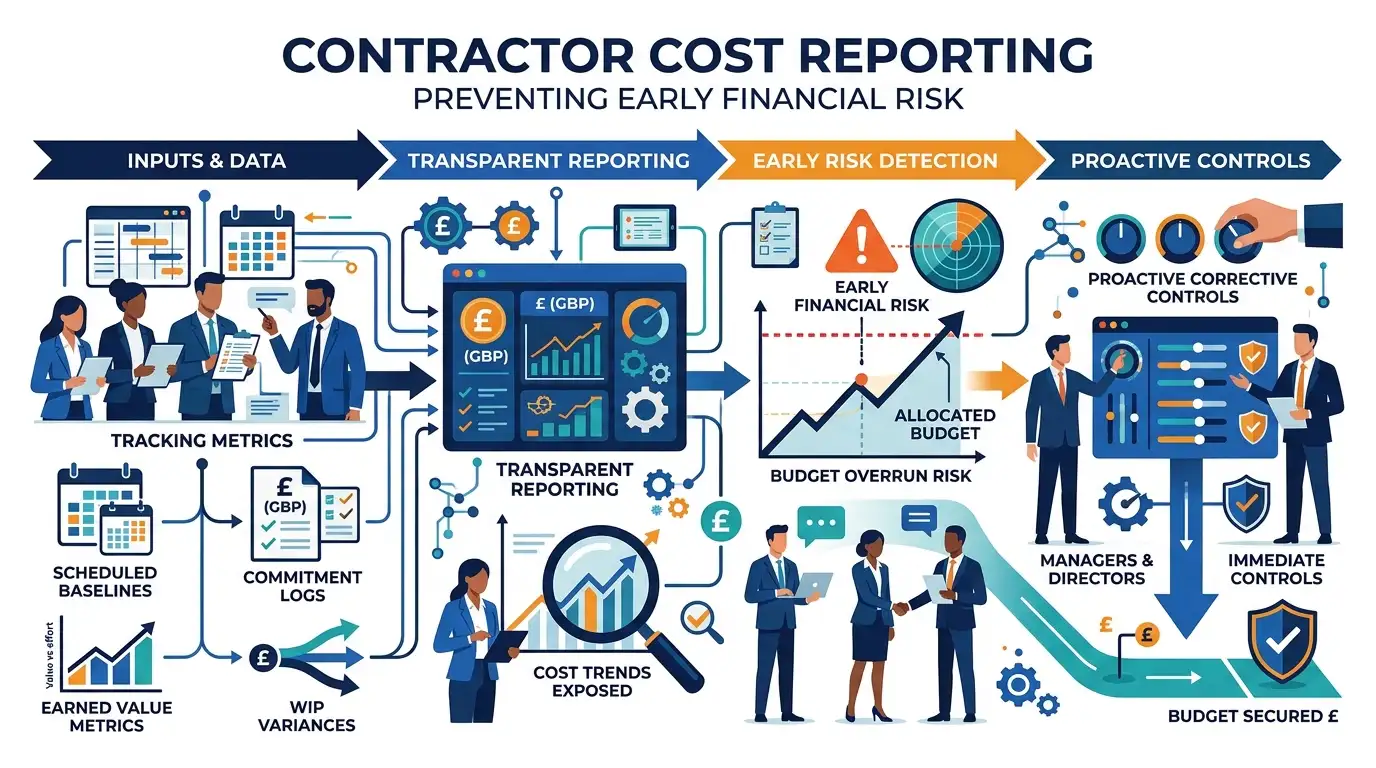
Relying solely on monthly invoices provides a lagging indicator of financial health. Effective cost governance requires real-time data integration directly from field operations.
Key indicators within contractor reporting frameworks include:
Cost Performance Index (CPI): A CPI value below 1.0 signals that work is costing more than planned, serving as an immediate alert for management review.
Commitment Tracking: Monitoring issued purchase orders against original budget allocations prevents unexpected financial exposure.
Accrual Accuracy: Ensuring contractors log unbilled liabilities accurately eliminates cash flow surprises during joint venture audits.
Corporate leadership must standardize reporting formats across all primary contractors and subcontractors. Standardized metrics clarify performance trends, making it easier for project directors to evaluate operational risks objectively.
Why Is Reimbursable Cost Verification Essential for Budget Protection?
Reimbursable cost verification is essential for budget protection because it validates contractor expenditure against contractual terms, baseline rates, and actual progress. Rigorous verification stops unauthorized billing, eliminates duplicate charges, and preserves project capital during intensive field operations.
Reimbursable contracts shift cost risk directly onto the project operator. Without strict auditing protocols, administrative errors and non-compliant expenditure rapidly erode project contingency funds.
Verification procedures must focus on three core areas:
Labor and Equipment Rates: Cross-referencing timesheets and machinery logs against agreed master service agreement schedules.
Third-Party Invoices: Auditing pass-through costs, markup percentages, and vendor discounts to ensure accurate cost recovery.
Subcontractor Management: Verifying that main contractors enforce the same pricing controls on lower-tier suppliers.
Structured auditing processes protect joint venture partners from non-allowable expenses. Establishing continuous verification protocols ensures financial compliance while maintaining project momentum.
How Do Variation and Claim Cost Impacts Escalate Project Budgets?
Variation and claim cost impacts escalate project budgets by introducing unbudgeted scope changes, schedule extensions, and associated disruption fees. Uncontrolled variation requests accumulate silently, consuming project contingency reserves and destabilizing baseline financial models.
Scope changes during construction are significantly more expensive than alterations made during the design phase. Each modification triggers a cascade of secondary costs, including engineering redesign, material scrapping, and contractor standing time.
Managing variation and claim cost impacts requires a formal Change Control Board (CCB). Every proposed change must undergo quantitative evaluation, assessing its direct financial cost, schedule impact, and downstream risk profile before authorization. Strict change control limits unnecessary scope additions and preserves baseline capital targets.
How Do Teams Accurately Forecast Final Cost During Execution?
Teams accurately forecast final cost by combining Estimate at Completion (EAC) calculations, trend analysis, and physical progress updates. Continuous re-baselining based on actual performance indicators ensures transparent financial reporting to executive stakeholders and joint venture partners.
Static annual budgets fail in dynamic project environments. Financial managers must update forecasts monthly using standardized forecasting methodologies:
$$\text{EAC} = \text{Actual Cost (AC)} + \frac{\text{Budget at Completion (BAC)} - \text{Earned Value (EV)}}{\text{CPI}}$$
Accurate forecasting relies on several core inputs:
Estimate to Complete (ETC): Bottom-up re-estimation of all remaining work packages by field managers.
Trend Analysis: Extrapolating current productivity rates to anticipate future labor and equipment expenditure.
Risk Reserve Allocation: Adjusting remaining contingency allowances based on updated quantitative risk registers.
Precise forecasting provides project leaders with the data required to reallocate capital, renegotiate contracts, or adjust project scope before cost overruns become irreversible.
What Controls Ensure Proper Cost Recovery of Project Expenditure?
Controls ensuring proper cost recovery of project expenditure include structured joint operating agreement (JOA) compliance, rigorous accounting categorization, and comprehensive audit trails. Validating eligible capital costs enables operators to reclaim expenditure efficiently under production sharing contracts.
In energy developments, cost recovery directly influences net cash flows. Misclassifying capital expenditure or failing to maintain supporting documentation leads to audit exceptions and permanent financial write-offs.
Essential controls for cost recovery management include:
JOA Cost Allocation Rules: Ensuring all direct and indirect expenses align strictly with joint venture accounting procedures.
Production Sharing Contract (PSC) Compliance: Categorizing costs correctly to maximize allowable cost oil or cost gas deductions.
Audit Readiness Procedures: Maintaining centralized, digital records of all purchase orders, approvals, and proof of performance documents.
Structured training in cost accounting bridges the gap between field operations and corporate finance, ensuring all incurred expenditures meet regulatory and contractual recovery criteria.
How Do Project Capitalisation and Close-Out Prevent Tail-End Overruns?
Project capitalisation and close-out prevent tail-end overruns by settling outstanding contractor claims, liquidating unused commitments, and transferring assets cleanly to operations. Formal close-out stops administrative expenditure drift and secures final asset valuations.
The final phase of a development project is highly vulnerable to cost leakage. Demobilization delays, unresolved commercial disputes, and protracted punch-list resolution continuously drain remaining project funds.
A structured close-out framework requires:
Commercial Settlement: Finalizing all outstanding change orders and closing main contracts systematically.
Asset Capitalisation: Transferring completed physical assets from work-in-progress accounts to fixed asset registers for depreciation tracking.
Financial Reconciliation: Reconciling ledger accounts, releasing retention monies, and closing active work codes to prevent further charging.
Executing a disciplined close-out process ensures that project budgets terminate decisively upon mechanical completion and handover.
Why Are Lessons Learned and Post-Completion Reviews Critical for Future Projects?
Lessons learned and post-completion reviews are critical because they capture cost performance data, identify systematic estimation errors, and refine organizational control frameworks. Institutionalizing these insights prevents repeated budgeting mistakes on subsequent field developments.
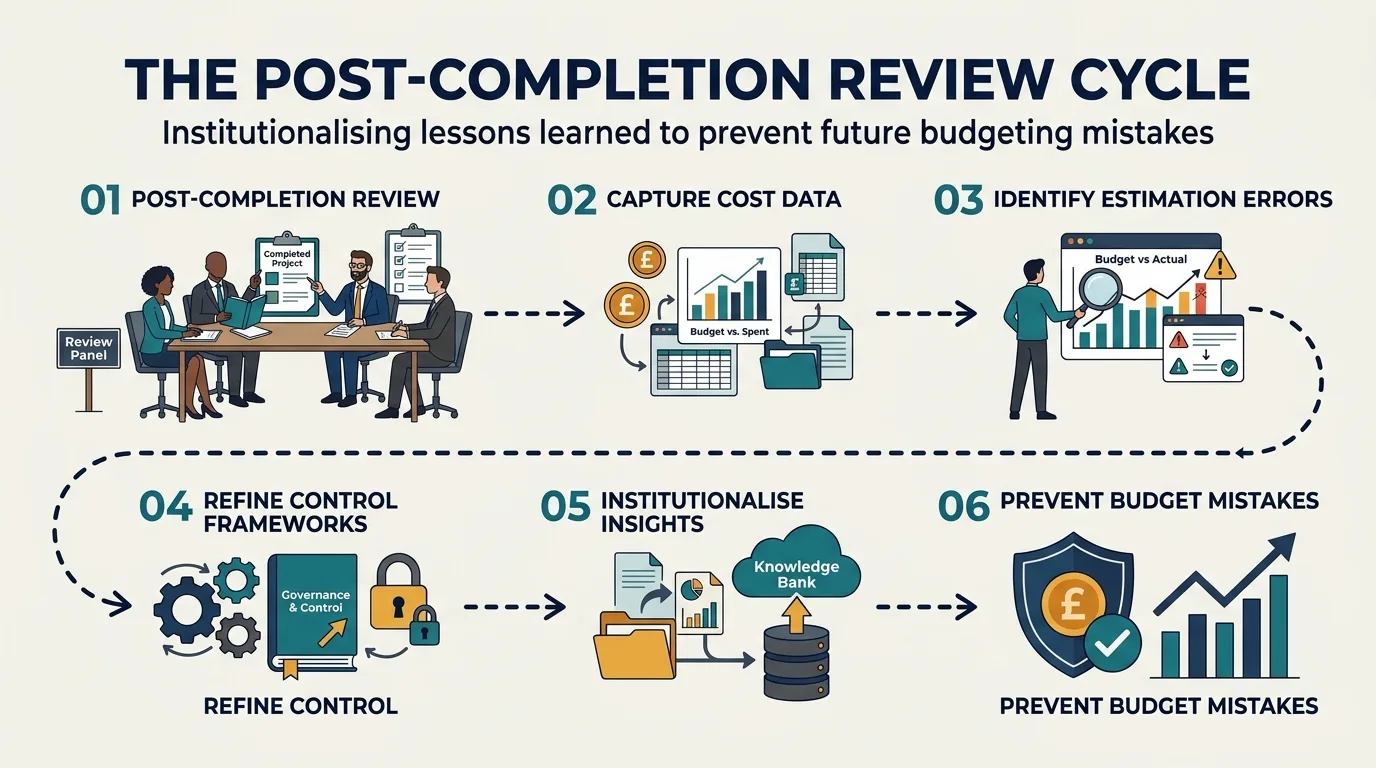
A formal post-completion review compares the final financial outcome against the initial project baseline. This analysis reveals structural gaps in initial risk modeling and execution management.
Key focus areas for post-completion evaluations include:
Estimation Accuracy Analysis: Comparing initial line-item budgets against final expenditures to calibrate future estimation models.
Contractor Performance Review: Evaluating vendor commercial behavior, claim frequencies, and reporting compliance.
Control Framework Audit: Identifying which cost control tools provided actionable early warnings and which failed to detect variances.
Systematically feeding these insights back into corporate governance standards improves institutional capability and strengthens cost control performance across future capital projects.
Comparing Cost Prevention Approaches Across Field Development Projects
Selecting the right control mechanism depends on project scale, organizational capability, and contractual complexity. Organizations must evaluate whether traditional internal controls, external third-party audits, or specialized capability development yield the highest risk mitigation return.
Prevention Approach | Implementation Focus | Cost Risk Exposure | Organizational Impact | ROI Horizon |
Internal Governance & Standard Controls | Policy enforcement, basic reporting templates | Moderate to High | Low process friction, reliance on existing staff | 12–18 Months |
Third-Party Commercial Auditing | External invoice verification, post-facto claims review | Moderate | High external cost, reactive risk detection | 6–12 Months |
Systemic Team Capability Development | Applied cost control training, real-time variance mastery | Low | High operational alignment, proactive risk prevention | 1–3 Months |
Internal governance provides necessary baseline compliance but often fails to catch complex field-level variances. External auditing recovers misallocated funds after expenditure occurs, making it a reactive financial defense. Building internal capability delivers proactive protection, empowering project teams to prevent cost escalation directly at the operational source.
Decision Framework: Evaluating Training Interventions for Cost Control
HR teams and project directors evaluating structured training solutions must align learning formats with specific organizational risk profiles and workforce skill gaps.
Evaluation Metric | In-House Internal Workshops | Generic Financial Courses | Specialized Corporate Training |
Industry Relevance | High organizational context, low technical depth | Low upstream context, general accounting focus | High technical depth, tailored to field development |
Target Audience | General project personnel | Junior finance administrative staff | Project managers, cost engineers, commercial leads |
Practical Application | Case-study dependent, variable quality | Theoretical framework emphasis | Real-world project simulation and data analysis |
Measurable Outcome | Basic policy awareness | Standard professional certification | Direct variance reduction and immediate control execution |
Generic financial courses lack the technical context required to manage complex field development contracts. To achieve measurable budget protection, organizations require industry-specific capability frameworks like the Cost Control for Field Development Projects: Overrun Prevention Training Course delivered by the Institute For Oil & Gas Training. Structured, practical learning ensures that engineering and commercial teams possess the exact competencies needed to monitor commitments, audit reimbursable expenses, and execute proactive risk controls.
Organizations ready to build internal risk prevention capabilities can deploy targeted corporate learning programs, such as the Cost Control for Field Development Projects Overrun Prevention Training by Institute For Oil & Gas Training, ensuring project leaders protect capital investment across every phase of field development.
Frequently Asked Questions
What is Oil & Gas Petroleum Budgeting & Cost Control?
Oil & Gas Petroleum Budgeting & Cost Control is a strategic management framework used to estimate, allocate, and manage expenditure across upstream, midstream, and downstream assets. The Institute For Oil & Gas Training delivers specialized training in this discipline to help professionals accurately forecast capital investments, monitor operating costs, and prevent budget overruns. Mastering these financial controls ensures project viability and aligns field operations with corporate profitability targets.
Why is cost control critical in petroleum field development?
Cost control is critical in field development because major energy projects involve high capital expenditure, complex supply chains, and volatile market conditions. Through Oil & Gas Petroleum Budgeting & Cost Control programs at the Institute For Oil & Gas Training, teams learn to identify financial variances early and manage contractor commitments effectively. Robust financial oversight protects project margins and ensures joint venture compliance throughout the asset lifecycle.
What are the main components of an oil and gas project budget?
An oil and gas project budget primarily comprises capital expenditure (CAPEX) for field development and operational expenditure (OPEX) for ongoing production activities. Effective Oil & Gas Petroleum Budgeting & Cost Control incorporates risk reserves, authorization for expenditure (AFE) tracking, and inflation adjustments. The Institute For Oil & Gas Training equips managers with the techniques required to structure these financial components and establish reliable cost baselines.
How do teams monitor variance in petroleum cost management?
Teams monitor variance by using key performance metrics such as Earned Value Management (EVM), Cost Performance Index (CPI), and real-time commitment tracking against baseline allocations. In the Oil & Gas Petroleum Budgeting & Cost Control course from the Institute For Oil & Gas Training, practitioners learn to analyze contractor cost reports and calculate Estimate at Completion (EAC). These analytical practices enable financial controllers to mitigate potential overruns before they impact project capital.
Who should undertake training in petroleum budgeting and financial control?
This training is designed for project managers, cost engineers, finance professionals, and commercial leads operating within the energy sector. The Institute For Oil & Gas Training tailors its Oil & Gas Petroleum Budgeting & Cost Control instruction to bridge the gap between technical field operations and corporate governance. Completing this program helps cross-functional teams make data-driven commercial decisions and optimize resource utilization.
Related training courses
Cost Control for Field Development Projects: Cost Baselines Training Course
- Specialisation
- Oil & Gas Petroleum Budgeting & Cost Control
- Duration
- 5 days · 15 CPD hours
Cash Calls, AFEs & Work Program/Budget Control: Preparation Training Course
- Specialisation
- Oil & Gas Petroleum Budgeting & Cost Control
- Duration
- 5 days · 15 CPD hours
Budget Management and Management Control in the Oil & Gas Industry
- Specialisation
- Oil & Gas Petroleum Budgeting & Cost Control
- Duration
- 5 days · 15 CPD hours
More articles

Cost Control for Field Development Projects Overrun Prevention Training by Institute For Oil & Gas Training
Explore the Cost Control for Field Development Projects Overrun Prevention Training Course by Institute For Oil & Gas Training for corporate team skill gain.
Read article →
Why Cost Overruns Occur in Oil and Gas Field Development Projects
Discover why cost overruns occur in oil and gas field development projects and how workforce training mitigates financial risks for energy firms.
Read article →
Cost Control for Field Development Projects Cost Baselines Training by Institute For Oil & Gas Training
Evaluate the Cost Control for Field Development Projects Cost Baselines Training by Institute For Oil & Gas Training. View syllabus and enroll.
Read article →