
Joint venture (JV) operations in the upstream oil and gas sector require strict financial governance, shared risk management, and precise cash management between operators and non-operating partners. Navigating complex Joint Operating Agreements (JOAs), accounting procedure standards, and cash calls preparation demands high technical proficiency from petroleum accountants, JV managers, and commercial analysts.
Understanding operational governance begins with recognizing Why Cash Calls AFEs and Work Program Budgets Matter in Joint Venture Operations across upstream asset lifecycles. Misalignments between approved annual work programs, Authorisations for Expenditure (AFEs), and monthly cash funding schedules create liquidity bottlenecks, operational delays, and severe contractual disputes between joint venture participants.
What Is the Strategic Process for Preparing Work Program Budgets in Oil and Gas Joint Ventures?
Work program and budget preparation requires operators to convert field development plans into line-item operational expenses, capital projects, and overhead allocations, aligning joint venture approval workflows with joint operating agreement clauses, financial reporting schedules, and partner audit standards.
Developing an operational work program and budget (WP&B) serves as the primary governance mechanism for upstream ventures. The operator initiates the cycle by gathering sub-surface, drilling, facility engineering, and HSE expenditure projections. These estimates must align with the accounting procedures prescribed by standards such as COPAS (Council of Petroleum Accountants Societies) or international JOA templates provided by the AIPN (Association of International Petroleum Negotiators).
Each expenditure line item undergoes categorization into capital expenditure (CAPEX), operating expenditure (OPEX), or exploration expenditure (EXPA). This classification dictates tax treatment, cost recovery mechanisms under Production Sharing Contracts (PSCs), and partner voting thresholds. Technical teams establish performance timelines, procurement milestones, and risk contingencies before submitting draft budgets to non-operating partners.
The Operating Committee (OPCO) reviews the proposed WP&B against contractual notice periods, typically 60 to 90 days prior to the commencement of the fiscal year. Non-operating partners examine line-item cost drivers, technical assumptions, and economic modeling. Approval requires meeting specified voting interest thresholds defined in the JOA, often set between 65% and 80% affirmative vote depending on the operational scope.
How Are Authorisations for Expenditure (AFEs) Issued, Evaluated, and Controlled?
AFEs serve as legally binding financial controls that authorize operators to commit capital to specific projects within approved work program budgets, setting clear cost limits, technical scopes, supplement thresholds, and partner voting rights.
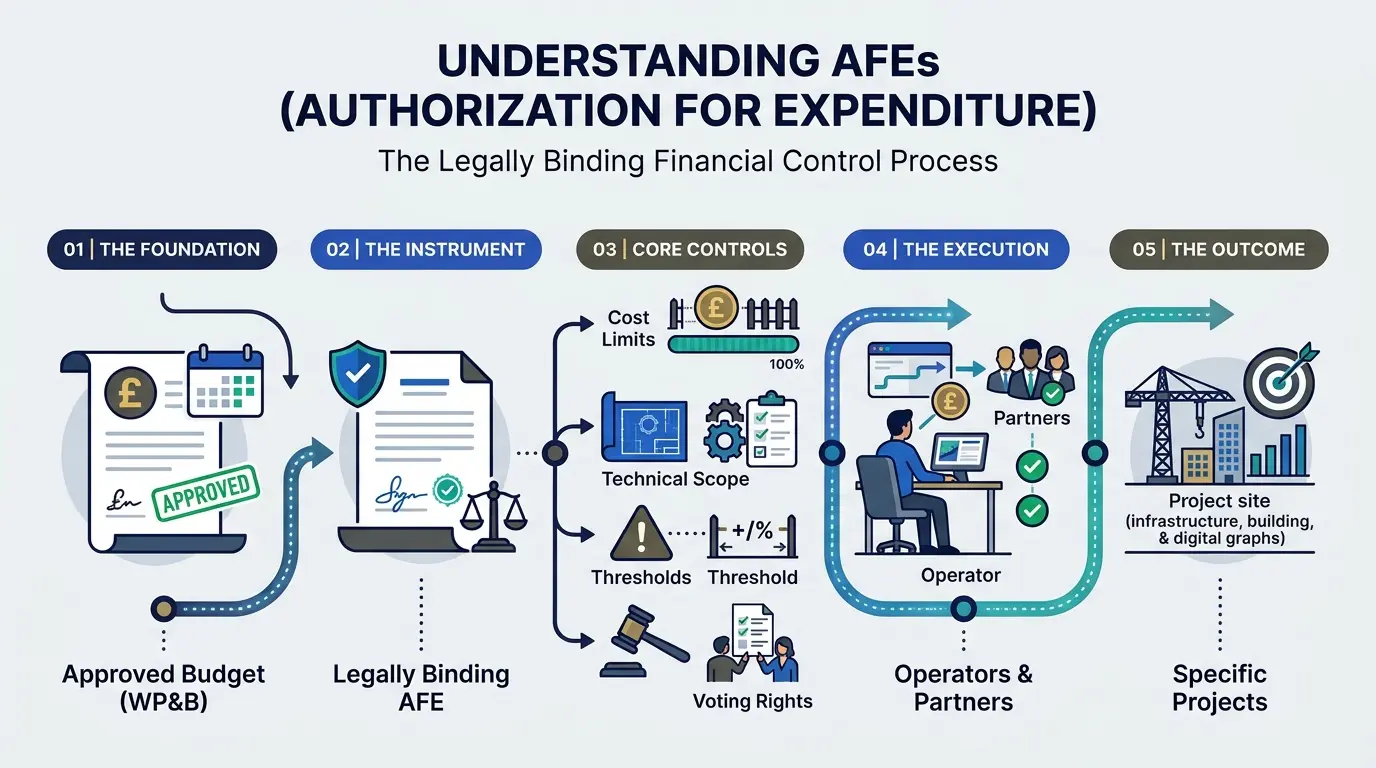
While an approved WP&B grants overall operational authorization, individual projects require specific AFEs prior to financial commitment. Operators issue AFEs for drilling campaigns, facility modifications, major maintenance overhauls, and seismic acquisition programs. An AFE detailing target depth, well design, casing programs, and dry-hole versus completion cost breakdowns ensures full transparency before rig mobilization.
Non-operating partners perform detailed commercial and engineering evaluations upon receiving an AFE. They verify that proposed costs conform to market rates for rig hire, oilfield services, and long-lead materials. Partners validate whether the AFE falls within the scope of the macro WP&B or requires a formal budget amendment vote under JOA provisions.
Cost control relies on rigorous variance tracking throughout project execution. Operating agreements establish overspend thresholds, typically 10% above the approved AFE amount. When projected costs breach this limit, the operator must issue supplemental and adjustment cash calls backed by a supplemental AFE, detailing the root causes of cost growth such as drilling surprises, equipment downtime, or supply chain inflation.
How Is a Monthly Cash Call Schedule Executed to Ensure Joint Venture Liquidity?
Executing a monthly cash call schedule requires operators to forecast upcoming operational expenditures, calculate net partner shares based on working interests, issue formal billing notices, and process receipts within strict contractual payment windows.
Cash call preparation requires precise short-term cash flow forecasting. Operators construct rolling 30-to-90-day liquidity projections that reflect scheduled vendor payments, rig day-rates, engineering milestone payments, and local administrative expenses. Accurate cash call calculations prevent operating cash deficits while avoiding excess cash accumulation in joint bank accounts.
The operator calculates each participant's share by applying working interest percentages to projected cash outflows. Official cash call notices specify banking details, currency denominations, payment due dates (usually 15 days from receipt), and detailed breakdowns of upcoming activities. This administrative routine ensures consistent capital inflows aligned with field operations.
Partner cash receipts flow into segregated joint venture bank accounts. Operator cash management obligations mandate that these funds remain strictly separate from the operator's corporate funds. Managing cash advances responsibly protects joint venture assets and maintains commercial trust among all joint venture partners.
What Are the Contractual Consequences and Financial Remedies for Funding Shortfalls and Late Payments?
Funding shortfalls disrupt operational momentum, triggering contractual default mechanisms under joint operating agreements, including late payment interest charges, forfeiture of voting rights, default notices, and eventual dilution or buy-out of non-paying partners.
Late payment and interest provisions activate immediately when a partner fails to remit cash call obligations by the specified due date. Joint operating agreements define standard interest rates, often calculated as LIBOR/SOFR plus a designated percentage margin (e.g., SOFR + 5%). Interest accrues daily from the payment due date until full settlement of the outstanding liability.
When default occurs, partner default remedies protect the operating capability of the venture. The operator issues a formal Notice of Default, giving the defaulting party a cure period (typically 30 days). During this period, the defaulting partner loses voting rights in the Operating Committee and loses access to joint venture operational data and technical reports.
If the default remains uncured, non-defaulting partners must fund the shortfall pro-rata to their working interests to prevent operational shutdown. Continued default empowers non-defaulting partners to exercise advanced remedies. These include seizing the defaulting partner's share of production, enforcing mortgage rights over their working interest, or enforcing forced dilution or total forfeiture of their equity in the block.
How Is Cash Call Reconciliation Performed Against Actual Joint Venture Spend?
Cash call reconciliation compares advance cash payments against actual incurred expenditures reported through Joint Interest Billings (JIBs), calculating net variance balances to adjust subsequent cash calls or issue cash refunds.
Cash call reconciliation to actual spend occurs monthly through the Joint Interest Billing cycle. The operator aggregates actual ledger expenses, verifies vendor invoices, applies COPAS or JOA overhead charges, and allocates costs across project work packages. This process yields the true historical spend for the prior operating period.
The operator nets advance cash calls received against actual JIB expenditures for each partner. A surplus occurs when cash calls exceed actual spend, resulting in a credit balance applied to future cash calls. A deficit requires an adjustment cash call to collect unpaid balances. Clear, timely reconciliation statements preserve financial integrity and reduce audit exceptions during joint venture financial audits.
How Do Structured Training Approaches Compare for Building Mastery in Cash Calls, AFEs, and Budgeting?
Building competence in joint venture financial control requires selecting a training approach that balances theoretical framework knowledge, legal JOA mechanics, and real-world accounting mechanics across different organizational learning models.
Organizations evaluating options to upskill joint venture accounting teams face choices regarding training formats. Traditional self-paced e-learning provides foundational knowledge of terminology but lacks practical exposure to complex financial calculations. Internal mentoring transfers legacy firm knowledge but risks repeating historical errors and lacks standardized framework alignment.
Structured corporate training delivered by domain experts combines accounting theory with practical cash management simulations, contract analysis, and real-world case exercises. Organizations seeking comprehensive capability development enroll teams in structured programs such as the Cash Calls, AFEs & Work Program/Budget Control: Preparation Training Course.
Selecting an upskilling format requires evaluating how different methodologies address key learning objectives:
Learning & Training Attribute | Self-Paced E-Learning | Internal Mentoring | Structured Corporate Workshop |
JOA & Accounting Mechanics | Basic terminology | Variable knowledge | Comprehensive contract analysis |
Practical Calculation Mastery | Static quizzes | Unstructured review | Real-world cash call modeling |
Default & Remedy Navigation | Theoretical overview | Historical anecdotes | Case-based dispute simulations |
COPAS/AIPN Alignment | High-level summary | Company-specific focus | Industry-standard implementation |
Time to Competency | 8 to 12 Weeks | 6 to 12 Months | 3 to 5 Days (Intensive) |
Audit Readiness Impact | Minimal impact | Moderate reliance | High error-reduction impact |
How Should HR Leaders and Finance Directors Select the Right Upskilling Framework for Upstream Teams?
Selecting an effective training program requires evaluating workforce capability gaps, joint venture operational complexity, partner audit exposure, and measurable business ROI to ensure financial compliance.
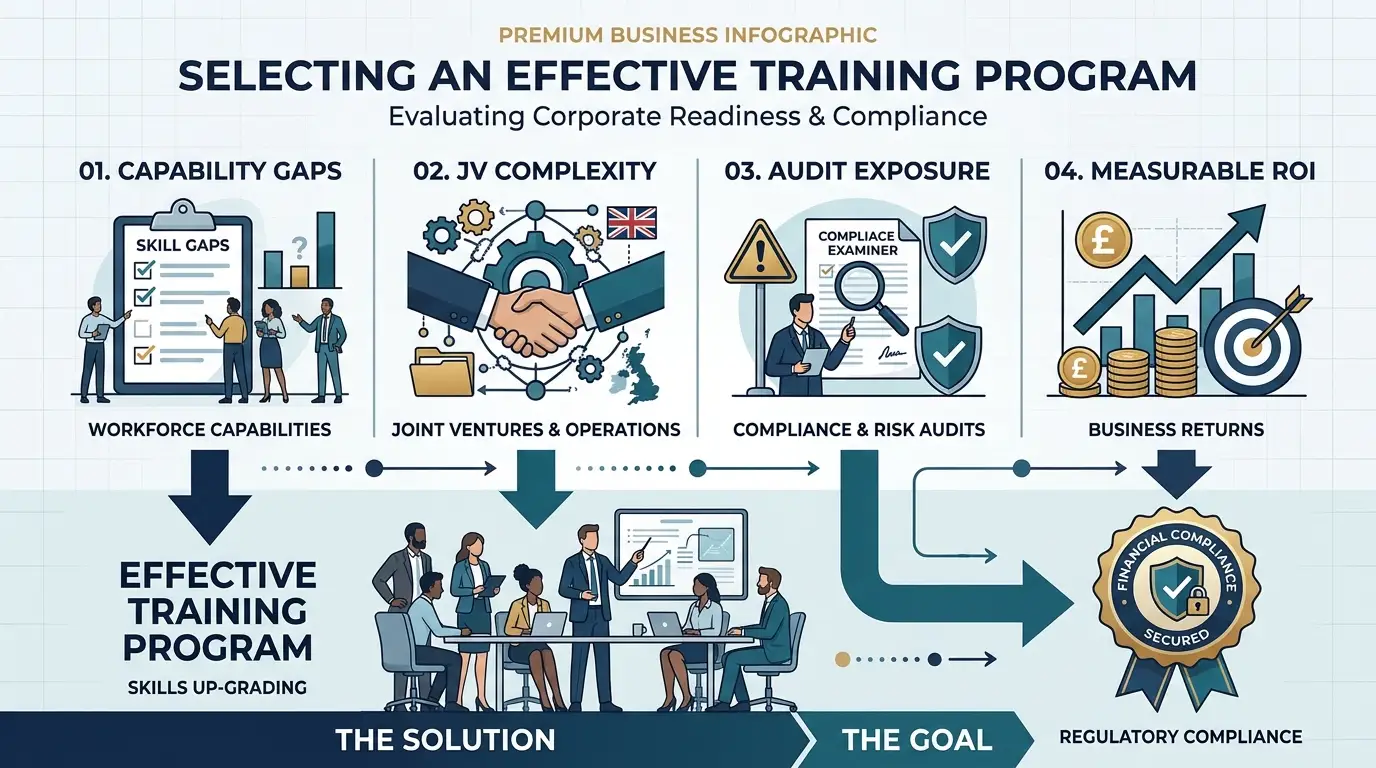
Decision-makers must assess their team's capability level across the joint venture financial lifecycle. Organizations managing operated assets require advanced cash forecasting and default management capabilities, while non-operating participants need rigorous AFE audit and budget review skills. Aligning training delivery with operational roles maximizes commercial value.
Evaluating training providers involves reviewing real-world application, industry-tested curriculum standards, and practical exercise design. Structured corporate programs address the gap between accounting knowledge and practical JV governance by immersing professionals in realistic scenarios.
Organizations seeking targeted capability development evaluate specialized programs like the Cash Calls AFEs and Work Program Budget Control Preparation Training by Institute For Oil & Gas Training to standardize financial routines across exploration and production business units.
HR leaders and department heads can use this framework to select appropriate learning solutions based on organizational priorities:
Selection Criteria | High Partner Audit Risk | Rapid Asset Expansion | New JV Team Onboarding |
Primary Learning Objective | Reduce audit exceptions & claims | Accelerate WP&B approval cycles | Standardize financial processes |
Recommended Format | Advanced Case-Based Workshop | Applied Financial Modeling | Structured Core Course |
Target Roles | JV Accountants, Internal Auditors | Commercial Managers, Asset Leads | Junior/Mid-Level E&P Accountants |
Key Performance Indicator | Lower audit adjustments ($) | Shorter cash call approval times | Zero compliance breaches |
Expected Business ROI | Immediate cost recovery | Optimized cash flow liquidity | Reduced operational downtime |
Investments in structured capability building directly reduce financial risk in upstream joint ventures. Equipping finance, commercial, and operational teams with standardized methods for WP&B preparation, AFE management, monthly cash calling, and variance reconciliation secures corporate liquidity, maintains partner trust, and protects asset profitability.
Frequently Asked Questions
What Is Oil & Gas Petroleum Budgeting & Cost Control?
Oil & Gas Petroleum Budgeting & Cost Control is a specialized financial management discipline that aligns capital expenditure (CAPEX) and operating expenditure (OPEX) with strategic exploration and production targets. The Institute For Oil & Gas Training delivers comprehensive instruction on managing work programs, Authorisations for Expenditure (AFEs), cost tracking, variance analysis, and Joint Venture (JV) cost recovery mechanisms. This discipline ensures petroleum projects maintain fiscal discipline, prevent budget overruns, and optimize financial returns across upstream, midstream, and downstream operations.
Why Is Cost Control Crucial in Upstream Oil and Gas Operations?
Cost control is critical in upstream petroleum operations due to extreme commodity price volatility, high capital intensity, and long operational lifecycles. Effective financial management frameworks taught by the Institute For Oil & Gas Training enable operators to monitor real-time project cash flows, control drilling and facility expenses, and mitigate joint venture audit risks. Implementing robust Oil & Gas Petroleum Budgeting & Cost Control protects asset profitability, ensures regulatory compliance, and reduces cost leakages.
Who Should Attend an Oil & Gas Budgeting and Cost Management Course?
This professional training is designed for petroleum accountants, cost control engineers, JV managers, finance analysts, and commercial directors working across the energy sector. Through specialized programs by the Institute For Oil & Gas Training, operational managers and project leads gain essential skills to interpret cost reports, evaluate vendor invoices, and manage budget allocations effectively. Gaining expertise in Oil & Gas Petroleum Budgeting & Cost Control also benefits government petroleum regulators and commercial auditors overseeing joint operating agreements.
What Are the Key Components of an Upstream Petroleum Budget?
An upstream petroleum budget primarily comprises exploration expenditures, development CAPEX, facility installation, drilling budgets, and ongoing OPEX. Programs at the Institute For Oil & Gas Training emphasize integrating activity-based costing, joint venture cash calls, and AFE cost breakdown structures into the master work program. Mastering these components within Oil & Gas Petroleum Budgeting & Cost Control ensures accurate financial forecasting and transparent expenditure reporting to non-operating partners.
How Does Effective Cost Control Improve Joint Venture Financial Governance?
Effective cost control standardizes financial communication between operating and non-operating partners, ensuring all charges strictly comply with Joint Operating Agreements (JOAs) and accounting procedures. The Institute For Oil & Gas Training equips teams with practical techniques for managing cash call reconciliations, variance reporting, and cost allocations. Applying formal Oil & Gas Petroleum Budgeting & Cost Control principles minimizes joint interest billing disputes, streamlines cash advances, and enhances overall partner audit readiness.
Related training courses
Budgeting & Forecasting for the Annual Budget Cycle Training Course
- Specialisation
- Oil & Gas Petroleum Budgeting & Cost Control
- Duration
- 5 days · 15 CPD hours
Cash Calls, AFEs & Work Program/Budget Control: Preparation Training Course
- Specialisation
- Oil & Gas Petroleum Budgeting & Cost Control
- Duration
- 5 days · 15 CPD hours
Budget Planning and Cost Optimisation Training Course
- Specialisation
- Oil & Gas Petroleum Budgeting & Cost Control
- Duration
- 5 days · 15 CPD hours
More articles

Budget Planning and Cost Optimisation Training by Institute For Oil & Gas Training
Master petroleum operating budgets, CAPEX, and OPEX management through the professional training course offered by the Institute For Oil & Gas Training.
Read article →
How to Identify Cost Saving Opportunities and Optimise Petroleum Operating Budgets
Discover proven methods to identify cost-saving opportunities, optimize OPEX and CAPEX, and improve financial forecasting in petroleum operations.
Read article →
Why Budget Planning and Cost Optimisation Matter in Oil and Gas Operations
Discover why budget planning and cost optimisation matter in oil and gas operations. Learn how structured training improves financial control and OPEX.
Read article →