

Oil and gas cost control and budget planning is a structured financial management discipline that aligns capital expenditures (CAPEX) and operating expenditures (OPEX) with strategic operational goals to maintain cash flow, mitigate risk, and secure long-term project profitability.
Petroleum budget planning establishes precise financial frameworks across upstream exploration, midstream transport, and downstream refining sectors. In capital-intensive energy environments, volatile crude oil prices and shifting global supply chains impact operational margins directly. Financial precision prevents project budget overruns, eliminates supply chain inefficiencies, and protects corporate liquidity during market downturns. Organisations that master petroleum cost estimation calculate expenditures using multi-variable engineering models, ensuring every dollar allocated delivers direct operational value.
At the workforce level, financial discipline requires systemic competence across departments. Operational teams, engineering divisions, and facility managers influence corporate spending daily through procurement decisions, maintenance schedules, and resource utilisation. When technical professionals lack commercial literacy, financial slippage occurs. Integrated oil and gas financial planning bridges the divide between engineering execution and commercial strategy, establishing shared fiscal accountability across asset management teams.
Why Do Organisations Struggle With CAPEX and OPEX Management?
Organisations struggle with CAPEX and OPEX Management due to fragmented communication between technical and financial departments, reliance on static spreadsheet models, inaccurate cost estimation techniques, and unaligned performance metrics that reward short-term output over total cost of ownership.
The operational complexity of energy infrastructure introduces systemic financial vulnerabilities. Engineering units frequently prioritize maximum technical performance or asset redundancy without evaluating operational expenditure implications. Conversely, corporate finance teams enforce rigid budgetary caps without understanding field-level engineering constraints. This structural disconnect creates capital misallocation, unbudgeted equipment downtime, and procurement delays in offshore platforms, refinery turnarounds, and pipeline expansions.
Misconceptions regarding financial management compound these operational challenges:
Treating Cost Optimisation as Reactive Cost Cutting: Traditional cost reduction focuses on immediate head-count reductions or deferred maintenance. This approach degrades asset integrity, increases safety hazards, and causes catastrophic equipment failures that escalate long-term operating costs. Strategic optimisation restructures processes to reduce unit production costs permanently.
Assuming Financial Control Belongs Exclusively to Finance Teams: Operating budgets are consumed on the rig floor, inside processing plants, and throughout logistics networks. Operations personnel make daily tactical decisions that dictate final expenditure. Restricting financial training to accounting personnel leaves field operations unequipped to control expenditures at the source.
Relying on Historical Budgeting Models: Incremental budgeting adds fixed percentage adjustments to previous operational cycles. This model fails to account for fluctuating material costs, changing geological complexity, and evolving regulatory compliance requirements. Modern asset management demands zero-based budgeting frameworks rooted in real-time operational data.
How Does Corporate Budget Planning and Cost Optimisation Training Work?
Corporate budget planning and cost optimisation training works through a structured four-stage learning methodology comprising baseline skill assessment, targeted workshop instruction, real-world operational simulation, and post-training performance tracking to ensure complete workplace application.
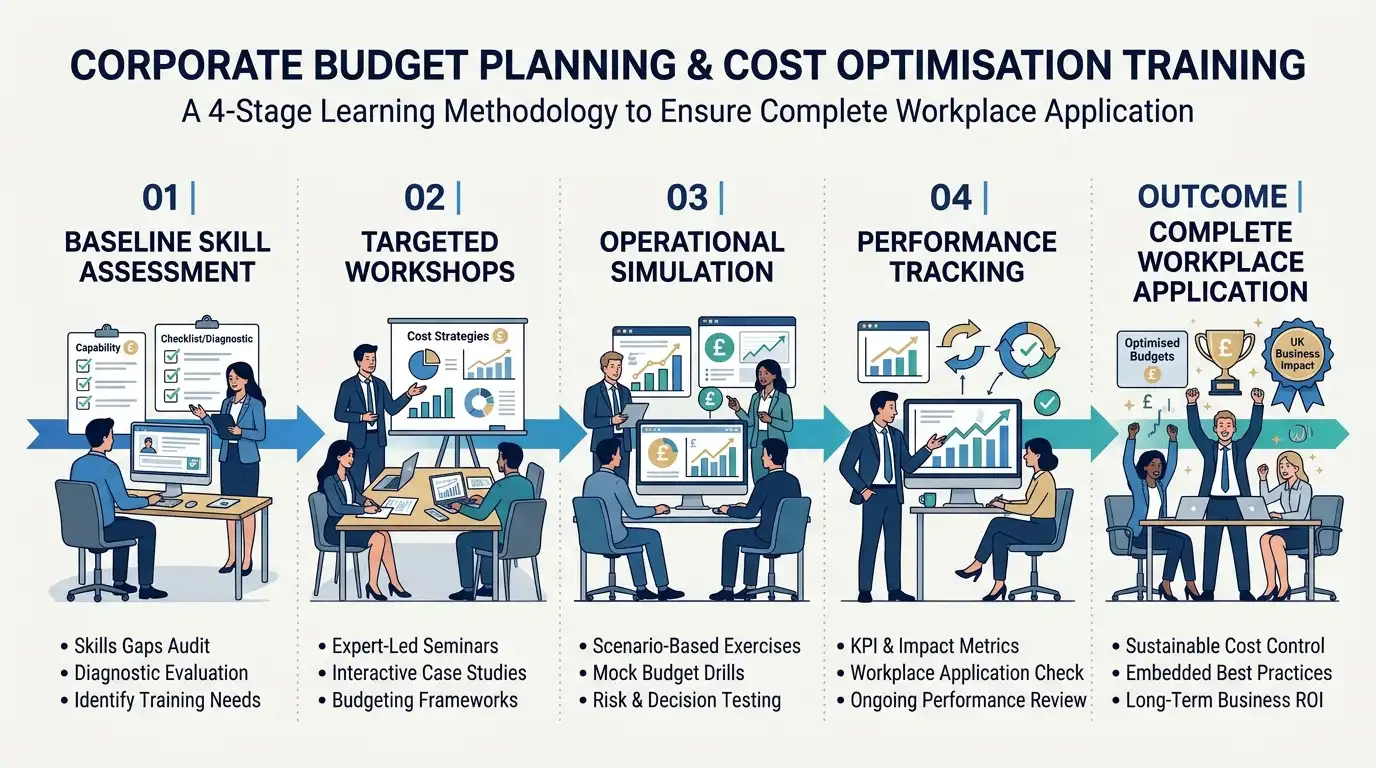
To deliver sustainable financial performance, workforce development programs follow a progressive implementation model designed for technical professionals and operational managers:
1. Skill Gap Assessment and Baseline Mapping
The implementation process begins with a comprehensive audit of current organisational capabilities. L&D professionals assess technical staff on core competencies, including variance analysis, risk-adjusted forecasting, contract management, and life-cycle cost analysis. Baseline mapping identifies specific knowledge deficits across asset management teams, establishing precise learning objectives aligned with corporate financial targets.
2. Structured Instructional Delivery
Training programs deliver core financial principles through blended learning formats. Participants engage with structured modules covering petroleum cost estimation, capital allocation models, and cost breakdown structures (CBS). Instruction combines theoretical accounting principles with practical petroleum engineering economics, ensuring technical managers master the mechanics of balance sheets, cash flow statements, and net present value (NPV) calculations.
3. Case-Based Learning and Applied Simulations
Learners work through real-world operational scenarios using historical asset data from onshore fields, offshore rigs, and petrochemical plants. Participants run sensitivity analyses on fluctuating oil prices, model project cash flows under supply chain disruption, and build zero-based budgets for turnaround maintenance operations. Interactive role-play scenarios simulate high-stakes budget review meetings, training technical leaders to defend capital requests using rigorous commercial metrics.
4. Post-Training Operational Integration and Audit
Following formal instruction, learners execute practical workplace projects under mentorship. Participants apply new financial tools directly to live operating budgets, identifying immediate cost-saving opportunities within their respective operational units. L&D teams and department heads monitor performance over 90 to 180 days, measuring skill retention, process improvements, and tangible fiscal results.
To evaluate structured capability building, decision-makers review the Budget Planning and Cost Optimisation Training Course for technical and operational personnel.
What Key Components Are Included in a Cost Control Training Framework?
A comprehensive cost control training framework includes core financial competencies, advanced forecasting tools, standardized cost breakdown structures, contract risk management techniques, and industry-standard key performance indicators.
A robust professional development curriculum incorporates five core building blocks:
Core Financial Competencies
CAPEX Allocation and Valuation: Net Present Value (NPV), Internal Rate of Return (IRR), Payback Period, and Capital Rationing models tailored to exploration and production projects.
OPEX Management: Variable vs. fixed cost identification, activity-based costing (ABC), unit operating cost calculations, and maintenance expense rationalization.
Life-Cycle Cost Analysis (LCCA): Evaluating total equipment acquisition, operation, maintenance, and decommissioning expenses over 20-to-30-year asset lifespans.
Advanced Forecasting and Risk Tools
Oil and Gas Budget Forecasting: Quantitative trend forecasting, time-series analysis, and Monte Carlo simulations for price volatility modeling.
Variance Analysis Frameworks: Earned Value Management (EVM), Cost Variance (CV), Schedule Variance (SV), and Cost Performance Index (CPI) tracking.
Scenario Planning: Stress-testing operating budgets against crude oil price shifts ($40/bbl to $100/bbl scenarios) and inflation rates.
Standardized Cost Structures and Procurement Controls
Cost Breakdown Structure (CBS): Mapping operational tasks directly to accounting ledger accounts for real-time spend visibility.
Contractor and Vendor Cost Management: Structuring lump-sum, cost-plus, and time-and-materials (T&M) contracts to mitigate supplier price escalation.
Procurement Optimization: Vendor negotiations, strategic sourcing, and inventory holding cost reduction strategies.
Operational KPI Tracking
Cost per Barrel Equivalent (BOE): Measuring field-level extraction cost efficiency against global industry benchmarks.
Budget Variance Percentage: Tracking deviation between planned and actual expenditures across monthly billing cycles.
Maintenance ROI: Quantifying the financial return of preventative maintenance programs versus emergency reactive repairs.
What Measurable Business Outcomes Does Budget Optimisation Training Produce?
Budget optimisation training produces measurable business outcomes including 12% to 18% reductions in operating expenditure, 25% faster budget approval cycles, improved project schedule adherence, and elevated return on invested capital (ROIC).
Organisations that invest in workforce financial capability achieve quantifiable returns across operational and financial metrics. Structured learning transforms abstract corporate targets into actionable field-level practices.
Metric Area | Pre-Training Baseline | Post-Training Outcome | Organisational Impact |
Operating Expenditure (OPEX) | Frequent 10–15% budget overruns | 12–18% net cost reduction | Increased cash reserves and operational margin protection during low price cycles. |
Budgeting Cycle Time | 60–90 days per annual cycle | 30–45 days streamlined execution | Faster strategic decision-making and reduced administrative overhead across departments. |
Earned Value Management (EVM) | Unmonitored schedule/cost drift | CPI maintained between 0.98–1.02 | On-time, on-budget completion of facility turnarounds and drilling campaigns. |
Maintenance Overtime Spend | 20–30% of total labor expenditure | Reduced to under 8% total spend | Optimised workforce scheduling and transition from reactive to predictive maintenance. |
Workforce Retention (L&D) | Baseline employee turnover | 15–22% higher team retention | Enhanced employee engagement, leadership pipeline stability, and institutional knowledge preservation. |
How Do Energy Organisations Implement Cost Optimisation Training Across Departments?
Energy organisations implement cost optimisation training by customizing learning paths for specific departments, embedding real-world project data into coursework, utilizing hybrid delivery formats, and aligning training milestones with annual budgeting cycles.
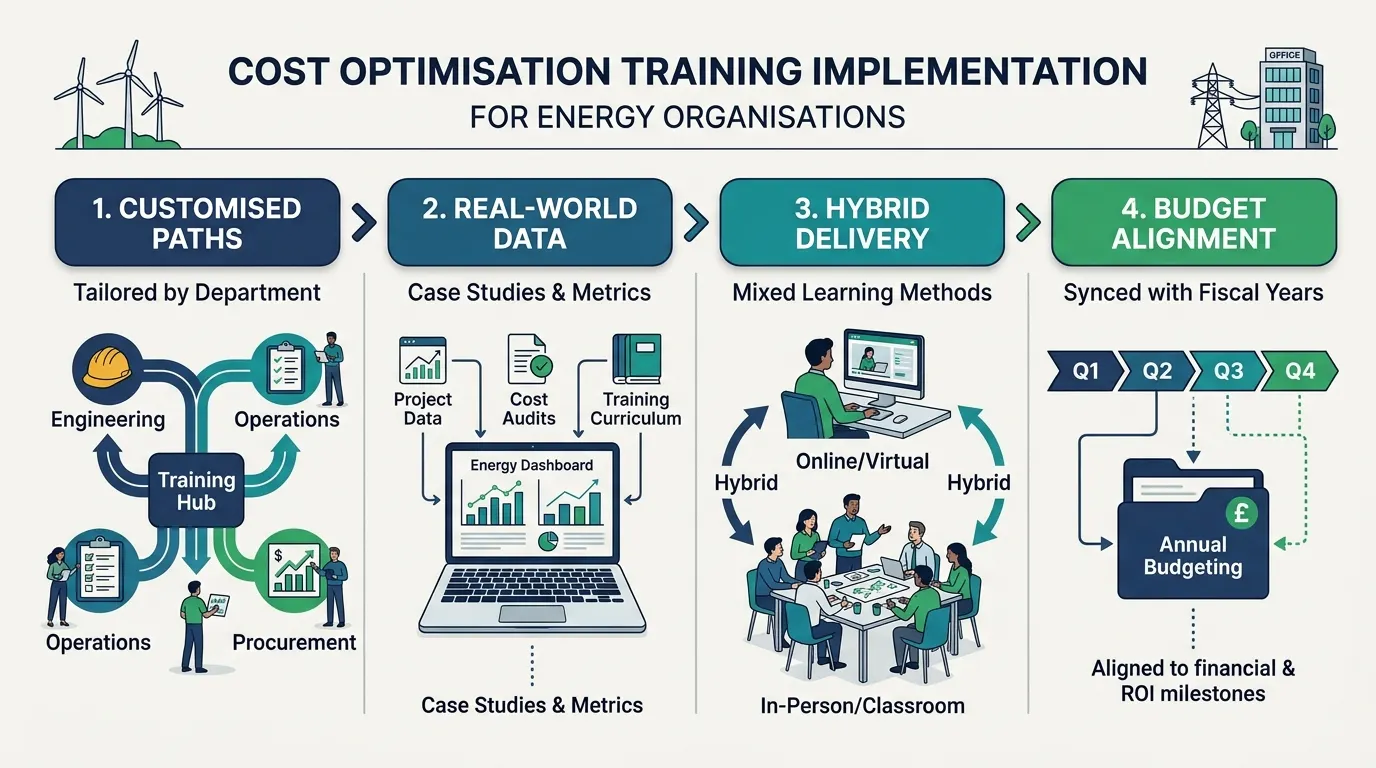
Successful implementation requires tailored instruction suited to specific operational responsibilities across industries like offshore drilling, refining, midstream pipeline transport, and oilfield services:
Upstream Asset Management Teams
Offshore and onshore exploration teams focus on high-risk CAPEX estimation and drilling cost control. Training emphasizes rig rate negotiations, well completion cost models, and authorization for expenditure (AFE) tracking. Engineers learn to calculate the financial impact of non-productive time (NPT), directly reducing costly downtime during field operations.
Midstream and Logistics Divisions
Pipeline operators and transportation units apply cost control to fuel management, pump station energy efficiency, and route optimization. Workforce development covers inventory holding costs, spare parts rationalisation, and long-term pipeline integrity budget management.
Downstream Refining and Petrochemical Facilities
Refining operations operate on narrow processing margins where plant availability determines profitability. Training for turnaround managers, plant engineers, and maintenance leads focuses on turnaround scope freeze execution, contractor T&M audits, and energy intensity index (EII) reduction.
When transitioning from operational awareness to active financial restructuring, decision-makers analyze how to identify cost saving opportunities and optimise petroleum operating budgets to establish clear benchmark targets.
Strategic Next Steps for Workforce Transformation
Building financial capability across technical and operational teams converts budgetary management from an annual administrative requirement into a continuous operational advantage. When engineering leads, plant managers, and procurement specialists speak a unified commercial language, organisations eliminate fiscal waste, protect capital, and maintain operational resilience regardless of market volatility.
Executives, HR leaders, and L&D directors must evaluate current workforce skill gaps across CAPEX and OPEX management. Aligning targeted training programs with upcoming budget cycles ensures immediate application, measurable cost reduction, and sustained asset performance.
Frequently Asked Questions
What is petroleum budgeting and cost control in the oil and gas sector?
Petroleum budgeting and cost control involve managing capital expenditure (CAPEX) and operating expenditure (OPEX) across upstream, midstream, and downstream operations. At the Institute For Oil & Gas Training, oil & gas petroleum budgeting & cost control programs teach technical and operational professionals how to align financial forecasts with real-world engineering constraints to maintain project profitability.
Why is cost control important for oil and gas operations?
Rigorous cost control protects operating margins and corporate liquidity against volatile crude oil prices and supply chain disruptions. Effective financial planning eliminates unbudgeted equipment downtime and project overruns, ensuring that capital allocation delivers maximum operational value across asset lifecycles.
How do oil and gas companies reduce operating expenditures (OPEX)?
Organisations reduce OPEX by implementing activity-based costing, shifting from reactive maintenance to predictive scheduling, and optimising logistics and vendor contracts. Structured professional development helps plant managers and engineers identify fiscal waste directly at the rig floor and processing facility.
What skills are taught in oil & gas petroleum budgeting and cost control training?
Participants learn net present value (NPV) calculations, life-cycle cost analysis, variance analysis frameworks, and risk-adjusted forecasting models. These practical competencies bridge the gap between technical execution and commercial strategy for engineers and project leads.
Who should participate in oil and gas financial planning and budgeting courses?
These courses are designed for operations managers, engineering leads, procurement specialists, and finance personnel working in upstream exploration, pipeline transport, and refinery operations. Cross-functional training ensures that every team member involved in field expenditures shares accountability for fiscal performance.
Related training courses
Budgeting & Forecasting for the Annual Budget Cycle Training Course
- Specialisation
- Oil & Gas Petroleum Budgeting & Cost Control
- Duration
- 5 days · 15 CPD hours
Cost Control & Variance Analysis Using Cost Coding Training Course
- Specialisation
- Oil & Gas Petroleum Budgeting & Cost Control
- Duration
- 5 days · 15 CPD hours
Cash Calls, AFEs & Work Program/Budget Control: Preparation Training Course
- Specialisation
- Oil & Gas Petroleum Budgeting & Cost Control
- Duration
- 5 days · 15 CPD hours
More articles

Budget Planning and Cost Optimisation Training by Institute For Oil & Gas Training
Master petroleum operating budgets, CAPEX, and OPEX management through the professional training course offered by the Institute For Oil & Gas Training.
Read article →
How to Identify Cost Saving Opportunities and Optimise Petroleum Operating Budgets
Discover proven methods to identify cost-saving opportunities, optimize OPEX and CAPEX, and improve financial forecasting in petroleum operations.
Read article →
Cash Calls AFEs and Work Program Budget Control Overruns Training by Institute For Oil & Gas Training
Master joint venture budget control and cash call management. Register for professional training by Institute For Oil & Gas Training.
Read article →