

Managing financial governance within upstream Joint Venture (JV) operations requires absolute precision, strict compliance with Joint Operating Agreements (JOA), and rigorous execution of financial controls. Misaligned cash requests, inaccurate Authorisation for Expenditure (AFE) tracking, and uncoordinated Work Program and Budget (WP&B) revisions frequently lead to serious operator-non-operator disputes, severe cash flow bottlenecks, and costly project execution delays. The Institute For Oil & Gas Training delivers this specialized training course to resolve these precise operational exposure points, equipping energy sector personnel with actionable skills to protect corporate liquidity and ensure transparent partner auditability.
Understanding the financial mechanics governing joint venture assets is critical for any professional operating in the exploration and production sector. For a broader overview of why these financial controls are fundamental to upstream asset performance, read our analysis on Why Cash Calls AFEs and Work Program Budgets Matter in Joint Venture Operations. Building upon those foundational operational principles, this advanced training course delivers the practical methodologies required to prepare, control, and reconcile joint venture accounts in full compliance with international energy standards.
What is the course and what problem does it solve?
This training course provides systematic, practical instruction on preparing, managing, and auditing cash calls, AFEs, and work program budgets in upstream joint ventures, directly resolving partner default risks, cash flow shortfalls, project cost overruns, and joint interest audit exceptions.
Joint venture operations in the energy sector rely on a delicate balance of trust, contractual alignment, and rigorous cash management. Operator cash management obligations dictate that operators must call forward cash from non-operating partners in strict accordance with approved work programs and accounting procedures. However, many operating companies struggle with inaccurate cash call preparation, inconsistent monthly cash call schedules, and poorly structured supplemental and adjustment cash calls. These procedural failures trigger partner disputes, delayed funds transfers, interest penalties, and unnecessary administrative burdens for both operating and non-operating financial teams.
The technical complexity of managing Authorisation for Expenditure (AFE) documents compounds these operational risks. AFEs serve as the legally binding authority to commit capital to specific exploration, development, or decommissioning activities. When project teams lack the structural framework to tie AFE line items directly to approved WP&B line items, financial visibility degrades rapidly. Uncontrolled scope changes lead to unapproved cost overruns, forcing operators to issue late supplemental AFEs that partners may legally challenge or reject under the terms of the Joint Operating Agreement.
Furthermore, cash call reconciliation to actual spend remains a major area of vulnerability during joint interest audits. Non-operators frequently challenge operator cash calls when actual expenditure timing diverges significantly from forecast cash call schedules, leading to delayed cash calls, disputed cash advances, and strained joint venture relationships. In extreme cases, failure to manage partner defaults properly through formal default notices, cash call interest charges, and default remedy provisions threatens the financial stability of the entire petroleum license.
The Institute For Oil & Gas Training developed the Cash Calls, AFEs & Work Program/Budget Control: Preparation Training Course to solve these precise corporate challenges. By bridging the operational gap between commercial finance, petroleum engineering, and joint venture accounting, this program equips professionals with standardized templates, execution protocols, and analytical models necessary to maintain absolute control over joint venture cash flows and budget execution.
Why is this course structured this way?
The curriculum is structured sequentially to reflect the real-world operational lifecycle of joint venture financial management, moving systematically from foundational Joint Operating Agreement frameworks through budget preparation, AFE execution, cash call operations, and post-execution accounting reconciliation.
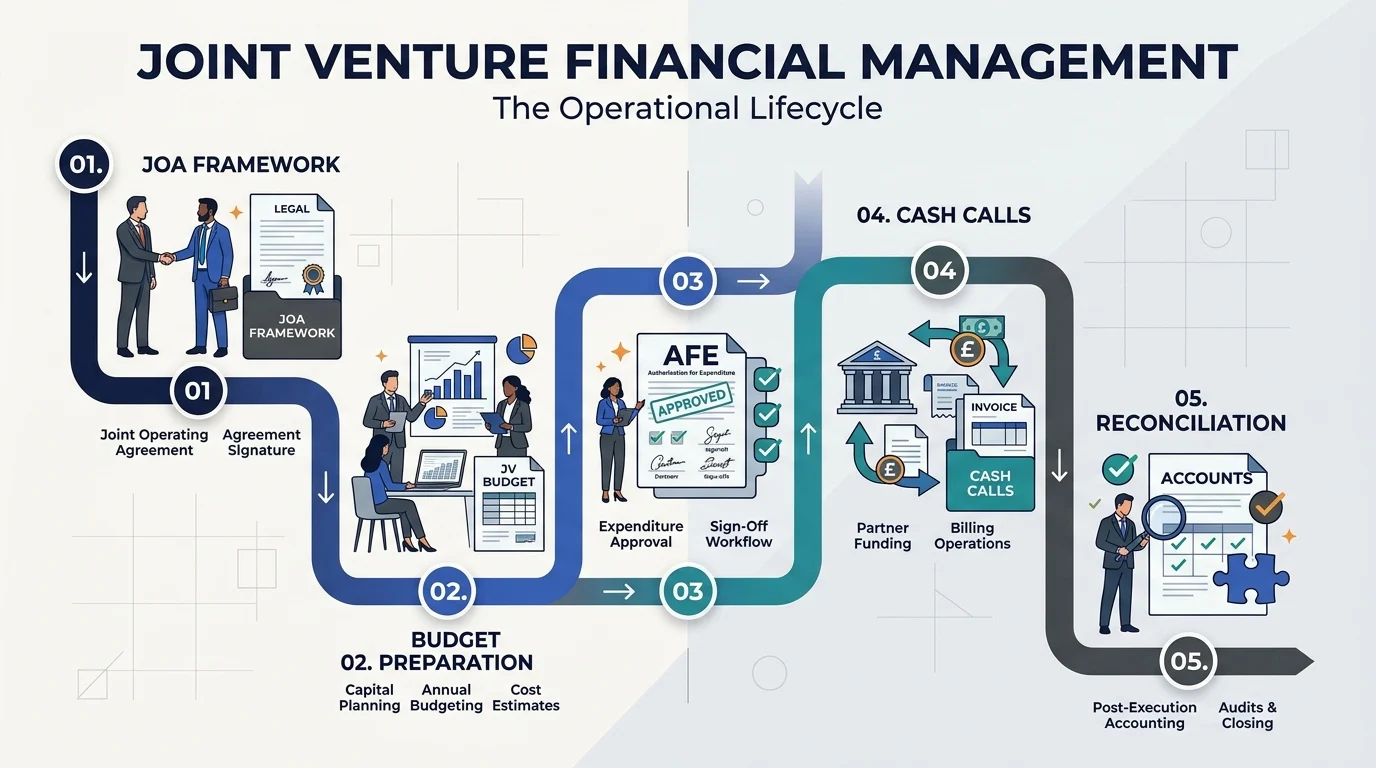
Designing an effective joint venture financial training program requires a logical progression that mirrors actual industry workflows. The Institute For Oil & Gas Training utilizes a structured pedagogical model that grounds participants in legal and contractual frameworks before moving into complex financial calculations and treasury operations. This architecture ensures that technical personnel understand the financial consequences of their operational decisions, while finance professionals gain insight into project execution mechanics.
The curriculum begins with the contractual foundation: the Joint Operating Agreement (JOA) and its attached Accounting Procedure (AP). Understanding these legal instruments is essential because they define voting interest thresholds, billing calendar rules, overhead charge allocations, and cash advance caps. Without this grounding, financial staff risk issuing non-compliant cash calls or miscalculating partner billing statements, exposing the operating company to financial audit exceptions and legal challenges.
Once the legal baseline is established, the course progresses into Work Program and Budget (WP&B) compilation. Participants learn how to translate complex field development plans, drilling campaigns, and facility maintenance schedules into standardized financial formats. The curriculum places heavy emphasis on building multi-currency budget models, applying appropriate inflation and contingency factors, and establishing clear line-item variance thresholds. Detailed guidance on detailed budget preparation techniques is available in our practical guide on How to Prepare Cash Calls AFEs and Work Program Budgets for Oil and Gas Projects.
The final phases of the course structure focus on real-time operational control: managing AFEs, processing cash calls, and executing monthly reconciliations. By organizing the learning sequence to match the actual lifecycle of an exploration or production asset, participants develop an intuitive, operational understanding of how cash calls, AFEs, and work program budgets interact to govern project performance.
What will participants learn?
Participants gain comprehensive operational skills in JOA compliance, WP&B compilation, AFE tracking, cash call calculation, interest provision application, partner default management, cash management reporting, and joint interest audit defense methodologies.
Module 1: Joint Venture Financial Governance & JOA Frameworks
Participants examine the structural mechanics of international Joint Operating Agreements (based on AIPN/AIEN model contracts) and standard Accounting Procedures.
Principles of non-operator cost sharing and joint account charging.
Analysis of operator cash management obligations and fiduciary duties.
Direct charges versus indirect allocations and corporate overhead formulas.
Voting thresholds for budget approvals, AFEs, and major project sanctions.
Legal implications of non-payment, cash call default, and remedy timelines.
Module 2: Work Program & Budget (WP&B) Construction & Control
This module focuses on building, submitting, and controlling annual work programs and capital/operating budgets for joint operations.
Translation of technical field development plans into financial budgets.
Establishing cost breakdown structures (CBS) aligned with joint accounts.
Multi-currency budgeting, exchange rate risk handling, and inflation adjustments.
Managing supplemental budget approvals and budget reallocations.
Tracking actual performance against approved WP&B baselines.
Module 3: Authorisation for Expenditure (AFE) Management
Participants master the lifecycle of AFEs, from initial cost estimation and draft preparation to closeout and audit reconciliation.
Preparation of exploration, drilling, development, and facility AFEs.
Structural alignment between AFE line items and approved WP&B line items.
Managing AFE overruns: thresholds, supplemental AFEs, and emergency approvals.
AFE closeout procedures, time-lapses, and unexpended capital returns.
Audit trail creation for internal and joint interest review processes.
Module 4: Cash Call Preparation & Treasury Operations
This practical module covers the mathematical calculations, forecasting techniques, and execution protocols required to issue compliant cash calls.
Formulating the monthly cash call schedule using project cash curves.
Calculating working capital requirements, minimum cash balances, and buffer funds.
Preparing baseline, supplemental, and adjustment cash calls.
Managing funding shortfall scenarios, late payment penalties, and interest provisions.
Partner default remedies, default notices, and forfeiture provisions.
Module 5: Cash Call Reconciliation & Joint Interest Accounting
The final module addresses post-execution financial management, billing statement generation, and partner audit procedures.
Executing cash call reconciliation to actual spend on a monthly and quarterly basis.
Preparing joint interest billing (JIB) statements and partner account ledgers.
Managing exchange rate gains/losses in multi-currency joint accounts.
Resolving partner audit exceptions, disputed line items, and credit memos.
Year-end financial close, asset retirement obligation (ARO) funding, and reporting.
How is the course delivered?
The program is delivered through immersive, specification-driven workshops available in four flexible formats: intensive live classroom, structured online sessions, hybrid corporate models, and tailored on-site corporate training.
The Institute For Oil & Gas Training designs training delivery formats specifically for working energy professionals, finance managers, joint venture accountants, and corporate HR learning pathways. Every delivery format incorporates practical exercise datasets, JOA clause analysis, and real-world financial modeling tools to ensure immediate workplace applicability.
Delivery Format | Duration | Target Audience | Primary Methodology |
Intensive Live Classroom | 5 Consecutive Days | Individuals, Small Teams, JV Specialists | Instructor-led lectures, group case studies, live financial modeling exercises |
Interactive Online Cohort | 4 Weeks (12 Hours Total) | Remote Personnel, International Teams | Virtual lectures, self-paced assignment review, online group discussions |
Hybrid Corporate Program | 2 Weeks Online + 3 Days Onsite | Enterprise HR cohorts, Cross-functional Units | Blended digital learning modules followed by hands-on operational workshops |
On-site Enterprise Workshop | Custom (3-5 Days) | Dedicated Corporate Finance/Asset Teams | Customized to company-specific JOA templates, ERP systems, and asset data |
Training methodology centers on practical application rather than pure theoretical instruction. Participants spend over 50% of instructional time working directly with realistic joint venture financial models, drafting cash call notices, evaluating draft AFEs, and calculating complex adjustment billing scenarios.
Assessment and skill validation are integral to the delivery structure. Participants complete module-level practical assignments, financial modeling stress tests, and a final capstone simulation involving a complex multi-partner cash call dispute. Successful completion requires demonstrating high competency in JOA contract interpretation, cash call calculation accuracy, and AFE variance tracking.
What measurable results can be expected?
Graduates achieve immediate operational gains, including zero joint interest audit penalties, reduced cash call processing cycles, precise AFE variance tracking, and elimination of partner funding shortfalls.
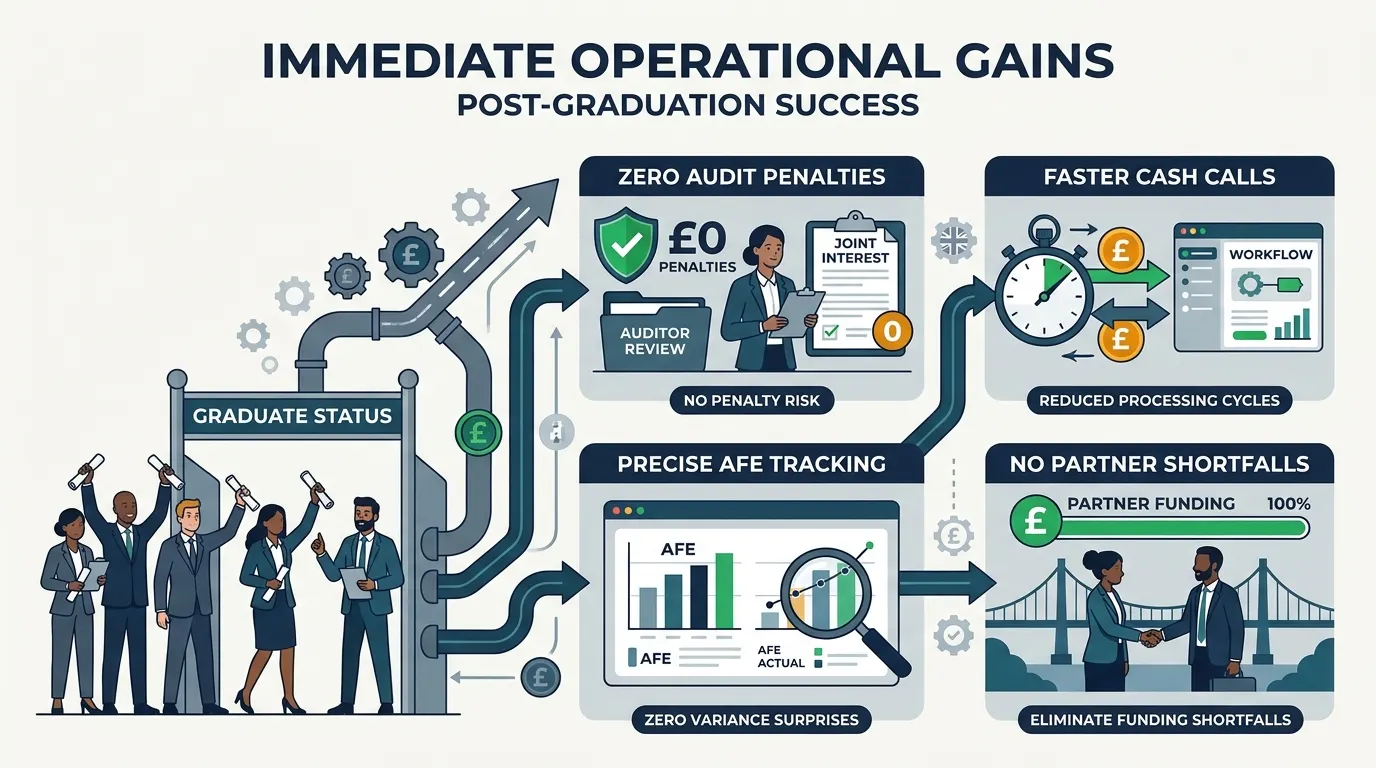
Corporate HR teams, department heads, and asset managers who enroll personnel in training delivered by the Institute For Oil & Gas Training experience tangible improvements in joint venture financial governance and cross-departmental coordination.
Individual Skill Capabilities
Upon completing this training program, individual participants demonstrate high proficiency across critical joint venture accounting and treasury functions:
Accurate Cash Call Formulation: Draft compliant baseline, supplemental, and adjustment cash calls using precise operational expenditure forecasts.
Effective AFE Management: Establish baseline AFEs, monitor real-time commitments, and execute supplemental approvals before cost overruns occur.
Rigorous Reconciliations: Perform complete cash call reconciliation to actual spend, ensuring clear audit trails for joint account charges.
Contractual Enforcement: Apply JOA default remedies, calculate late payment interest charges correctly, and handle partner funding shortfalls assertively.
Organizational and Corporate Outcomes
For operating companies, non-operating partners, and national oil companies (NOCs), sending teams through this program delivers immediate corporate performance benefits:
Elimination of Joint Interest Audit Exceptions: Standardizing cash call and AFE workflows ensures all charges comply strictly with JOA Accounting Procedures, preventing costly audit disputes and partner clawbacks.
Optimized Working Capital Management: Accurate monthly cash call schedules prevent over-calling cash (which alienates partners) or under-calling cash (which jeopardizes asset liquidity and supplier payments).
Enhanced Cross-Functional Alignment: Petroleum engineers, project managers, and finance professionals gain a shared understanding of AFE limits and budget rules, preventing unapproved field commitments.
Strengthened Partner Relationships: Professional, transparent, and contractually sound cash call administration fosters trust among joint venture partners, facilitating smoother approvals for future capital projects.
How does enrollment work?
Enrollment involves a formal candidate pre-qualification process, prerequisite verification, platform access provision, and structured post-course professional certification.
Eligibility & Prerequisites
To maintain professional instructional standards, applicants must meet baseline industry qualifications prior to enrollment approval:
Target Roles: Joint Venture Accountants, Finance Managers, Asset Managers, Petroleum Economists, Commercial Analysts, Planning Engineers, Joint Interest Auditors, and Enterprise HR Training Coordinators.
Recommended Background: A minimum of two years of operational or financial experience within the energy sector, or a foundational qualification in accounting, finance, or petroleum engineering.
Technical Requirements: Basic to intermediate proficiency in Microsoft Excel and familiarity with corporate accounting software or ERP environments (e.g., SAP, Oracle).
Step-by-Step Enrollment Process
Application Submission: Candidates or corporate HR teams submit a formal enrollment request specifying the preferred training delivery format (Classroom, Online, Hybrid, or Onsite).
Pre-Qualification Review: Admissions coordinators at the Institute For Oil & Gas Training evaluate candidate profiles to ensure alignment with course difficulty and peer group background.
Onboarding & Pre-Course Reading: Approved participants receive access to preparatory reading materials, including sample JOA Accounting Procedures and financial vocabulary primers.
Course Execution: Candidates complete the structured modules, interactive exercises, and capstone practical assessments under expert instructor guidance.
Certification & Continuing Education: Graduates earn a formal Certificate of Completion in Joint Venture Cash Calls, AFEs & Budget Control, earning recognized Continuing Professional Development (CPD) credit hours.
Organizations seeking to upgrade their financial operations and safeguard joint venture liquidity can enroll in this program today to secure seats in the upcoming training cohort.
Frequently Asked Questions
What is covered in oil and gas petroleum budgeting and cost control training?
Oil and gas petroleum budgeting and cost control training covers Joint Operating Agreement (JOA) financial compliance, Authorisation for Expenditure (AFE) tracking, and Work Program and Budget (WP&B) compilation. Participants learn to manage monthly cash calls, forecast capital expenditures, and reconcile operational accounts against approved budgets. The Institute For Oil & Gas Training designs these modules to ensure complete auditability and prevent cost overruns across exploration and production projects.
Who should attend an oil and gas cost control and budgeting course?
This course is designed for joint venture accountants, financial analysts, asset managers, petroleum engineers, and commercial planning teams in the energy sector. Professionals involved in joint interest auditing, operator cash management, or project finance benefit directly from the practical frameworks taught by the Institute For Oil & Gas Training. Corporate HR departments also utilize this program to bridge knowledge gaps between technical field teams and financial controllers.
How do AFEs and cash calls interact within petroleum budget control?
Authorisation for Expenditure (AFE) documents define approved capital limits for specific operational tasks, which form the baseline for monthly cash call calculations. Operators issue cash calls based on these AFE expenditure timelines and approved work programs to request necessary capital from non-operating partners. The Institute For Oil & Gas Training teaches precise reconciliation techniques to align cash advance calls with actual project spend and prevent partner funding shortfalls.
Why is cost control critical in upstream joint venture operations?
Upstream joint ventures involve shared financial risk, multi-currency expenditures, and strict contractual obligations governed by Joint Operating Agreements. Ineffective cost control leads to unauthorized AFE overruns, partner billing disputes, delayed cash calls, and severe joint interest audit exceptions. Specialized training from the Institute For Oil & Gas Training establishes standardized financial protocols that protect asset liquidity and maintain transparent partner relationships.
What are the main methods used for cash call reconciliation to actual spend?
Cash call reconciliation compares forecasted monthly cash advances against actual joint account expenditures recorded in the ledger. Finance teams analyze line-item variances, account for currency exchange fluctuations, and issue adjustment or supplemental cash calls to settle balance differences. Through practical financial modeling, the Institute For Oil & Gas Training prepares teams to execute these reconciliations accurately to maintain audit readiness and contract compliance.
Related training courses
CAPEX vs OPEX Impact on Cost Recovery Training Course
- Specialisation
- Oil & Gas Petroleum Budgeting & Cost Control
- Duration
- 5 days · 15 CPD hours
Budgeting & Forecasting: Rolling & Zero-Based Techniques Training Course
- Specialisation
- Oil & Gas Petroleum Budgeting & Cost Control
- Duration
- 5 days · 15 CPD hours
Cash Calls, AFEs & Work Program/Budget Control: Overruns Training Course
- Specialisation
- Oil & Gas Petroleum Budgeting & Cost Control
- Duration
- 5 days · 15 CPD hours
More articles

Budget Planning and Cost Optimisation Training by Institute For Oil & Gas Training
Master petroleum operating budgets, CAPEX, and OPEX management through the professional training course offered by the Institute For Oil & Gas Training.
Read article →
How to Identify Cost Saving Opportunities and Optimise Petroleum Operating Budgets
Discover proven methods to identify cost-saving opportunities, optimize OPEX and CAPEX, and improve financial forecasting in petroleum operations.
Read article →
Why Budget Planning and Cost Optimisation Matter in Oil and Gas Operations
Discover why budget planning and cost optimisation matter in oil and gas operations. Learn how structured training improves financial control and OPEX.
Read article →