
Cash Calls, Authorization for Expenditure (AFE) documents, and Work Program Budgets (WP&B) form the foundational financial control framework for joint venture operations. They align venture partners, enforce governance, manage cash flow, and prevent financial default across complex international projects.
In joint venture (JV) environments, operational execution depends on strict alignment between non-operating partners and the designated operator. Work Program Budgets establish the annual operational scope and financial boundaries approved by the joint operating committee. Authorizations for Expenditure act as project-level financial contracts that approve specific capital expenditure (CAPEX) or operational expenditure (OPEX) initiatives before procurement begins. Cash Calls represent the operational mechanism used by the operator to request cash advances from joint venture partners to fund these approved expenditures.
Organizations implement these financial structures to maintain liquidity and eliminate partner default risks. Joint operating agreements (JOA) dictate the legal and financial rules governing these three instruments. Without integrated control across WP&B, AFEs, and Cash Calls, joint ventures experience cost overruns, funding shortfalls, and cash flow disruptions. Enterprise workforce development programs build core competencies in joint venture accounting, financial auditing, and joint venture governance to ensure financial controllers and joint venture accountants execute these mechanisms with accuracy.
Corporate training initiatives translate these financial governance concepts into standardized workplace competencies. Workplaces require structured learning to address employee skill gaps in joint venture financial control, joint operating agreement compliance, and joint interest billing. Organizations that upskill their finance and engineering teams achieve a 25% reduction in budget variance and a 30% decrease in cash call billing disputes. Professional development in joint venture financial management establishes clear operational lines between approval, funding, and expenditure reconciliation.
How Does Joint Venture Financial Control Work in Corporate Environments?
Joint venture financial control operates through a multi-stage process of budget approval, expenditure authorization, cash call issuance, and monthly financial reconciliation. Organizations execute these processes using structured joint operating agreement protocols to ensure partner alignment and capital discipline.
Corporate environments implement joint venture financial control across four distinct phases:
Work Program Budget Formulation: The operator constructs the annual Work Program Budget detailing planned exploration, development, and production activities across 12 monthly operational cycles. Non-operating partners review, audit, and approve the WP&B within the joint operating committee.
AFE Issuance and Approval: Before initiating specific project activities, the operator issues an Authorization for Expenditure. The AFE defines the detailed scope, estimated costs, and schedule. Partners formally execute the AFE, locking in their financial commitment.
Cash Call Issuance: The operator issues monthly cash calls to partners 30 days prior to the billing period based on forecasted expenditures. Partners must transfer their equity share of funds within specified deadlines, typically 15 to 30 days.
Accounting and Reconciliation: The operator records actual expenditures, issues Joint Interest Billings (JIB), and reconciles advance cash calls against actual spend. Supplemental cash calls resolve funding shortfalls, while adjustment cash calls reallocate excess funds.
Enterprise learning programs deliver this operational methodology using hybrid learning formats combining 16 hours of live instruction with self-paced analytical modules. Participants analyze real-world joint venture financial statements and joint operating agreement clauses. Training programs integrate simulation exercises where participants manage a mock 100 million USD joint venture budget, issue cash calls, handle late payment scenarios, and execute partner default remedies.
Organisations measure implementation success using key performance indicators such as cash call processing speed, AFE variance accuracy, and partner audit exception rates. Standardised training ensures cross-functional teams comprising joint venture accountants, project engineers, and commercial managers maintain alignment with corporate governance standards.
What Are the Key Components of an Effective Joint Venture Control Framework?
An effective joint venture financial control framework integrates cash call preparation, AFE tracking, budget reconciliation, partner default remedies, and operator cash management obligations. These components protect venture liquidity and ensure legal compliance under joint operating agreements.
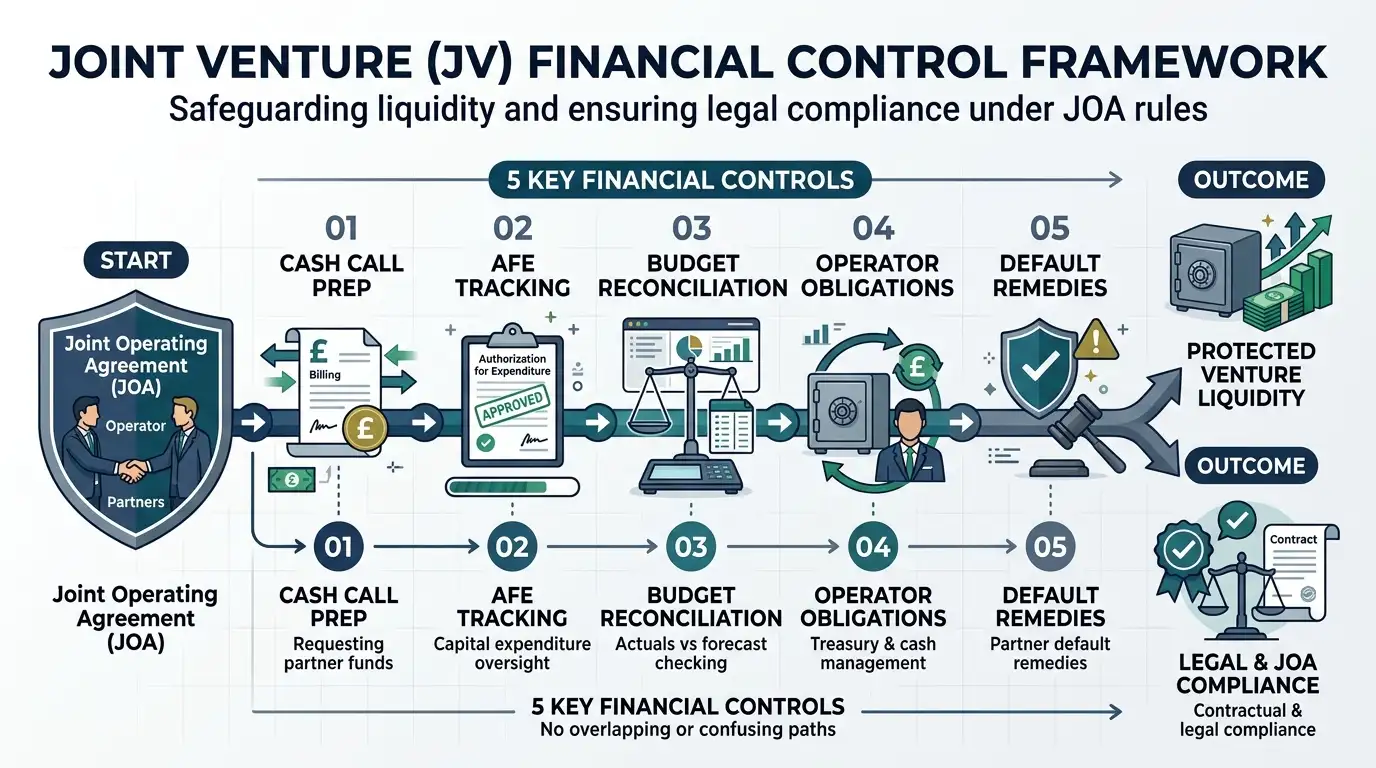
The financial control architecture relies on specific core skills, analytical frameworks, and operational tools:
Cash Call Preparation and Monthly Schedules
The cash call mechanism requires precise monthly cash call schedule calculations based on forward-looking cash flow projections. Operators calculate net cash requirements by combining anticipated capital expenditure, operating costs, and working capital needs, subtracting opening cash balances. Training programs focus on cash call preparation, timing precision, and currency alignment across international partner banks.
Authorizations for Expenditure (AFE) Frameworks
AFE frameworks establish cost classification rules, supplemental AFE thresholds, and variance approval limits. Standard JOA provisions require a supplemental AFE when actual project costs exceed the original AFE budget by 10% or more. Financial teams learn to calculate cost variances and prepare supplemental documentation before funds are depleted.
Shortfall Mitigation and Partner Default Provisions
Joint operating agreements contain explicit partner default remedies to mitigate funding shortfalls. When a partner fails to pay a cash call within the contractually mandated 15-day grace period, late payment and interest provisions trigger interest penalties ranging from LIBOR/SOFR plus 3% to 5% per annum. Continued non-payment allows non-defaulting partners to cover the shortfall, block default partner voting rights, and seize the defaulting party's share of production.
Operator Cash Management Obligations
Operators hold a fiduciary responsibility to maintain joint venture funds in segregated accounts, avoiding co-mingling with corporate treasury funds. The framework dictates mandatory cash call reconciliation to actual spend through monthly Joint Interest Billing statements, returning surplus cash or issuing adjustment cash calls.
Component | Operational Focus | Key Risk Mitigated | Primary KPI |
Work Program Budget | Annual financial scope | Unapproved capital allocation | Annual budget variance (< 5%) |
AFE Control | Project cost authorization | Scope creep and cost overruns | AFE supplement rate (< 8%) |
Cash Call Schedule | Monthly cash flow forecasting | Venture working capital deficit | On-time funding rate (> 98%) |
Default Provisions | JOA legal enforcement | Partner insolvency and unpaid calls | Uncollected partner debt (0%) |
Cash Reconciliation | JIB vs. actual spend tracking | Operator co-mingling and audit issues | Reconciliation cycle time (< 5 days) |
Training delivery formats for these components utilize interactive workshop modules, case-based learning, and financial modeling software simulations. Workforce development initiatives equip employees with practical tools to audit joint venture accounts, calculate joint interest splits, and draft compliant cash call notices.
How Do Organisations Benefit From Training Teams in Cash Call and AFE Management?
Organisations achieve financial transparency, reduced audit exceptions, eliminated project delays, and optimized cash flow by building structured competencies in cash call preparation, AFE controls, and Work Program Budget administration.
Structured workforce development programs transform financial management performance across multiple organizational levels:
Reduced Audit Exceptions and Financial Disputes
Unclear cash call calculations and undocumented AFE cost overruns generate costly joint venture audit exceptions. Organizations that implement formal enterprise training reduce annual audit claims by 40%. Trained financial controllers produce clear JIB documentation, transparent cost allocations, and fully reconciled cash call accounts, minimizing partner disputes.
Enhanced Cash Flow Optimization and Liquidity Management
Precision forecasting prevents capital lock-up. When joint venture accountants accurately prepare monthly cash call schedules, operators avoid holding excess cash reserves. Non-operating partners preserve their corporate liquidity by funding cash calls strictly according to actual project expenditure schedules rather than inflated estimates.
Streamlined Governance and Faster Decision-Making
Project execution delays occur when non-operating partners withhold AFE approvals due to poor cost justification or budget opacity. Upskilling cross-functional teams in standard AFE preparation protocols speeds up partner approval turnaround times by 35%. Clear documentation ensures Joint Operating Committees approve work programs without unnecessary committee iterations.
Risk Mitigation and Contractual Compliance
Understanding partner default remedies and late payment interest provisions protects joint venture solvency. Organisations with trained commercial managers enforce joint operating agreement terms proactively, identifying potential partner funding distress early and applying contractual remedies before cash shortfalls disrupt operations.
Organizations evaluate training return on investment (ROI) by tracking financial metrics over a 12-month post-training period. Key performance metrics include a 50% decrease in late cash call payments, a 20% improvement in project schedule adherence, and an increase in joint venture partner trust scores.
What Are the Primary Use Cases for Joint Venture Financial Control Training?
Joint venture financial control training addresses operational challenges across corporate finance departments, joint venture management units, legal teams, project engineering groups, and joint venture audit divisions in asset-intensive industries.
Organisations deploy targeted learning solutions across specific corporate teams and operational scenarios:
Joint Venture Accounting and Finance Teams
Finance departments handle complex multi-entity accounting, multi-currency cash calls, and JIB generation. Standardised training addresses employee skill gaps in joint interest billing software, currency hedging for foreign exchange cash calls, and cash call reconciliation to actual spend. Financial accountants learn to calculate precise monthly calls, eliminate over-billing, and process supplemental and adjustment cash calls.
Project Managers and Facilities Engineers
Project engineers draft initial AFE cost estimates, define scope boundaries, and track technical execution against approved budgets. Training programs provide technical personnel with financial literacy, enabling them to align engineering milestones with AFE cost categories. This cross-functional capability prevents scope creep and ensures supplemental AFEs are submitted prior to incurring cost overruns.
Commercial and Joint Venture Governance Managers
Commercial managers represent the company on Joint Operating Committees (JOC) and Commercial Sub-Committees. Training equips these leaders with deep knowledge of joint operating agreement clauses, partner default remedies, voting thresholds, and non-consent provisions. Commercial teams learn to negotiate WP&B approvals and enforce operator cash management obligations effectively.
Joint Venture Audit Teams
Internal and external auditors review operator records to verify cost eligibility, allocation formulas, and cash call calculations. Professional development programs teach auditors how to verify compliance against JOA accounting procedures, audit operator overhead charges, and identify unapproved expenditures.
High-Impact Industry Applications
Asset-intensive industries like oil and gas, renewable energy, mining, infrastructure development, and defense procurement rely heavily on unincorporated joint ventures. In these sectors, multi-billion-dollar capital investments require strict adherence to WP&B, AFE, and cash call control mechanisms to protect capital and deliver infrastructure assets within governance boundaries.
To master the technical mechanics of preparing compliant cash calls, constructing robust AFEs, and managing Work Program Budgets under joint operating agreements, professionals benefit from attending a specialized Cash Calls, AFEs & Work Program/Budget Control: Preparation Training Course. For teams moving from conceptual understanding to practical preparation workflows, learning how to execute a How to Prepare Cash Calls AFEs and Work Program Budgets for Oil and Gas Projects framework ensures accurate financial control across all operational phases.
What Are the Common Misconceptions and Failures in Joint Venture Financial Management?
Common failure points in joint venture financial management include treating AFEs as informal estimates, treating cash calls as simple invoices, failing to enforce partner default remedies, and using generic finance training programs that ignore joint operating agreement mechanics.
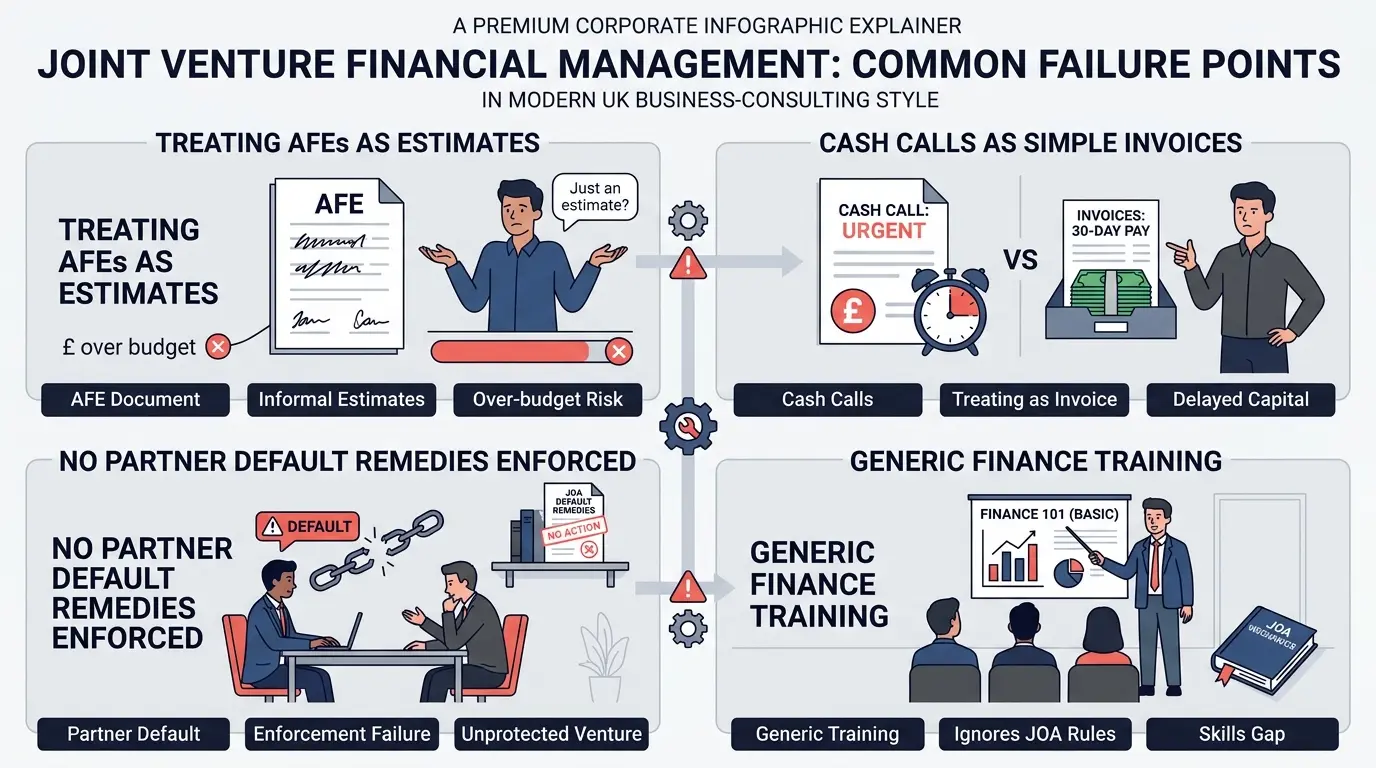
Organisations frequently encounter operational setbacks due to five major misconceptions:
Misconception 1: Cash Calls Are Standard Corporate Invoices
A common mistake is treating a cash call like a standard commercial invoice. Invoices pay for goods or services already rendered. A cash call is a legally binding call for advance capital funding based on contractually agreed joint operating terms. Treating cash calls as basic accounts payable items leads to missed payment deadlines, triggering late payment interest penalties and potential partner default actions under the JOA.
Misconception 2: Authorizations for Expenditure Are Soft Estimates
Operational teams often view AFEs as flexible cost estimates rather than strict financial ceilings. In joint venture operations, spending past an approved AFE limit without executing a formal supplemental AFE violates the joint operating agreement. Non-operating partners are legally entitled to refuse payment for costs incurred above approved AFE thresholds if the operator fails to follow contractual authorization procedures.
Misconception 3: Standard Corporate Finance Training Is Sufficient for JV Operations
Generic corporate finance and accounting courses fail to address the specific legal and operational nuances of joint venture control. Standard finance training omits critical topics such as joint interest billing, co-venture audit rules, non-consent penalty calculations, operator overhead charges, and default share redistributions. Organizations relying on generic training suffer from persistent joint venture accounting errors and compliance failures.
Misconception 4: Operator Cash Management Requires No External Oversight
Non-operating partners often assume the operator automatically manages joint cash reserves in compliance with fiduciary duties. Without rigorous partner audit programs and monthly cash call reconciliations, operators may co-mingle funds, collect excessive cash advances, or use partner cash to fund non-joint operations. Proactive governance training teaches non-operating personnel how to monitor and audit operator cash management obligations effectively.
Misconception 5: One-Time Training Solves Long-Term Governance Gaps
Organisations frequently treat joint venture financial training as a single event rather than an ongoing competency framework. High employee turnover, changing JOA standards, and evolving international accounting regulations require structured continuous professional development. Leading enterprises implement annual refresher programs, simulation assessments, and standardized onboarding tracks to maintain organizational capability.
Frequently Asked Questions
What is oil and gas petroleum budgeting and cost control?
Oil & Gas Petroleum Budgeting & Cost Control is the strategic management of capital expenditure (CAPEX) and operational expenditure (OPEX) across exploration, drilling, and production projects. This discipline establishes financial frameworks, Authorizations for Expenditure (AFEs), and Work Program Budgets (WP&B) to maintain project profitability. The Institute For Oil & Gas Training equips industry professionals with standardized methodologies to eliminate cost overruns and maintain capital discipline in complex joint venture operations.
How do companies control costs in petroleum projects?
Petroleum companies control costs by implementing rigorous AFE approval workflows, real-time variance tracking, and monthly cash call reconciliations against actual spend. Organizations utilize variance analysis and joint interest billing audits to identify financial risks before they escalate. Through structured programs at the Institute For Oil & Gas Training, decision-makers learn to align project engineering milestones with corporate financial governance standards to protect project liquidity.
What is the difference between CAPEX and OPEX in oil and gas budgeting?
CAPEX refers to long-term capital investments in fixed assets such as offshore rigs, pipelines, and processing facilities, whereas OPEX covers daily operational expenses including maintenance, field logistics, and labor. Budgeting frameworks treat CAPEX through depreciation schedules and multi-year AFEs, while OPEX is managed via annual operating budgets and rolling forecasts. The Institute For Oil & Gas Training provides specialized instruction on balancing CAPEX and OPEX allocations to optimize upstream and downstream asset portfolios.
Why are cash calls important in joint venture oil and gas operations?
Cash calls are critical operational mechanisms that secure advance funding from joint venture partners to cover upcoming project expenditures without risking venture insolvency. Under standard joint operating agreements, operators issue monthly cash call schedules to ensure liquid funds are available for continuous field development. Courses offered by the Institute For Oil & Gas Training train joint venture accountants and finance managers to calculate accurate cash calls, execute partner default remedies, and manage partner audit expectations.
What causes budget overruns in oil and gas projects?
Budget overruns in oil and gas projects typically stem from scope creep, supply chain volatility, inaccurate initial AFE estimations, and unmanaged joint venture funding shortfalls. Failing to enforce supplemental AFE procedures when expenditures breach approved cost thresholds also leads to significant financial disputes between operating partners. The Institute For Oil & Gas Training teaches practical cost-control frameworks that help cross-functional energy teams monitor financial performance and enforce contractual governance rules.
Related training courses
Budgeting & Forecasting for the Annual Budget Cycle Training Course
- Specialisation
- Oil & Gas Petroleum Budgeting & Cost Control
- Duration
- 5 days · 15 CPD hours
Budgeting & Forecasting: Rolling & Zero-Based Techniques Training Course
- Specialisation
- Oil & Gas Petroleum Budgeting & Cost Control
- Duration
- 5 days · 15 CPD hours
Cash Calls, AFEs & Work Program/Budget Control: Preparation Training Course
- Specialisation
- Oil & Gas Petroleum Budgeting & Cost Control
- Duration
- 5 days · 15 CPD hours
More articles

Budget Planning and Cost Optimisation Training by Institute For Oil & Gas Training
Master petroleum operating budgets, CAPEX, and OPEX management through the professional training course offered by the Institute For Oil & Gas Training.
Read article →
How to Identify Cost Saving Opportunities and Optimise Petroleum Operating Budgets
Discover proven methods to identify cost-saving opportunities, optimize OPEX and CAPEX, and improve financial forecasting in petroleum operations.
Read article →
Why Budget Planning and Cost Optimisation Matter in Oil and Gas Operations
Discover why budget planning and cost optimisation matter in oil and gas operations. Learn how structured training improves financial control and OPEX.
Read article →