

The Budget Planning and Cost Optimisation Training Course delivers structured instruction on financial forecasting, operational expenditure management, and capital asset allocation for energy sector professionals. It resolves systemic cost overruns, imprecise variance reporting, and misalignment between engineering operations and commercial targets across complex upstream, midstream, and downstream projects.
Volatile commodity pricing, shifting regulatory mandates, and rising operational extraction costs create severe margin pressure across energy projects. Operating teams frequently encounter structural disconnects between field execution decisions and central corporate budgeting frameworks. Without rigorous control frameworks, capital projects experience unbudgeted variances, while routine maintenance schedules fail to reflect lifecycle asset value targets. The Institute For Oil & Gas Training developed this comprehensive curriculum to bridge technical engineering management with financial accountability. By establishing uniform estimation protocols and continuous variance tracking, the program transforms operational data into actionable cost-control metrics.
Understanding foundational financial mechanics is vital before implementing complex field-level interventions. For a comprehensive overview of industry cost drivers and macroeconomic factors, review Why Budget Planning and Cost Optimisation Matter in Oil and Gas Operations.
Corporate financial architecture requires systematic alignment across all operating tiers. The Institute For Oil & Gas Training structures this course around decision-ready frameworks, ensuring engineering teams, financial analysts, and operational planners share standardized methodologies. Training focuses directly on operational metrics, eliminating theoretical abstractions in favour of empirical evaluation methodologies. Participants master techniques required to stabilize cash flow forecasts, optimize supply chain procurement costs, and eliminate wasteful operational expenditure across project lifecycles.
Why Is the Budget Planning and Cost Optimisation Training Course Structured This Way?
This course uses a sequential, module-based progression that transitions participants from foundational accounting principles to advanced financial modeling and lifecycle cost management. The curriculum structure ensures immediate workplace application by mirroring real-world capital allocation cycles, operational budgeting workflows, and corporate variance auditing procedures.
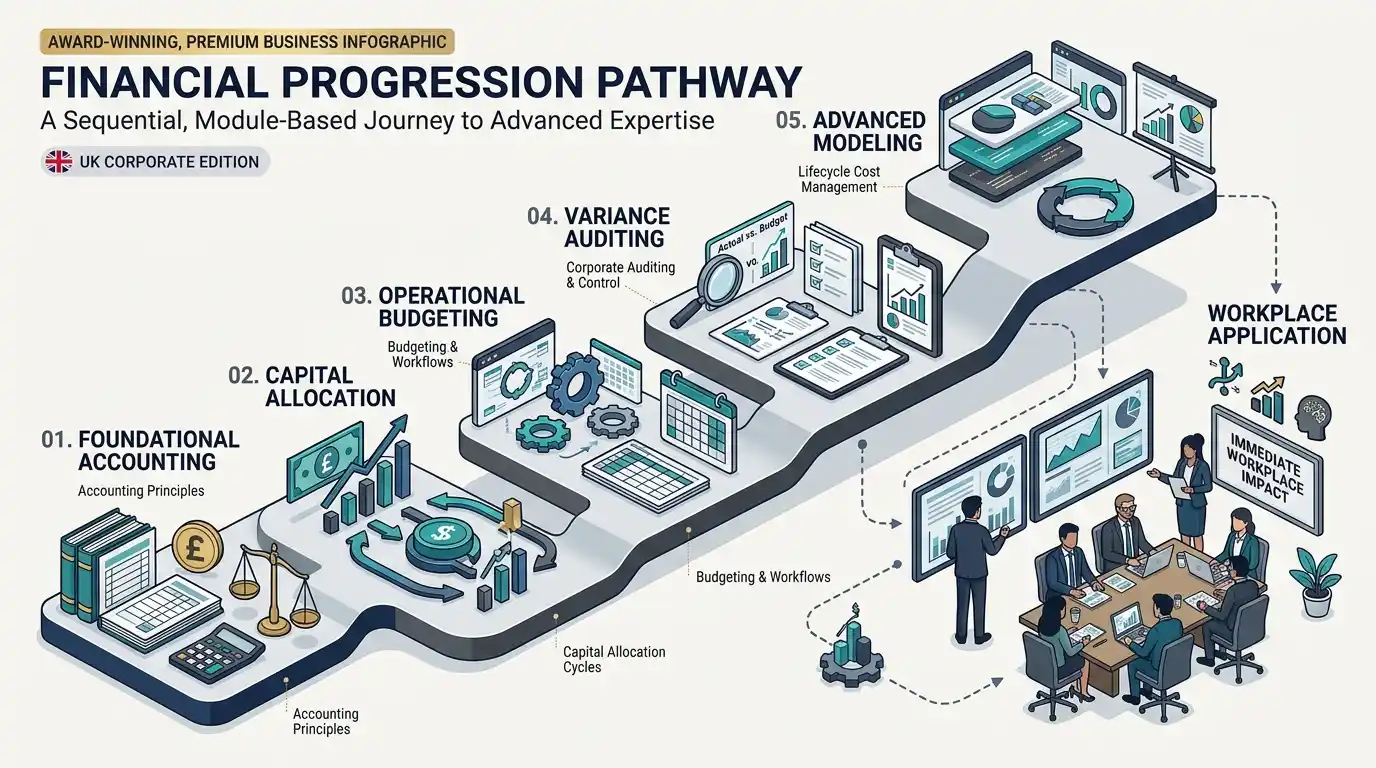
Effective skill development requires an instructional design that reflects actual enterprise decision cycles. The Institute For Oil & Gas Training developed this syllabus using a scaffolded instructional framework. Initial modules establish core terminology and analytical concepts, ensuring professionals from non-financial backgrounds gain functional competency in balance sheet mechanics, cost center structure, and ledger accounting. Subsequent modules introduce technical estimation models tailored specifically to energy exploration, refining, and distribution assets.
The instructional logic addresses the practical realities of managing Oil and Gas Cost Control within high-risk, capital-intensive environments. Industry budgets cannot rely on static desktop projections; they require dynamic adjustment mechanisms capable of responding to supply chain disruptions, subsurface drilling anomalies, and market volatility. By progressing from single-variable cost estimation to multi-scenario risk modeling, participants build the analytical rigor necessary to defend budget proposals before corporate investment committees.
Evaluating operational efficiency demands systematic diagnostic tools. To learn how to systematically audit field operations and identify specific expenditure leakage, consult How to Identify Cost Saving Opportunities and Optimise Petroleum Operating Budgets.
Every phase of the course incorporates empirical datasets derived from active energy projects. The Institute For Oil & Gas Training enforces a learning methodology where theoretical lectures are immediately validated through hands-on practical exercises. This approach ensures participants do not merely memorize financial formulas, but master the operational execution of budgetary controls under actual market conditions.
What Will Participants Learn in the Budget Planning and Cost Optimisation Training Course?
Participants gain practical mastery over financial forecasting, variance analysis, zero-based budgeting, and capital project auditing. The program delivers measurable capabilities in establishing operational baseline budgets, conducting parametric cost estimations, managing currency and price risks, and deploying capital efficiently across complex energy asset portfolios.
The curriculum delivers targeted competencies tailored to current energy industry requirements. Training focuses on building technical confidence in quantitative financial tools, risk assessment frameworks, and cost-control systems.
Module | Core Focus Areas | Technical Competencies Mastered |
Module 1: Financial Architecture | Cost accounting basics, ledger classification, cost centers | • CAPEX and OPEX Management differentiation • Work Breakdown Structure (WBS) integration • Chart of Accounts standardization |
Module 2: Estimation & Forecasting | Petroleum Cost Estimation, baseline development | • Parametric and bottom-up cost modeling • Oil and Gas Budget Forecasting under uncertainty • Inflation and indexation adjustment models |
Module 3: Operational Control | Variance analysis, cost tracking, zero-based budgeting | • Earned Value Management (EVM) tracking • Root-cause variance identification • Operational cost elimination techniques |
Module 4: Risk & Governance | Oil and Gas Financial Planning, risk integration | • Monte Carlo simulation interpretation • Sensitivity and scenario analysis • Corporate financial governance compliance |
Core Learning Outcomes
Establish Rigorous Cost Classification Systems: Differentiate capital expenditure from operating expenditure to optimize tax structures, asset depreciation schedules, and corporate financial reporting accuracy.
Execute Precise Cost Estimations: Deploy parametric, analog, and bottom-up estimation techniques to formulate accurate baseline projections for exploration, field development, and facility maintenance programs.
Deploy Earned Value Management (EVM): Integrate project schedule tracking with financial expenditure metrics to calculate Cost Performance Index (CPI) and Schedule Performance Index (SPI) across active operations.
Implement Zero-Based Budgeting (ZBB): Rebuild departmental operating budgets from baseline assumptions annually, eliminating legacy spending inefficiencies and non-essential operational overhead.
Manage Commodity and Operational Risk: Build dynamic sensitivity models that stress-test operating budgets against crude oil price shifts, foreign exchange fluctuations, and supply chain cost inflation.
The Institute For Oil & Gas Training ensures all curriculum content reflects current international accounting standards, joint operating agreement (JOA) cost-recovery clauses, and energy industry fiscal regimes.
How Is the Budget Planning and Cost Optimisation Training Course Delivered?
The course is delivered through flexible formats including structured multi-day intensive workshops, live interactive virtual classrooms, customized onsite corporate programs, and blended self-paced digital modules. All delivery modes utilize real-world energy sector datasets, proprietary financial software tools, and instructor-led analytical reviews.
To accommodate diverse organizational requirements and global work schedules, the Institute For Oil & Gas Training offers four structured delivery channels. Each format maintains identical learning objectives, academic rigor, and practical assessment standards.
Delivery Mode Specifications
In-Person Executive Workshops: Five consecutive days of immersive, classroom-based instruction held at international energy hubs. Features face-to-face workshop facilitation, peer-to-peer working groups, and immediate instructor feedback on financial model builds.
Live Virtual Classrooms: Delivered over two weeks via structured online sessions. Designed for working professionals, this format combines live evening lectures with digital breakout rooms for collaborative problem-solving.
Onsite Corporate Programs: Tailored directly to host organizations. The Institute For Oil & Gas Training adapts training scenarios using the client organization's actual chart of accounts, operational workflows, and historical budget data.
Blended Digital Modules: Combines asynchronous video lectures and financial template downloads with weekly live masterclasses, offering maximum scheduling flexibility for field-based personnel.
Pedagogical Methodology & Practical Work
The program avoids passive lecture structures. Over 60% of instructional time is dedicated to practical financial modeling, case study reviews, and live budget rebuilding exercises. Participants work directly with customized spreadsheet templates, industry-standard estimation software, and simulated cost auditing tools.
Instructional faculty consist of senior petroleum economists, corporate finance directors, and seasoned asset managers with extensive field experience. Every cohort benefits from direct exposure to real-world financial decision-making frameworks.
What Workplace Results and Performance Improvements Can Be Expected?
Organizations report immediate quantifiable improvements in budget variance accuracy, reduced operational expenditure leakage, enhanced capital deployment efficiency, and streamlined fiscal reporting cycles. Individual participants gain senior-level analytical capabilities, positioning them for expanded financial oversight and asset management responsibilities.
Enrollment yields clear, measurable returns for both individual participants and sponsoring corporate entities. By aligning engineering execution directly with financial governance, organizations eliminate the friction typically associated with budget reconciliation cycles.
Organizational Impact for Corporate Sponsors and HR Teams
Human resource leaders and corporate talent managers utilize this course to build internal capability across engineering, operations, and finance departments.
Standardized Fiscal Vocabulary: Establishes a shared analytical language between asset managers, field engineers, procurement specialists, and corporate finance teams.
Enhanced Capital Allocation: Ensures capital proposals presented to executive boards contain rigorous, risk-adjusted net present value (NPV) and internal rate of return (IRR) calculations.
Elimination of Budget Padding: Replaces arbitrary safety margins with precise probabilistic cost distributions, freeing locked capital for alternative operational investment.
Strengthened Leadership Pipelines: Equips mid-level technical managers with the commercial acumen required to transition into executive general management roles.
Individual Career and Role Effectiveness
For individual professionals, completing the program builds critical skills for career advancement.
Engineers, project managers, and operational supervisors move beyond purely technical metrics to manage multi-million-dollar asset portfolios with complete commercial authority. Graduates demonstrate immediate value by identifying operational redundancies, defending cost structures during internal audits, and protecting asset margins during down-cycle market conditions. The Institute For Oil & Gas Training tracks graduate outcomes to ensure curriculum alignment with modern energy sector demands.
How Does Enrollment Work for the Budget Planning and Cost Optimisation Training Course?
Enrollment involves a formal candidate profile review, selection of delivery format and schedule, verification of prerequisite technical background, and confirmation of corporate sponsorship or individual registration. The admissions process ensures cohort alignment and optimizes peer-to-peer professional networking.

The Institute For Oil & Gas Training maintains a structured admissions protocol to maintain cohort quality and ensure participants possess the background needed to absorb advanced financial concepts.
Eligibility Criteria and Target Audience
The program is engineered specifically for professionals operating within or supporting the energy sector:
Petroleum Engineers and Technical Leads: Seeking to master commercial management and project cost controls.
Asset Managers and Operations Directors: Responsible for multi-million-dollar departmental OPEX and CAPEX budgets.
Financial Analysts and Cost Engineers: Requiring specialized knowledge of upstream, midstream, and downstream fiscal structures.
Procurement and Supply Chain Executives: Focused on optimizing vendor contracts, equipment leasing, and logistics costs.
HR and Corporate Development Managers: Structuring targeted capability programs for high-potential management candidates.
Assessment and Professional Certification
To earn the official certificate of completion from the Institute For Oil & Gas Training, participants must meet strict academic criteria:
Attendance: Minimum 90% active participation across all scheduled instructional modules and workshops.
Practical Financial Modeling Examination: Successful build and defense of a complete capital allocation and variance model using simulated field data.
Applied Capstone Project: Submission of a cost-optimization proposal addressing a verified operational challenge within the participant's current organization.
Certifications issued are digitally verifiable and recognized internationally across energy organizations, providing portable professional proof of commercial management competence.
Organizations seeking to upgrade operational cost management capabilities can enroll in the Budget Planning and Cost Optimisation Training Course to secure upcoming cohort placements.
Frequently Asked Questions
What is covered in the Oil & Gas Petroleum Budgeting & Cost Control training?
The Oil & Gas Petroleum Budgeting & Cost Control course by Institute For Oil & Gas Training covers essential financial planning concepts, including capital expenditure (CAPEX) and operating expenditure (OPEX) management. Participants learn practical techniques for petroleum cost estimation, budget forecasting, zero-based budgeting, and variance analysis tailored to upstream, midstream, and downstream operations.
Who should attend the Oil & Gas Petroleum Budgeting & Cost Control course?
This program is designed for petroleum engineers, asset managers, financial analysts, project directors, and corporate procurement leaders seeking to master financial oversight in energy operations. Delivered by Institute For Oil & Gas Training, the training equips technical and managerial professionals with the commercial skills required to control operational expenditure and optimize asset performance.
How does cost control improve profitability in petroleum operations?
Effective cost control establishes accurate financial baselines and continuous variance auditing, allowing field teams to eliminate operational spending leakage early. Through the Oil & Gas Petroleum Budgeting & Cost Control framework from Institute For Oil & Gas Training, energy organizations improve capital allocation efficiency, protect profit margins against commodity price volatility, and enhance joint-venture fiscal governance.
What delivery formats are available for Institute For Oil & Gas Training courses?
Institute For Oil & Gas Training provides flexible delivery options, including five-day in-person executive workshops, live virtual online classrooms, self-paced digital modules, and customized onsite corporate programs. Each format covers identical practical financial modeling exercises, real-world case studies, and corporate cost-auditing methodologies.
What prerequisites are required for Oil & Gas Petroleum Budgeting & Cost Control enrollment?
Participants should have a foundational understanding of energy operations, project management, or basic corporate accounting structures. Institute For Oil & Gas Training reviews candidate professional experience prior to enrollment to ensure cohort alignment and optimize peer-to-peer practical learning during workshop sessions.
Related training courses
Cost Control for Field Development Projects: Cost Baselines Training Course
- Specialisation
- Oil & Gas Petroleum Budgeting & Cost Control
- Duration
- 5 days · 15 CPD hours
Cost Control for Field Development Projects: Overrun Prevention Training Course
- Specialisation
- Oil & Gas Petroleum Budgeting & Cost Control
- Duration
- 5 days · 15 CPD hours
Cash Calls, AFEs & Work Program/Budget Control: Preparation Training Course
- Specialisation
- Oil & Gas Petroleum Budgeting & Cost Control
- Duration
- 5 days · 15 CPD hours
More articles

How to Identify Cost Saving Opportunities and Optimise Petroleum Operating Budgets
Discover proven methods to identify cost-saving opportunities, optimize OPEX and CAPEX, and improve financial forecasting in petroleum operations.
Read article →
Why Budget Planning and Cost Optimisation Matter in Oil and Gas Operations
Discover why budget planning and cost optimisation matter in oil and gas operations. Learn how structured training improves financial control and OPEX.
Read article →
Cash Calls AFEs and Work Program Budget Control Overruns Training by Institute For Oil & Gas Training
Master joint venture budget control and cash call management. Register for professional training by Institute For Oil & Gas Training.
Read article →