
Petroleum organisations operate in an environment where capital expenditures and operating expenditures dictate financial viability. When commodity prices fluctuate unpredictably, executive leadership and finance departments face intense pressure to safeguard profit margins without compromising asset integrity or operational safety. Finding financial efficiencies requires a systematic approach to evaluating every stage of the upstream, midstream, and downstream lifecycle. Organisations must move beyond surface-level spending cuts and instead adopt rigorous analytical frameworks that isolate structural inefficiencies. This review explores how technical teams and finance professionals can uncover hidden expenditures, streamline workflows, and secure long-term fiscal resilience through strategic interventions.
Effective financial governance begins long before assets face liquidity pressures, making foundational awareness vital for technical and non-technical stakeholders alike. To build this baseline understanding, teams often examine core principles outlined in foundational guides such as Why Budget Planning and Cost Optimisation Matter in Oil and Gas Operations, which establishes how macro-level market volatility directly impacts field-level spending decisions. Without this initial context, department heads often struggle to connect daily field activities to broader corporate financial targets. Asset managers must consequently bridge the gap between engineering requirements and accounting ledgers to ensure every dollar allocated generates measurable enterprise value.
How do CAPEX and OPEX management drive petroleum cost control?
Capital expenditure and operating expenditure management dictate the long-term financial health of upstream assets by balancing upfront asset investments with ongoing maintenance costs, facility upkeep, and daily field extraction expenses.
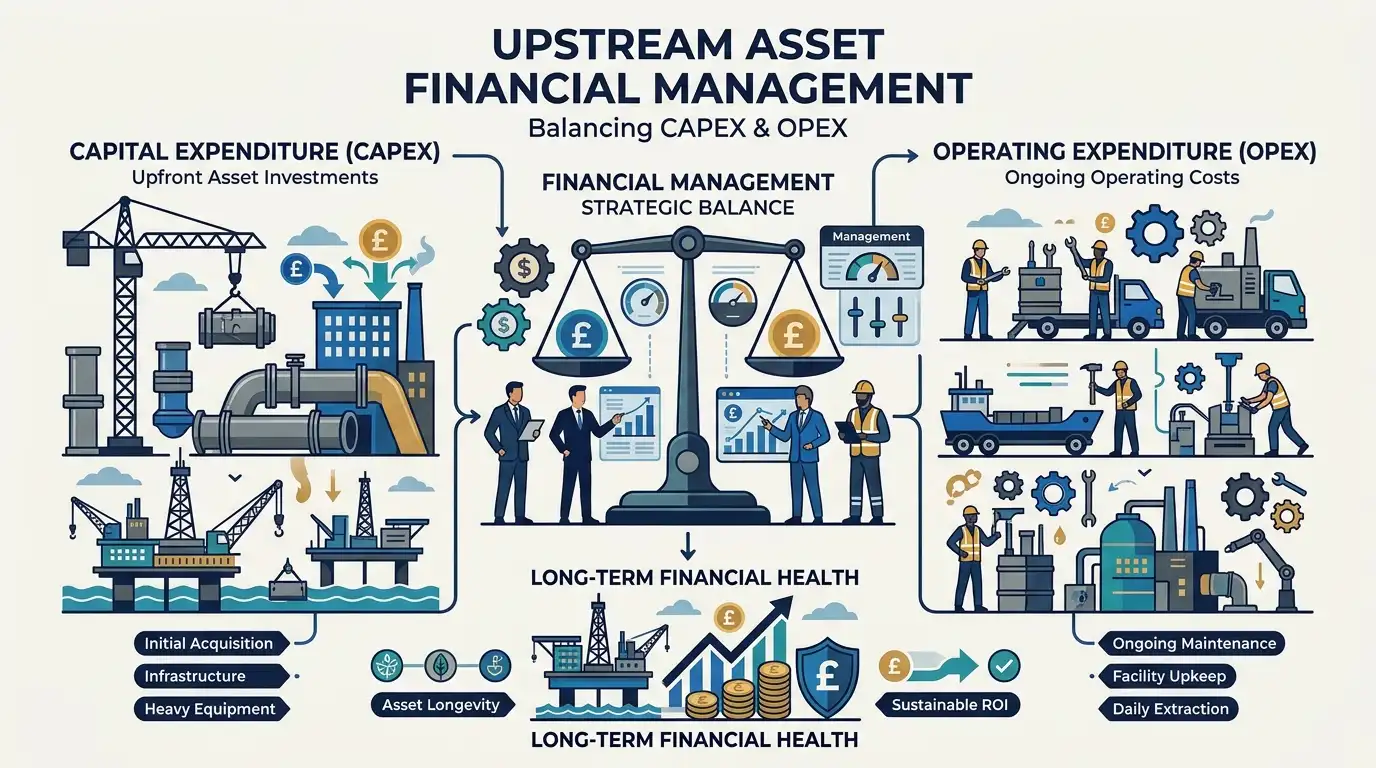
Managing capital expenditure requires rigorous gate reviews during the project lifecycle. Engineering teams must evaluate front-end loading phases meticulously to prevent scope creep before final investment decisions occur. By challenging baseline assumptions during the design phase, operators eliminate redundant equipment purchases and over-engineered infrastructure that inflate project costs. Asset retirement obligations also demand careful tracking to ensure future liabilities do not distort current balance sheets.
Operating expenditure management focuses on sustaining daily production efficiently. Maintenance strategies often shift from reactive repairs to predictive reliability models powered by data analytics. Condition monitoring of rotating equipment, pipelines, and wellhead instrumentation prevents catastrophic failures that trigger costly emergency interventions. Procurement teams contribute by negotiating long-term service agreements with drilling contractors and equipment vendors, securing volume discounts and performance-linked incentives.
Organisations that integrate these two expenditure categories eliminate silos between project engineers and finance controllers. When engineering decisions incorporate lifecycle cost analysis rather than relying solely on initial purchase price, total cost of ownership drops significantly. This alignment ensures that every facility modification or well intervention delivers a positive net present value.
What methods define effective oil and gas financial planning?
Oil and gas financial planning relies on zero-based budgeting, variance analysis, rolling forecasts, and activity-based costing to allocate capital precisely according to asset productivity and strategic corporate priorities.
Traditional incremental budgeting often perpetuates historical inefficiencies by adjusting previous year allocations by a fixed percentage. Zero-based budgeting dismantles this practice by requiring department managers to justify every line item from scratch for each fiscal period. This method forces operations teams to scrutinize chemical usage, logistics contracts, and consultancy fees, exposing expenditures that no longer serve operational objectives.
Variance analysis acts as a vital corrective tool during execution phases. Finance controllers compare actual expenditure against planned baselines monthly, isolating root causes of cost overruns immediately. Whether an overrun stems from unexpected subsurface drilling complications or supply chain bottlenecks, rapid identification allows management to implement corrective actions before budgets spiral out of control.
Rolling forecasts replace static annual budgets with dynamic twelve-to-eighteen-month projections that adapt to shifting commodity prices and production volumes. This agility helps management adjust capital allocation mid-cycle, deferring non-essential projects during market downturns while accelerating high-yield developments. Activity-based costing assigns overhead expenses directly to specific production units or wells based on resource consumption. This granular visibility reveals which assets generate profit and which drain corporate capital, guiding strategic divestment or operational restructuring decisions.
How does petroleum cost estimation prevent budget forecasting errors?
Petroleum cost estimation relies on historical benchmarking, parametric modelling, probabilistic risk analysis, and expert elicitation to establish realistic baseline budgets that withstand market volatility and technical uncertainties.
Accurate cost estimation prevents the systematic optimism bias that historically plagues mega-projects in the energy sector. Parametric models use historical data from similar completed projects, scaling costs based on variables such as total depth, reservoir pressure, and geographic location. These statistical baselines provide an objective reality check against contractor estimates submitted during the bidding process.
Probabilistic risk analysis uses Monte Carlo simulations to account for uncertainties inherent in subsurface operations. Instead of relying on a single deterministic cost figure, estimators generate probability distributions that reflect risks such as adverse weather, geological anomalies, and supply chain delays. Management can then set contingency funds at confidence levels that match corporate risk appetite, typically targeting the P80 or P90 confidence interval for major capital developments.
Human judgment remains critical when historical data is scarce, particularly in frontier exploration basins. Structured expert elicitation protocols capture insights from experienced geologists, drilling supervisors, and reservoir engineers while mitigating cognitive biases. Refining these estimates requires structured professional development, and many enterprises utilise specialized programmes like the Budget Planning and Cost Optimisation Training Course to equip technical teams with advanced forecasting methodologies and risk mitigation tools. Continuous feedback loops between cost estimators and execution teams ensure that estimation models improve iteratively over successive operational cycles.
How do workforce capabilities influence oil and gas budget forecasting?
Workforce capability directly dictates forecasting accuracy, as operational personnel must possess the analytical acumen to interpret financial metrics, evaluate trade-offs, and implement cost-saving initiatives without compromising asset integrity.
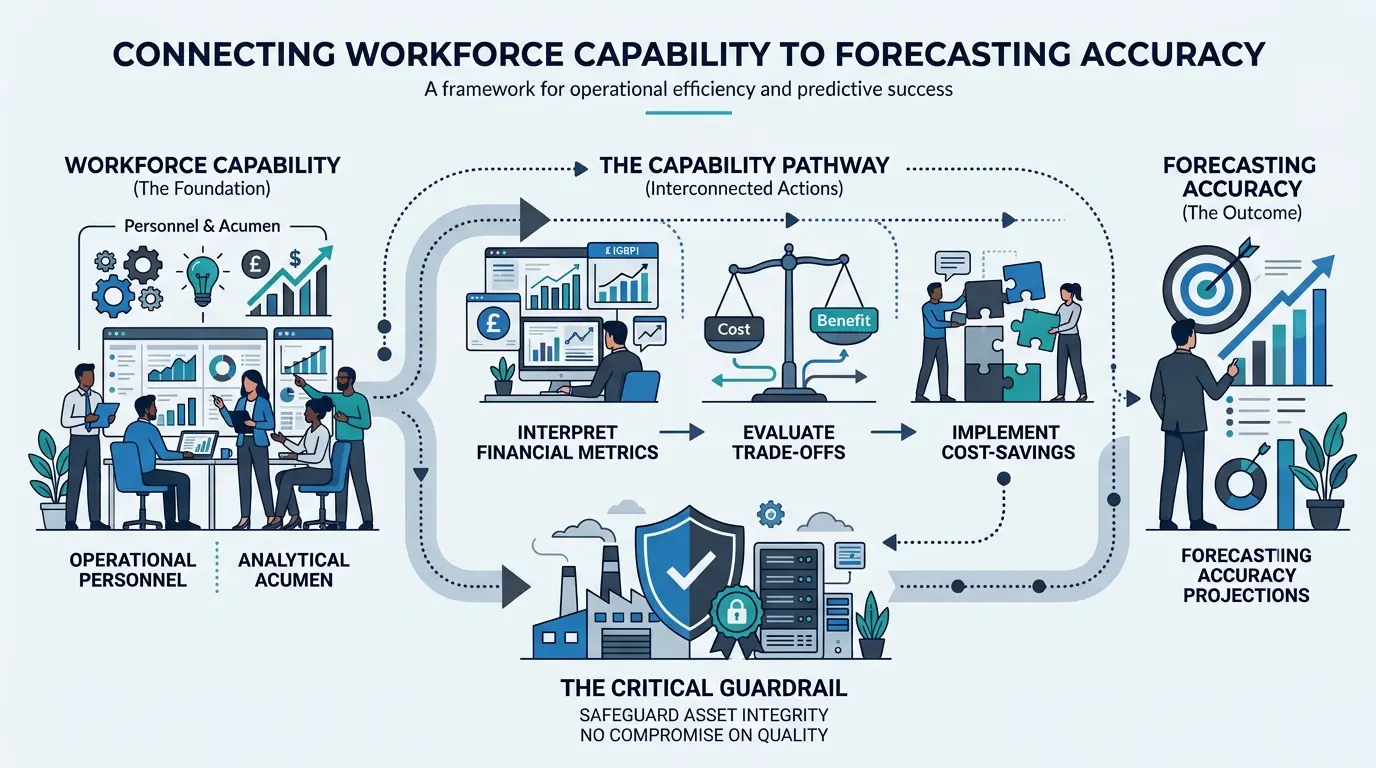
Skill gaps in financial literacy among non-financial managers frequently create operational blind spots. Engineers and facility supervisors often treat budgets as arbitrary administrative constraints rather than strategic operational boundaries. Bridging this gap requires targeted corporate training initiatives that demystify financial statements, capital allocation rules, and variance reporting for technical personnel.
Human resource departments play a pivotal role in designing learning pathways that blend financial acumen with technical petroleum engineering principles. When drilling supervisors understand how rig-rate fluctuations and non-productive time impact field economics, their daily operational decisions shift toward efficiency. They minimize fluid waste, optimize drilling parameters to reduce bit wear, and schedule maintenance activities to coincide with planned operational lulls.
Organisations seeking to institutionalize this capability frequently implement comprehensive skill development frameworks. Integrating structured programs such as the Budget Planning and Cost Optimisation Training into internal corporate academies accelerates competency acquisition across multidisciplinary teams. These learning interventions use practical, industry-driven case studies reflecting real-world upstream and downstream challenges, ensuring participants translate theoretical financial concepts into immediate workplace efficiencies. Measurable performance metrics, pre- and post-training assessments, and post-implementation workplace audits ensure that learning investments yield tangible return on investment through optimized operational spending.
Frequently Asked Questions
What does oil and gas petroleum budgeting and cost control involve?
Petroleum budgeting and cost control involve systematic planning, monitoring, and optimisation of both capital expenditures (CAPEX) and operating expenditures (OPEX) across upstream and downstream assets. At the Institute For Oil & Gas Training, this process focuses on aligning financial forecasts with operational realities to safeguard profit margins against market volatility. Effective financial control ensures asset integrity, efficient resource allocation, and long-term economic viability for energy organisations.
How can petroleum organisations identify cost-saving opportunities in operations?
Organisations uncover financial efficiencies by conducting rigorous variance analysis, implementing zero-based budgeting, and leveraging activity-based costing to scrutinise asset-level expenditures. The Institute For Oil & Gas Training equips finance and engineering teams with frameworks to evaluate supply chain logistics, reduce non-productive drilling time, and eliminate redundant infrastructure. These analytical methods isolate structural inefficiencies without compromising safety or regulatory compliance.
Why is petroleum cost estimation prone to forecasting errors?
Petroleum cost estimation often suffers from optimism bias, unexpected subsurface geological complexities, and volatile global commodity prices during mega-project execution. Mitigating these forecasting risks requires combining historical benchmarking and parametric modelling with probabilistic risk analyses such as Monte Carlo simulations. The Institute For Oil & Gas Training teaches structured methodologies to establish realistic contingency funds and robust baseline budgets that withstand market uncertainties.
How does CAPEX and OPEX management impact upstream financial health?
Capital and operating expenditure management directly dictates asset profitability by balancing upfront facility investments with ongoing maintenance and daily extraction costs. Integrating engineering requirements with financial ledgers allows operators to perform lifecycle cost analyses before final investment decisions occur. Programmes through the Institute For Oil & Gas Training help technical and non-technical stakeholders coordinate these expenses to deliver a positive net present value across the asset lifecycle.
What are the benefits of specialised financial training for oil and gas personnel?
Specialised training bridges critical skill gaps between non-financial managers, engineers, and corporate finance controllers within energy enterprises. By demystifying financial statements and cost-control metrics, personnel can make daily operational decisions that minimise fluid waste and optimise maintenance schedules. The Institute For Oil & Gas Training delivers practical, industry-driven programmes that empower workforce capabilities and translate technical competence into measurable business outcomes.
Related training courses
CAPEX vs OPEX Impact on Cost Recovery Training Course
- Specialisation
- Oil & Gas Petroleum Budgeting & Cost Control
- Duration
- 5 days · 15 CPD hours
Cash Calls, AFEs & Work Program/Budget Control: Overruns Training Course
- Specialisation
- Oil & Gas Petroleum Budgeting & Cost Control
- Duration
- 5 days · 15 CPD hours
Budget Management and Management Control in the Oil & Gas Industry
- Specialisation
- Oil & Gas Petroleum Budgeting & Cost Control
- Duration
- 5 days · 15 CPD hours
More articles

Budget Planning and Cost Optimisation Training by Institute For Oil & Gas Training
Master petroleum operating budgets, CAPEX, and OPEX management through the professional training course offered by the Institute For Oil & Gas Training.
Read article →
Why Budget Planning and Cost Optimisation Matter in Oil and Gas Operations
Discover why budget planning and cost optimisation matter in oil and gas operations. Learn how structured training improves financial control and OPEX.
Read article →
Cash Calls AFEs and Work Program Budget Control Overruns Training by Institute For Oil & Gas Training
Master joint venture budget control and cash call management. Register for professional training by Institute For Oil & Gas Training.
Read article →