

Oil and gas contracts contain complex financial commitments, operational milestones, regulatory notices, and joint venture covenants spread across hundreds of pages. Extracting, tracking, and monitoring these contractual commitments requires systematic document parsing, centralized accountability structures, clear risk registers, and automated performance verification metrics across the entire operating asset lifecycle.
Upstream, midstream, and downstream joint venture operations depend on absolute clarity regarding contractual responsibilities to avoid costly disputes, operational delays, and regulatory penalties. Understanding Why Contract Obligation Management Matters in Oil and Gas Projects forms the foundational starting point for asset managers, legal counsel, and commercial teams seeking to protect enterprise margins and maintain joint operating agreement integrity.
How Do Energy Companies Extract Obligation Data from Complex Upstream Agreements?
To extract obligation data effectively, energy teams must convert unstructured contractual text into structured data points by performing systematic legal parsing, categorizing operational Covenants, mapping deliverable timelines, and assigning specific ownership to every compliance requirement across all project agreements.
Contractual obligation extraction begins with a comprehensive review of the executed agreement, including all exhibits, annexes, and amendments. Legal and commercial experts examine the text to identify explicit operational directives, conditional requirements, and reporting deadlines. This process converts dense legal prose into granular, actionable data entries that populate a centralized contract obligation register.
The process relies heavily on obligation extraction and mapping techniques. Teams classify obligations into operational, financial, HSE (Health, Safety, and Environment), and regulatory buckets. Each extracted record includes the source section reference, mandatory action, governing trigger, deadline calculation rule, and relevant counterparties.
Assigning explicit contract owner accountability completes the extraction workflow. Unassigned obligations create severe exposure to project non-compliance. Each entry in the register requires a primary owner, a secondary verifier, and designated technical approval pathways to ensure operational execution matches contractual intent.
What Frameworks Ensure Effective Monitoring of Contract Milestones and Deliverables?
Energy organisations maintain compliance by establishing a formal compliance monitoring framework that integrates real-time progress verification, automated notification schedules, structured deliverable audits, and transparent reporting loops directly linked to operational project management systems.
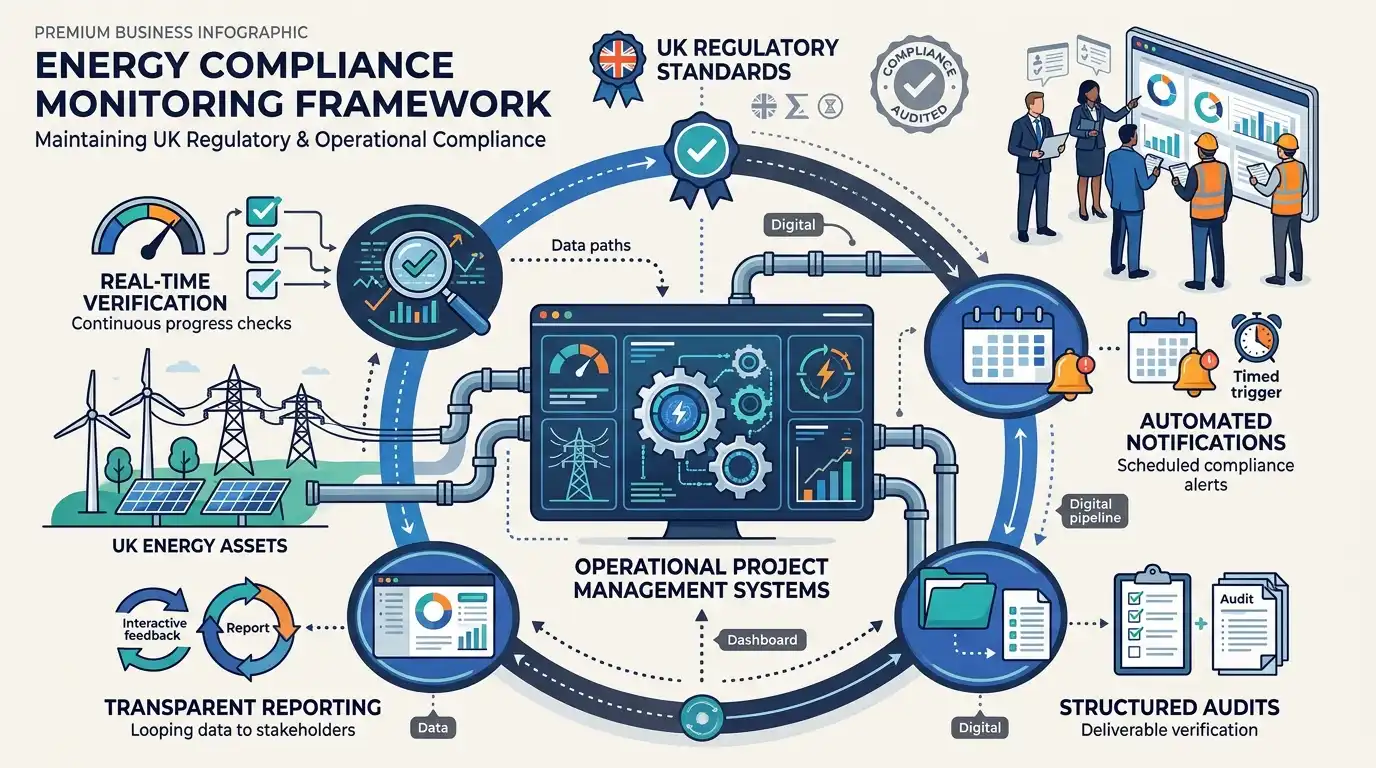
A robust compliance monitoring framework translates extracted obligations into daily operational tasks. The framework aligns project management schedules with contractual commitments, allowing technical teams to monitor progress against agreed milestones. Automated triggers alert contract owners well in advance of upcoming deadlines.
Effective frameworks mandate three core monitoring operational loops:
Physical deliverable verification to confirm technical tasks meet exact contract standards before sign-off.
Financial commitment matching to ensure invoices, letters of credit, and parent company guarantees reflect active terms.
Regulatory deadline verification to submit statutory notices, environmental impact assessments, and safety cases on time.
Rigorous milestone and deliverable monitoring guarantees that joint venture partners, contractors, and national oil companies receive timely proof of performance. Clear verification audit trails protect the operating entity during joint venture audits and commercial renegotiations.
How Do Organizations Track Key Terms and Critical Notice Requirements?
Organizations track critical terms and notice periods by configuring automated tracking registries that measure statutory lead times, calculate precise notice windows, issue escalation alerts, and maintain immutable logs of all formal party communications.
Failing to deliver formal notices within defined timeframes leads to lost commercial rights, default declarations, or unrecoverable cost overruns. Systematic key terms tracking isolates clauses governing price adjustments, indexation calculations, contract extensions, termination rights, and joint operating committee voting procedures.
Managing notice requirements requires calculated lead-time rules. Contracts frequently demand 30, 60, or 90 days of advance written notice for actions such as exercising lease renewal options, invoking force majeure, or initiating dispute resolution. Tracking systems must automatically calculate these notice windows based on operational target dates.
The tracking workflow records the exact delivery method required by the agreement, whether registered post, courier, or formal electronic portal. Documenting confirmation of receipt creates legal proof of service, protecting the organisation against claims of procedural non-compliance.
What Protocols Prevent Breach and Manage Remedy Provisions in Energy Contracts?
Companies mitigate breach risks by establishing early-warning indicator protocols, implementing automated cure period tracking systems, defining immediate response pathways, and maintaining complete documentation trails for all remediation actions.
Preventing default requires strict visibility over breach and remedy provisions. Contracts specify exact cure periods—often 14 to 30 business days—following a formal notice of default. Operating procedures must trigger immediate containment workflows the moment a potential breach occurs.
When a breach notice arrives, the contract administrator initiates an emergency escalation path:
Validate the factual and legal basis of the alleged breach.
Calculate the exact expiration date of the cure period.
Formulate a corrective action plan with engineering, operations, and procurement units.
Deliver formal written response updates to the counterparty proving active remediation.
Log all corrective actions into the central compliance record for dispute protection.
Proactive management of remedy provisions ensures minor operational variances do not escalate into contract termination, operator removal, or expensive international arbitration.
How Do Alternative Obligation Management Approaches Compare?
Energy enterprises evaluate manual spreadsheet tracking, custom enterprise software solutions, and structured corporate workforce training to determine the optimal balance of accuracy, cost efficiency, scalability, and long-term risk reduction.
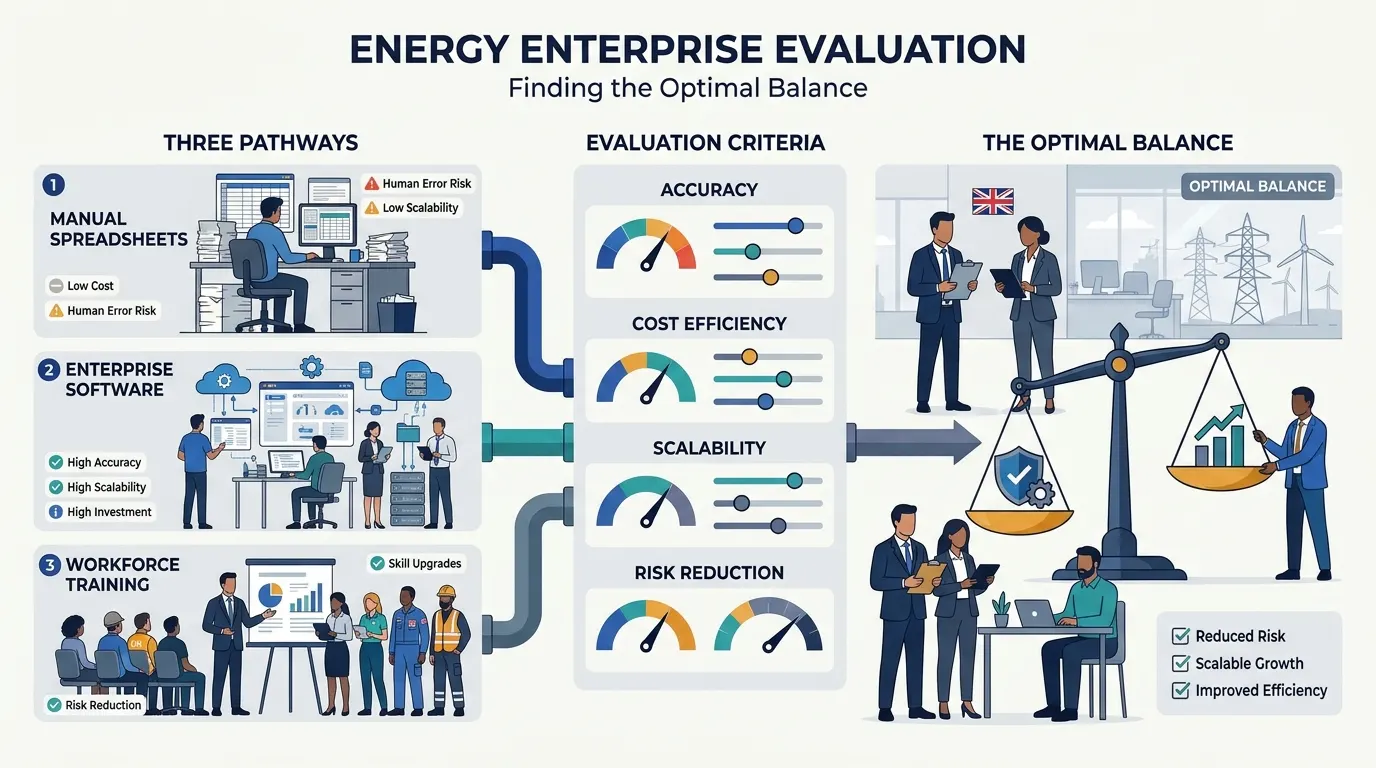
Choosing an obligation management strategy requires assessing operational scale, contract complexity, and organizational capabilities. Organizations often combine technology platforms with intensive staff development to ensure complete governance.
Evaluation Attribute | Manual Spreadsheets | Enterprise CLM Software | Structured Training Programs |
Data Extraction Accuracy | Low (High risk of human oversight) | Medium (Requires human validation) | High (Trained specialists extract terms) |
Implementation Timeline | Immediate | 6 to 18 months | 1 to 4 weeks |
Operational Scalability | Poor (Breaks under complex JV structures) | High (Handles enterprise contract volumes) | High (Embeds capability into teams) |
Compliance Ownership | Diffuse | System-dependent | Clear organizational accountability |
Audit Risk Reduction | Minimal | Moderate | Maximum |
Capital Expenditure | Low | High | Low to Moderate |
While software tools assist with document storage and keyword searching, software alone cannot interpret nuanced legal covenants or manage cross-functional joint venture governance. Developing internal expertise through targeted training ensures staff can interpret complex provisions, manage counterparties, and operate compliance platforms effectively across the complete contract lifecycle management spectrum.
Selecting the right professional capability development path depends on existing skill gaps, organizational structure, and project maturity.
Decision Factor | Internal Mentorship | Generic Commercial Courses | Energy-Specific Obligation Training |
Industry Context | Limited to historical internal practices | General commercial law focus | Upstream, midstream, and downstream focus |
Practical Tool Use | Ad-hoc spreadsheet sharing | Theoretical frameworks | Practical register construction & extraction |
Time to Competence | 12 to 24 months | 3 to 6 months | Immediate post-training execution |
Risk Containment Impact | Inconsistent across departments | Moderate | Comprehensive across all asset teams |
Enrolling commercial teams, legal officers, contract administrators, and asset managers in specialized courses bridges the gap between legal text and operational execution. Professional programs prepare personnel to design custom extraction models, establish audit-ready monitoring registers, and safeguard enterprise value across complex energy projects.
Organizations looking to establish internal extraction capabilities and build robust monitoring registers benefit from specialized commercial development programs like the Contract Compliance: Obligation Extraction & Monitoring Training Course. For teams ready to deploy structured compliance workflows across active joint venture assets, comprehensive workforce upskilling is available through Contract Compliance Obligation Extraction and Monitoring Training by Institute For Oil & Gas Training.
Frequently Asked Questions
What are the main types of oil and gas petroleum contracts?
The primary contract types in the energy sector are concession agreements, Production Sharing Contracts (PSCs), Service Contracts, and Joint Operating Agreements (JOAs). Each framework establishes specific risk-sharing arrangements, royalty structures, and operational obligations between host governments and international oil companies. The Institute For Oil & Gas Training provides comprehensive instruction on negotiating and managing these diverse Oil & Gas Petroleum Contracts.
How do Production Sharing Contracts differ from Joint Operating Agreements?
A Production Sharing Contract defines the commercial arrangement between a host government and a contractor regarding cost recovery and profit-oil splits. In contrast, a Joint Operating Agreement governs the operational relationship, voting rights, and cost-sharing mechanisms among co-venturers working on the same asset. Understanding these structural differences is essential for contract administrators enrolled in Oil & Gas Petroleum Contracts courses at the Institute For Oil & Gas Training.
How do energy companies manage compliance in upstream oil and gas agreements?
Energy companies manage contract compliance by extracting explicit covenants into a centralized obligation register, assigning clear department accountability, and setting up automated milestone tracking. This structured monitoring framework ensures timely notice delivery, prevents operational breaches, and protects joint venture margins. Specialized training programs from the Institute For Oil & Gas Training help commercial teams build audit-ready monitoring protocols for complex Oil & Gas Petroleum Contracts.
What are key notice requirements and cure periods in petroleum contracts?
Notice requirements dictate the formal communication lead times—typically 30, 60, or 90 days—required to exercise options, declare default, or initiate dispute resolution in petroleum agreements. Cure periods provide a specified timeframe, usually 14 to 30 business days, for a defaulting party to rectify a breach before contract termination or legal action occurs. Proper tracking of these provisions is a core focus of the Oil & Gas Petroleum Contracts curriculum delivered by the Institute For Oil & Gas Training.
Why is contract obligation tracking critical for joint operating assets?
Unmonitored contractual commitments in joint operating assets expose operators to severe financial penalties, unrecoverable cost overruns, loss of operator status, and costly international arbitration. Systematic extraction and continuous monitoring of deliverables ensure full alignment with regulatory standards and joint venture covenants. The Institute For Oil & Gas Training equips workforce professionals with practical skills to control risk across the complete lifecycle of Oil & Gas Petroleum Contracts.
Related training courses
Contract Compliance for Day-Rate Agreements & Claims Training Course
- Specialisation
- Oil & Gas Petroleum Contracts
- Duration
- 5 days · 15 CPD hours
Contract Compliance Across JOAs, PSCs & HGAs Training Course
- Specialisation
- Oil & Gas Petroleum Contracts
- Duration
- 5 days · 15 CPD hours
Contract Strategy, Risk and Negotiation Training Course
- Specialisation
- Oil & Gas Petroleum Contracts
- Duration
- 5 days · 15 CPD hours
More articles

Contract Compliance Across JOAs PSCs and HGAs Training by Institute For Oil & Gas Training
Evaluate the Contract Compliance Across JOAs PSCs and HGAs Training by Institute For Oil & Gas Training for oil and gas compliance management.
Read article →
How to Monitor and Manage Contractual Compliance Across JOAs PSCs and HGAs
Learn how to evaluate monitoring frameworks, audit protocols, and governance models for JOA, PSC, and HGA contractual compliance.
Read article →
Why Contract Compliance Is Challenging Across JOAs PSCs and HGAs
Learn why managing compliance across JOAs PSCs and HGAs challenges energy sector teams and how corporate training builds risk mitigation skills.
Read article →