

Contract management failure in upstream, midstream, and downstream operations rarely stems from legal misinterpretation. It originates from operational leakage where technical, commercial, and administrative terms fail to transfer into daily execution routines. Complex engineering, procurement, and construction (EPC) agreements, joint operating agreements (JOAs), and service-level contracts contain hundreds of conditional performance triggers, notice windows, and milestone obligations. When project teams lack structured extraction protocols, these contractual terms remain buried inside unread legal documentation, leading directly to revenue leakage, regulatory non-compliance, and unrecovered contractor claims.
Understanding Why Contract Obligation Management Matters in Oil and Gas Projects provides the foundation for identifying structural vulnerabilities in energy operations. Bridging the gap between executed legal instruments and field-level execution requires systematic workforce upskilling. Institute For Oil & Gas Training developed the Contract Compliance: Obligation Extraction & Monitoring Training Course to provide enterprise project teams, commercial managers, and contract administration specialists with a practical, specification-driven framework for converting raw agreements into traceable compliance registers.
What is the Contract Compliance Obligation Extraction and Monitoring Training by Institute For Oil & Gas Training and what problem does it solve?
This course is a specification-driven corporate training program designed to eliminate operational contractual non-compliance in energy sector projects. It trains professionals to systematically extract, categorize, map, and monitor legal and commercial obligations across complex oil and gas supply chains.
Energy projects operate within highly volatile technical, environmental, and financial environments. Contracts governing these ventures are dense, multi-layered legal instruments containing operational requirements dispersed across schedules, annexes, and technical exhibits. A primary source of value leakage in corporate asset management is the reliance on informal, static summaries created at project launch and rarely updated during field execution.
When operational teams lack formal methods for parsing agreement text, critical compliance triggers fall through administrative cracks. Commercial engineers often miss tight notification windows for variation orders or weather-related delays, resulting in the permanent forfeiture of legitimate cost recovery claims. Similarly, health, safety, and environmental (HSE) reporting mandates buried in contract appendices are frequently overlooked until regulatory audits trigger operational suspensions.
The Contract Compliance: Obligation Extraction & Monitoring Training Course solves these systematic execution failures by establishing a standardized operational workflow across project departments. Developed by Institute For Oil & Gas Training, the curriculum transitions legal commitments from passive digital archives into dynamic, accountable field management frameworks. Participants master the exact methodologies required to construct an enterprise-level contract obligation register, map operational dependencies, assign contract owner accountability, and enforce compliance checks throughout the commercial asset lifecycle.
Why is this corporate compliance training structured this way?
The curriculum follows a progressive skill-building architecture that mirrors the actual lifecycle of contract administration. It moves systematically from text parsing techniques to operational mapping frameworks, automated monitoring setups, and risk mitigation strategies.
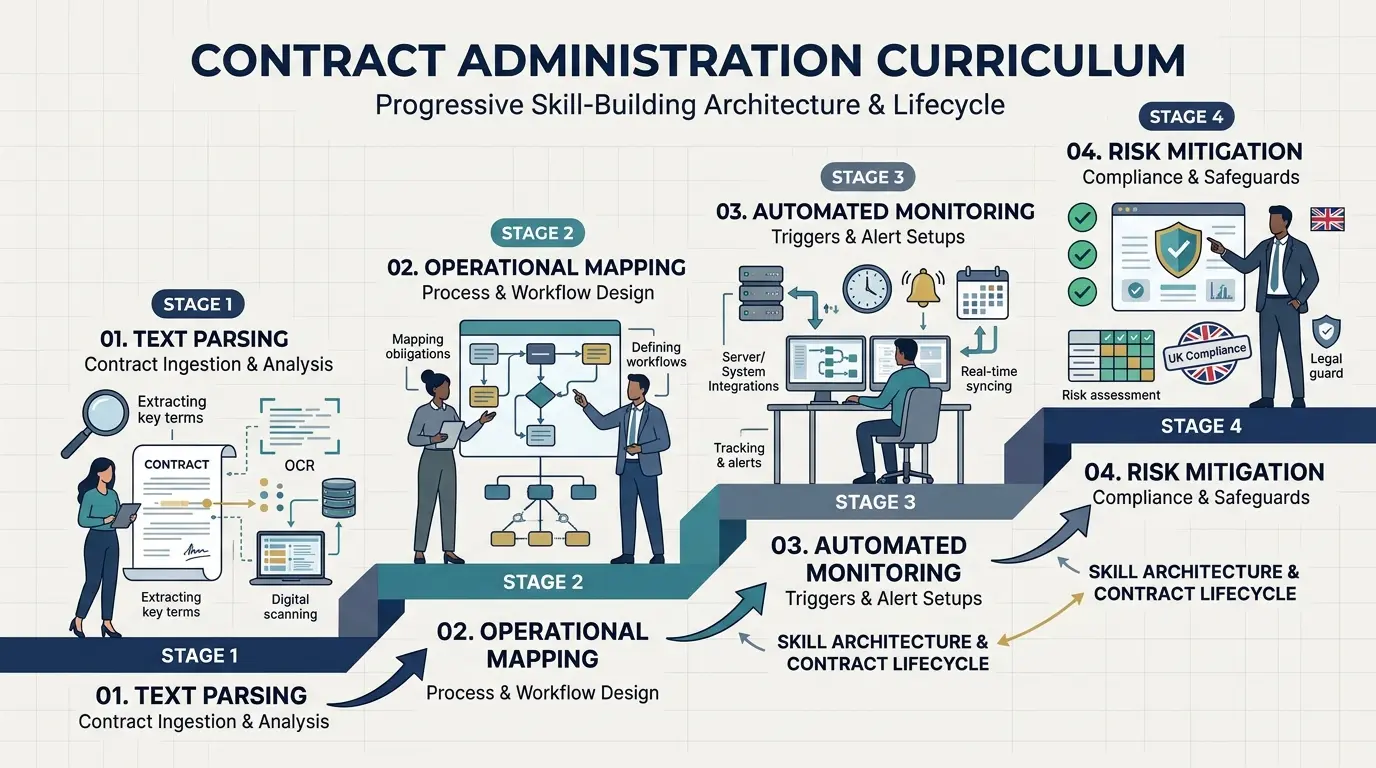
Corporate learning in complex technical environments fails when instruction remains purely theoretical. Contractual obligations are inherently interconnected; an extraction process is useless if the extracted data cannot be mapped to a specific department head or monitored against operational timelines. Therefore, Institute For Oil & Gas Training engineered this training framework using a sequential capability model.
The learning progression begins with deep structural analysis of legal texts. Participants analyze complex EPC, Joint Venture, and Field Development contracts to identify explicit obligations, conditional triggers, implicit requirements, and cross-referenced standards. This phase eliminates ambiguity regarding what constitutes a mandatory performance obligation versus a general legal recitals statement.
Once extraction principles are mastered, the course advances directly to operational data structuring. Students learn how to build robust relational matrices that bind every clause to a specific job function, operational milestone, and verification artifact. Evaluating the detailed methodology for How to Extract Track and Monitor Contractual Obligations in Oil and Gas Agreements illustrates how this structured structural shift converts static legal legalities into active operational workflows.
The final segments focus on long-term administrative control, governance protocols, and audit readiness. By structuring the training to mirror live project execution phases, Institute For Oil & Gas Training ensures that participants gain immediate, actionable capabilities that can be directly applied to active operational assets upon course completion.
What specific skills and modules will participants learn?
Participants acquire core competencies in clause extraction, risk-based obligation categorization, notice schedule management, performance metric tracking, and default prevention. The learning syllabus consists of four rigorous, outcome-focused training modules.
Module 1: Contractual Text Parsing and Obligation Extraction
Taxonomy of Contractual Terms: Differentiating binding obligations, warranties, representations, indemnities, and non-binding recitals across major industry contract formats (FIDIC, LOGIC, AIPN/AIEN).
Deconstruction Techniques: Isolating hidden requirements within operational schedules, safety exhibits, environmental impact statements, and local content mandates.
Key Terms Tracking & Identification: Standardizing the identification of key terms tracking, performance thresholds, testing milestones, and acceptance criteria.
Notice Requirements Management: Mapping time-critical communication triggers, form requirements, delivery channels, and recipient protocols for operational events.
Module 2: Obligation Extraction and Mapping Frameworks
Obligation Mapping & Mapping Protocols: Translating legal clauses into structured database records featuring clear inputs, operational triggers, outputs, and verification methods.
Contract Obligation Register Architecture: Building enterprise-level compliance tracking tools equipped with metadata fields for clause references, priority levels, and action types.
Contract Owner Accountability Matrices: Assigning clear RACI (Responsible, Accountable, Consulted, Informed) models to every contractual requirement to ensure clear departmental ownership.
Milestone and Deliverable Monitoring Design: Linking commercial payment schedules directly to verified technical milestones and field completion documentation.
Module 3: Operational Compliance Monitoring Frameworks
Monitoring Framework Implementation: Integrating the compliance monitoring framework into enterprise software solutions (SAP, Primavera P6, contract lifecycle management tools).
Verification Data Collection: Defining acceptable evidence types (inspection reports, factory acceptance test certificates, joint measurement sheets) for compliance sign-off.
Interface Management & Subcontract Alignment: Cascading main contract obligations down through subcontractor chains to ensure complete alignment across supply tiers.
Performance Metrics & KPIs: Establishing leading indicators to track compliance health before non-performance events escalate into commercial disputes.
Module 4: Breach Mitigation, Remedies, and Governance
Breach and Remedy Provisions Administration: Operationalizing contract default terms, cure notices, liquidated damages calculations, and performance bond call processes.
Variation and Claim Management: Aligning change-order procedures with obligation registers to prevent scope creep and unapproved project expenditure.
Contract Lifecycle Management Integration: Embedding obligation monitoring protocols into end-to-end contract lifecycle management enterprise workflows.
Compliance Audit Protocols: Conducting periodic contractual compliance audits to identify systemic execution gaps prior to external regulatory or partner reviews.
How is the Contract Compliance: Obligation Extraction & Monitoring Training Course delivered?
The course offers flexible, high-intensity delivery formats: live interactive virtual classrooms, hands-on corporate workshops, hybrid models, and dedicated on-site enterprise programs. Delivery focuses heavily on practical execution using live contract data.
Professional training delivered by Institute For Oil & Gas Training prioritizes direct application over abstract instruction. The course structure deliberately limits lecture modules to short methodological briefings, reserving the majority of instructional time for applied laboratory exercises, document parsing workshops, and operational scenario simulation.
Interactive Workshop Environment
Programs are conducted in dedicated learning environments using real-world case studies drawn from actual offshore, onshore, refining, and pipeline assets. Trainees work directly with redacted master service agreements, drilling contracts, and facility construction deeds to build functional compliance databases from scratch.
Custom Corporate Deployment
For enterprise clients, Institute For Oil & Gas Training customizes the practical modules to incorporate the client's existing operational templates, governance systems, and live contract portfolios. This approach guarantees that training outputs directly generate immediate operational value for active organizational assets.
Rigorous Evaluation & Skill Verification
Skill acquisition is systematically evaluated throughout the program using a three-tier assessment framework:
Participants who achieve passing marks across all diagnostic assessments receive formal professional certification validating their capability in technical contract compliance administration.
What measurable organizational results can be expected?
Graduates gain immediate technical competency in operationalizing legal agreements, resulting in significantly reduced risk of commercial default, zero missed claim notice windows, streamlined departmental handovers, and robust audit readiness.
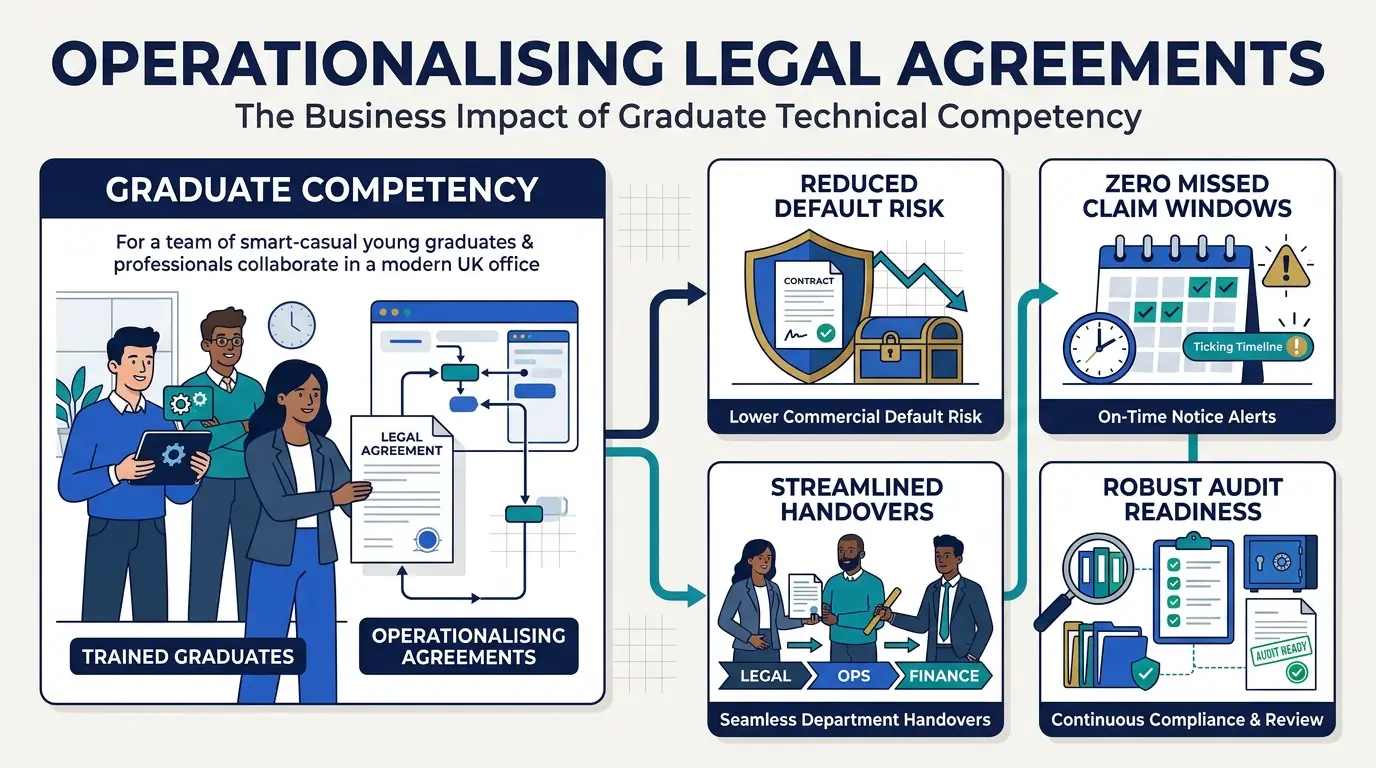
Enrolling project personnel in the Contract Compliance: Obligation Extraction & Monitoring Training Course directly transforms how operating entities manage commercial exposures. Enterprise organizations sending cohorts through programs delivered by Institute For Oil & Gas Training experience measurable structural improvements across multiple functional areas.
Commercial and Legal Risk Mitigation
Commercial teams eliminate unforced financial losses caused by procedural errors. By embedding structured tracking systems for time-sensitive notices, organizations systematically protect their right to claim time extensions, cost adjustments, and variations, preventing contractors or operators from disallowing claims on procedural grounds.
Human Resources and Talent Pipeline Upskilling
HR managers and talent development leaders use this training program to systematically build specialized competencies within corporate asset teams. The clear competency benchmarks provide human resources leadership with concrete metrics for evaluating technical workforce readiness, supporting structured succession planning within commercial, procurement, and contract administration departments.
Inter-Departmental Operational Efficiency
The implementation of a standardized contract obligation register resolves persistent friction between corporate legal departments, commercial management teams, and field site engineers. By establishing unambiguous operational ownership for every contractual line item, project teams eliminate administrative ambiguity, streamline handovers, and accelerate formal verification sign-offs.
How does enrollment and corporate program onboarding work?
Enrollment is open to individual energy sector professionals and corporate organizational cohorts. Candidates apply online, undergo a background prerequisite verification, select their preferred delivery format, and complete pre-course baseline assessments.
Eligibility Prerequisites
To maintain high-level instructional standards, candidates must possess baseline professional familiarity with commercial operations, project engineering, legal administration, or procurement management within the energy, petrochemical, or industrial infrastructure sectors.
Recommended Participant Roles
Contract Administrators and Managers
Commercial and Quantity Surveyors
EPC Project Managers and Field Engineers
Procurement and Supply Chain Specialists
In-House Legal Counsel and Compliance Officers
Corporate Audit and Risk Management Personnel
Enrollment Execution
Corporate HR departments managing multi-delegate cohorts receive dedicated onboarding coordination, including custom pre-training skills assessments to align the curriculum with specific organizational contract types.
To upskill your project execution team and secure your operational assets against commercial non-compliance, enroll in this program today to reserve course placement.
Frequently Asked Questions
What are the main types of Oil & Gas Petroleum Contracts?
The primary agreements in the energy sector include Production Sharing Contracts (PSCs), Joint Operating Agreements (JOAs), Concession Agreements, and Service Contracts. Each contract framework dictates how risk, operational control, and financial returns are distributed between host governments and international oil companies. Professional training through the Institute For Oil & Gas Training helps commercial teams navigate the unique legal obligations and compliance requirements of these Oil & Gas Petroleum Contracts.
How do Production Sharing Contracts work in the petroleum industry?
In a Production Sharing Contract, the host government retains ultimate ownership of the hydrocarbon resources while contracting an oil company to bear the financial and operational risk of exploration and development. If commercial reserves are discovered, the contractor recovers its costs ("cost oil") and splits the remaining production ("profit oil") with the state according to pre-agreed terms. Understanding these fiscal regimes is a core component of the commercial curriculum at the Institute For Oil & Gas Training.
What key clauses must be monitored in Oil & Gas Petroleum Contracts?
Critical provisions requiring continuous oversight include notice requirements, milestone deliverable deadlines, work commitment obligations, health and safety mandates, and default remedy terms. Failing to extract and systematically monitor these operational triggers can lead to forfeiture of claims, cost disallowances, or regulatory penalties. The Institute For Oil & Gas Training provides specialized instruction on constructing obligation registers to ensure strict adherence to all contractual covenants.
Who needs training on Oil & Gas Petroleum Contracts?
Contract administrators, commercial managers, quantity surveyors, project engineers, procurement specialists, and legal counsel working across upstream, midstream, or downstream assets benefit from structured training. Upskilling in this domain ensures that cross-functional teams understand how legal terms translate into daily field execution. Programs hosted by the Institute For Oil & Gas Training equip these professionals with practical frameworks for managing commercial risk throughout the contract lifecycle.
What is the role of a Joint Operating Agreement in petroleum projects?
A Joint Operating Agreement governs the working relationship, financial contributions, and operational responsibilities among co-venturers sharing an exploration or production licence. It establishes voting rights, operating committee procedures, sole-risk provisions, and default mechanisms to maintain alignment among joint venture partners. Mastering JOA administration through the Institute For Oil & Gas Training helps organizations manage shared liability and avoid joint venture disputes when executing Oil & Gas Petroleum Contracts.
Related training courses
Contract Compliance: Obligation Extraction & Monitoring Training Course
- Specialisation
- Oil & Gas Petroleum Contracts
- Duration
- 5 days · 13 CPD hours
Contract Compliance for Day-Rate Agreements & Claims Training Course
- Specialisation
- Oil & Gas Petroleum Contracts
- Duration
- 5 days · 15 CPD hours
Contract Strategy, Risk and Negotiation Training Course
- Specialisation
- Oil & Gas Petroleum Contracts
- Duration
- 5 days · 15 CPD hours
More articles

Contract Compliance Across JOAs PSCs and HGAs Training by Institute For Oil & Gas Training
Evaluate the Contract Compliance Across JOAs PSCs and HGAs Training by Institute For Oil & Gas Training for oil and gas compliance management.
Read article →
How to Monitor and Manage Contractual Compliance Across JOAs PSCs and HGAs
Learn how to evaluate monitoring frameworks, audit protocols, and governance models for JOA, PSC, and HGA contractual compliance.
Read article →
Why Contract Compliance Is Challenging Across JOAs PSCs and HGAs
Learn why managing compliance across JOAs PSCs and HGAs challenges energy sector teams and how corporate training builds risk mitigation skills.
Read article →