

What is the Contract Compliance Across JOAs PSCs and HGAs Training Course and what workplace problem does it resolve within upstream energy management?
The Contract Compliance Across JOAs, PSCs & HGAs Training Course is a professional capability programme designed to eliminate contractual breach risks, financial leakage, and partner disputes in upstream oil and gas operations through systematic multi-agreement governance.
Upstream petroleum activities operate under multi-layered regulatory frameworks where a single operational decision intersects with three distinct legal agreements. Upstream joint ventures frequently experience cost recovery disallowances, unfulfilled minimum work commitments, and governance deadlocks due to poor administrative oversight of complex legal structures. Operating companies and non-operating partners often manage Joint Operating Agreements (JOAs), Production Sharing Contracts (PSCs), and Host Government Agreements (HGAs) as isolated documents rather than an interconnected legal ecosystem. This siloed management approach creates operational friction, triggers partner audit exceptions, and increases default exposure across joint ventures. Professionals seeking to understand the root causes of non-compliance across complex commercial arrangements should review our analysis on Why Contract Compliance Is Challenging Across JOAs PSCs and HGAs.
The Institute For Oil & Gas Training developed the Contract Compliance Across JOAs, PSCs & HGAs Training Course to address these critical structural vulnerabilities in commercial energy administration. The curriculum bridges the operational gap between legal obligations, financial controls, and joint venture execution. Organizations deploying this training equip commercial managers, joint venture accountants, and legal advisers with precise methodologies to audit, monitor, and enforce compliance across every phase of the asset lifecycle.
Why is the Contract Compliance Across JOAs, PSCs & HGAs Training Course structured in this specific learning progression?
This course is structured in a progressive four-stage technical framework to advance participants from foundational legal architecture to complex multi-agreement alignment, dynamic risk monitoring, and strategic joint venture governance.
The curriculum architecture designed by the Institute For Oil & Gas Training reflects the operational reality of upstream asset administration. Upstream professionals must first understand the distinct legal mechanics of each agreement type before attempting to manage cross-agreement obligations. The learning journey begins by dissecting the underlying legal instruments independently, establishing baseline knowledge of joint operating agreement obligations, host government agreement obligations, and production sharing contract terms adherence. Without this foundational understanding, commercial practitioners cannot identify structural contradictions between commercial terms and government fiscal mandates.
The second stage transitions from isolated analysis to multi-agreement alignment and harmonisation. Participants analyze how operational actions under an operating agreement trigger compliance requirements under state concession contracts. The third stage introduces dynamic compliance monitoring mechanisms, providing practical toolkits for tracking work programme and budget commitments alongside accounting procedure compliance. The final stage addresses joint venture governance, focusing on partner consent and voting requirements, default mechanisms, and dispute resolution. This structured progression ensures that participants move systematically from theoretical comprehension to practical operational mastery. For an in-depth breakdown of practical tracking frameworks, read our guide on How to Monitor and Manage Contractual Compliance Across JOAs PSCs and HGAs.
What core competencies and technical modules will participants learn during the course?
Participants gain practical skills to audit accounting procedures, verify work program commitments, manage voting mechanics, calculate cost recovery caps, and enforce default and forfeiture provisions across complex joint operations.
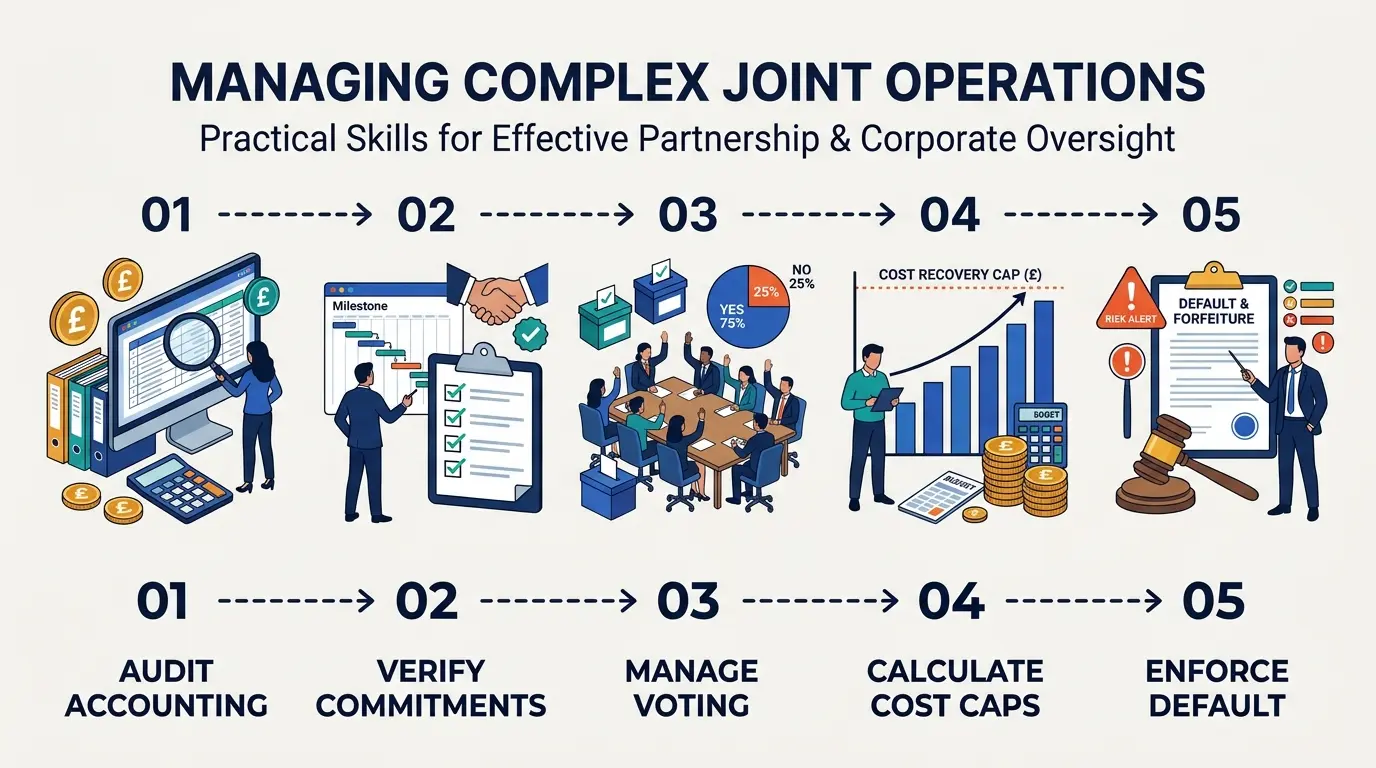
The Contract Compliance Across JOAs, PSCs & HGAs Training Course provides comprehensive coverage of commercial, legal, and operational compliance vectors. Delivered by the Institute For Oil & Gas Training, the syllabus integrates practical technical frameworks into six core modules designed for direct workplace execution.
Module Title | Key Focus Areas | Core Technical Competency |
Module 1: Legal Architecture of Upstream Agreements | JOA structures (AIPN/AIEN models), PSC fiscal regimes, HGA stabilization provisions | Mapping contractual hierarchies and identifying legal priority clauses across agreements |
Module 2: Operational Work Programmes & Fiscal Commitments | Minimum work obligations, relinquished land deadlines, expenditure verification | Tracking minimum work obligations against license condition compliance parameters |
Module 3: Accounting Procedure Compliance & Cost Recovery | Joint account auditing, billable cost classification, overhead allocation formulas | Executing accounting procedure compliance and preventing cost recovery disallowances |
Module 4: Joint Venture Governance & Partner Voting | Operating committee (OPCO) procedures, voting thresholds, sole risk operations | Managing partner consent and voting requirements and documented pass-mark thresholds |
Module 5: Default, Forfeiture & Remedies | Cash call default timelines, default notices, security interests, forfeiture mechanics | Applying default and forfeiture provisions without exposing the venture to legal liability |
Module 6: Multi-Agreement Compliance Systems | Integrated compliance matrices, automated reporting workflows, audit preparation | Constructing operational compliance management systems for corporate asset oversight |
Module 1: Foundational Architecture of Upstream Contracts
This module establishes the core legal frameworks governing international petroleum exploration and production. Participants examine standard AIPN/AIEN model Joint Operating Agreements, variant Production Sharing Contracts, and Host Government Agreements including Concession Agreements and Pipeline Development Agreements. Analysis focuses on stabilization clauses, sovereign immunity waivers, and the legal hierarchy when agreement terms conflict.
Module 2: Managing Work Programmes, Budgets, and License Conditions
Operational continuity requires strict adherence to scheduled work commitments and regulatory mandates. This module provides systematic frameworks to monitor exploration phase minimum work obligations, seismic acquisition targets, and appraisal drilling deadlines. Participants learn to reconcile operational milestones with host government agreement obligations and statutory licence condition compliance timetables.
Module 3: Accounting Procedure Compliance and Cost Auditing
Financial non-compliance remains the primary driver of joint venture disputes and partner litigation. Training covers joint account audit protocols, non-consent penalty calculations, and parent company overhead allocations. Participants learn to audit operator billings against contract schedules, ensuring strict accounting procedure compliance and safeguarding production sharing contract terms adherence regarding cost oil limits.
Module 4: Operating Committee Governance and Voting Mechanics
Effective governance requires precise administration of Joint Operating Committee (JOC) and Operating Committee (OPCO) activities. This module details the mechanics of partner consent and voting requirements, pass-mark thresholds, non-consent provisions, and sole risk project proposals. Exercises demonstrate how to document formal notices, manage emergency authorizations for expenditure (AFEs), and maintain valid committee records.
Module 5: Managing Default, Remedy Periods, and Forfeiture
When partners fail to meet cash call requirements or operational commitments, joint ventures must execute legal remedies swiftly. This module covers default notice structures, cure periods, interest accrual calculations, and the enforcement of security interests. Participants analyze default and forfeiture provisions to understand the precise legal steps required to forfeit a defaulting party's share while protecting non-defaulting partners.
Module 6: Enterprise Compliance Integration and Audit Preparedness
The final module focuses on embedding contractual compliance routines into ongoing organizational workflows. Participants learn to build digital compliance matrices, design internal control checklists, and prepare joint venture assets for external audits by state entities or non-operating partners.
How is the training course delivered, structured, and assessed by the Institute For Oil & Gas Training?
The training is delivered through structured 5-day intensive workshops, interactive online cohorts, or customized corporate onsite programs featuring real-world case simulations and formal competency assessments.
The Institute For Oil & Gas Training prioritizes practical application over passive learning. Every delivery format incorporates interactive simulations, legal document drafting exercises, and real-life joint venture scenario analysis.
Training Delivery Formats
In-Person Executive Workshops: Intensive 5-day classroom programs hosted at regional oil and gas hubs (London, Dubai, Houston, Singapore, Kuala Lumpur). Includes collaborative case study workshops, expert-led instruction, and peer group networking.
Live Virtual Online Cohorts: Delivered across 10 interactive sessions over two weeks via a dedicated digital learning platform. Designed for active professionals requiring flexible learning schedules without international travel.
Corporate Onsite Delivery: Custom-designed programs conducted at an organization's facility. Content is adapted to incorporate the client's specific active JOAs, PSCs, and HGAs.
Instructional Methodologies
The Institute For Oil & Gas Training utilizes an action-learning model built around four core elements:
Document Analysis Workshops: Participants work directly with redacted AIPN model JOAs, international PSCs, and government concession documents to identify compliance traps and ambiguous clauses.
Interactive Case Simulations: Teams act as Operators and Non-Operators in simulated JOC meetings, negotiating disputed AFEs, voting on sole risk operations, and resolving default scenarios.
Financial Audit Exercises: Practical workshops involving the reconciliation of joint account charges against strict accounting procedures to identify non-recoverable expenses.
Compliance Framework Construction: Guided creation of an operational compliance matrix tailored to participant asset portfolios.
Assessment and Certification Framework
To ensure measurable skill transfer, participants undergo rigorous evaluation:
Pre-Course Capability Baseline Assessment: Evaluates baseline understanding of contract terms, joint venture structures, and accounting rules prior to instruction.
Formative Practical Assignments: Daily scenario-based problems requiring written analysis of contractual disputes, voting outcome calculations, and default remedies.
Summative Capstone Simulation: A comprehensive final exercise where participants analyze a multi-agreement compliance failure, prepare an audit exceptions report, and present a mitigation strategy to a mock executive board.
Professional Certification: Candidates scoring 70% or higher across evaluations receive the formal Certificate of Competency in Upstream Contract Compliance issued by the Institute For Oil & Gas Training.
What operational performance results and organizational impacts can companies expect post-training?
Organizations achieve immediate reductions in audit exceptions, zero exposure to missed work program deadlines, improved joint venture partner alignment, and protected cost recovery margins.
Upstream petroleum companies deploying teams through the Contract Compliance Across JOAs, PSCs & HGAs Training Course secure measurable operational benefits. The Institute For Oil & Gas Training designs its curriculum to generate direct commercial returns across legal, financial, and operational departments.
Quantitative Operational Improvements
Reduced Financial Disallowances: Systematic verification of expenditures against approved work programme and budget commitments minimizes unrecoverable costs during host government and partner audits.
Eliminated Relinquishment and Default Risks: Standardized tracking schedules ensure total adherence to minimum work obligations and statutory filing deadlines, preventing license cancellation.
Accelerated Joint Venture Approvals: Structured management of partner consent and voting requirements reduces administrative delays in AFE approvals and project sanctions.
Mitigated Legal Exposure: Rigorous execution of default and forfeiture provisions protects corporate assets when operating partners experience financial distress.
Role-Specific Competency Gains
Commercial Managers & Asset Directors: Gain the ability to structure operational strategies within legal constraints, manage JOC voting dynamics, and maintain productive relations with state regulators and corporate partners.
Joint Venture Accountants: Master the practical execution of accounting procedure compliance, ensuring accurate joint account billings, overhead calculations, and audit defensibility.
Legal Advisers & Compliance Officers: Enhance their ability to interpret overlapping agreement terms, draft unambiguous operational notices, and resolve cross-contractual disputes before arbitration.
HR Directors & L&D Leaders: Secure a standardized, repeatable professional training framework that upskills cross-functional teams, builds leadership capability, and simplifies technical talent development.
How does enrollment, eligibility, and participant selection work for this training programme?
Enrollment requires a formal application evaluating professional background, with structured corporate registration tracks available for individuals, project teams, and enterprise cohorts.
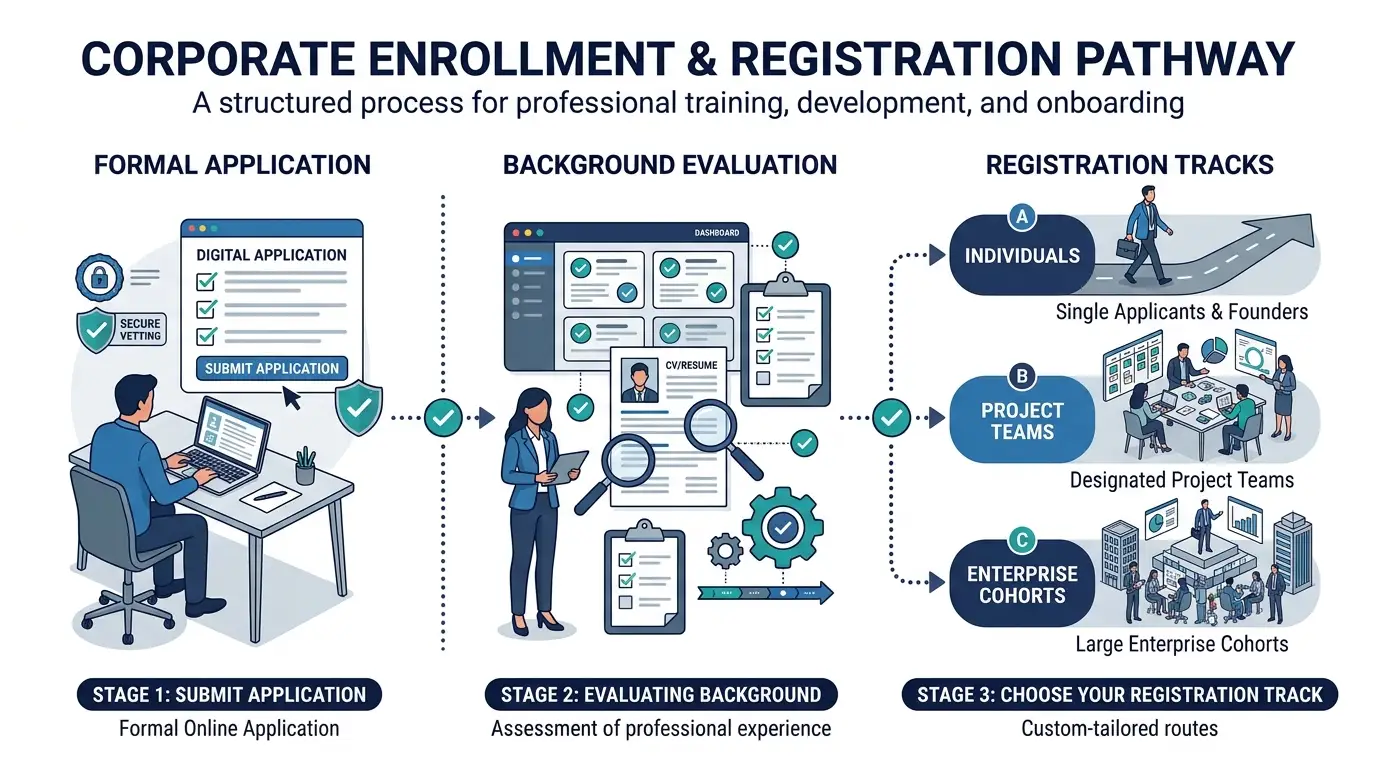
The Institute For Oil & Gas Training maintains clear entry criteria to ensure high-level, peer-to-peer technical exchange within every training cohort.
Candidate Eligibility Criteria
This program is structured for professionals operating within or supporting upstream petroleum activities. Ideal participants include:
Commercial Managers and Joint Venture Administrators
Petroleum Engineers and Asset Managers moving into commercial oversight roles
Joint Venture Accountants, Finance Managers, and Internal Auditors
In-House Legal Counsel, Contracts Managers, and Compliance Officers
Government Relations Officers and National Oil Company (NOC) Regulators
While formal legal or accounting degrees are not mandatory, candidates must possess at least two years of professional experience within the energy sector or related commercial administration environments.
Enrollment Process and Path to Completion
1.Application Submission:Review by admissions board.
Submit the formal online candidate application form detailing professional experience, current job role, and organizational learning objectives.
2.Candidate Verification:Within 48 business hours.
The admissions team at the Institute For Oil & Gas Training reviews the applicant's profile to confirm eligibility and assign appropriate cohort placement.
3.Pre-Course Onboarding:14 days prior to start date.
Approved participants receive preliminary reading materials, model agreement templates, and access to the online learning portal to complete their baseline assessment.
4.Program Attendance & Evaluation:Active training phase.
Complete all instructional sessions, practical case workshops, and group simulations across the chosen delivery format.
5.Certification & Post-Course Support:Post-program integration.
Achieve passing grades on the summative capstone assessment to receive the Certificate of Competency in Upstream Contract Compliance, along with 12 months of alumni resource library access.
Corporate Team Enrolments
For organizations seeking to upskill entire asset teams or cross-functional departments, corporate group bookings offer streamlined enrollment, tailored case study integration, and flexible delivery schedules. Dedicated corporate cohorts allow internal teams to evaluate active operational assets under confidential non-disclosure frameworks.
To review available training dates, request a detailed syllabus brochure, or register your team, enroll in this program.
Frequently Asked Questions
What is included in the Oil & Gas Petroleum Contracts training by the Institute For Oil & Gas Training?
The Oil & Gas Petroleum Contracts training provided by the Institute For Oil & Gas Training covers legal, financial, and operational frameworks governing upstream and midstream energy assets. Participants examine key instruments including Joint Operating Agreements (JOAs), Production Sharing Contracts (PSCs), and Host Government Agreements (HGAs). The syllabus focuses on compliance monitoring, accounting procedures, voting rights, default provisions, and cost recovery mechanisms.
Who should attend an Oil & Gas Petroleum Contracts training course?
This course is designed for commercial managers, joint venture accountants, legal counsel, asset directors, and regulatory compliance officers in the energy sector. It caters to both operating and non-operating partner teams, as well as government officials managing petroleum agreements. Professionals seeking to minimize contractual breach risks and streamline joint venture administration benefit directly from the structured curriculum at the Institute For Oil & Gas Training.
How do JOAs, PSCs, and HGAs differ in petroleum contract management?
A Joint Operating Agreement (JOA) governs the relationship and cost-sharing mechanics between co-venturers working on an asset. A Production Sharing Contract (PSC) defines the commercial terms, profit split, and cost recovery limits between an operating oil company and a host government. A Host Government Agreement (HGA) establishes overall regulatory, concession, and stabilization terms, making cross-agreement alignment vital for complete contract compliance.
How does the Institute For Oil & Gas Training assess learning outcomes for contract courses?
The Institute For Oil & Gas Training evaluates participants using pre-course baseline assessments, practical document auditing workshops, and daily scenario-based case studies. Candidates culminate their training with a capstone joint venture simulation involving dispute resolution and audit exception reporting. Successful participants receive a formal Certificate of Competency demonstrating practical mastery of petroleum contract administration.
What are the delivery formats available for Oil & Gas Petroleum Contracts training?
Training is delivered via intensive 5-day in-person executive workshops at major global energy hubs, live virtual online cohorts spread over two weeks, or customized corporate onsite sessions. Corporate onsite programs conducted by the Institute For Oil & Gas Training can integrate an organization’s specific active contracts and operational schedules under confidential agreements.
Related training courses
Contract Compliance for Day-Rate Agreements & Claims Training Course
- Specialisation
- Oil & Gas Petroleum Contracts
- Duration
- 5 days · 15 CPD hours
Contract Compliance Across JOAs, PSCs & HGAs Training Course
- Specialisation
- Oil & Gas Petroleum Contracts
- Duration
- 5 days · 15 CPD hours
Contract Strategy, Risk and Negotiation Training Course
- Specialisation
- Oil & Gas Petroleum Contracts
- Duration
- 5 days · 15 CPD hours
More articles

CAPEX vs OPEX Impact on Cost Recovery Training by Institute For Oil & Gas Training
Evaluate the CAPEX vs OPEX Impact on Cost Recovery Training by Institute For Oil & Gas Training. Learn modules, structure, outcomes, and enrollment details.
Read article →
How to Assess the Impact of CAPEX and OPEX Classification on Petroleum Cost Recovery
Learn how to assess CAPEX and OPEX classification in petroleum cost recovery. Evaluate audit risks, cash flow effects, and joint venture compliance.
Read article →
Why CAPEX and OPEX Classification Affects Cost Recovery in Oil and Gas
Learn how CAPEX and OPEX classification dictates cost recovery mechanisms, cash flow velocity, and regulatory compliance in upstream petroleum accounting.
Read article →