

Contract compliance across JOAs PSCs and HGAs is the systematic governance of legal, financial, and operational obligations in multi-party energy agreements. It prevents costly default, ensures regulatory adherence, and aligns joint venture operations with host government requirements across international jurisdictions.
In international upstream energy operations, joint operating agreements (JOAs), production sharing contracts (PSCs), and host government agreements (HGAs) form the structural backbone of multi-billion-pound exploration and production ventures. These complex contracts govern relationships between operator entities, non-operating partners, state oil companies, and host governments. Contract compliance represents a cross-functional business governance process requiring precise coordination between legal counsel, commercial managers, Joint Venture (JV) accountants, and technical operations teams.
Workforce skill gaps in contractual interpretation directly create commercial risk. When asset managers or project engineers misinterpret joint operating agreement obligations, operating consortia face immediate financial exposure and operational delays. Organisations implement targeted professional development programs to convert complex legal text into executable operational workflows. Structured workforce training equips technical and financial personnel with the analytical frameworks needed to track compliance metrics, manage audit rights, and maintain regulatory alignment across all operational phases.
Why Is Contract Compliance Challenging Across JOAs PSCs and HGAs for Energy Organizations?
Contract compliance is challenging due to overlapping governance frameworks, conflicting partner priorities, strict fiscal terms, and ambiguous operational clauses. Organizations struggle when technical teams lack formal training in contractual interpretation, cross-border regulatory compliance, and joint venture accounting procedures.
Managing compliance across three overlapping legal frameworks creates severe operational friction. A JOA governs private partner interactions, a PSC regulates production splits with a sovereign host state, and an HGA secures fiscal stabilization and infrastructure access. Operating teams face conflicting mandates when a decision compliant with a JOA violates production sharing contract terms adherence or host government fiscal rules.
Organisations encounter significant challenges across specific functional areas:
Accounting procedure compliance: Non-operating partners routinely challenge overhead allocations, shared asset charges, and cost recovery eligibility during formal Joint Venture audits.
Work programme and budget commitments: Missing strict submission deadlines or overspending authorized budget thresholds leads to non-recoverable expenditures under state contracts.
Minimum work obligations: Failure to complete seismic acquisition or drill mandatory exploration wells triggers multi-million-pound bank guarantee forfeitures and licence revocations.
Licence condition compliance: Complex environmental reporting schedules, health and safety regulations, and local content thresholds require real-time tracking across diverse operational departments.
Partner consent and voting requirements: Miscalculating passthrough voting thresholds or failing to secure proper authorization for expenditure (AFE) approval invalidates major procurement contracts.
Default and forfeiture provisions: Minor administrative errors in issuing cash calls can inadvertently initiate aggressive remedy clauses, potentially stripping a partner of their asset equity.
Without formal training, cross-functional teams work in departmental silos. Technical engineers execute field operations without recognizing how minor schedule adjustments violate host government agreement obligations. Corporate learning initiatives solve this by establishing standardized governance protocols across exploration, legal, asset management, and financial departments.
How Do Enterprise Organizations Build Competency in JOA PSC and HGA Governance?
Organisations build compliance competency through structured corporate training programs using scenario simulations, contract analysis workshops, and interactive case studies. Learning operations align multi-disciplinary teams around unified risk management frameworks, audit readiness protocols, and contract management methodologies.
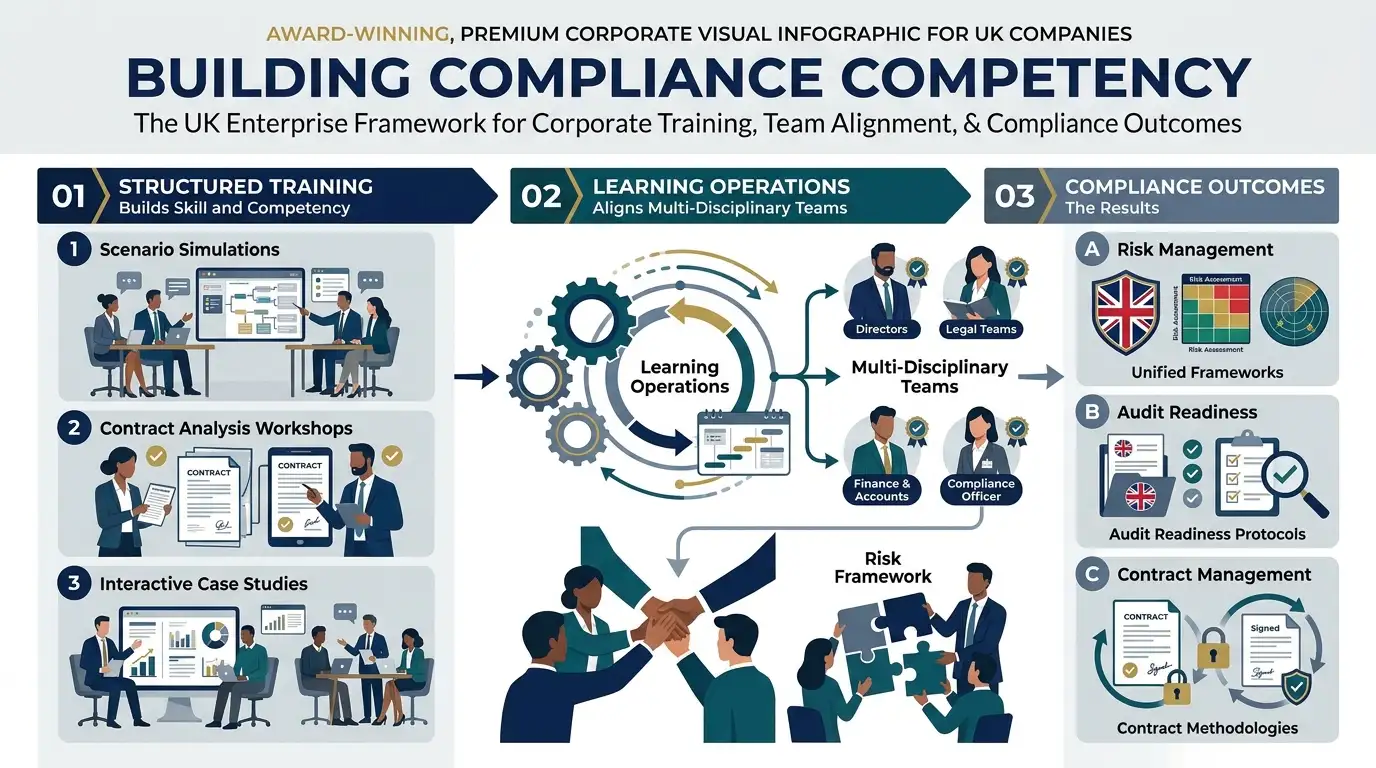
Enterprise skill transformation requires a deliberate macro-to-micro learning framework. Training initiatives transition professionals from foundational contractual concepts to advanced multi-party negotiations and dispute resolution.
Professional development programs deliver instruction through three main formats:
Intensive Executive Workshops: 3 to 5-day immersive sessions focused on strategic alignment, complex negotiation tactics, and cross-border dispute resolution for senior managers.
Modular Online Learning: Self-paced digital modules covering baseline legal frameworks, joint interest accounting fundamentals, and international petroleum standards.
Hybrid Workforce Solutions: Combined digital instruction with hands-on, instructor-led case studies focused on active company assets and historical audit findings.
During implementation, learning facilitators utilize real-world scenario analysis. Participants analyze historical Joint Venture defaults, cost-recovery rejections, and host state arbitrations across international jurisdictions. This practical approach ensures learners gain actionable skills directly transferable to daily operations.
What Key Components Must a Corporate Contract Compliance Framework Include?
A corporate contract compliance framework includes standardized risk management tools, clear governance workflows, cross-functional communication matrices, and automated compliance tracking systems. It integrates legal mandates into practical daily operational procedures for technical and financial teams.
High-performing energy organizations structure their contract compliance capabilities around five core pillars:
Compliance Pillar | Operational Focus | Primary Tools & Deliverables |
Legal Architecture | Interpreting JOA, PSC, and HGA terms | Clause matrices, precedence charts, obligation registers |
Financial Control | Cost recovery and JV accounting | AFE tracking software, audit defence books, cash call schedules |
Operational Alignment | Work program execution | Integrated master schedules, compliance checklists, risk registers |
Governance & Voting | Partner management | Voting calculators, OpCo resolution templates, passthrough logs |
Regulatory & Local Content | Host state adherence | Local procurement trackers, environmental obligation logs |
Corporate training programs train personnel to deploy these tools efficiently. For example, joint interest accountants master techniques to verify cost eligibility before billing non-operators, reducing formal audit exceptions by up to 45%. Concurrently, operational managers learn to track minimum work commitments against strict regulatory timelines, preventing costly contractual breaches.
What Are the Measurable Business Benefits of Upstream Contract Compliance Training?
Upstream contract compliance training reduces legal disputes, prevents financial leakage through unrecoverable costs, minimizes default risks, and protects asset profitability. It improves inter-departmental collaboration, accelerates decision-making cycles, and strengthens relationships with host governments.
Investing in specialized corporate training produces measurable organizational impact:
30% Reduction in Audit Exceptions: Standardizing joint interest accounting procedures minimizes billing disputes and unrecoverable expense designations between operators and non-operators.
25% Faster AFE Approvals: Clear understanding of voting mechanics, passthrough rights, and partner authorization procedures eliminates administrative delays in capital deployment.
Zero Contested Deficit Notices: Educating cash-management teams on strict joint operating agreement obligations prevents accidental partner default proceedings and costly legal remedies.
Improved Host Government Relations: Rigorous compliance with minimum work programs and host government agreement obligations protects operational licences and secures future concession awards.
Enhanced Talent Retention: Providing structured career development pathways increases job satisfaction and reduces costly turnover among commercial managers and contracts analysts by 18%.
Organizations evaluating formal workforce solutions review practical options like the Contract Compliance Across JOAs, PSCs & HGAs Training Course to standardize competencies across global operations. Proactive capability building protects joint venture equity and secures operational continuity across complex international assets.
Which Enterprise Roles and Industries Require JOA PSC and HGA Compliance Training?
Enterprise roles requiring compliance training include asset managers, legal counsel, joint venture accountants, commercial analysts, procurement specialists, and government relations leads. Key industries encompass upstream oil and gas, offshore wind, green hydrogen, and large-scale infrastructure consortiums.
Multi-party contract compliance skills are essential across several capital-intensive sectors:
Within these organizations, specific operational departments apply these competencies to solve daily business challenges:
Joint Venture Management Teams: Oversee daily communication with partners, execute voting procedures, and monitor operational compliance against agreed work budgets.
Finance and JV Accounting Departments: Manage cash calls, process authorization for expenditures (AFEs), calculate cost recovery balances, and defend external financial audits.
Legal and Commercial Affairs: Draft amendments, interpret complex indemnities, manage dispute resolution workflows, and negotiate host government stabilization clauses.
Technical and Field Operations: Align drilling schedules, seismic acquisition tasks, and environmental management plans with regulatory licence deadlines.
Government Relations Teams: Track local content percentages, social investment commitments, and national workforce development mandates imposed by host states.
Tailored enterprise learning maps directly to the functional requirements of each role, ensuring technical experts and financial controllers operate within identical legal boundaries.
What Are the Common Misconceptions and Pitfalls in Contract Compliance Training?
Common misconceptions include assuming legal teams alone handle compliance, relying on generic contract management courses, treating training as an isolated event, and failing to measure post-training operational outcomes. Effective compliance training must be practical, asset-specific, and continuous.
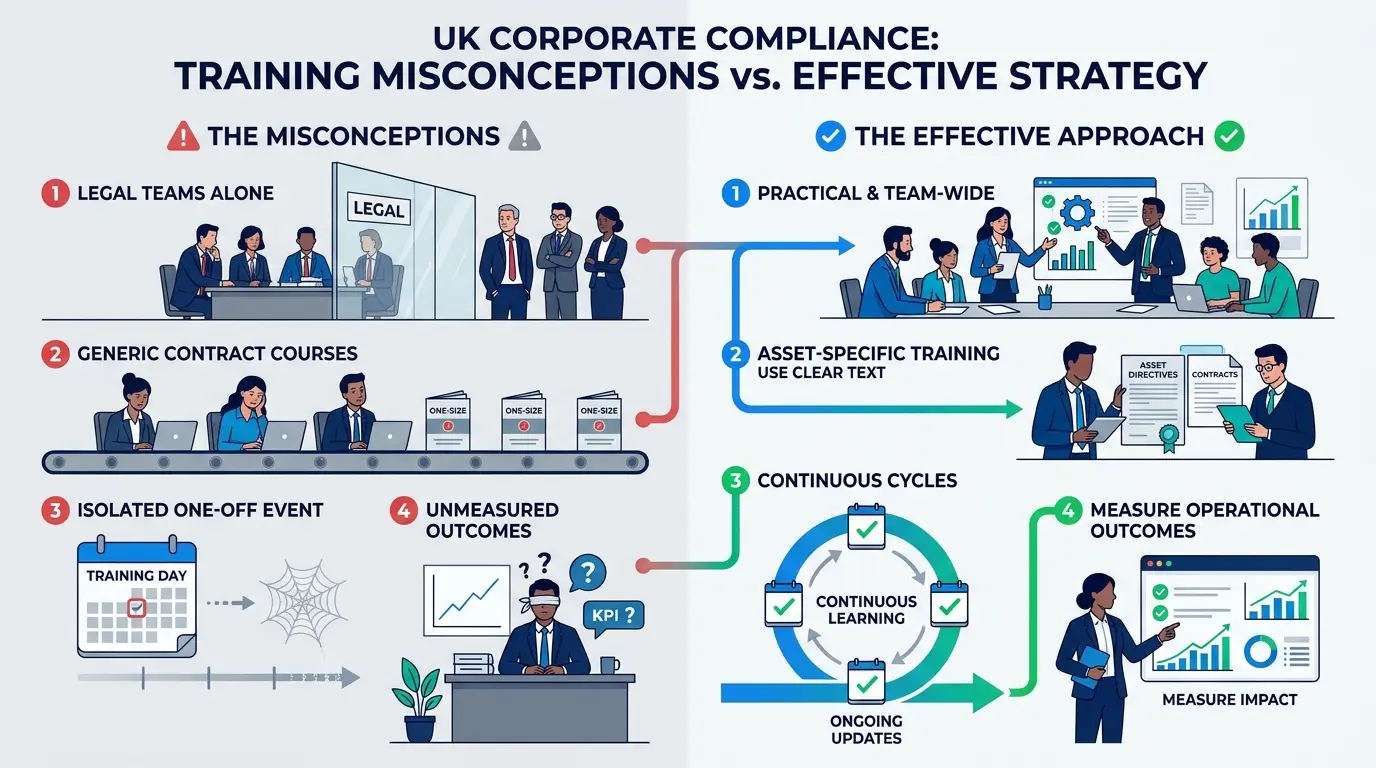
Organisations frequently encounter friction when implementing compliance learning initiatives:
The "Legal-Only" Fallacy: Assuming contract compliance is exclusively a legal department responsibility. In practice, field engineers and JV accountants make daily decisions that trigger legal liability.
Generic Training Off-the-Shelf: Utilizing generic contract administration courses that lack specialized petroleum, energy, or multi-party joint venture contexts.
One-Off Learning Events: Conducting single training sessions without ongoing refresher modules, updated case studies, or post-training practical evaluations.
Absence of Measurable KPIs: Failing to track operational performance metrics, such as audit resolution speed, budget variance improvements, or compliance reporting accuracy post-training.
To build continuous organizational capability, management teams must move beyond passive awareness toward structured operational execution. Learning professionals interested in monitoring workflows, managing joint venture reporting, and implementing rigorous oversight frameworks should explore How to Monitor and Manage Contractual Compliance Across JOAs PSCs and HGAs to establish persistent enterprise governance.
How Do Enterprise Organizations Implement Sustainable Contract Compliance Learning?
Organisations implement sustainable learning by conducting thorough skill gap analyses, customizing course content to active asset contracts, integrating digital tracking tools, and institutionalizing continuous refresher programs across global teams.
Executing a successful enterprise-wide training strategy requires a four-phase implementation roadmap:
By embedding structured professional development into corporate governance, energy enterprises transform contract compliance from a reactive legal burden into a proactive commercial advantage. Well-trained cross-functional teams consistently protect equity assets, preserve partner trust, and maintain seamless regulatory compliance across international operations.
Frequently Asked Questions
What are the main types of oil and gas petroleum contracts?
The primary types of oil and gas petroleum contracts include Joint Operating Agreements (JOAs), Production Sharing Contracts (PSCs), Concession Agreements, and Host Government Agreements (HGAs). Each contract framework defines the legal terms, risk distribution, financial split, and operational responsibilities between international operators, non-operating partners, and host governments. The Institute For Oil & Gas Training provides practical workforce instruction covering the compliance mandates and fiscal terms across all major upstream contract models.
Why is contract compliance critical in oil and gas petroleum contracts?
Strict contract compliance prevents multi-million-pound joint venture disputes, avoids non-recoverable cost designations, and protects operational licences from regulatory forfeiture. Failing to meet minimum work commitments or joint interest accounting procedures exposes operating consortia to immediate financial default and legal liability. Professional development programs delivered by the Institute For Oil & Gas Training help cross-functional teams systematically monitor and execute contractual obligations.
How do Production Sharing Contracts differ from Joint Operating Agreements?
A Production Sharing Contract (PSC) is an agreement between a host state government and an international oil company that governs cost recovery limits and profit oil splits. Conversely, a Joint Operating Agreement (JOA) regulates the private operational relationship, voting rights, and cash-call obligations among joint venture partners within a working interest consortium. The Institute For Oil & Gas Training offers specialized oil and gas petroleum contracts courses to clarify how these overlapping legal regimes interact during field operations.
What causes financial audit disputes in petroleum contract management?
Financial audit disputes typically arise from joint interest accounting errors, unauthorized expenditure overheads, unapproved budget overruns, and misallocated shared operational charges. Non-operating partners routinely audit operators to ensure expenses adhere to contractual accounting procedures and authorization thresholds. Through targeted corporate training, the Institute For Oil & Gas Training equips finance and commercial teams with practical audit defence frameworks to minimize billing exceptions.
Who needs training on oil and gas petroleum contracts within an organization?
Commercial managers, joint venture accountants, asset directors, legal counsel, and technical leads responsible for field execution require formal contract training. Because daily operational and procurement decisions directly impact legal compliance, technical professionals must understand contract management alongside legal specialists. The Institute For Oil & Gas Training delivers industry-aligned programs that align multi-disciplinary teams around unified contract governance standards.
Related training courses
Contract Compliance: Obligation Extraction & Monitoring Training Course
- Specialisation
- Oil & Gas Petroleum Contracts
- Duration
- 5 days · 13 CPD hours
Contract Compliance for Day-Rate Agreements & Claims Training Course
- Specialisation
- Oil & Gas Petroleum Contracts
- Duration
- 5 days · 15 CPD hours
Contract Compliance Across JOAs, PSCs & HGAs Training Course
- Specialisation
- Oil & Gas Petroleum Contracts
- Duration
- 5 days · 15 CPD hours
More articles

Contract Compliance Across JOAs PSCs and HGAs Training by Institute For Oil & Gas Training
Evaluate the Contract Compliance Across JOAs PSCs and HGAs Training by Institute For Oil & Gas Training for oil and gas compliance management.
Read article →
How to Monitor and Manage Contractual Compliance Across JOAs PSCs and HGAs
Learn how to evaluate monitoring frameworks, audit protocols, and governance models for JOA, PSC, and HGA contractual compliance.
Read article →
Contract Compliance for Day Rate Agreements and Claims Training by Institute For Oil & Gas Training
Master day rate contract compliance, claim controls, and rate card auditing with the Institute For Oil & Gas Training professional certification course.
Read article →