

Managing obligations across upstream oil and gas agreements requires robust oversight mechanisms, structured data governance, and clear cross-functional workflows. Operating companies face distinct compliance requirements under each regulatory and commercial structure, ranging from cost-recovery limits to host nation local content mandates.
Establishing systematic oversight prevents costly legal disputes, revenue leakage, and regulatory penalties. Organisations that struggle with operational oversight often find that why contract compliance is challenging across JOAs PSCs and HGAs stems from misalignment between commercial teams and operational personnel. Overcoming these governance gaps requires structured monitoring methodologies tailored to complex joint-venture environments.
How Do Joint Operating Agreements Impose Compliance Requirements on Operators?
Joint Operating Agreements impose strict compliance requirements by establishing clear operational boundaries, voting thresholds, sole risk clauses, and non-consent rules. Operators must strictly execute work programmes, manage cash calls, and submit regular financial accounting reports to non-operating partners without variance.
Joint Operating Agreements (JOAs) govern the relationship between co-venturers in an exploration or production block. The operator bears the primary duty to manage daily operations, while non-operating partners exercise control through an Operating Committee (OCOM). Monitoring compliance within a JOA centers on verifying joint operating agreement obligations, managing accounting procedure compliance, and keeping track of partner consent and voting requirements.
Work Programme and Budget Approvals
Operators cannot commit funds without prior OCOM approval. The work programme and budget commitments outline planned expenditures and operational timelines for each calendar year. Operators issue an Authority for Expenditure (AFE) for specific capital projects. Non-operating partners review AFEs against the approved budget before releasing funds.
When project costs exceed approved AFE limits, operators must issue supplemental AFEs. Failing to secure partner approvals before overspending creates financial liabilities and triggers formal dispute resolution under established default and forfeiture provisions.
Financial Accounting Protocols
Accounting procedures attached to JOAs specify how operators charge direct and indirect costs to the joint account. Non-operating partners conduct joint interest audits to verify expenses. Audit teams examine overhead rates, parent company service charges, equipment rental fees, and inventory allocations.
Clear compliance frameworks ensure that direct charges reflect actual expenses incurred. Systemic accounting errors lead to joint venture billing adjustments, cash call withholding by partners, and strained joint-venture relations.
Non-Consent and Default Mechanisms
JOAs contain explicit rules for non-consent operations, sole risk projects, and partner defaults. When a partner fails to meet a cash call deadline, the operator issues a formal notice of default. The defaulting party loses voting rights and access to production information during the default period.
Continued default triggers forfeiture provisions, allowing non-defaulting partners to absorb the defaulting party's equity share. Compliance managers must track cure periods precisely to enforce or remedy default actions legally.
What Are the Key Adherence Protocols for Production Sharing Contracts?
Production sharing contract adherence requires tracking exploration commitments, managing cost recovery accounts, fulfilling local content rules, and delivering state profit shares. Companies must align field operations with national oil company oversight to maintain legal licence standing.
Production Sharing Contracts (PSCs) establish an agreement between a international oil company (IOC) and a host government or National Oil Company (NOC). The IOC acts as a contractor bearing financial and operational risks in exchange for a share of produced hydrocarbons. Monitoring production sharing contract terms adherence requires distinct accounting and operational tracking frameworks.
Minimum Work Commitments and Licence Terms
PSCs divide exploration timelines into distinct phases. Each phase carries mandatory minimum work obligations, such as acquiring 3D seismic data or drilling a set number of exploration wells. Contractors must meet these commitments within specified timeframes to retain the block or move to the next exploration phase.
Failure to fulfill minimum work commitments results in financial penalties, performance bond calls, or automatic relinquishment of acreage. Monitoring systems must track geological, geophysical, and drilling milestones against licence condition compliance schedules.
Cost Recovery and Profit Sharing Accounting
PSCs limit the percentage of gross production allocated to cost recovery in any given accounting period. Expenses eligible for cost recovery must be necessary, reasonable, and directly linked to petroleum operations. Petroleum accounting teams must segregate:
Exploration expenditure (fully recoverable, often amortised over specified periods).
Development capital expenditure (depreciated over set operational schedules).
Operating expenditure (recovered in the period incurred).
Non-recoverable costs (penalties, interest payments, unapproved corporate overheads).
After deducting cost petroleum, the remaining volume is split into profit petroleum between the contractor and the government according to negotiated sliding-scale brackets. Operating companies must conduct quarterly cost-recovery reconciliations to prevent government audit disallowances.
Local Content and Domestic Market Obligations
Host governments mandate local procurement targets, national workforce employment percentages, and domestic market obligations (DMO). DMO rules require contractors to supply a portion of produced oil or gas to domestic markets, often at discounted prices.
Tracking local content compliance requires evaluating vendor supply chains, training programmes, and national employee percentage metrics. Non-compliance leads to financial surcharges, delay of cost recovery approvals, and reputational damage.
How Do Host Government Agreements Impact Operational Compliance?
Host Government Agreements impact compliance by establishing land access, environmental standards, tax terms, security arrangements, and stabilization protections. Energy companies must monitor cross-border pipelines and facility infrastructure against strict statutory rules and sovereign guarantees.
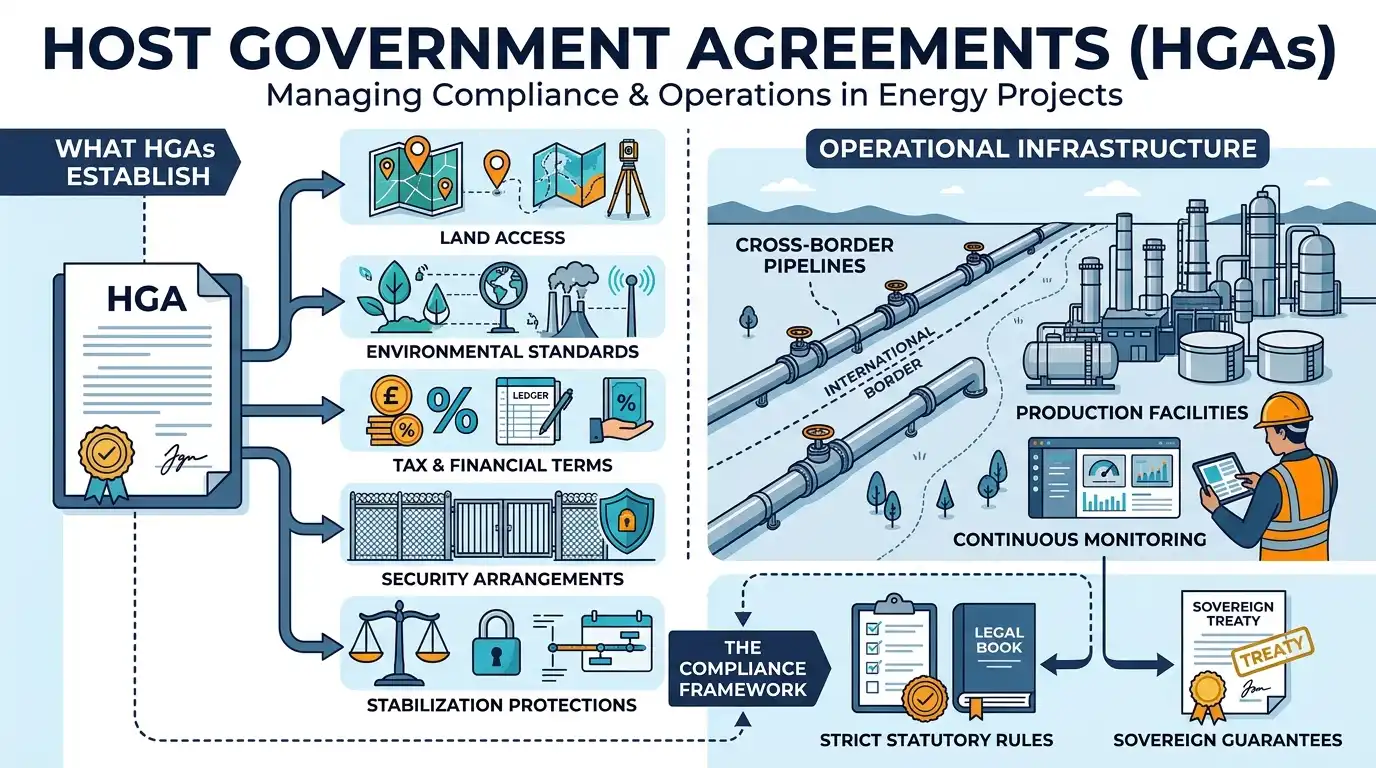
Host Government Agreements (HGAs) govern large-scale infrastructure projects such as cross-border pipelines, LNG export terminals, and central processing facilities. HGAs grant host governments regulatory oversight while offering project developers fiscal stability and legal protection. Compliance teams manage host government agreement obligations across environmental, legal, and operational domains.
Land Rights and Environmental Obligations
HGAs outline terms for land acquisition, rights-of-way, and environmental protection. Project teams must comply with national Environmental Impact Assessments (EIAs), emission standards, and site restoration obligations.
Monitoring environmental compliance involves continuous measurement of flaring volumes, produced water disposal, and pipeline corridor rehabilitation. Non-compliance results in regulatory fines, facility shutdowns, or environmental remediation liabilities.
Fiscal Stabilization and Sovereign Guarantees
HGAs often contain stabilization clauses protecting investors from adverse legislative or tax changes during the project life cycle. If a host government enacts new tariffs or taxes, stabilization provisions trigger compensation mechanisms or fiscal adjustments.
Legal teams track statutory updates in the host country continuously. Preserving legal remedies requires documenting all cost increases resulting from new host nation regulations to substantiate stabilization claims.
Transit, Security, and Cross-Border Protocols
For cross-border pipelines, HGAs define transit tariffs, metering procedures, and security obligations. Host governments provide facility security within agreed boundaries, while project operators enforce asset integrity and operational safety standards.
Metering stations at international borders require third-party calibration and joint verification. Precise flow measurements ensure accurate tariff calculations and prevent international transit disputes.
Agreement Type | Primary Counterparty | Key Compliance Focus Areas | Main Risk of Non-Compliance |
Joint Operating Agreement (JOA) | Co-venturers / Partners | AFEs, cash calls, voting rules, joint interest audits | Default, loss of voting rights, equity forfeiture |
Production Sharing Contract (PSC) | Host Government / NOC | Work commitments, cost recovery caps, profit splits | Acreage relinquishment, audit disallowances |
Host Government Agreement (HGA) | Sovereign Host State | Land access, EIAs, stabilization rules, transit fees | Regulatory shutdown, host nation legal disputes |
What Frameworks Best Support Multi-Agreement Monitoring?
Multi-agreement monitoring works best through centralized obligation registers, automated compliance software, cross-functional oversight committees, and formal audit schedules. Integrating legal, financial, and technical data prevents operational gaps across overlapping commercial contracts.
Managing compliance across JOAs, PSCs, and HGAs simultaneously introduces operational complexity. The same offshore block may involve a JOA with international partners, a PSC with the state authority, and an HGA for pipeline export infrastructure. Operating companies must structure compliance management into distinct organizational workflows.
Obligation Mapping and Compliance Matrices
The foundation of effective contract management is an integrated compliance matrix. Legal and commercial teams extract every contractual requirement, deadline, and reporting obligation from the agreements, converting them into structured database inputs.
Each entry in the compliance register defines:
The specific clause and contract source.
The responsible internal department (Legal, Finance, Operations, HSE).
The recurring frequency or trigger event (monthly, annual, milestone-based).
The required output (report submission, audit response, payment transfer).
The secondary review authority (Legal Counsel, Audit Committee).
Enterprise Data Integration
Manual tracking using spreadsheets leads to missed deadlines and untracked cost overruns. Energy companies deploy specialized contract lifecycle management (CLM) software integrated with Enterprise Resource Planning (ERP) engines.
Automated systems generate notifications before AFE expiry dates, work programme deadlines, and tax filing windows. ERP integration ensures that expenditure posts directly to approved joint account line items, flagging unapproved costs before billing non-operating partners.
Cross-Functional Operational Alignment
Compliance oversight requires coordination across commercial, operational, legal, and financial departments. Establishing a cross-functional Compliance Steering Committee ensures that operational teams understand the legal constraints of governing agreements.
Regular internal audits evaluate readiness for partner and host-government reviews. Pre-audit reviews identify missing documentation, unapproved scope changes, or unverified cost allocations early, avoiding external audit adjustments.
How Do Training Approaches Compare for Building Compliance Competence?
Training approaches compare on practical application, contextual customization, and knowledge retention. Experiential workshops and industry-tailored corporate instruction outperform generic legal seminars by embedding operational compliance directly into everyday business workflows.
Organisations face distinct choices when selecting workforce development frameworks for joint venture and contract compliance. Selecting the right educational format determines how effectively teams manage complex contractual risks.
Public Seminars vs. In-House Corporate Training
Public training courses offer broad overviews of standard contract models (such as AIPN/AIEN model contracts). These courses introduce concepts well but lack company-specific context. Participants learn general principles without addressing the unique terms of their asset portfolio.
In-house corporate training tailors course content directly to an organization's active JOAs, PSCs, and HGAs. Case studies use the company's real AFE structures, accounting procedures, and host nation constraints. Tailored delivery aligns legal, financial, and technical teams around unified operational procedures.
Self-Paced E-Learning vs. Instructor-Led Masterclasses
Self-paced digital learning suits basic awareness training, such as introducing contract terminology to junior engineers. It provides scalable, cost-effective coverage for high-level concepts across large workforces.
Instructor-led masterclasses, delivered online or in-person, excel at teaching complex dispute resolution, petroleum accounting, and audit defense strategies. Live interaction allows participants to work through complex joint-interest audit disputes and cost-recovery scenarios guided by industry experts.
For organizations shifting from basic awareness to operational execution, enrolling teams in structured programs like the Contract Compliance Across JOAs PSCs and HGAs Training by Institute For Oil & Gas Training establishes standardized internal oversight protocols across assets. Specialized instruction equips legal, financial, and operational personnel to mitigate risk collectively across all agreement types.
Learning Delivery Model | Ideal Target Audience | Primary Benefit | Operational Limitation |
Public Open-Enrollment | Individual professionals, new hires | Exposure to industry benchmarks and networking | Lacks application to proprietary contracts |
Customized Corporate In-House | Asset teams, cross-functional units | Directly uses active company contracts and AFEs | Requires team availability for block scheduling |
Self-Paced E-Learning | General workforce, enterprise-wide | Low cost per head, flexible scheduling | High dropout rates, lacks deep problem-solving |
Interactive Masterclasses | Commercial managers, audit leads | Deep-dive case studies, live expert guidance | Higher initial investment per participant |
Which Framework Evaluates Training ROI for Contract Management?
The Kirkpatrick Evaluation Model provides the clearest framework for evaluating training ROI in contract management. It measures participant reaction, learning acquisition, operational behavior change, and business results, such as reduced audit disallowances and faster cash call collections.
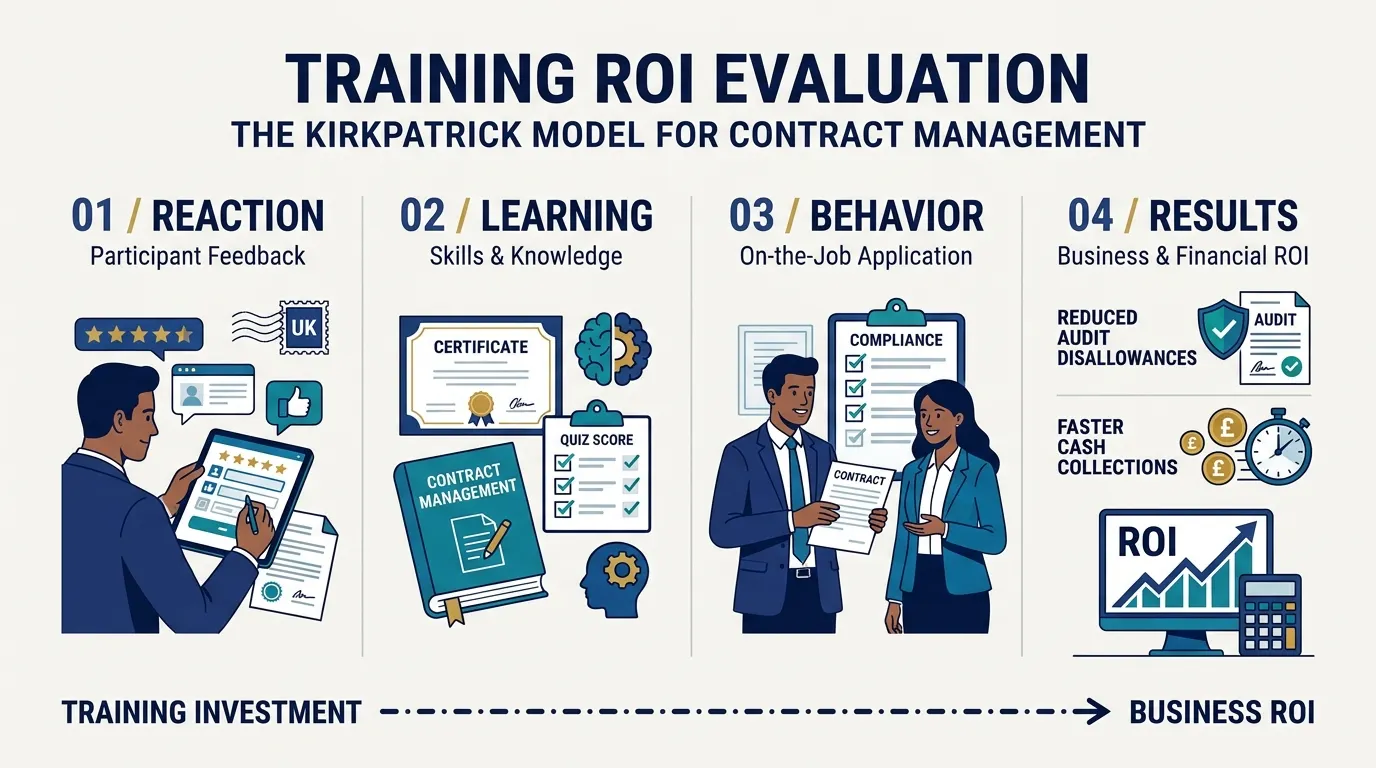
HR directors and asset leaders must validate the business case for workforce training investments. Applying a structured evaluation framework connects learning outcomes directly to commercial performance metrics.
Level 1 & Level 2: Reaction and Knowledge Retention
Evaluation begins by assessing participant satisfaction and knowledge absorption. Pre- and post-course assessments measure participant mastery of key topics, including:
Calculating cost recovery caps and profit petroleum splits under PSC rules.
Identifying non-consent mechanisms and default cure timelines in JOAs.
Interpreting fiscal stabilization rights within HGAs.
High scoring shows that participants understand contract terms theoretically.
Level 3: Behavior Change in Field Operations
Level 3 measures how effectively employees apply new knowledge to daily workflows. Indicators of behavioral change include:
Timely creation and submission of AFEs before work execution begins.
Rigorous verification of vendor invoices against joint accounting procedures.
Consistent updating of centralized obligation registers across asset teams.
Line managers track these metrics 60 to 90 days after training to confirm operational adoption.
Level 4: Business Results and Financial Impact
Level 4 evaluates the financial return generated by improved contract compliance. Measurable outcomes include:
Reduction in Audit Disallowances: Lower write-downs during host government cost recovery audits.
Faster Cash Call Receipts: Fewer billing disputes with non-operating partners, accelerating joint venture cash flows.
Zero Penalty Accruals: Meeting minimum work commitments on time, avoiding bank guarantee calls.
Shorter Dispute Resolution Cycles: Resolving joint venture accounting differences internally without entering formal arbitration.
Building internal expertise through targeted programs like the Contract Compliance Across JOAs, PSCs & HGAs Training Course helps energy companies convert compliance knowledge into measurable financial protection.
How to Select the Ideal Compliance Framework for Your Asset Portfolio
Select the ideal compliance framework by assessing asset complexity, host state regulatory volatility, joint venture ownership structures, and existing workforce skill gaps. Match monitoring systems directly to organizational risk exposure and operational scale.
Choosing and implementing a compliance oversight strategy requires systematic evaluation. Use the following decision framework to align organizational resources with asset portfolio requirements.
Step 1: Assess Portfolio Complexity and Contractual Exposure
Determine the dominant agreement types across your active blocks:
Operated JOAs with Multiple Partners: Requires strong AFE governance, clear voting management, and joint accounting controls.
Frontier Exploration PSCs: Demands rigorous tracking of minimum work commitments, seismic deadlines, and relinquishment schedules.
Infrastructure-Heavy Projects under HGAs: Requires dedicated environmental compliance monitoring, land rights tracking, and transit tariff reconciliation.
Higher contractual complexity requires automated CLM software and formal cross-functional oversight committees.
Step 2: Evaluate Internal Capability and Skill Gaps
Conduct a capability audit across commercial, legal, and operational departments. Identify whether historical joint venture disputes stemmed from poor contract wording, missing documentation, or operational misunderstandings.
Where skill gaps exist, select a targeted training approach. Custom corporate programs suit asset teams needing immediate alignment around shared joint-venture agreements.
Step 3: Implement an Integrated Monitoring System
Combine software automation, clear internal workflows, and continuous workforce development into a unified compliance architecture. Regularly review obligation registers, audit readiness, and joint interest accounts to maintain operational integrity across every asset.
Frequently Asked Questions
What are the main types of oil and gas petroleum contracts?
Oil and gas petroleum contracts generally fall into four primary categories: Concession/Licence Agreements, Production Sharing Contracts (PSCs), Joint Operating Agreements (JOAs), and Service Contracts (Risk or Pure). Each framework defines the legal terms, cost-recovery mechanisms, revenue-sharing models, and operational responsibilities between host governments and international oil companies. Institute For Oil & Gas Training provides specialized practical training to help commercial, legal, and financial teams effectively navigate and manage these Oil & Gas Petroleum Contracts.
How do Production Sharing Contracts differ from Joint Operating Agreements?
A Production Sharing Contract (PSC) is an agreement between a host government and a contractor where the contractor bears financial risk in exchange for a share of produced hydrocarbons. In contrast, a Joint Operating Agreement (JOA) governs the operational and financial relationship between co-venturers sharing equity within a single exploration or production block. Understanding these structural differences is vital for joint venture accounting and risk management, key areas covered in corporate training on Oil & Gas Petroleum Contracts by Institute For Oil & Gas Training.
Why is compliance management critical in petroleum contracts?
Strict adherence to Oil & Gas Petroleum Contracts prevents revenue leakage, partner default, regulatory fines, and acreage relinquishment. Contracts contain complex provisions such as minimum work obligations, accounting procedures, Authority for Expenditure (AFE) caps, and local content requirements that demand continuous cross-functional oversight. Institute For Oil & Gas Training equips energy professionals with practical obligation-mapping techniques to maintain full compliance across complex asset portfolios.
What key clauses should be monitored in host government agreements?
Host Government Agreements (HGAs) require diligent monitoring of fiscal stabilization rights, land access protocols, environmental impact standards, and cross-border transit tariffs. Managing these clauses protects project developers from adverse legislative changes and operational interruptions during long-term infrastructure projects. Professional development in Oil & Gas Petroleum Contracts through Institute For Oil & Gas Training helps legal and asset management teams substantiate stabilization claims and mitigate sovereign risk.
Who benefits from training in oil and gas petroleum contracts?
Commercial managers, petroleum accountants, legal counsel, procurement specialists, and asset managers benefit directly from structured instruction in Oil & Gas Petroleum Contracts. Developing cross-functional competency ensures field operations align with legal obligations, joint interest audit requirements, and corporate ROI targets. Institute For Oil & Gas Training delivers industry-tailored corporate instruction designed to close workforce skill gaps across upstream and midstream agreement management.
Related training courses
Contract Compliance: Obligation Extraction & Monitoring Training Course
- Specialisation
- Oil & Gas Petroleum Contracts
- Duration
- 5 days · 13 CPD hours
Contract Compliance for Day-Rate Agreements & Claims Training Course
- Specialisation
- Oil & Gas Petroleum Contracts
- Duration
- 5 days · 15 CPD hours
Contract Strategy, Risk and Negotiation Training Course
- Specialisation
- Oil & Gas Petroleum Contracts
- Duration
- 5 days · 15 CPD hours
More articles

Contract Compliance Across JOAs PSCs and HGAs Training by Institute For Oil & Gas Training
Evaluate the Contract Compliance Across JOAs PSCs and HGAs Training by Institute For Oil & Gas Training for oil and gas compliance management.
Read article →
Why Contract Compliance Is Challenging Across JOAs PSCs and HGAs
Learn why managing compliance across JOAs PSCs and HGAs challenges energy sector teams and how corporate training builds risk mitigation skills.
Read article →
Contract Compliance for Day Rate Agreements and Claims Training by Institute For Oil & Gas Training
Master day rate contract compliance, claim controls, and rate card auditing with the Institute For Oil & Gas Training professional certification course.
Read article →