

Managing offshore and onshore oil and gas operations requires strict commercial governance to prevent budget overruns and operational delays. Evaluating day rate contract compliance involves systematic auditing of contractor logs, rate cards, and operational scope to ensure every invoice reflects actual field activity and agreed contractual terms.
Establishing robust verification processes ensures organisations mitigate financial leakage before processing payments. Operational teams must understand why contract compliance matters in day rate agreements and claims management to protect project margins, maintain contractor accountability, and build an airtight foundation for dispute resolution across complex energy assets.
What Is the Framework for Evaluating Day Rate Contract Compliance?
Evaluating day rate contract compliance requires a structured four-stage audit framework: scope verification, time and log reconciliation, rate card validation, and variation order alignment. This systematic review identifies billing discrepancies early, ensures contractual adherence, and prevents improper operator payouts.
Contractual evaluation begins by examining contractor performance obligations against the approved scope of work. Operators must audit daily progress reports (DPRs), vessel logbooks, and equipment utilization sheets to confirm that billed hours reflect active operations.
The audit team cross-references field logs with agreed rate cards. This step ensures that standby rates apply only during contractual standby conditions, preventing contractors from applying full operating day rates during unauthorized downtime.
The third stage reconciles remeasurement and reimbursable terms. Commercial teams verify third-party equipment rentals, fuel consumption figures, and consumable pass-through costs against original receipts and baseline markup caps.
Finally, evaluators audit change directives. Unapproved work items billed under general day rates are isolated immediately. The evaluation framework establishes clear evidentiary standards that contractors must satisfy before invoice sign-off.
Rate Card and Standby Rate Verification
Rate card compliance demands precise classification of operational states. Contracts specify distinct pricing tiers for active operations, standby waiting on weather (WOW), client-conditioned standby, and repair downtime.
Evaluators check daily timesheets against operational telemetry to verify proper day rate and standby rate application. Billed standby hours caused by contractor equipment failure are reclassified as zero-rate maintenance time.
Scope of Work and Reimbursable Auditing
Verifying scope of work adherence prevents scope crawl and improper cost allocation. Commercial auditors assess whether billed equipment and personnel fall strictly within the base contract provisions.
Reimbursable items require line-by-line verification against third-party receipts and procurement agreements. Unapproved administrative markups or undocumented freight charges must be flagged and deducted during pre-payment audits.
How Do Commercial Teams Manage Claims and Variation Orders?
Managing claims and variation orders requires strict change control procedures, contemporaneous record-keeping, and rapid entitlement analysis. Commercial managers evaluate contractor notices against baseline scope, contractual time bars, and causation proof to mitigate financial exposure and prevent escalation.
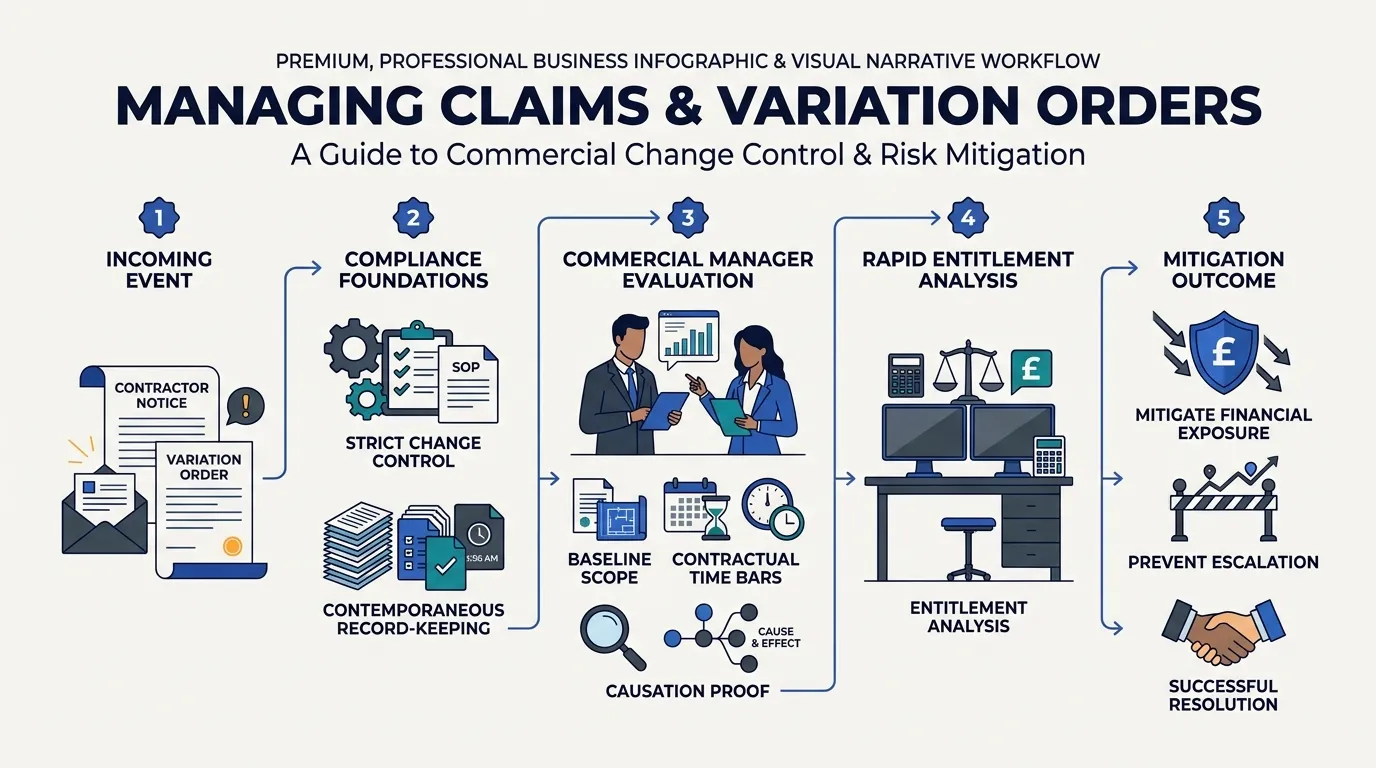
Effective variation and change order control relies on real-time field documentation. When a contractor submits a claim for additional time or compensation, the commercial team reviews the original contract baseline to determine entitlement.
Claims evaluation hinges on verifying causation and compliance with notice requirements. If a contractor fails to issue a notice of intent to claim within the specified timeframe, the claim is legally barred.
Commercial teams perform quantum analysis on all submitted variation requests. Billed labor hours, equipment usage, and overhead claims are benchmarked against agreed schedule rates rather than cost-plus estimates.
Structured claim reviews protect project budgets from inflated back charges. Early resolution of change orders maintains transparency and prevents unresolved disputes from accumulating during project execution.
Liquidated Damages and Back Charges
Liquidated damages apply when contractors fail to meet key contractual milestones due to unexcused delays. Commercial teams calculate damages based on pre-agreed daily rates reflecting actual commercial loss.
Back charges are assessed when the operator incurs costs to rectify non-conforming work or supply services assigned to the contractor. Every back charge must be supported by detailed expense records and formal notification.
Contract Close-Out and Dispute Resolution
Contract close-out requires a complete audit of all issued change orders, interim payments, and outstanding claims. Commercial managers reconcile final accounts only after securing formal release waivers from the contractor.
Unresolved claims move into structured negotiation, mediation, or arbitration. Maintaining complete daily logs and contemporaneous records throughout execution ensures the operator’s legal position remains defensible.
How Do Different Contract Compliance Training Approaches Compare?
Comparing contract compliance training approaches involves assessing theoretical instruction, case-study workshops, and practical simulator-based programs against execution efficacy. Comprehensive practical training yields higher retention, faster claim resolution, and superior commercial audit outcomes for energy sector professionals.
Selecting the right training strategy depends on workforce technical readiness and operational exposure. The table below compares the four primary learning delivery models used in commercial contract governance.
Training Approach | Primary Focus | Practical Application Level | Claim Resolution Efficacy | Implementation Time |
Traditional Classroom | Contract law theory and general clauses | Low (Lecture-based) | Moderate (20-30% skill transfer) | 1 to 2 Days |
E-Learning Modules | Self-paced compliance awareness | Minimal (Multiple choice) | Low (10-15% skill transfer) | Immediate Access |
Case-Study Workshops | Historical claims analysis and drafting | High (Group exercises) | High (60-70% skill transfer) | 3 to 5 Days |
Simulated Audit Labs | Real-time DPR auditing and claim defense | Critical (Live scenarios) | Maximum (85-95% skill transfer) | 3 to 5 Days |
Traditional classroom instruction provides foundational knowledge of legal terms but lacks real-world application. Learners gain theoretical understanding but often struggle to identify rate card misapplications during live operations.
E-learning modules offer scalable compliance coverage for large workforces. However, self-paced digital courses cannot replicate the complex negotiation dynamics required during contentious contract variation meetings.
Case-study workshops bridge theory and practice by examining past offshore dispute cases. Participants analyze real contract clauses, audit sample daily logs, and construct claim rejection letters under expert guidance.
Simulated audit labs represent the most rigorous training format. Commercial personnel manage mock project files, audit actual contractor invoices, and defend variations in live scenario-driven environments.
Evaluating Training Delivery Options
HR teams must evaluate learning models based on measurable operational ROI. Off-the-shelf courses often fail to address specific day rate mechanisms used in offshore marine, drilling, and EPC projects.
Customized, industry-driven workshops yield immediate operational improvements. Teams trained on real-world energy contracts catch billing errors faster and draft airtight change orders during live project execution.
How Should Organisations Evaluate Their Contract Governance Framework?
Organisations should evaluate their contract governance framework by auditing current billing leakages, claim resolution speeds, workforce competency gaps, and commercial decision workflows. A structured evaluation matrix identifies operational vulnerabilities and directs targeted capability-building initiatives.
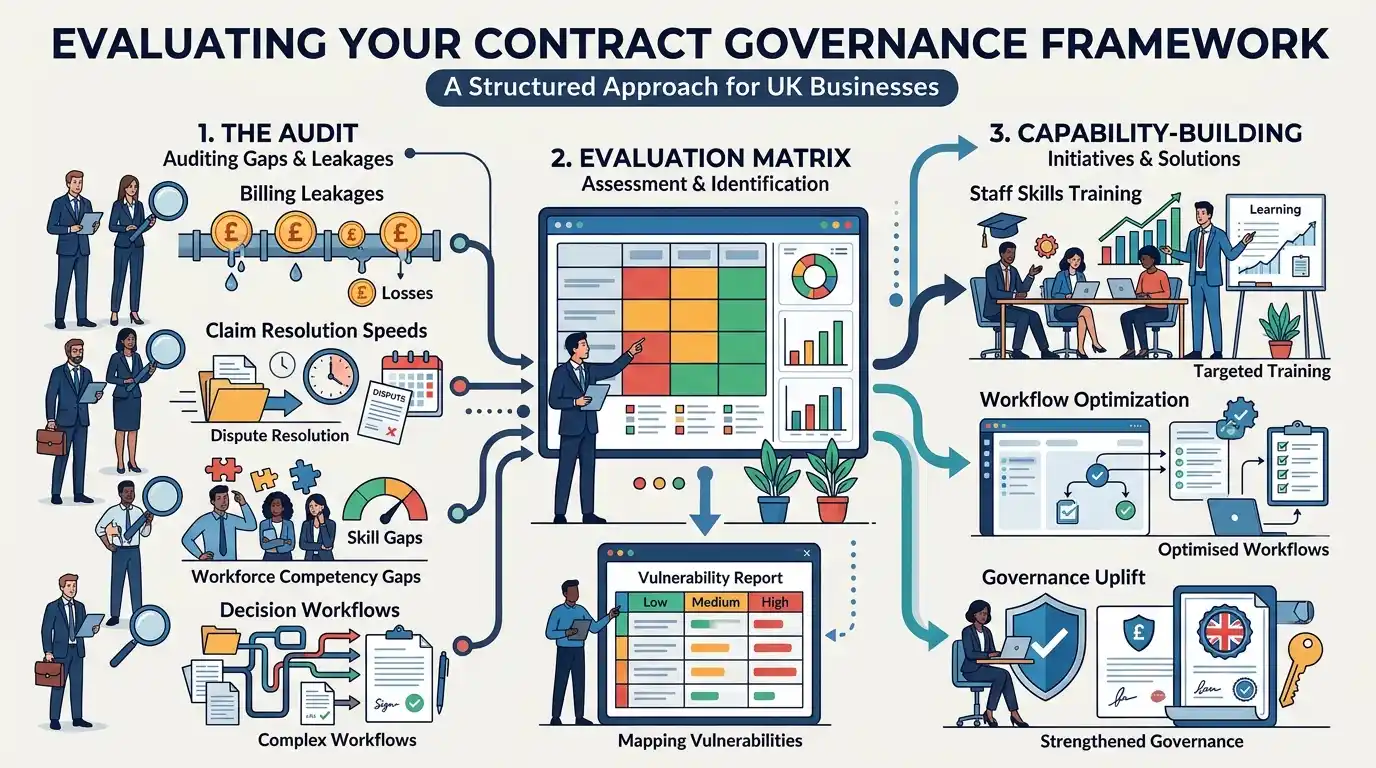
A robust evaluation framework measures both process maturity and personnel capability. HR leaders and commercial directors use diagnostic criteria to benchmark their internal contract management performance.
Governance Attribute | Low Maturity (Reactive) | Medium Maturity (Standardized) | High Maturity (Optimized) |
Verification Speed | Invoices audited post-payment; frequent overpayment. | Pre-payment manual checks against rate cards. | Automated log reconciliation with real-time DPR cross-checks. |
Variation Control | Verbal change directives; claims settled at close-out. | Formal change orders submitted within 14 days. | Real-time time-bar enforcement and quantum benchmarking. |
Claims Mitigation | High dependence on external legal counsel. | Internal commercial teams handle routine disputes. | In-house teams resolve 90%+ of claims without escalation. |
Workforce Capability | No formal day rate training; informal mentoring. | Generic contract management training. | Industry-specific [Contract Compliance for Day-Rate Agreements & Claims Training Course](Course Title) completion. |
Identifying governance gaps allows organisations to modernize their commercial workflows. Transitioning from reactive auditing to proactive day rate management prevents financial leakage across multi-year asset operations.
Professional capability development forms the cornerstone of optimized governance. Implementing targeted upskilling through Contract Compliance for Day Rate Agreements and Claims Training by Institute For Oil & Gas Training equips teams to handle complex rate card structures, control variations, and protect project margins.
Organizations with trained commercial personnel achieve faster claim resolution cycles and lower legal costs. Structured capability building transforms contract management from an administrative task into a strategic commercial asset.
Frequently Asked Questions
What are the main types of oil and gas petroleum contracts?
Oil and gas petroleum contracts generally fall into four main legal frameworks: Concession/Tax-and-Royalty Agreements, Production Sharing Contracts (PSCs), Risk Service Contracts, and Joint Operating Agreements (JOAs). Each contract type defines how exploration risks, operational responsibilities, and production revenues are divided between national oil companies (NOCs) and international oil companies (IOCs). Professional training from the Institute For Oil & Gas Training helps commercial and legal teams master the nuances of these contractual models.
What is the difference between a Concession Agreement and a Production Sharing Contract?
In a Concession Agreement, the contractor holds the mineral rights and owns the extracted oil or gas at the wellhead, paying taxes and royalties to the host government. Conversely, under a Production Sharing Contract (PSC), the host state retains resource ownership while the operating company recovers its capital expenditure through "cost oil" and splits the remaining "profit oil" according to pre-agreed ratios. Understanding these fiscal regimes is a core component of the Oil & Gas Petroleum Contracts curriculum offered by the Institute For Oil & Gas Training.
What key clauses must be included in an oil and gas Joint Operating Agreement (JOA)?
A robust Joint Operating Agreement (JOA) must include precise terms governing the operator's scope of authority, Accounting Procedures, Operating Committee voting thresholds, Cash Call default remedies, and Sole Risk or Non-Consent provisions. These clauses manage financial liabilities, cost allocation, and decision-making among joint venture partners during exploration and production operations. The Institute For Oil & Gas Training provides comprehensive guidance on drafting and negotiating these critical legal protections within Oil & Gas Petroleum Contracts.
How are fiscal regimes and revenue sharing structured in petroleum agreements?
Petroleum fiscal regimes use a combination of bonuses, royalties, cost-recovery caps, profit splits, and corporate income taxes to balance government take with investor profitability. The exact structure depends on geological risk, market prices, and national energy policy, requiring continuous financial modeling and risk assessment. Courses on Oil & Gas Petroleum Contracts at the Institute For Oil & Gas Training equip energy sector professionals to evaluate economic terms and maintain fiscal compliance throughout the asset lifecycle.
How do force majeure and stabilization clauses protect parties in energy contracts?
Stabilization clauses shield international investors from adverse legislative or tax changes by the host government during multi-decade projects, often requiring compensation or fiscal adjustments. Force majeure clauses excuse contractual non-performance when extraordinary events, such as geopolitical conflicts or major environmental disasters, disrupt operations beyond either party's control. Specialist modules from the Institute For Oil & Gas Training cover how to draft and enforce these risk-mitigation terms within international Oil & Gas Petroleum Contracts.
Related training courses
Contract Compliance for Day-Rate Agreements & Claims Training Course
- Specialisation
- Oil & Gas Petroleum Contracts
- Duration
- 5 days · 15 CPD hours
Contract Compliance Across JOAs, PSCs & HGAs Training Course
- Specialisation
- Oil & Gas Petroleum Contracts
- Duration
- 5 days · 15 CPD hours
Contract Strategy, Risk and Negotiation Training Course
- Specialisation
- Oil & Gas Petroleum Contracts
- Duration
- 5 days · 15 CPD hours
More articles

CAPEX vs OPEX Impact on Cost Recovery Training by Institute For Oil & Gas Training
Evaluate the CAPEX vs OPEX Impact on Cost Recovery Training by Institute For Oil & Gas Training. Learn modules, structure, outcomes, and enrollment details.
Read article →
How to Assess the Impact of CAPEX and OPEX Classification on Petroleum Cost Recovery
Learn how to assess CAPEX and OPEX classification in petroleum cost recovery. Evaluate audit risks, cash flow effects, and joint venture compliance.
Read article →
Why CAPEX and OPEX Classification Affects Cost Recovery in Oil and Gas
Learn how CAPEX and OPEX classification dictates cost recovery mechanisms, cash flow velocity, and regulatory compliance in upstream petroleum accounting.
Read article →