

The Contract Compliance for Day-Rate Agreements & Claims Training Course by the Institute For Oil & Gas Training resolves financial leakage, rate misapplications, and unverified contractor claims by equipping commercial managers and procurement specialists with audit-ready verification and enforcement frameworks.
Commercial operations across heavy industries, offshore drilling, marine logistics, and large-scale capital projects rely heavily on day-rate contractual structures to maintain operational flexibility. However, these financial arrangements introduce substantial exposure to cost overruns, rate card misinterpretations, and contested contractor claims. Organizations frequently suffer from financial leakage when contract management teams lack specialized auditing techniques required to verify daily timesheets, equipment logs, and operational standby conditions. The failure to enforce precise contractual boundaries during ongoing operations leads to standard billing practices escalating into multi-million-pound commercial disputes during final account reconciliations.
Unclear operational definitions surrounding standby rates, maintenance downtime, and weather delays routinely undermine financial predictability. Operational teams often approve field tickets without cross-referencing specific contract clauses, effectively waiving contractual protections and accepting unauthorized surcharges. Furthermore, inadequate variation and change order control mechanisms allow contractors to claim additional compensation for tasks already covered under the baseline operational scope. These systemic vulnerabilities stem directly from a critical skill gap: commercial personnel, quantity surveyors, and contract administrators are frequently trained in general contract law, yet lack the granular auditing techniques required for day-rate verification.
Addressing these operational vulnerabilities requires structured technical intervention and clear governance protocol. The Institute For Oil & Gas Training developed this technical training syllabus to bridge the operational gap between field-level approvals and corporate commercial governance. Participants learn how to systematically deconstruct rate cards, audit daily operational logs, establish verifiable documentation trails, and enforce compliance across every phase of contract execution. By establishing clear verification frameworks, corporate teams prevent unauthorized cost escalations before field tickets progress to final invoice processing. Understanding foundational contractual mechanisms is essential, which is why professionals often review Why Contract Compliance Matters in Day Rate Agreements and Claims Management to establish core operational alignment prior to undergoing advanced audit training.
Why is the contract compliance curriculum structured in this operational sequence?
The curriculum designed by the Institute For Oil & Gas Training follows a precise operational progression, moving from baseline contractual clause analysis through practical rate auditing to complex dispute mitigation, ensuring immediate workplace implementation and measurable audit rigor.
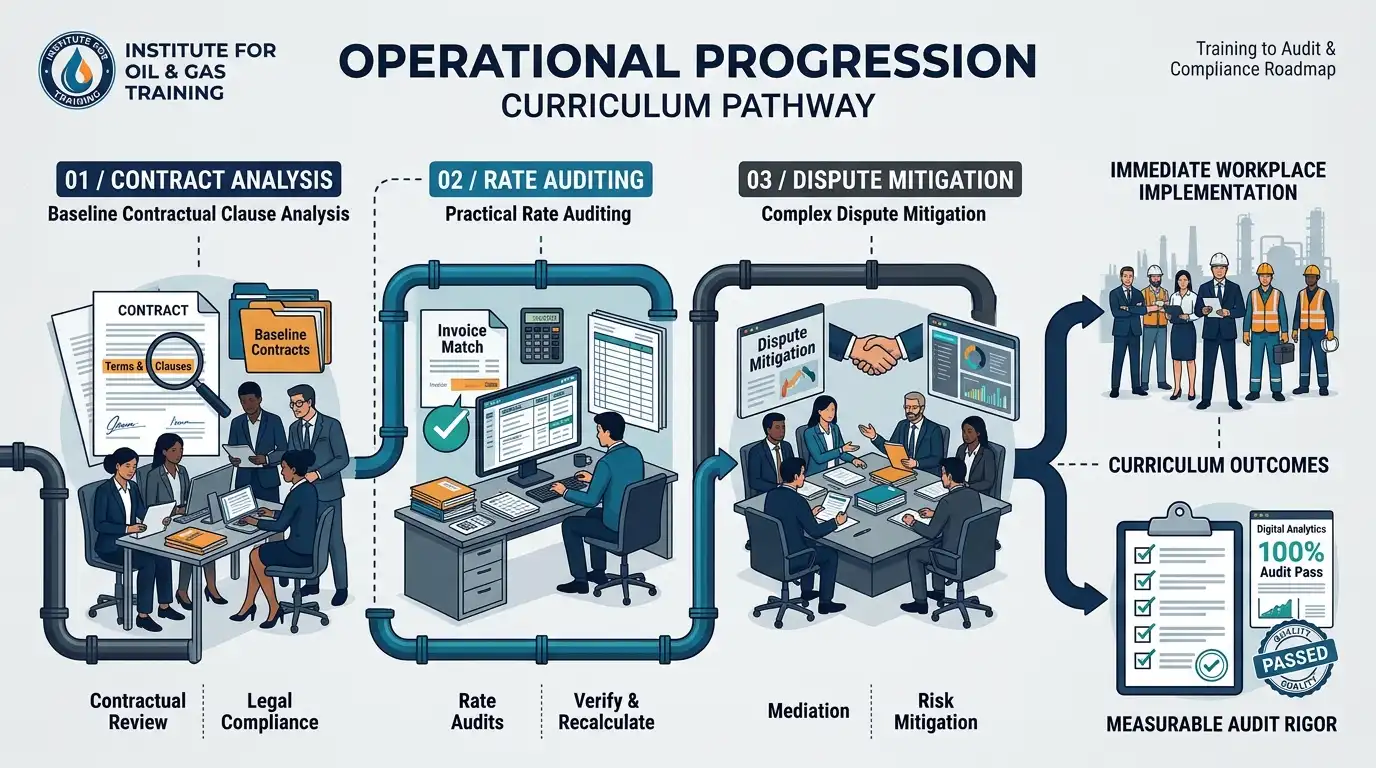
The learning architecture of this program reflects the actual lifecycle of commercial contract management. Learning begins with foundational contractual analysis because effective compliance enforcement relies entirely on the precise interpretation of scope boundaries, rate definitions, and condition precedent clauses. Without a clear structural understanding of how rate card terms interact with operational logs, commercial teams cannot defend audit adjustments or reject invalid contractor claims. The curriculum deliberately establishes precise technical definitions before introducing complex auditing workflows or financial reconciliation exercises.
The second phase of the course transitions directly into empirical rate card compliance and field ticket verification mechanics. Participants analyze how day rate and standby rate application rules must be reconciled against daily progress reports, deck logs, and equipment utilization tracking sheets. Structuring the curriculum to move directly from contractual principles to data reconciliation ensures that learners immediately apply legal interpretations to actual operational documentation. This stage eliminates ambiguity regarding when an asset transitions from an active operating rate to an unbilled maintenance status or reduced standby rate.
The final stages of the curriculum cover variation management, claim forensics, and contract close-out protocols. Once participants master daily ticket verification, they learn to handle complex commercial disruptions, including contested scope additions, back charge calculations, and liquidated damages enforcement. Moving from routine administration to complex dispute management mirrors the professional growth required for senior commercial roles. Organizations evaluating training options can review How to Evaluate Day Rate Contract Compliance and Manage Claims Effectively to assess organizational readiness for this advanced analytical curriculum. This structured progression ensures every participant exits the program fully capable of executing robust financial defenses.
What specific competencies and technical skills will participants acquire?
Participants acquire advanced capabilities in rate card auditing, field ticket reconciliation, claim forensic analysis, variation control, and contractual close-out execution through rigorous technical instruction provided by the Institute For Oil & Gas Training.
Core Technical Competencies
Rate Card & Standby Application Audit: Mastery over the precise enforcement of tiered day rates, mobilization fees, cold/hot standby rates, and maintenance deductions under varying operational states.
Scope of Work & Variation Control: Skill in identifying unauthorized scope creep, evaluating contractor change requests, and administering formal variation orders to preserve baseline budgets.
Claims Forensic Verification & Back Charges: Proficiency in analyzing contractor claim submittals, substantiating back charges for non-performance, and calculating liquidated damages strictly in accordance with contractual terms.
Reimbursable & Remeasurement Accounting: Ability to audit third-party passthrough costs, markups, and remeasureable quantities against verifiable market benchmarks and supply chain records.
Contract Close-Out & Financial Reconciliation: Capability to execute formal contract close-out audits, clear outstanding liabilities, resolve pending claims, and issue definitive commercial releases.
The primary objective of the curriculum focus is transforming theoretical contractual knowledge into concrete verification habits. Participants work directly with complex commercial scenarios, analyzing multi-layered rate schedules and ambiguous operational logs. Through structured exercises, learners master the forensic skills required to spot unauthorized rate escalations, unapproved personnel substitutions, and duplicated reimbursable expenses. This rigorous approach equips personnel to safeguard project capital across complex operating environments.
Furthermore, training emphasizes clear documentation practices that hold up under legal scrutiny and formal commercial arbitration. Participants learn to draft formal contractual correspondence, construct audit defense files, and negotiate claim settlements using objective operational data. By establishing these capabilities, commercial specialists protect their organizations from financial losses caused by administrative oversights or weak claim defenses during contract execution.
How is the training program delivered, assessed, and certified?
The Institute For Oil & Gas Training delivers this professional program through intensive instructor-led workshops, live interactive online cohorts, and customized corporate onsite sessions featuring rigorous practical assessment models.
Delivery Formats & Specifications
Delivery Format | Total Duration | Schedule Structure | Target Audience | Primary Methodology |
In-Person Intensive | 5 Business Days | 09:00 - 17:00 Daily | Senior Commercial Teams, Project Directors | Classroom lectures, group case studies, live exercises |
Live Virtual Cohort | 4 Weeks | Two 3-Hour Sessions / Week | Distributed Procurement & Audit Specialists | Interactive online modules, digital breakout rooms |
Corporate Onsite | Modular (3-5 Days) | Tailored to Shift Schedules | Enterprise HR & Commercial Operations Teams | Company-specific contract auditing & data integration |
The instructional design prioritizes direct engagement with realistic commercial data. Rather than relying on passive lecture methods, the Institute For Oil & Gas Training utilizes scenario-based simulations where participants receive un-audited operational logs, contractor daily reports, and complex rate cards. Learners must perform real-time commercial audits, identify billing errors, draft formal rejection notices, and recalculate correct invoice values within timed operational constraints.
Assessment is continuous and practical, ensuring every participant demonstrates verified skill acquisition. Learners complete practical auditing assignments following each core module, culminating in a comprehensive capstone contract audit project. During this final evaluation, participants analyze a full project contract dataset containing hidden scope overlaps, incorrect standby rate applications, and contested change orders. Certification requires demonstrating compliance verification accuracy, accurate back-charge calculations, and clear contractual reporting.
Successful graduates receive formal professional certification issued by the Institute For Oil & Gas Training, validating their technical proficiency in commercial contract auditing, rate card compliance, and claims management. This credential serves corporate employers as verified proof that certified personnel possess the skills required to audit high-value day-rate agreements effectively.
What measurable organizational impact and performance outcomes does this course deliver?
Enterprise adoption of this compliance training by the Institute For Oil & Gas Training yields immediate cost recovery, reduces unverified claim payouts by up to 35%, and establishes standardized commercial control across operations.
Organizations that send commercial personnel through this program achieve measurable financial protection and operational efficiency gains. Procurement departments and contract administration teams report immediate reductions in leakage caused by erroneous day rate and standby rate application practices. By enforcing standard verification protocols, corporate teams capture unauthorized billing entries prior to payment authorization, directly preserving project operating margins.
Key Organizational Outcomes
Immediate Financial Leakage Elimination: Standardized verification procedures prevent incorrect rate applications, unearned standby claims, and duplicated reimbursable charges.
Streamlined Invoice Approval Workflows: Field supervisors and contract administrators adopt unified auditing standards, reducing field ticket processing times while improving verification accuracy.
Defensible Claims Management: Commercial teams gain the legal and analytical capability to reject unsubstantiated contractor claims and successfully defend corporate positions during dispute negotiations.
Enhanced Variation Governance: Rigorous change order control protocols ensure contractors perform baseline tasks without claiming unauthorized additional compensation.
Accelerated Contract Close-Out: Systematic documentation throughout the contract lifecycle prevents final account impasses, allowing prompt commercial close-out and liability release.
Human Resource leaders and department managers utilize this structured training to build clear competency benchmarks across commercial management pipelines. Standardizing contract auditing capabilities across cross-functional teams—including engineering, finance, supply chain, and legal affairs—ensures corporate compliance policies are strictly enforced at every operational touchpoint. The financial return on investment is frequently realized within the first post-training contract audit cycle through identified cost recoveries and rejected unauthorized claims.
How does the enrollment process work and what are the entry requirements?
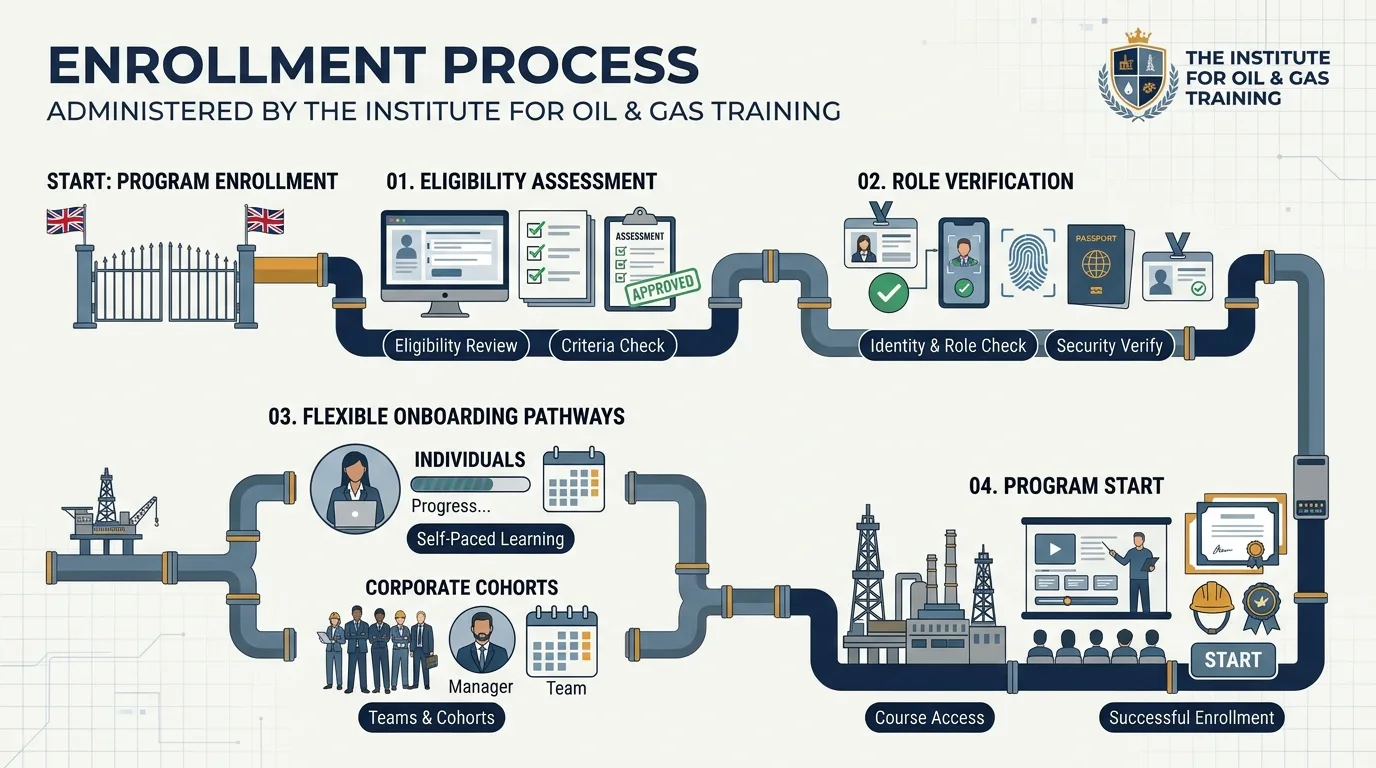
Enrollment in the program administered by the Institute For Oil & Gas Training involves a structured eligibility assessment, role verification, and flexible corporate onboarding pathways tailored for individuals and corporate cohorts.
Entry Requirements & Candidate Profile
The program is designed for mid-to-senior commercial professionals involved in contract administration, procurement, quantity surveying, cost engineering, and legal risk management. Applicants should possess at least two years of professional experience managing commercial agreements or operating within industrial project environments. While prior exposure to day-rate structures is beneficial, the course systematically builds technical auditing skills from established baseline legal concepts.
Step-by-Step Enrollment Process
Application Submission: Candidates or corporate HR representatives submit professional profiles detailing current job responsibilities and operational focus areas.
Prerequisite Verification: The admissions committee reviews candidate profiles to ensure baseline commercial experience aligns with course technical complexity.
Delivery Format Selection: Applicants choose between open-enrollment public workshops, live virtual learning cohorts, or dedicated corporate onsite programs.
Pre-Course Diagnostic: Admitted participants complete a self-assessment to identify specific skill gaps across rate card compliance, claims management, and close-out procedures.
Official Onboarding: Confirmed participants receive preparatory reading materials, pre-course case files, and access to learning portal resources prior to initial instruction.
Corporate HR departments and training directors requesting group enrollments receive customized scheduling options, dedicated progress tracking, and post-training impact assessments. Enterprise cohorts can also incorporate company-specific contract templates, rate schedules, and past auditing case studies directly into practical learning modules. To secure seat allocations for upcoming cohorts or register corporate teams, professionals should apply for course access through the official registration portal.
Frequently Asked Questions
What are the main types of oil and gas petroleum contracts?
The primary structures include concessions or royalty systems, Production Sharing Contracts (PSCs), Joint Operating Agreements (JOAs), and Service Contracts. The Institute For Oil & Gas Training provides technical instruction on how these frameworks allocate exploration risk, operational control, revenue splits, and tax liabilities between host governments and international oil companies.
What is the difference between a Production Sharing Contract and a Concession Agreement?
In a concession agreement, the operating company owns the mineral rights and production volume, paying royalties and taxes directly to the host state. Conversely, under a Production Sharing Contract (PSC), the state retains resource ownership while the contractor recovers costs and receives a designated share of profit oil or gas, a core operational distinction analyzed within Oil & Gas Petroleum Contracts training.
How do fiscal regimes impact oil and gas contract negotiations?
Fiscal regimes dictate royalty percentages, tax obligations, cost recovery caps, and profit-sharing thresholds that determine commercial project viability. Training delivered by the Institute For Oil & Gas Training prepares commercial managers to model these revenue mechanics, assess economic rent, and evaluate risk-return profiles across varying regulatory environments.
What key clauses should be audited in petroleum contract compliance?
Essential compliance focus areas include cost recovery audit provisions, work program commitments, local content mandates, decommissioning obligations, and force majeure terms. Rigorous auditing of Oil & Gas Petroleum Contracts ensures operators avoid unexpected financial exposure, maintain regulatory compliance, and properly substantiate operational expenditure.
Who should undertake training in Oil & Gas Petroleum Contracts?
This training is designed for commercial directors, legal advisors, procurement specialists, petroleum accountants, and government energy officials. Programs led by the Institute For Oil & Gas Training equip these cross-functional teams with the analytical skills required to draft, negotiate, and execute complex petroleum agreements effectively.
Related training courses
Contract Compliance for Day-Rate Agreements & Claims Training Course
- Specialisation
- Oil & Gas Petroleum Contracts
- Duration
- 5 days · 15 CPD hours
Contract Compliance Across JOAs, PSCs & HGAs Training Course
- Specialisation
- Oil & Gas Petroleum Contracts
- Duration
- 5 days · 15 CPD hours
Contract Strategy, Risk and Negotiation Training Course
- Specialisation
- Oil & Gas Petroleum Contracts
- Duration
- 5 days · 15 CPD hours
More articles

Contract Compliance Across JOAs PSCs and HGAs Training by Institute For Oil & Gas Training
Evaluate the Contract Compliance Across JOAs PSCs and HGAs Training by Institute For Oil & Gas Training for oil and gas compliance management.
Read article →
How to Monitor and Manage Contractual Compliance Across JOAs PSCs and HGAs
Learn how to evaluate monitoring frameworks, audit protocols, and governance models for JOA, PSC, and HGA contractual compliance.
Read article →
Why Contract Compliance Is Challenging Across JOAs PSCs and HGAs
Learn why managing compliance across JOAs PSCs and HGAs challenges energy sector teams and how corporate training builds risk mitigation skills.
Read article →