
CAPEX and OPEX classification in petroleum accounting is the legal and financial process of categorising exploration, development, and operational expenditures under a Production Sharing Contract (PSC) or Joint Operating Agreement (JOA) to determine immediate versus deferred cost recovery entitlement.
Upstream oil and gas ventures operate under complex contractual frameworks like Production Sharing Agreements (PSAs) and Joint Operating Agreements (JOAs). Capital Expenditure (CAPEX) represents long-term investments in physical infrastructure, including drilling rigs, production platforms, and processing facilities. Operational Expenditure (OPEX) covers day-to-day running costs, such as field maintenance, well servicing, and administrative overheads.
Organizations must categorise these expenses correctly because the classification dictates the speed and volume of revenue allocation. In cost recovery mechanisms, OPEX is typically recoverable in the accounting period in which the expense occurs. CAPEX is subject to depreciation schedules or straight-line amortisation across specified recovery periods of 5 to 10 years.
Misclassification disrupts cash flow forecasting, alters net present value (NPV) calculations, and triggers severe compliance penalties during joint venture audits. Workforce development programs in joint venture accounting ensure finance, legal, and engineering personnel apply uniform accounting standards across all operational assets.
How Does Expenditure Classification Drive Financial Performance in Corporate Environments?
Expenditure classification drives financial performance by controlling the rate of capital clearing through the cost ceiling, directly impacting immediate liquidity, tax liability calculations, partner profit split timing, and overall venture internal rate of return (IRR).
Joint ventures in capital-intensive sectors like offshore drilling, natural gas processing, and pipeline construction rely on precise revenue sharing calculations. The cost recovery pool is capped by a contractual cost ceiling, often set between 40% and 70% of gross annual production.
When an organisation expenses an item as OPEX, it clears the cost pool immediately, reducing short-term taxable income and returning cash directly to the operator. Classifying an item as CAPEX defers cost recovery over multi-year horizons, tying up capital and exposing the venture to inflation risks and currency fluctuations.
Incorrect allocations lead to host government audit exceptions and joint venture disputes. Unresolved misclassifications force organisations to issue cash call adjustments, write down assets, or enter formal arbitration. Corporate workforce training standardises how cross-functional teams evaluate project costs, preventing multi-million-pound line-item reclassifications during national oil company (NOC) audits.
Why Do Non-Finance Teams Require Structured Training on Cost Recovery Mechanisms?
Non-finance teams require structured training on cost recovery mechanisms because operational engineers, procurement managers, and site directors initiate expenditure commitments that legally establish the accounting classification, joint venture chargeability, and audit defensibility of project costs.
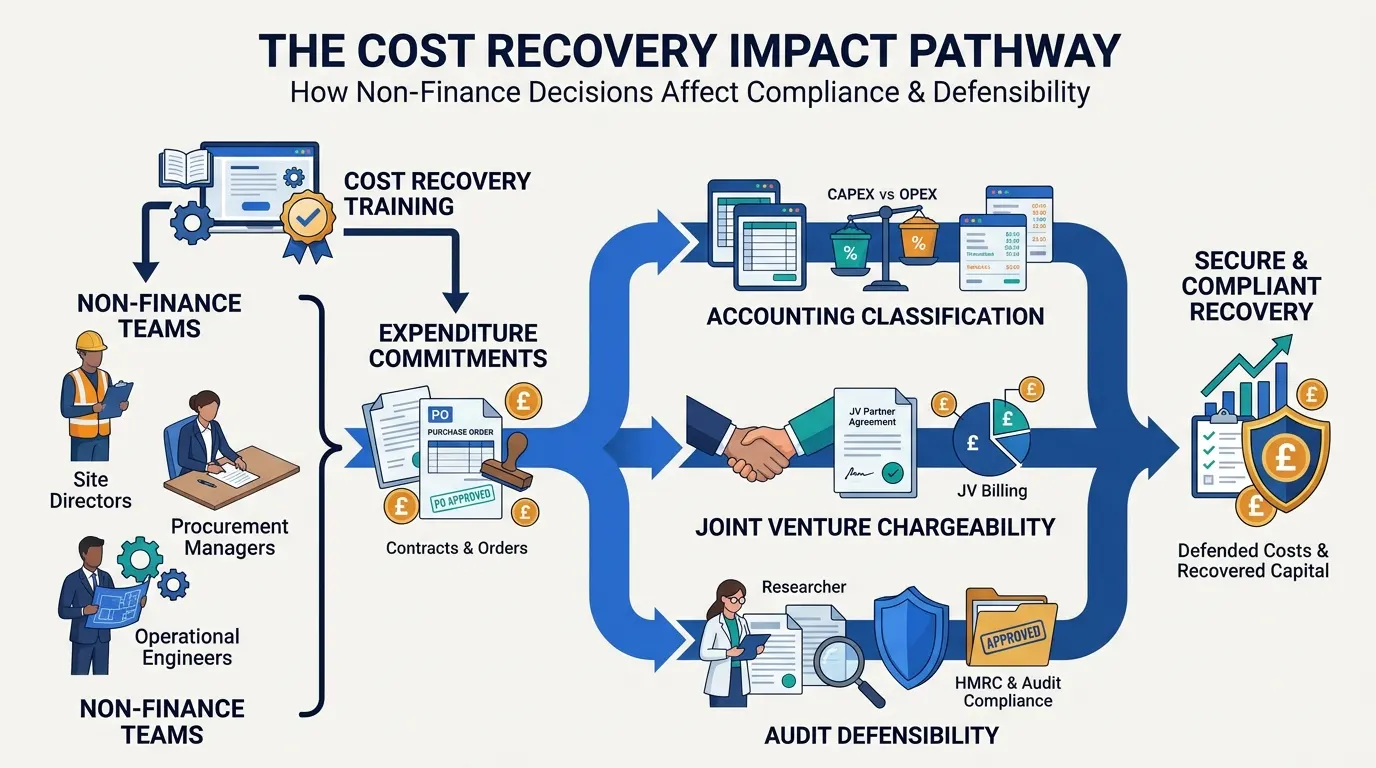
Engineering and operations personnel frequently execute Work Format Authorisations for Expenditure (AFE) without evaluating the downstream financial implications. When field managers log capital asset modifications as routine maintenance, the finance department faces irreconcilable differences between physical asset registers and cost recovery ledgers.
Organizations eliminate these operational friction points by deploying structured learning programs across cross-functional departments.
1. Procurement and Supply Chain Management
Procurement teams negotiate vendor contracts for equipment rentals, logistics, and heavy machinery. Training ensures buyers structure contract terms to separate capital asset acquisition costs from ongoing operational service fees, securing joint venture chargeability.
2. Drilling and Production Engineering
Engineers oversee reservoir maintenance, well workovers, and facility upgrades. Structured education enables technical specialists to distinguish between capitalised reservoir stimulation and expensed routine well interventions.
3. Legal and Commercial Contracts Teams
Commercial specialists manage Joint Operating Agreements (JOAs) and Production Sharing Contracts (PSCs). Professional development aligns contract drafting with statutory fiscal regimes and international petroleum accounting standards.
How Do Organisations Deliver Enterprise-Wide Training on CAPEX and OPEX Management?
Organisations deliver enterprise-wide training on CAPEX and OPEX management through multi-stage learning pathways, combining immersive financial simulation software, real-world PSC case studies, cross-departmental workshops, and formal competency assessments.
Enterprise learning programs must move beyond theoretical accounting definitions. Effective workforce development integrates real operational data into practical learning environments to build durable technical competencies.
Stage 1: Diagnostic Assessment and Baseline Mapping
Learners undergo pre-course evaluation to identify knowledge gaps regarding local fiscal regimes, accounting standards, and joint venture guidelines. The diagnostic process establishes baseline metrics for financial literacy across non-finance departments.
Stage 2: Interactive Workshops and Financial Simulation
Participants engage in 3-day intensive workshops or 6-week hybrid learning modules. Instructors utilise financial simulation tools where teams manage simulated upstream assets, make capital allocation decisions, and observe immediate impacts on cash flow velocity and cost recovery yields.
Stage 3: Real-World Case Studies and Role Play
Learners analyze historic joint venture audit disputes, negotiating line-item classifications between NOC auditor roles and contractor operator roles. Case-based learning builds negotiation skills and exposes the hidden risks of vague AFE line-item descriptions.
Stage 4: Competency Evaluation and Practical Application
Post-training assessments measure participant mastery of accounting standards, cost allocation rules, and PSC provisions. Successful completion requires learners to achieve an 85% score on practical cost-classification scenarios.
What Core Frameworks and Components Must a Modern Petroleum Accounting Course Include?
A modern petroleum accounting course must include statutory fiscal regime frameworks, joint venture accounting standards, depreciation models, AFE drafting protocols, cost allocation matrices, and contractual dispute resolution methodologies.
Comprehensive corporate training curricula focus on the financial control mechanisms that govern oil and gas assets.
Fiscal Regime Analysis
Training modules examine the structural differences between concessionary tax/royalty systems and contractual production sharing agreements. Learners master how different state contracts treat capital allowances versus deductible expenses.
Joint Venture Accounting Standards
Participants analyze standard international accounting frameworks, including COPAS (Council of Petroleum Accountants Societies) and JOA accounting procedures. The curriculum details approved methods for charging direct field costs, parent company overheads, and shared facility usage.
Depreciation and Amortisation Mechanics
Courses detail the mathematical models governing asset depreciation. Learners compare straight-line amortisation against unit-of-production methods to calculate precise depreciation impact on earnings and long-term project profitability.
Cost Allocation Frameworks
Participants construct practical allocation matrices to categorize ambiguous expenditures correctly. The framework separates direct operational costs from shared corporate services, ensuring every claim withstands rigorous regulatory oversight.
What Common Misconceptions Cause Cost Recovery Disputes in Joint Ventures?
Common misconceptions include assuming all field expenditures are immediately recoverable, believing finance teams can reclassify expenses post-audit, and treating host government cost ceilings as automatic expense approval thresholds.
Misunderstanding joint venture accounting rules damages commercial partnerships and leads to severe financial write-downs. Organizations must address four prevalent operational misconceptions through targeted workforce development:
Misconception 1: "All field expenditure is fully recoverable."
Contractual cost ceilings limit total annual recovery. Unapproved capital projects or expenditures outside the annual Work Program and Budget (WPB) are strictly non-recoverable under standard PSC terms.
Misconception 2: "Accounting classification can be fixed during year-end closing."
Reclassifying expenditure after AFE execution violates joint venture billing protocols. Costs logged incorrectly at procurement remain vulnerable to audit exceptions during host state inspections.
Misconception 3: "OPEX is always superior to CAPEX for financial returns."
Unchecked capex to opex shift strategy applications cause structural underinvestment in primary infrastructure, increasing long-term facility failure rates and reducing total asset recovery factors.
Misconception 4: "Joint venture partners share identical financial incentives."
Non-operating partners and state oil companies operate under entirely different tax structures, discount rates, and capital allocation priorities, leading to persistent classification disputes with partners and regulators.
When organisations seek to resolve these operational misunderstandings and standardize joint venture accounting practices across global project teams, discovering How to Assess the Impact of CAPEX and OPEX Classification on Petroleum Cost Recovery provides senior leaders with an actionable decision-making framework to evaluate enterprise risk.
What Measurable Outcomes Do Organisations Achieve Through Targeted Training?
Organisations achieve targeted training outcomes including a 40% reduction in audit exceptions, 25% faster cost clearing through recovery pools, 30% fewer joint venture billing disputes, and improved project Net Present Value.
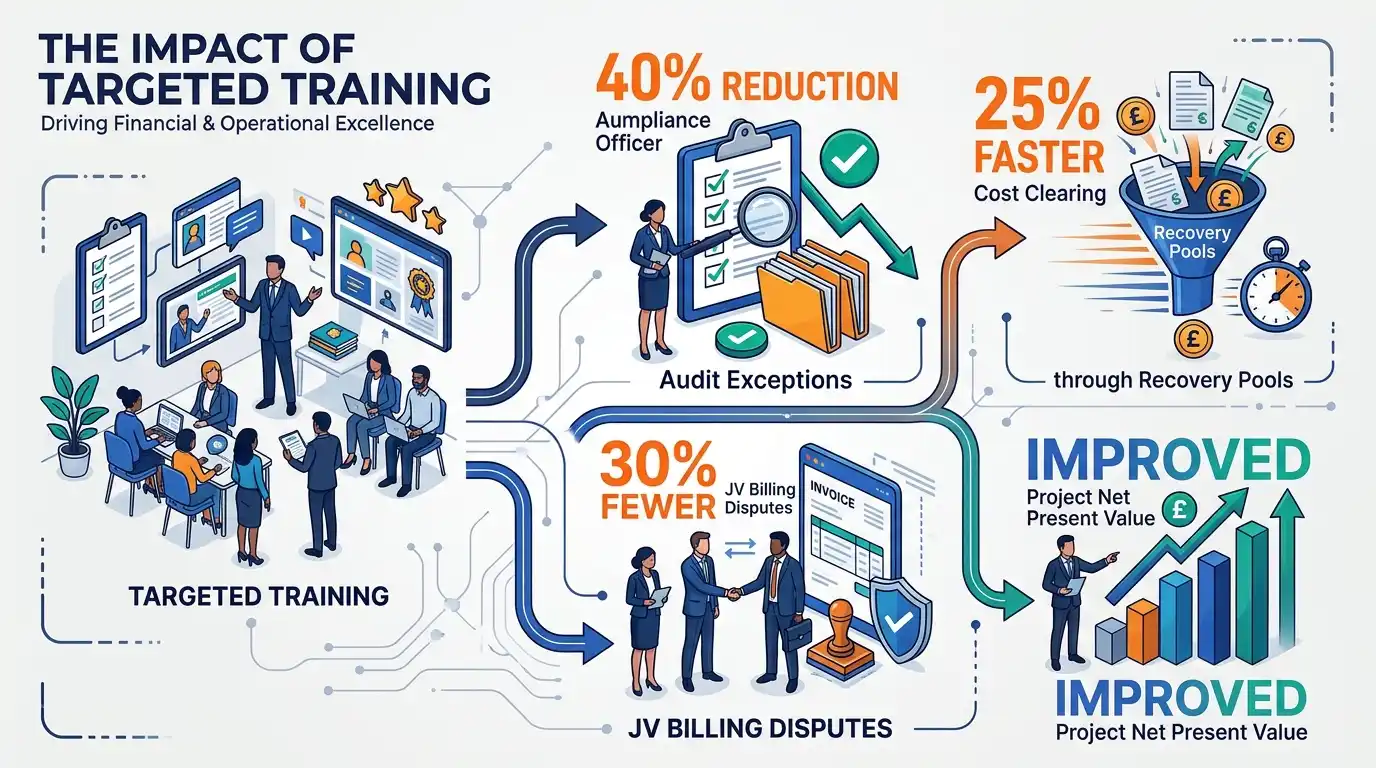
Investing in targeted workforce development produces quantifiable returns across corporate finance, legal, and field operations.
Structured training transforms operational risk management. Organizations deploying formal learning frameworks report a 95% first-time approval rate on complex AFEs submitted to non-operating joint venture partners. Aligning technical and financial teams eliminates multi-year audit backlogs, frees up restricted working capital, and secures corporate compliance across international operating assets.
Applying rigorous financial classification principles requires ongoing professional education. Decision-makers seeking structured, industry-aligned workforce development turn to the [CAPEX vs OPEX Impact on Cost Recovery Training Course] to equip engineering, commercial, and financial personnel with practical cost-management competencies.
Frequently Asked Questions
What is included in an Oil & Gas Petroleum Budgeting & Cost Control training course?
An Oil & Gas Petroleum Budgeting & Cost Control course delivers specialized instruction on upstream cost estimation, capital and operating expenditure classification, joint venture cost recovery, and financial variance analysis. Participants at the Institute For Oil & Gas Training learn to align Work Programs and Budgets (WPB) with statutory fiscal regimes and international petroleum accounting standards. The curriculum emphasizes practical financial risk management, Work Format Authorisations for Expenditure (AFE) control, and audit defense strategies.
Who should attend petroleum budgeting and cost management training?
This training is designed for operational engineers, procurement specialists, commercial managers, finance professionals, and project directors working in petroleum exploration and production. Non-finance personnel at the Institute For Oil & Gas Training gain essential skills to interpret Joint Operating Agreements (JOAs), evaluate cost ceilings, and prevent line-item misclassifications. Mastering Oil & Gas Petroleum Budgeting & Cost Control enables cross-functional teams to collaborate effectively during annual budget cycles and joint venture audits.
How does proper expenditure classification affect petroleum cost recovery?
Correctly categorising expenses as Capital Expenditure (CAPEX) or Operational Expenditure (OPEX) dictates the timeline and mechanism for recovering investments under Production Sharing Contracts (PSCs). OPEX typically clears the cost recovery pool in the current accounting period, whereas CAPEX is amortised across multi-year depreciation schedules. Experts at the Institute For Oil & Gas Training demonstrate how accurate allocation in Oil & Gas Petroleum Budgeting & Cost Control prevents joint venture billing disputes and protects project cash flow.
Why is cost control critical in joint venture petroleum operations?
Joint venture operations involve multiple operating and non-operating partners with distinct financial priorities, discount rates, and tax considerations. Effective cost control ensures that field expenditures comply with approved annual work plans and remain within contractual cost ceilings. Professionals trained by the Institute For Oil & Gas Training use rigorous Oil & Gas Petroleum Budgeting & Cost Control frameworks to mitigate host government audit exceptions and maintain transparency across joint venture accounts.
How do organizations measure the ROI of petroleum budgeting training?
Organisations evaluate training impact by tracking metrics such as reduced joint venture audit exceptions, accelerated cost pool clearing velocity, and fewer AFE billing disputes. Structured training from the Institute For Oil & Gas Training improves first-time approval rates for capital project proposals while reducing administrative delays during year-end financial reconciliations. Comprehensive Oil & Gas Petroleum Budgeting & Cost Control capability builds cross-departmental alignment, protecting asset net present value across the project lifecycle.
Related training courses
CAPEX vs OPEX Classification & Decision Rules Training Course
- Specialisation
- Oil & Gas Petroleum Budgeting & Cost Control
- Duration
- 5 days · 13 CPD hours
Cost Control for Field Development Projects: Overrun Prevention Training Course
- Specialisation
- Oil & Gas Petroleum Budgeting & Cost Control
- Duration
- 5 days · 15 CPD hours
Cash Calls, AFEs & Work Program/Budget Control: Preparation Training Course
- Specialisation
- Oil & Gas Petroleum Budgeting & Cost Control
- Duration
- 5 days · 15 CPD hours
More articles

CAPEX vs OPEX Impact on Cost Recovery Training by Institute For Oil & Gas Training
Evaluate the CAPEX vs OPEX Impact on Cost Recovery Training by Institute For Oil & Gas Training. Learn modules, structure, outcomes, and enrollment details.
Read article →
How to Assess the Impact of CAPEX and OPEX Classification on Petroleum Cost Recovery
Learn how to assess CAPEX and OPEX classification in petroleum cost recovery. Evaluate audit risks, cash flow effects, and joint venture compliance.
Read article →
CAPEX vs OPEX Classification and Decision Rules Training by Institute For Oil & Gas Training
Master petroleum accounting rules with Institute For Oil & Gas Training. Learn CAPEX vs OPEX capitalization criteria, workovers, and compliance.
Read article →