
Petroleum exploration and production operates under strict fiscal regimes where upstream operators must correctly classify capital expenditure and operating expenditure to recover investments from production revenues. The financial distinction between capital investment and operational expense determines the exact timing, sequence, and volume of cost oil allocations under Production Sharing Contracts (PSCs) and Joint Operating Agreements (JOAs). Misallocating these expenditures delays cash flow recovery, reduces project Net Present Value (NPV), and triggers severe financial penalties during joint venture audits.
Accurate categorization directly dictates how quickly an operator recovers funds through cost oil limits before profit oil is split with host governments. Operators must establish clear accounting frameworks to evaluate Why CAPEX and OPEX Classification Affects Cost Recovery in Oil and Gas across every project phase, from initial seismic survey campaigns to eventual facility decommissioning. Establishing rigorous audit mechanisms, joint venture chargeability definitions, and asset registration controls ensures full compliance with local petroleum regulations while safeguarding investor returns.
How Does CAPEX and OPEX Classification Determine Petroleum Cost Recovery Timing?
Capital expenditure is recovered over multi-year depreciation schedules or cost oil ceilings, whereas operating expenditure is fully deducted in the current accounting period, directly altering the rate of cash flow recovery and delaying profit share distributions to host government entities.
Immediate Expense Allocation Versus Capital Amortization
Under standard Production Sharing Contracts, operating expenditures represent the day-to-day costs of producing hydrocarbons, such as field maintenance, well workovers, and administrative overheads. Operators deduct these costs immediately against gross revenue in the financial quarter incurred, up to the contractually agreed cost oil limit (typically ranging between 40% and 70% of gross production). Immediate deduction yields rapid liquidity, reducing the operator's working capital exposure in high-risk operating environments.
Capital expenditures encompass long-term assets, including exploration drilling, offshore platform construction, and pipeline installations. Regulators require these expenditures to be capitalized on the asset register and recovered incrementally through contractual depreciation schedules or annual cost oil allowances. When operators classify operational outlays incorrectly as capital investments, the recovery of those funds stretches across several fiscal years. This amortization schedule slows down initial cash flow, increases financing costs, and depresses short-term internal rates of return (IRR).
Cost Oil Ceilings and Unrecovered Cost Carries
Production Sharing Contracts impose an annual cap on the percentage of total oil revenue designated as cost oil. When total allowable costs exceed this ceiling within a given period, the unrecovered balance carries forward into subsequent accounting cycles. The sequence of deduction matters significantly: operating costs normally hold priority status over capital depreciation within the cost recovery pool.
Prioritizing operational expense deductions ensures immediate liquidity for ongoing field operations. However, if capital expenditure projects swell without proper classification controls, the cumulative unrecovered cost balance expands rapidly. High unrecovered balances defer the point at which the project achieves economic break-even, altering the financial dynamics between joint venture partners and state authorities.
What Are the Financial and Tax Risks of Misclassifying Upstream Expenditures?
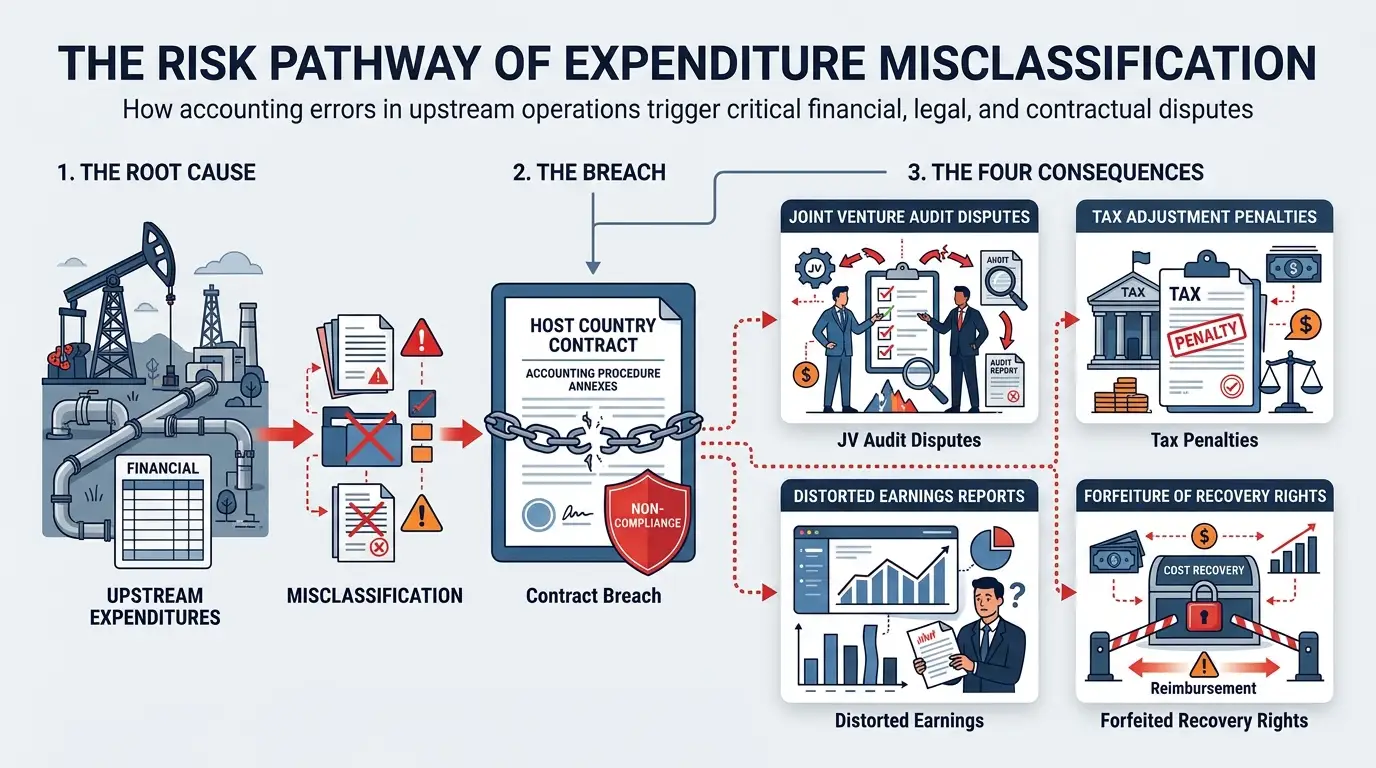
Misclassifying upstream expenditures leads to joint venture audit disputes, tax adjustment penalties, distorted corporate earnings reports, and potential forfeiture of cost recovery rights due to non-compliance with Accounting Procedure annexes in host country contracts.
Joint Venture Chargeability and Non-Consent Audit Disputes
Joint venture operations rely on explicit Accounting Procedures annexed to the JOA, which outline strict definitions of joint venture chargeability. Operators must present clear documentation proving that expenses directly benefit joint field operations rather than corporate headquarters. Misassigning corporate overhead or regional operational support as direct capital expenditure triggers immediate audit exceptions from non-operating partners.
Non-operating partners scrutinize monthly billing statements to prevent operators from inflating the capital base. Disallowed expenditures are excised from the joint account, forcing the operator to absorb 100% of the cost without reimbursement. These classification disputes lead to cash call withholding, delayed partner approvals for subsequent work programs, and costly legal arbitration proceedings that halt development schedules.
Tax Treatment and Capital Allowances Variance
National tax authorities enforce distinct rules for capital allowances versus deductible expenses. Operating expenses offset revenue directly, lowering taxable income in the current fiscal year. Capital expenditures qualify for specific capital allowances, investment tax credits, or uplift mechanisms, which amortize taxable liability over specified asset life spans.
Incorrect categorization alters corporate income tax calculations, creating compliance vulnerabilities during state revenue audits. If an operator claims an immediate tax deduction for a capital installation mislabeled as routine maintenance, tax authorities reassess the filing, demand back-taxes, and impose compounding interest penalties. Conversely, misclassifying valid operational expenses as capital investments forfeits immediate tax shields, unnecessarily elevating short-term tax liabilities.
Financial Reporting Disconnect: Cash Flow Versus Profit Impact
Evaluating financial performance requires understanding the cash flow versus profit impact caused by expenditure decisions. Capitalizing an expense removes it from the current income statement, artificially boosting short-term net income and EBITDA. However, the cash outlay remains immediate, creating a divergence between reported profitability and actual cash availability.
This sructural disconnect distorts key performance metrics. Senior financial managers must balance earnings presentation for public markets against the practical reality of cost recovery limits under local petroleum legislation. Misjudging this equilibrium leads to severe liquidity constraints when cash outflows for capital build-outs outpace the contractual rate of cost oil reimbursement.
How Do Operators Evaluate CAPEX and OPEX Treatment in Upstream Projects?
Operators evaluate expenditure treatment by reviewing contract clauses, performing life-of-field cash flow modeling, auditing work breakdown structures, and benchmarking classification methodologies against regulatory guidelines and joint venture accounting standards.
Structural Assessment Framework
To establish compliance and optimize financial returns, joint venture teams apply structured analytical frameworks. The following matrix illustrates the core attributes used by accounting and technical teams to classify expenditures during field development.
Assessment Attribute | Capital Expenditure (CAPEX) | Operating Expenditure (OPEX) | Cost Recovery Impact |
Primary Financial Function | Asset creation, capacity expansion, field development | Asset preservation, routine production, field maintenance | Controls the timing of cost oil reimbursement and profit split triggers |
Accounting Treatment | Capitalized to balance sheet; depreciated over asset life | Expensed immediately in current income statement | OPEX cleared first against cost oil cap; CAPEX amortized |
Audit Risk Profile | High: Subject to capitalization thresholds and uplift verification | High: Subject to joint venture chargeability and overhead allocation limits | High risk of cost disallowance during state or partner audits |
Tax Impact | Deferred tax shield via capital allowances and investment credits | Immediate tax shield against current-year taxable revenue | Direct variance in net corporate tax liabilities |
Cash Flow Profile | Substantial up-front capital outlay; delayed cost recovery | Ongoing incremental cash outlays; rapid cost recovery | Alters project Internal Rate of Return (IRR) and Net Present Value (NPV) |
Life-of-Field Financial Modeling
Financial analysts construct detailed asset models to simulate how expenditure choices affect long-term project metrics. The assessment workflow follows a rigorous sequence to ensure all team members adhere to contractual standards:
Contractual Framework Mapping: Review the specific Production Sharing Contract or Risk Service Contract to identify cost oil ceilings, priority deduction rules, and non-recoverable expense categories.
Work Breakdown Structure (WBS) Tagging: Assign explicit cost codes at the purchase order stage, separating capital facility construction from ongoing operational maintenance.
Depreciation Schedule Integration: Apply approved statutory depreciation methods (straight-line, unit-of-production, or declining balance) to all capital line items.
Cost Oil Ceiling Simulation: Run sensitivity models testing different production volumes and crude price scenarios against annual cost recovery caps to project cash flow profiles.
Audit Trail Verification: Document technical justification for every major expenditure to withstand scrutiny from state regulatory agencies and joint venture partners.
Assessing the Strategic CAPEX to OPEX Shift
Modern oil and gas strategies frequently evaluate a capex to opex shift strategy to lower up-front capital commitments and mitigate exploration risk. Leasing production equipment, utilizing Third-Party Infrastructure (TPI), or executing integrated service contracts transfers massive up-front capital costs into predictable, recurring operational expenses.
While shifting to an operational expenditure model accelerates cost recovery by avoiding long depreciation schedules, it raises annual operating baselines. Higher fixed operating costs reduce profit margins during low oil price cycles. Financial teams must analyze whether the immediate cash flow advantages of operational leasing outweigh the long-term cost efficiencies of owning capital assets outright.
How Can Organizations Bridge Workforce Skill Gaps in Petroleum Cost Accounting?
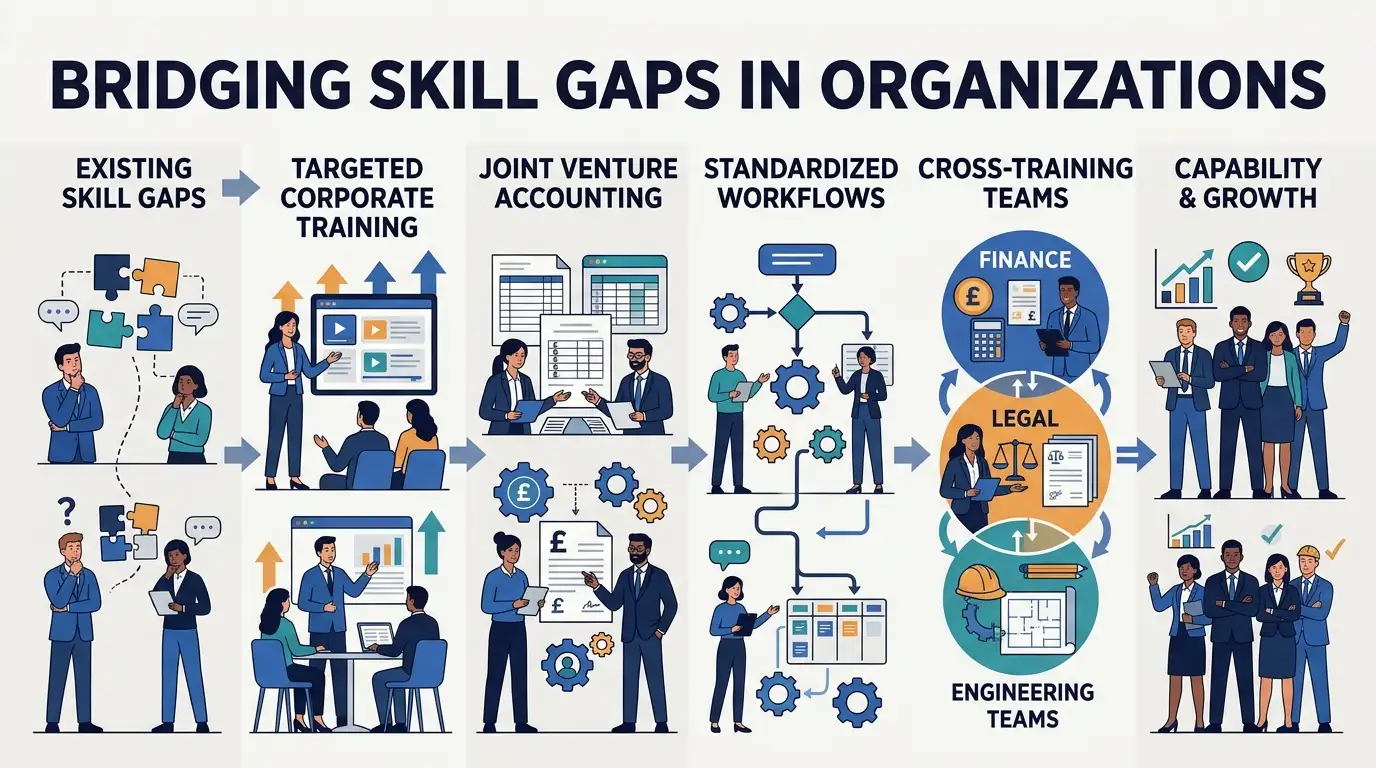
Organizations bridge skill gaps by deploying targeted corporate training programs, implementing structured joint venture accounting protocols, standardizing cross-departmental workflows, and cross-training finance, legal, and engineering professionals.
Addressing Cross-Departmental Disconnects
A primary driver of classification errors in upstream petroleum operations is the disconnect between technical engineering teams and financial accounting departments. Field engineers routinely initiate procurement orders without fully recognizing how line-item descriptions affect tax liabilities, capital allowance claims, or cost oil recovery limits. Conversely, finance staff may lack the operational domain knowledge required to correctly categorize complex subsea interventions or facility modifications.
To resolve these operational silos, enterprise organizations implement integrated capability frameworks. Providing targeted professional instruction ensures that asset managers, petroleum engineers, joint venture accountants, and legal counsel operate under a unified understanding of petroleum accounting rules.
Evaluating Capability Development Approaches
Human resource executives and operational leaders must select the correct learning delivery model to build organizational competency in upstream cost control. Structured training programs ensure teams avoid cost disallowances during external audits.
Training Approach | Delivery Structure | Operational Focus | Business ROI & Impact |
Self-Paced Digital Modules | Asynchronous online learning modules | Fundamental concepts, basic petroleum terminology, introductory accounting principles | Low cost per participant; ideal for broad onboarding but lacks practical application depth for complex JOA audits |
Public Multi-Company Seminars | Standardized off-site classroom instruction | Generic PSC frameworks, standard industry accounting templates, high-level compliance | Broad industry networking; limited customization for specific asset PSC contract terms or country-specific tax codes |
Customized Corporate Programs | Tailored intensive workshops using real company asset data | Asset-specific PSC terms, live joint venture audit simulation, company-specific WBS structures | High operational ROI; directly reduces audit exceptions, disallowance risks, and classification disputes |
Organizations facing active joint venture audits or preparing for major field development planning derive maximum financial benefit from customized corporate learning programs. Structured instruction focused on depreciation impact on earnings and cost recovery rules equips teams to defend corporate financial filings effectively.
Professional corporate training platforms provide deep, practical focus on these fiscal challenges. For organizations seeking comprehensive competency development, enrolling key personnel in the CAPEX vs OPEX Impact on Cost Recovery Training Course establishes the foundational and advanced expertise needed to navigate complex joint operating environments.
When evaluating external educational partners, HR teams must prioritize practical case-study analysis over purely theoretical lectures. Programs built around live Production Sharing Agreement models, real-world audit dispute scenarios, and direct fiscal regime comparisons deliver immediate operational value, enabling teams to safeguard project returns from day one of field deployment.
Establishing Measurable Performance Metrics
To verify the ROI of workforce training initiatives, corporate leaders must track specific key performance indicators across financial and operational domain areas:
Audit Disallowance Rate: Measure the percentage reduction in cost recovery line items rejected by state regulators or joint venture partners following team training.
Classification Resolution Time: Track the average time required for cross-functional teams to resolve internal classification disputes with partners and regulators.
WBS Coding Accuracy: Evaluate initial purchase order cost-coding accuracy to minimize manual journal entry corrections during end-of-month financial closes.
Cost Recovery Speed: Calculate the acceleration of cost oil recovery timelines resulting from optimized capital depreciation choices and correct operational expense claims.
Strengthening internal financial controls through targeted workforce capability development transforms cost accounting from a routine compliance task into a powerful strategic driver of upstream profitability.
Frequently Asked Questions
What is covered in Oil & Gas Petroleum Budgeting & Cost Control training?
The Oil & Gas Petroleum Budgeting & Cost Control program delivered by the Institute For Oil & Gas Training covers capital expenditure (CAPEX) and operating expenditure (OPEX) management, Production Sharing Contract (PSC) cost oil recovery, and joint venture accounting protocols. Participants learn financial forecasting, variance analysis, and cash flow modeling tailored specifically to upstream, midstream, and downstream petroleum operations.
Why is cost control critical in upstream petroleum budgeting?
Effective cost control ensures that exploration and production operators maximize cost recovery allocations while remaining compliant with contractual cost oil ceilings and Joint Operating Agreements (JOAs). Proper expenditure tracking through the Institute For Oil & Gas Training's specialized frameworks minimizes audit disallowances from host governments and non-operating partners, directly safeguarding project Net Present Value (NPV).
How does CAPEX and OPEX classification affect petroleum budgeting?
CAPEX classification determines multi-year depreciation schedules and capital allowances, whereas OPEX line items are deducted immediately against current-year production revenues within cost recovery pools. The Institute For Oil & Gas Training teaches financial managers how to categorize work breakdown structures correctly to avoid corporate income tax penalties and cash flow imbalances.
Who should attend an Oil & Gas Petroleum Budgeting & Cost Control course?
This professional training is designed for petroleum accountants, joint venture financial analysts, commercial managers, asset managers, and budget control engineers within the energy sector. Organizations rely on the Institute For Oil & Gas Training to bridge skill gaps between engineering operations and enterprise financial governance to streamline financial reporting.
How does petroleum budget management reduce joint venture audit risks?
Standardized petroleum budget management enforces clear joint venture chargeability rules, detailed audit trails, and strict authorization for expenditure (AFE) procedures prior to project execution. By training teams through the Institute For Oil & Gas Training, energy companies reduce classification disputes with joint venture partners and regulatory bodies during post-period financial audits.
Related training courses
Budgeting & Forecasting: Rolling & Zero-Based Techniques Training Course
- Specialisation
- Oil & Gas Petroleum Budgeting & Cost Control
- Duration
- 5 days · 15 CPD hours
Cost Control for Field Development Projects: Overrun Prevention Training Course
- Specialisation
- Oil & Gas Petroleum Budgeting & Cost Control
- Duration
- 5 days · 15 CPD hours
Cash Calls, AFEs & Work Program/Budget Control: Preparation Training Course
- Specialisation
- Oil & Gas Petroleum Budgeting & Cost Control
- Duration
- 5 days · 15 CPD hours
More articles

CAPEX vs OPEX Impact on Cost Recovery Training by Institute For Oil & Gas Training
Evaluate the CAPEX vs OPEX Impact on Cost Recovery Training by Institute For Oil & Gas Training. Learn modules, structure, outcomes, and enrollment details.
Read article →
Why CAPEX and OPEX Classification Affects Cost Recovery in Oil and Gas
Learn how CAPEX and OPEX classification dictates cost recovery mechanisms, cash flow velocity, and regulatory compliance in upstream petroleum accounting.
Read article →
CAPEX vs OPEX Classification and Decision Rules Training by Institute For Oil & Gas Training
Master petroleum accounting rules with Institute For Oil & Gas Training. Learn CAPEX vs OPEX capitalization criteria, workovers, and compliance.
Read article →