

Contract compliance in day rate agreements and claims management is the systematic verification of daily personnel rates, equipment charges, change orders, and contractual terms to eliminate financial leakage, maintain project budget precision, and enforce contractor operational accountability across capital-intensive business operations.
In corporate environments, day rate agreements govern short-term and long-term operational engagements where contractors charge fixed daily fees for personnel, equipment, or specialized technical services. Organisations in capital-intensive sectors like oil and gas, construction, marine engineering, and infrastructure rely on these agreements to execute complex, time-sensitive projects. Without structured contract compliance, businesses suffer from unverified timesheets, improper standby rate applications, unauthorized variation orders, and inflated financial claims.
Contract compliance creates an operational environment where every invoice matches contractual provisions. It aligns project management, procurement, finance, and legal teams around standard protocols for verifying contractor deliverables. Managing claims requires structured audit frameworks that evaluate time logs, mobilization records, and equipment logbooks against agreed rate cards. When corporate teams enforce compliance, they prevent overbilling, control scope creep, reduce commercial disputes, and maintain audit readiness across multi-million-pound project portfolios.
How Does Contract Compliance Work in Corporate Environments?
Contract compliance operates through a four-stage structured workflow encompassing pre-award alignment, real-time daily operational verification, systematic invoice reconciliation, and formal claims assessment, ensuring that all contractor billings strictly align with agreed terms, risk allocation frameworks, and project performance standards.
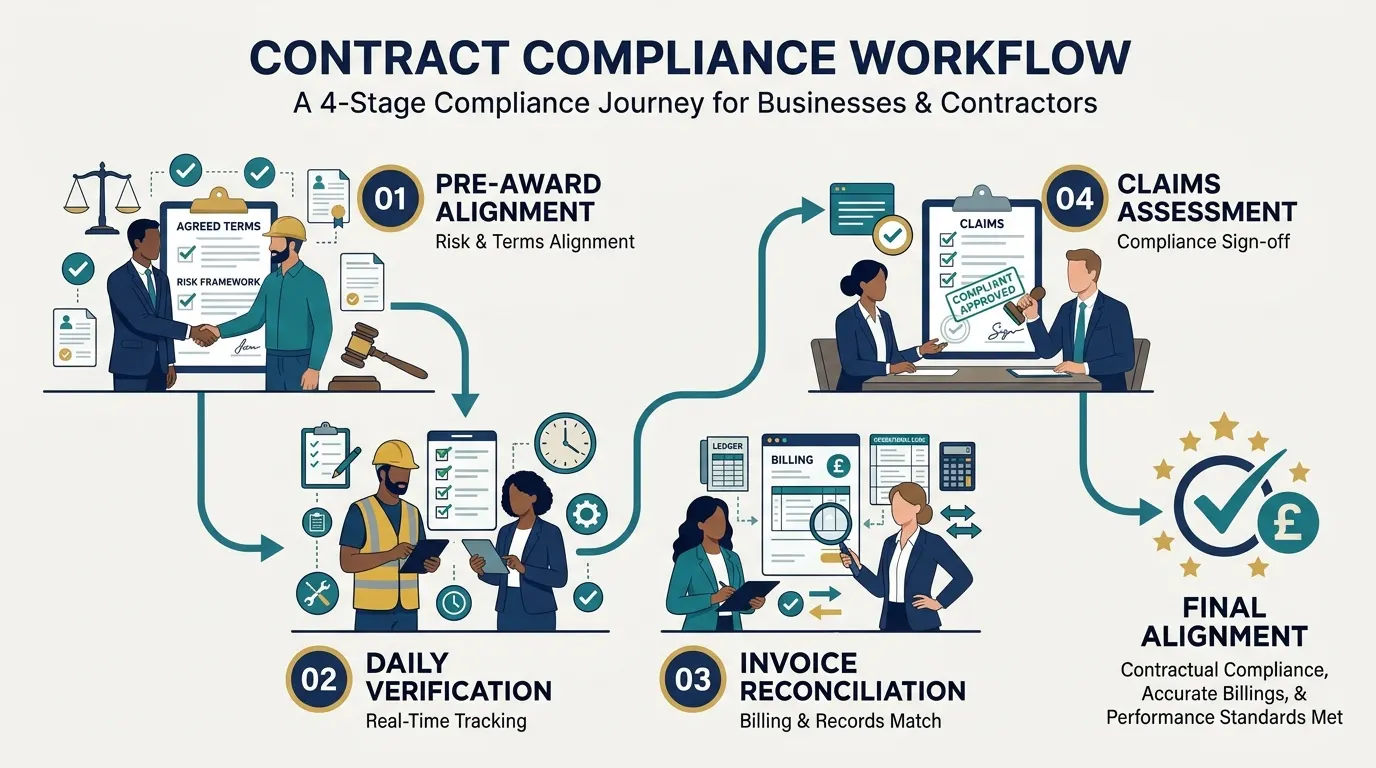
Stage 1: Pre-Award Alignment and Governance Framework Setup
Organisations establish clear governance rules before work commences on site. Procurement and legal teams translate commercial terms into operational compliance protocols.
Project managers establish baseline scope of work documents and precise rate schedules.
Commercial teams define explicit conditions for applying standard day rates versus discounted standby rates.
Legal specialists embed liquidated damages clauses, back charge mechanisms, and remeasurement procedures into the master services agreement.
Department heads establish approval hierarchies for variation requests, ensuring that field supervisors cannot grant informal scope changes.
Stage 2: Operational Monitoring and Verification
Field personnel track contractor activities continuously using structured reporting templates and digital logging platforms.
Site supervisors document daily headcount, equipment utilization hours, weather delays, and idle time.
Verification officers check contractor daily progress reports against site logbooks every 24 hours.
Field leaders issue formal operational notices immediately when contractor equipment fails or key personnel are absent.
Technical auditors cross-check mobilization schedules to ensure equipment meets specified technical requirements before rate accrual begins.
Stage 3: Invoice Reconciliation and Remeasurement Audit
Finance and commercial management teams process contractor submissions through rigid audit gates prior to payment authorization.
Accounts payable teams verify rate card entries, multiplying logged days by agreed unit prices without deviation.
Commercial analysts evaluate reimbursable expenses against receipts, removing unapproved markups and undocumented costs.
Cost controllers apply standby rates for unutilized equipment or forced operational shutdowns according to contract terms.
Audit leads log and deduct back charges for contractor-caused re-work, damages, or safety non-compliance incidents.
Stage 4: Claims Resolution and Dispute Mitigation
When contractors submit equitable adjustments or financial claims, corporate teams execute a formal audit process.
Claims managers evaluate entitlement by checking contractual notice timelines and cause-and-effect records.
Quantum analysts recalculate claimed costs using verified site logs, stripping out overhead additions and unsubstantiated delays.
Commercial directors negotiate settlements using audit evidence, preventing formal litigation and protecting project contingency funds.
What Key Components Are Included in Contract Compliance Training?
Contract compliance training integrates critical technical competencies including rate card verification, variation order control, standby rate application, back charge calculation, and claims substantiation into a unified operational framework designed to build commercial competence across corporate project management teams.
1. Rate Card Compliance and Standby Rate Application
Training equips participants with exact auditing mechanisms to evaluate daily billing structures. Learners master the commercial distinction between full operational day rates, reduced standby rates, and zero-rate maintenance periods.
2. Scope of Work Adherence and Change Order Control
Participants learn structured methodologies to isolate baseline contract deliverables from scope variations. The curriculum trains professionals to identify unauthorized work directives issued in the field, convert verbal requests into formal variation orders, and evaluate price adjustments against baseline contract rates.
3. Claims Management and Back Charge Execution
The training provides clear frameworks for analyzing contractor claims, calculating delay entitlements, and enforcing financial offsets. Learners develop skills to compile contemporaneous evidence, calculate back charges for non-conforming work, and apply liquidated damages clauses to compensate for project delays.
What Common Problems Disrupt Contract Compliance and Claims Management?
Unclear contract language, informal field variations, delayed invoice reviews, lack of contemporaneous site documentation, and siloed communication between project and finance teams routinely disrupt compliance, leading to budget overruns, unverified payments, and costly commercial disputes.
Misinterpretation of Standby Rates and Operational Delays
Project teams frequently misapply full day rates during operational disruptions caused by weather, equipment breakdowns, or third-party delays. Without formal training, site managers sign daily tickets indicating contractor presence without noting equipment downtime or non-operational status.
Informal Variation Approvals in the Field
Site engineers often approve scope additions verbally or via informal email communications without triggering formal variation order procedures. Contractors subsequently submit substantial financial claims at project completion based on these informal directives.
Ineffective Inter-Departmental Alignment
Commercial risk increases when project management, procurement, and finance departments operate in isolation. Project managers approve daily tickets based on physical work completed, while finance teams process invoices without validating operational logs against master agreement terms.
How Do Organisations Implement Contract Compliance Systems?
Organisations implement contract compliance systems by introducing standardized site reporting tools, establishing cross-functional commercial governance teams, delivering structured workforce training programs, and conducting mandatory post-project contract close-out audits across all major operational departments.
1. Standardizing Site Ticket and Documentation Protocols
Organisations deploy standardized daily report templates and digital tracking platforms across all project sites. Teams enforce daily ticket sign-offs that categorize contractor hours into operational, standby, maintenance, and delay classifications.
2. Establishing Cross-Functional Governance Frameworks
Companies create joint commercial review boards combining project controls, legal counsel, procurement specialists, and finance leads. This group reviews high-value change orders, evaluates ongoing contractor claims, and monitors rate card compliance on a 30-day reporting cycle.
3. Executing Workforce Capability Building Programs
Organisations enroll project managers, site engineers, quantity surveyors, and accounts payable staff into targeted professional development initiatives. Training aligns internal teams on contractual obligations, risk allocation rules, and claims defense strategies.
4. Enforcing Formal Contract Close-Out Audits
Businesses introduce structured close-out checklists before releasing final retention payments or closing project accounts. Teams audit final accounts, verify all change orders, settle outstanding back charges, and archive performance records for future procurement evaluations.
What Measurable Outcomes Does Contract Compliance Training Produce?
Contract compliance training delivers quantifiable business results by reducing invoice overpayment errors, lowering dispute settlement costs, accelerating change order processing times, cutting claims resolution windows, and boosting overall project profitability across enterprise operations.
Direct Financial Savings and Leakage Prevention
Rigorous compliance training eliminates billing errors caused by incorrect rate applications and duplicate line-item charges. Organisations deploying trained audit teams achieve a 12% to 18% reduction in overall contractor expenditure across day-rate contract portfolios.
Enhanced Claims Defense Capabilities
Trained commercial teams capture structured, legally defensible site records daily. This documentation enables companies to reject up to 25% of unsubstantiated contractor claims during informal negotiation phases, avoiding expensive formal litigation or arbitration proceedings.
Streamlined Operational Efficiency and Risk Reduction
Standardized variation control workflows reduce change order processing cycles from 21 days to 5 days. Efficient approval pathways prevent project delays, eliminate administrative bottlenecks, and protect contingency funds across complex engineering and operational initiatives.
Which Roles and Business Functions Benefit Most From This Training?
Project managers, quantity surveyors, procurement directors, contract administrators, finance heads, and site superintendents in engineering, energy, construction, and logistics sectors gain direct operational value from contract compliance and claims management training.
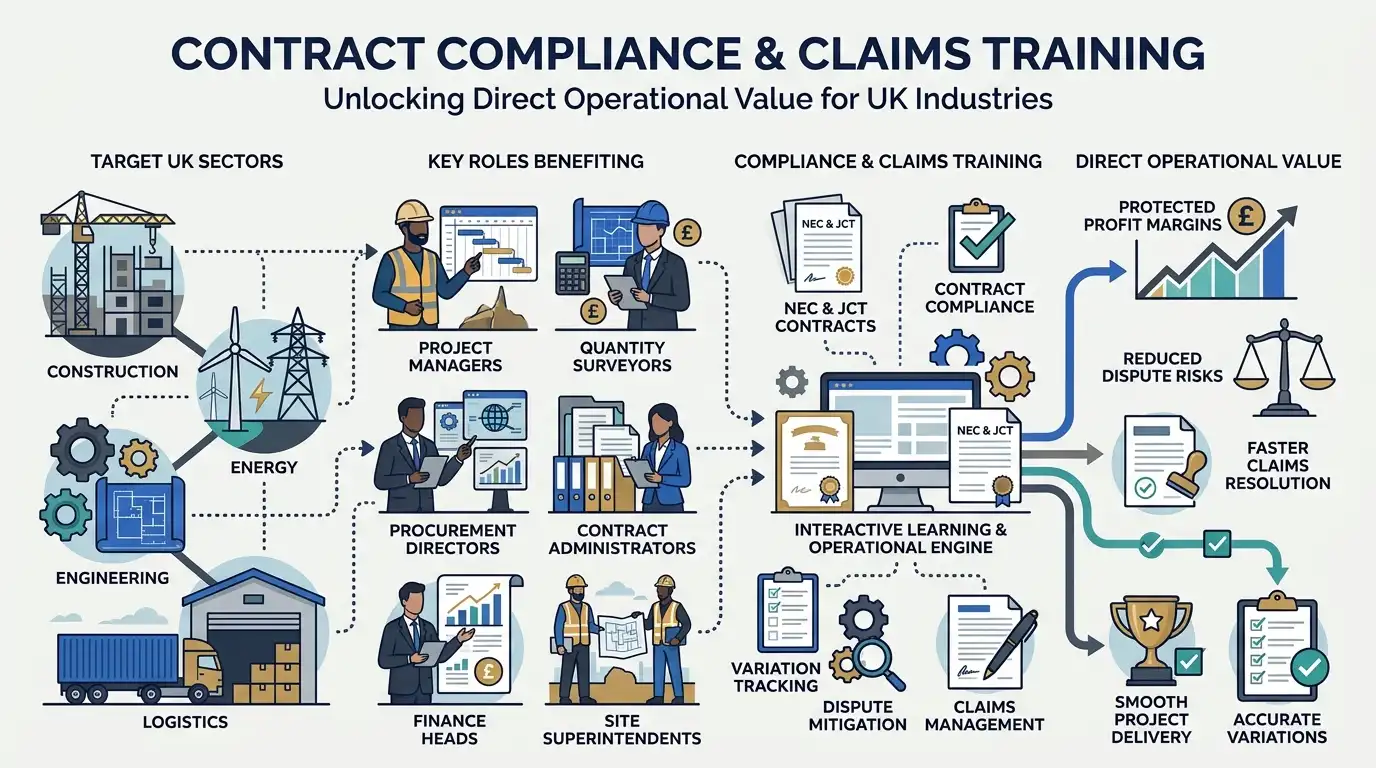
Project Managers and Site Superintendents
Field leaders responsible for day-to-day contractor oversight gain the capability to manage daily tickets, enforce scope boundaries, and document non-performance accurately on site.
Quantity Surveyors and Commercial Managers
Commercial professionals acquire advanced methodologies to audit complex rate cards, calculate precise back charges, evaluate delay claims, and manage remeasurement procedures under day-rate frameworks.
Procurement Leaders and Finance Executives
Strategic decision-makers gain frameworks to structure unambiguous master service agreements, streamline invoice reconciliation pipelines, and protect organizational capital through compliant financial controls.
If your organization requires a structured framework to evaluate day-rate billing accuracy and resolve contractor disputes, reviewing How to Evaluate Day Rate Contract Compliance and Manage Claims Effectively provides the analytical steps necessary to assess current audit processes.
Strategic Implementation Plan
To embed contract compliance across operational teams, learning and development leaders must implement a structured, multi-phase capability development strategy.
1.Assess Skill Gaps and Compliance Vulnerabilities:Complete within Weeks 1-2.
Execute a baseline audit of existing contractor billing records, claims histories, and site ticketing procedures. Identify recurring financial leakage points, informal scope variations, and inter-departmental communication gaps between site managers and finance teams.
2.Enroll Project and Commercial Teams in Targeted Training:Complete within Weeks 3-6.
Deploy the Contract Compliance for Day-Rate Agreements & Claims Training Course across project management, procurement, quantity surveying, and finance functions. Ensure participants master rate card auditing, variation order controls, and claims substantiation frameworks through practical, case-based learning modules.
3.Standardize Site Ticketing and Approval Workflows:Complete within Weeks 7-8.
Introduce unified daily report templates, digital tracking logs, and formal variation authorization levels across all operating sites. Align accounts payable validation protocols directly with verified site logs to eliminate unapproved billing processing.
4.Monitor Compliance KPIs and Execute Post-Project Audits:Ongoing Operational Rhythm.
Track key performance indicators including invoice rejection rates, change order processing times, and financial savings on contractor billings. Conduct formal contract close-out reviews on all completed agreements to ensure total financial recovery and continuous process refinement.
Frequently Asked Questions
What is covered in oil & gas petroleum contracts training?
Oil & gas petroleum contracts training covers the key legal, commercial, and operational frameworks governing upstream, midstream, and downstream energy projects. Participants learn to analyze joint operating agreements (JOAs), production sharing contracts (PSCs), service agreements, and risk-sharing mechanisms. The Institute For Oil & Gas Training structures these programs to build practical skills in negotiation, risk mitigation, and regulatory compliance.
Why is contract management critical in the petroleum industry?
Contract management in the petroleum industry is essential because energy projects involve multi-million-pound investments, complex joint ventures, and high operational risks. Proper contract administration ensures strict scope adherence, prevents costly dispute escalations, and maintains regulatory compliance across cross-border joint ventures. Through specialized training by the Institute For Oil & Gas Training, professionals learn how to protect corporate assets and optimize project margins under day-rate and reimbursable terms.
Who should undertake training in oil & gas petroleum contracts?
Training in oil & gas petroleum contracts is designed for project managers, legal counsel, commercial negotiators, procurement specialists, and commercial executives operating within the energy sector. It is equally valuable for corporate teams and decision-makers responsible for managing contractor performance, negotiating concession agreements, and overseeing project governance. The Institute For Oil & Gas Training delivers these programs to bridge knowledge gaps between technical execution and commercial legal compliance.
What are the main types of petroleum contracts in the energy sector?
The main types of petroleum contracts include concession agreements, Production Sharing Contracts (PSCs), Risk Service Contracts (RSCs), and Joint Operating Agreements (JOAs). Each contract structure defines how exploration risks, operational costs, tax liabilities, and production revenues are divided between host governments and international oil companies. The Institute For Oil & Gas Training provides detailed comparative analysis of these contractual models to support strategic corporate decision-making.
How do oil & gas petroleum contracts manage operational risks and claims?
Oil & gas petroleum contracts manage operational risks by embedding explicit clauses for liquidated damages, dispute resolution, indemnities, force majeure, and variation controls. These terms establish clear financial and legal liabilities when project delays, equipment downtime, or scope changes occur. Professional development programs from the Institute For Oil & Gas Training equip project teams with continuous monitoring and claims substantiation frameworks to defend against unverified contractor costs.
Related training courses
Contract Compliance: Obligation Extraction & Monitoring Training Course
- Specialisation
- Oil & Gas Petroleum Contracts
- Duration
- 5 days · 13 CPD hours
Contract Compliance for Day-Rate Agreements & Claims Training Course
- Specialisation
- Oil & Gas Petroleum Contracts
- Duration
- 5 days · 15 CPD hours
Contract Compliance Across JOAs, PSCs & HGAs Training Course
- Specialisation
- Oil & Gas Petroleum Contracts
- Duration
- 5 days · 15 CPD hours
More articles

CAPEX vs OPEX Impact on Cost Recovery Training by Institute For Oil & Gas Training
Evaluate the CAPEX vs OPEX Impact on Cost Recovery Training by Institute For Oil & Gas Training. Learn modules, structure, outcomes, and enrollment details.
Read article →
How to Assess the Impact of CAPEX and OPEX Classification on Petroleum Cost Recovery
Learn how to assess CAPEX and OPEX classification in petroleum cost recovery. Evaluate audit risks, cash flow effects, and joint venture compliance.
Read article →
Why CAPEX and OPEX Classification Affects Cost Recovery in Oil and Gas
Learn how CAPEX and OPEX classification dictates cost recovery mechanisms, cash flow velocity, and regulatory compliance in upstream petroleum accounting.
Read article →