

Petroleum contracts represent high-value commitments characterised by substantial capital expenditure, volatile market conditions, and multi-decade operational horizons. Evaluating contract risks requires a systematic assessment of exposure across exploration, development, production, and decommissioning phases. Energy organisations must balance revenue protection with operational flexibility while addressing regulatory compliance, joint venture alignment, and supply chain vulnerabilities.
Understanding the foundation of commercial exposure is essential before attempting to restructure complex agreements. Project teams often struggle to isolate systemic liabilities from standard operational contingencies. Exploring Why Contract Strategy and Risk Management Matter in Oil and Gas Projects provides the operational context needed to evaluate how unmitigated exposures compound across project lifecycles. Effective risk assessment transforms static agreements into adaptable commercial frameworks that shield cash flow from unexpected market shifts.
What Are the Primary Contract Risks in Oil and Gas Projects?
Primary contract risks in oil and gas projects stem from price volatility, fiscal regime shifts, joint operating disputes, subsea asset damage, and force majeure events. Identifying these exposures early prevents catastrophic financial leakage and operational stagnation across complex supply chains.
Petroleum operations carry unique exposure profiles due to the technical uncertainty inherent in sub-surface developments. Risk categorization must begin by separating commercial liabilities from technical and regulatory exposures. Commercial risks center on price indexation, currency fluctuations, and volume commitment mismatches. Technical risks involve subsurface performance variations, equipment failure, and environmental containment failures.
Legal and regulatory exposures present significant long-term threats to project profitability. State host governments frequently modify tax structures, local content mandates, and environmental compliance rules during thirty-year production sharing contracts. Operating companies must continuously monitor regulatory developments to anticipate compliance shifts that erode project margins.
Joint venture arrangements create distinct governance risks. Non-operating partners may dispute capital expenditures, operational timelines, or procurement decisions made by the designated operator. Misalignment within Joint Operating Agreements often leads to project stalls, delayed authorizations for expenditure, and costly arbitration proceedings.
Contractual risk identification relies on structured forensic audits of historical project data. Energy firms systematically review past disputes to isolate root causes. Effective exposure mapping assigns financial values to identified risks, allowing procurement teams to prioritise mitigation efforts based on potential balance sheet impact.
How Do You Audit Petroleum Contracts for Hidden Vulnerabilities?
Auditing petroleum contracts for hidden vulnerabilities involves systematically verifying cost-recovery accounts, joint venture billings, local content compliance, and indexation clauses. Rigorous audits identify fiscal leakages, prevent overbilling, and ensure full alignment with primary concession terms.
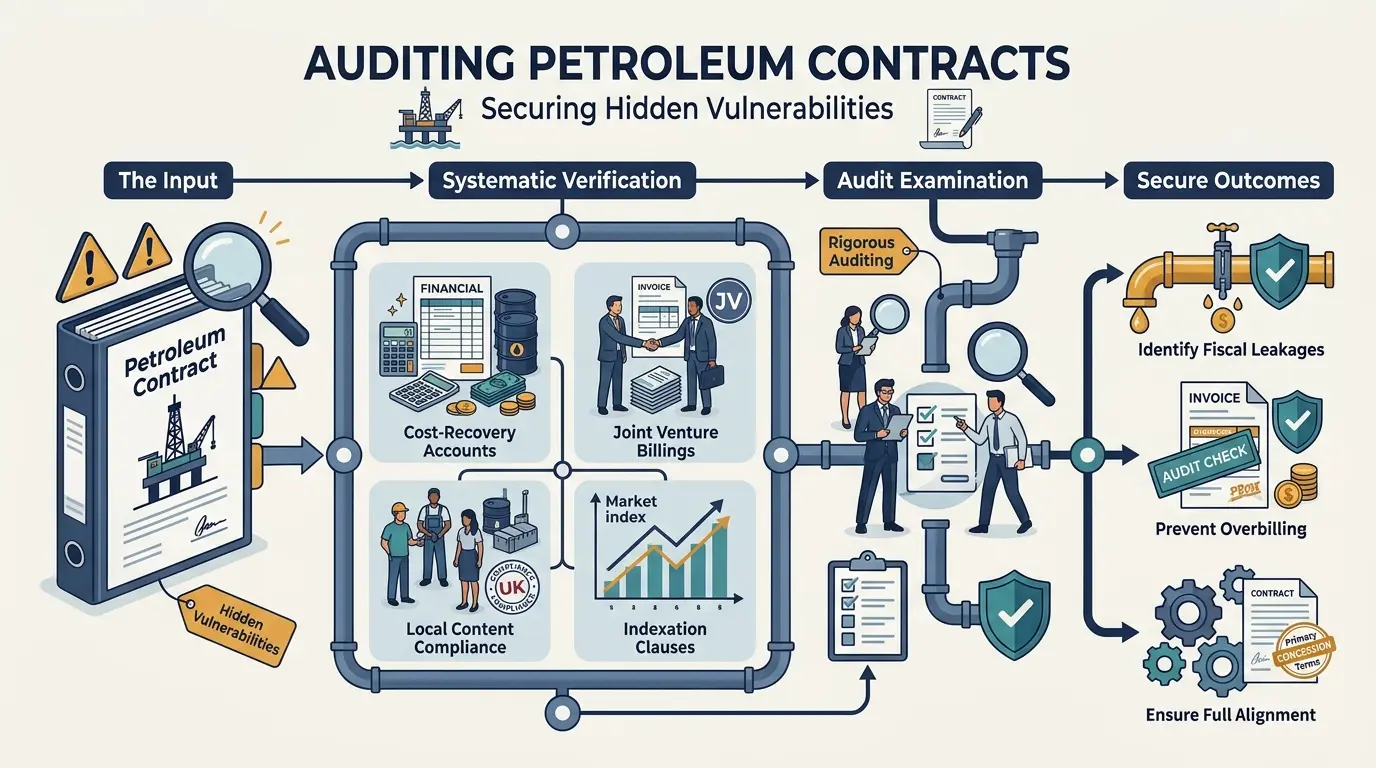
Comprehensive Oil and Gas Contract Auditing isolates systemic fiscal leaks before they compound into major disputes. Auditors examine billing records against approved accounting procedures, focusing on overhead allocations, equipment rental rates, and shared services charges. Uncovering non-compliant costs protects cash reserves and maintains trust between joint venture partners.
Auditing teams must verify price adjustment formulas embedded within long-term gas purchase agreements and service contracts. Inflation indexation, foreign exchange adjustments, and commodity price links require recalculation against independent indices. Minor calculation errors in multi-year agreements accumulate into multi-million-pound discrepancies if left undetected.
Legal terms require equal audit scrutiny. Liabilities, indemnities, and knock-for-knock provisions must align perfectly across master service agreements, subcontractor contracts, and primary concession terms. Gaps in cross-indemnification leave operators vulnerable to uninsured liabilities during catastrophic incidents.
The final phase of contract auditing evaluates compliance with host-nation regulatory frameworks. Local content obligations demand verified reporting of domestic spend, workforce metrics, and technology transfer initiatives. Non-compliance exposes energy companies to severe financial penalties, operational suspension, or permit revocation.
Which Frameworks Best Structure Oil and Gas Negotiation Strategies?
Structuring oil and gas negotiation strategies requires frameworks like BATNA, ZOPA, and principled negotiation tailored to energy assets. These frameworks establish objective valuation metrics, define acceptable concessions, and secure long-term value creation across complex stakeholder networks.
Formulating robust Oil and Gas Negotiation Strategies demands a clear shift from positional bargaining to interest-based valuation models. Negotiators must establish their Best Alternative to a Negotiated Agreement before entering discussions. A well-defined alternative sets an absolute threshold below which walking away becomes the commercially optimal choice.
Establishing the Zone of Possible Agreement requires deep financial modeling of both parties' commercial constraints. In petroleum deals, ZOPA calculations incorporate oil price assumptions, discount rates, tax implications, and field decline curves. Accurately mapping this space prevents teams from settling for sub-optimal terms or abandoning viable deals.
Principled negotiation frameworks focus on separating subjective partner dynamics from technical and economic realities. Commercial teams ground negotiations on objective criteria such as benchmarked drilling costs, industry standard liability caps, and independent reserve estimates. Objective baselines minimize emotional friction between host governments, operators, and contractors.
Scenario planning forms the structural backbone of strategic negotiation preparation. Teams construct dynamic decision trees accounting for market shifts, discovery sizes, and regulatory adjustments. Preparing pre-approved concession packages for each scenario ensures commercial negotiators maintain tactical agility without compromising core risk thresholds.
How Does Structured Training Improve Petroleum Contract Administration?
Structured training improves petroleum contract administration by establishing standardized risk protocols, enhancing cross-functional collaboration, and mitigating commercial leakage. Professional development builds workforce competency in managing complex multi-party agreements across project lifecycles.
The execution of complex offshore and onshore contracts depends directly on workforce capability. Systematic Oil and Gas Contract Administration requires seamless collaboration between legal advisors, commercial managers, procurement specialists, and field engineers. Capability gaps in contract interpretation routinely result in unrecovered variations, missed claim deadlines, and unmitigated scope creep.
Training Approach | Core Focus Area | Primary Target Audience | Typical Operational Impact |
Academic & Legal Certification | Theoretical framework, international energy law, dispute jurisprudence | Corporate Counsel, Legal Executives | High legal accuracy; low integration with daily field operations. |
Internal On-the-Job Mentoring | Company-specific procedures, legacy workflow adoption | Junior Commercial Analysts, Contract Engineers | Preserves institutional memory; risks perpetuating outdated practices. |
Simulated Practical Workshops | Real-world scenario negotiation, live contract auditing, risk modeling | Commercial Managers, Procurement Leads, Asset Directors | Rapid skill application; measurable reduction in commercial claims. |
E-Learning Modules | Fundamental compliance, regulatory overviews, introductory terminology | General Project Staff, Support Functions | Broad baseline awareness; limited impact on complex negotiations. |
Modern energy organizations transition away from passive learning models toward immersive, scenario-based skill building. Practical training exposes teams to simulated renegotiations, complex variation disputes, and contractor claims. Experiential learning embeds tactical decision-making skills that directly translate to live commercial environments.
Structured capability development standardizes risk identification protocols across global asset teams. When asset managers and legal teams utilize a unified risk taxonomy, contract handovers run smoothly. Standardized administration reduces administrative overheads and accelerates approval cycles for essential project variations.
Investing in structured corporate training yields quantifiable returns through dispute avoidance and leak reduction. Organisations tracking post-training performance report reduced reliance on external legal counsel for routine disputes, alongside faster contract execution timelines. Building internal expertise secures commercial resilience across volatile market cycles.
How to Choose the Right Contract Strategy and Negotiation Training Model?
Choosing the right training model requires evaluating organizational skill gaps, project complexity, delivery formats, and measurable business outcomes. Enterprise decisions must prioritize practical, industry-specific curriculum design over generic commercial management programs.
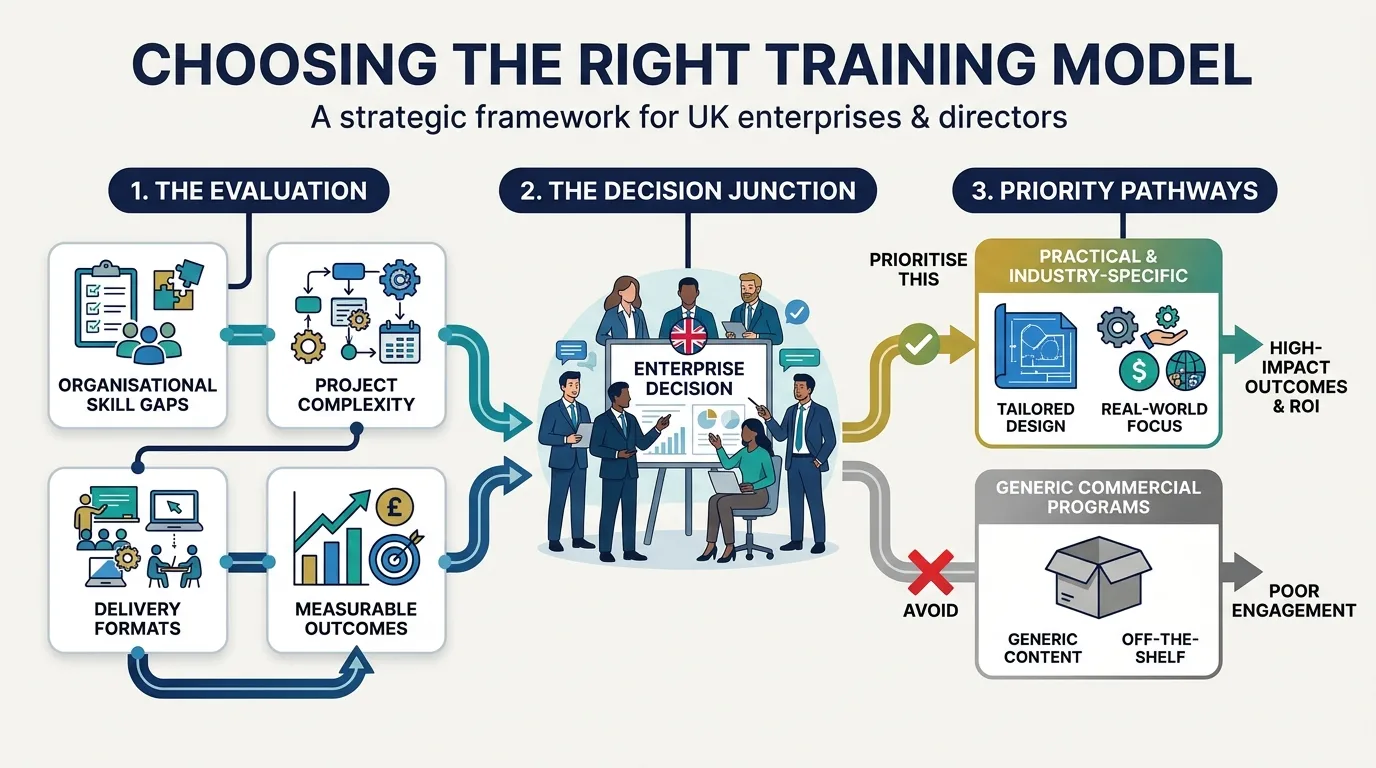
Organizations evaluating professional development options must select a practical, sector-specific solution such as the Contract Strategy, Risk and Negotiation Training Course to address specialized petroleum commercial challenges. Generic business training fails to address complex issues like production sharing splits, Joint Operating Agreement disputes, or subsea liability allocations. Industry-tailored programs ground theoretical principles in real-world energy contexts.
The decision framework below outlines key evaluation criteria when selecting an external training provider for energy contract management:
Evaluation Criterion | Low Alignment Indicator | High Alignment Indicator | Strategic Value |
Curriculum Specificity | Generic procurement concepts; non-energy case studies | Custom petroleum scenarios; PSC, JOA, and EPC focus | Ensures immediate applicability to current asset operations. |
Instructor Expertise | Purely academic background; limited industry experience | Senior practitioners with extensive field execution history | Delivers actionable commercial insights beyond theoretical rules. |
Delivery Methodology | Passive lecture-based presentations | Interactive simulations, live negotiations, contract audits | Maximizes knowledge retention and tactical skill transfer. |
Measurable Business ROI | Attendance certification without performance metrics | Pre- and post-assessment of contract risk management competence | Guarantees alignment with enterprise commercial risk targets. |
HR directors and commercial leads must assess delivery formats against operational constraints. Intensive, cohort-based practical workshops foster cross-functional alignment between legal, financial, and engineering personnel. Building shared commercial understanding across departments eliminates siloed decision-making during high-stakes vendor negotiations.
Selecting specialized programs like the Contract Strategy Risk and Negotiation Training by Institute For Oil & Gas Training ensures training directly targets institutional vulnerabilities. Practical training equips commercial teams with the precise strategies needed to evaluate exposures, conduct rigorous audits, and execute high-value negotiations across the petroleum lifecycle.
Frequently Asked Questions
What are the main types of petroleum contracts in the oil and gas industry?
The main types of petroleum contracts include Concession Agreements, Production Sharing Contracts (PSCs), Joint Operating Agreements (JOAs), and Risk Service Contracts. Each contract model establishes distinct ownership structures, fiscal terms, and cost-recovery mechanisms between host national oil companies and international operators. Specialized training programs from the Institute For Oil & Gas Training prepare commercial teams to evaluate, manage, and administer Oil & Gas Petroleum Contracts effectively across all project phases.
Why is risk management critical in oil and gas petroleum contracts?
Risk management is critical in Oil & Gas Petroleum Contracts because energy projects involve multi-million-pound capital investments, volatile commodity pricing, complex joint ventures, and long-term regulatory commitments. Failing to identify and mitigate fiscal, subsurface, or operational liabilities early can result in severe financial leakage, costly litigation, and project delays. Training offered by the Institute For Oil & Gas Training equips professionals with structured frameworks to audit contract terms, align joint venture obligations, and protect project margins.
What key skills are required for effective oil and gas contract negotiation?
Effective negotiation of Oil & Gas Petroleum Contracts requires deep technical knowledge of fiscal regimes, mastery of commercial valuation models, strategic application of BATNA and ZOPA frameworks, and cross-functional legal expertise. Negotiators must balance host country compliance with corporate risk tolerance while managing complex multi-party stakeholder dynamics. Professional capability development through the Institute For Oil & Gas Training provides enterprise teams with practical, scenario-based simulation training to execute high-value commercial agreements.
How do petroleum contract audits prevent commercial leakage?
Petroleum contract audits prevent commercial leakage by systematically reviewing cost-recovery accounts, overhead allocations, indexation formulas, and joint venture billings against baseline accounting procedures. Forensic contract auditing identifies overcharges, resolves non-compliant expenditure claims, and ensures strict alignment with primary concession terms. The Institute For Oil & Gas Training delivers comprehensive workforce instruction on auditing Oil & Gas Petroleum Contracts to safeguard corporate liquidity and maintain joint venture transparency.
What is the role of Joint Operating Agreements in oil and gas projects?
Joint Operating Agreements (JOAs) govern the operational and financial relationship between non-operating partners and the designated operator in petroleum ventures. A well-drafted JOA defines voting thresholds, sole risk rights, default remedies, and authorization for expenditure (AFE) procedures to ensure seamless project execution. Through targeted modules on Oil & Gas Petroleum Contracts, the Institute For Oil & Gas Training helps legal, procurement, and asset management teams streamline JOA administration and prevent partner disputes.
Related training courses
Contract Compliance: Obligation Extraction & Monitoring Training Course
- Specialisation
- Oil & Gas Petroleum Contracts
- Duration
- 5 days · 13 CPD hours
Contract Compliance for Day-Rate Agreements & Claims Training Course
- Specialisation
- Oil & Gas Petroleum Contracts
- Duration
- 5 days · 15 CPD hours
Contract Compliance Across JOAs, PSCs & HGAs Training Course
- Specialisation
- Oil & Gas Petroleum Contracts
- Duration
- 5 days · 15 CPD hours
More articles

CAPEX vs OPEX Impact on Cost Recovery Training by Institute For Oil & Gas Training
Evaluate the CAPEX vs OPEX Impact on Cost Recovery Training by Institute For Oil & Gas Training. Learn modules, structure, outcomes, and enrollment details.
Read article →
How to Assess the Impact of CAPEX and OPEX Classification on Petroleum Cost Recovery
Learn how to assess CAPEX and OPEX classification in petroleum cost recovery. Evaluate audit risks, cash flow effects, and joint venture compliance.
Read article →
Why CAPEX and OPEX Classification Affects Cost Recovery in Oil and Gas
Learn how CAPEX and OPEX classification dictates cost recovery mechanisms, cash flow velocity, and regulatory compliance in upstream petroleum accounting.
Read article →