

What is the Contract Strategy, Risk and Negotiation Training Course and what specific operational problems does it resolve within capital-intensive energy projects? This professional training program provides a structured framework for managing contract lifecycles, mitigating financial risk, and conducting high-stakes commercial negotiations. It resolves project margin erosion, regulatory non-compliance, supply chain friction, and costly dispute escalations common across upstream, midstream, and downstream operations.
In modern energy infrastructure projects, contract failure rarely stems from a lack of legal intent. It occurs because operational managers, procurement leads, and commercial teams execute project phases without unified governance or rigorous negotiation strategies. Misaligned risk allocation in Joint Operating Agreements (JOAs), Engineering, Procurement, and Construction (EPC) frameworks, and Production Sharing Contracts (PSCs) directly causes budget overruns, project delays, and liquidated damage disputes. Organizations frequently suffer financial leakage because team members lack formal exposure to Why Contract Strategy and Risk Management Matter in Oil and Gas Projects during the early planning stages of capital allocation.
The Institute For Oil & Gas Training designed this curriculum to address these precise systemic vulnerabilities. By replacing fragmented, reactive decision-making with standardized risk assessment matrices and structured commercial negotiation tactics, the Institute For Oil & Gas Training equips delegates with actionable strategies to safeguard project cash flows.
Why Is the Contract Strategy, Risk and Negotiation Training Course Structured This Way?
Why is the curriculum designed in a progressive, multi-tiered structure rather than as a series of standalone, isolated commercial seminars? The course utilizes a sequential learning structure that transitions from strategic commercial planning and risk identification to advanced negotiation tactics and contract execution. This progression ensures participants master foundational governance before engaging in complex, multi-party commercial bargaining.
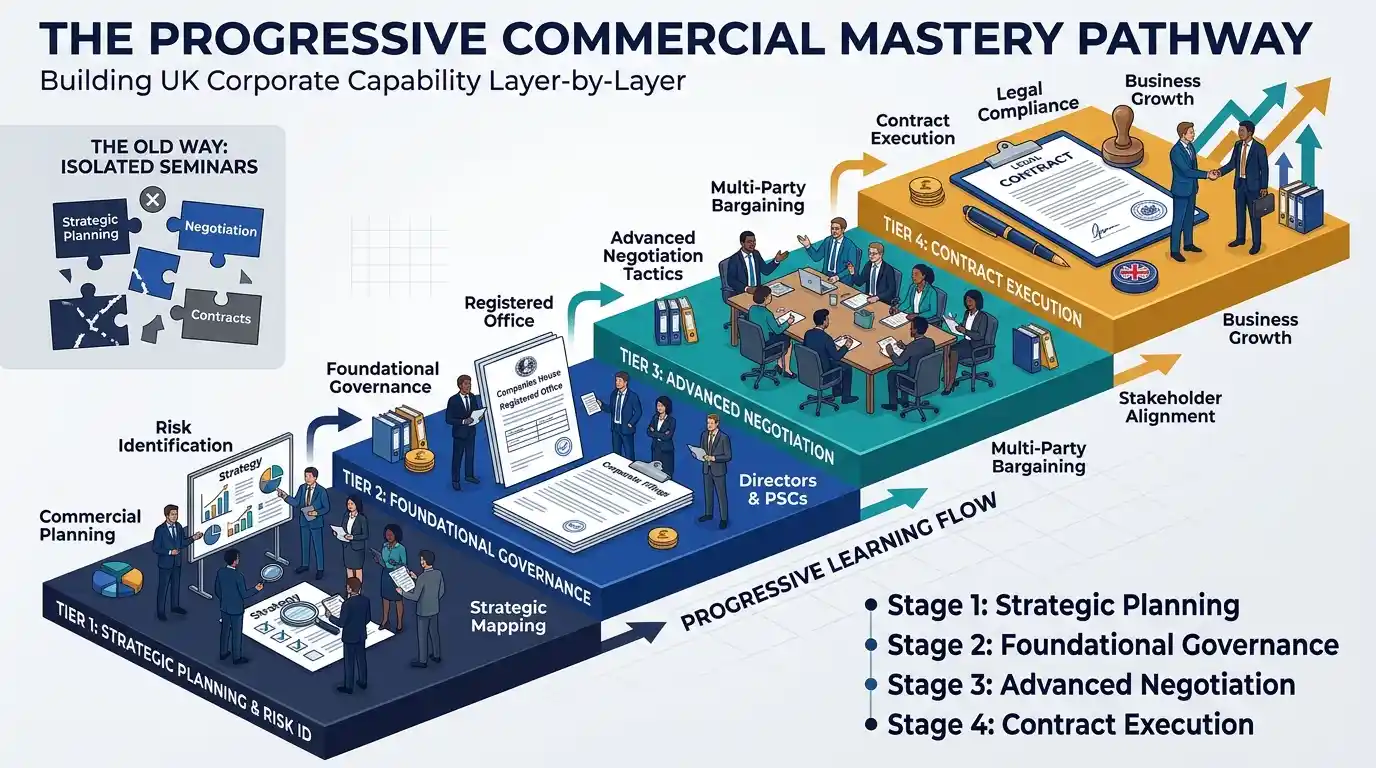
Commercial success in the energy industry requires a clear understanding of how early-stage strategic decisions dictate late-stage contract administration outcomes. If an asset development team miscalculates risk transfer during the initial tender phase, even exceptional project management cannot prevent margin contraction during execution.
The Institute For Oil & Gas Training structures the syllabus to reflect the exact lifecycle of oil and gas commercial agreements. Delegates first analyze structural risk models, then evaluate quantitative exposure, and finally practice negotiation execution through realistic industry scenarios. To evaluate specific risk metrics and negotiation tactics in detail, commercial teams routinely review How to Evaluate Contract Risks and Develop Effective Negotiation Strategies in Oil and Gas alongside formal coursework.
This pedagogical framework ensures that learning moves systematically from theoretical comprehension to practical workplace application, establishing a repeatable standard for commercial governance across joint ventures and major capital projects.
What Will Participants Learn During the Training Program?
What specific competencies, tactical methodologies, and analytical tools will delegates acquire upon completing this advanced commercial training syllabus? Participants acquire core competencies in petroleum contract risk management, quantitative risk assessment, dispute resolution, variation management, and strategic bargaining techniques. The curriculum delivers practical tools for constructing defensible risk matrices and leading high-value commercial negotiations.
The program is divided into five targeted instructional modules. Each module focuses on a critical operational phase within international oil and gas commercial administration:
Module 1: Strategic Contract Selection and Model Frameworks
Comparative evaluation of EPC, EPCM, Joint Venture, Concession, and Production Sharing Agreements.
Matching project risk profiles to appropriate contract delivery models to minimize corporate exposure.
Drafting scope of work specifications to prevent ambiguity and minimize late-stage contractor claims.
Aligning contracting strategy with corporate governance, local content requirements, and ESG standards.
Module 2: Petroleum Contract Risk Management and Quantitative Analysis
Establishing comprehensive risk identification protocols across technical, financial, and political domains.
Applying quantitative risk matrix models to calculate financial exposure and contingency reserves.
Structuring indemnities, liabilities, insurance provisions, and force majeure clauses effectively.
Designing risk-reward sharing mechanisms to align owner and contractor financial incentives.
Module 3: Oil and Gas Negotiation Strategies and Tactical Execution
Preparing multi-variable negotiation plans tailored for joint venture partners, contractors, and host governments.
Distinguishing between interest-based bargaining and positional negotiation tactics in high-stakes environments.
Countering aggressive commercial maneuvers, deadlock scenarios, and power imbalances during bargaining.
Executing negotiation simulations involving price adjustments, delay claims, and scope changes.
Module 4: Oil and Gas Contract Administration and Performance Control
Implementing rigorous contract monitoring systems to track performance key performance indicators (KPIs).
Managing variation orders, amendments, and scope alterations without compromising project baselines.
Establishing formal payment verification, milestone tracking, and retentions procedures.
Administering default provisions, termination rights, and transition protocols safely.
Module 5: Oil and Gas Contract Auditing and Dispute Resolution
Executing comprehensive Oil and Gas Contract Auditing procedures to identify cost overcharges and compliance breaches.
Establishing robust claim defense documentation and counter-claim strategies during project execution.
Utilizing Alternative Dispute Resolution (ADR) tools, including mediation, expert determination, and international arbitration.
Capturing post-project commercial lessons learned to update organizational contracting guidelines continuously.
How Is the Course Delivered Across Different Corporate Formats?
How does the Institute For Oil & Gas Training deliver this program to accommodate diverse corporate schedules, global locations, and organizational needs? The course is delivered through interactive face-to-face workshops, live virtual classrooms, tailored onsite corporate sessions, and blended hybrid formats. All options combine expert instruction, case study analysis, commercial simulations, and practical assessment tools.
The Institute For Oil & Gas Training provides flexible delivery modalities tailored to the operational demands of international energy organizations and busy commercial professionals:
Delivery Format | Structure & Duration | Ideal For | Key Features |
In-Person Workshops | Intensive 5-day classroom training at regional energy hubs | Individual delegates, senior managers, cross-functional leads | Direct peer interaction, physical negotiation role-plays, real-time instructor feedback |
Live Virtual Classrooms | 10 modular sessions over 2 to 3 weeks via interactive platform | Geographically dispersed teams, offshore personnel, remote workers | Flexible scheduling, digital breakout groups, recorded sessions for review |
Onsite Corporate Training | Customized 3-to-5-day programs delivered at client headquarters | Enterprise teams, business units, project task forces | Standardized team capability, client-specific contract analysis, customized case studies |
Blended Hybrid Learning | Self-paced digital modules combined with intensive live workshops | Organizations balancing ongoing project duties with skill building | Foundational online prep followed by high-impact practical negotiation simulations |
Regardless of format, every delivery model incorporates real-world energy sector case studies, live contract drafting audits, and multi-party negotiation exercises. Participants receive comprehensive course materials, risk calculation templates, and diagnostic checklists ready for immediate workplace deployment.
What Measurable Performance Results Can Organizations Expect?
What tangible improvements in operational performance, cost control, and project execution can human resources leads and executive managers expect after training? Organizations achieve measurable reductions in contract dispute costs, improved compliance accuracy, reduced procurement cycle times, and enhanced margin retention. Trainees consistently demonstrate superior capability in negotiating favorable commercial terms and managing scope variations.
When corporate human resource departments and enterprise division heads sponsor teams through the Institute For Oil & Gas Training, they establish a standardized commercial governance benchmark across their operations.
Key Quantitative and Qualitative Business Impacts
Enhanced Cost Control: Participants master techniques to eliminate non-conforming invoices, unapproved variation requests, and inflated contractor claims during auditing reviews.
Risk Mitigation: Teams systematically identify high-impact contractual vulnerabilities prior to signing, preventing unmitigated financial liability exposure.
Streamlined Negotiation Timelines: Commercial leads leverage structured bargaining frameworks to finalize high-value agreements faster without sacrificing critical contract protections.
Cross-Functional Alignment: Operations, legal, and procurement departments gain a shared vocabulary and standardized process for managing supplier performance and contract compliance.
Leadership Pipeline Development: High-potential engineering and operational personnel build the commercial capability required to step into senior project director roles seamlessly.
By instilling rigorous Petroleum Contract Risk Management standards, organizations turn their commercial management function into a predictable driver of project profitability and risk control.
Who Should Attend and How Does the Enrollment Process Work?
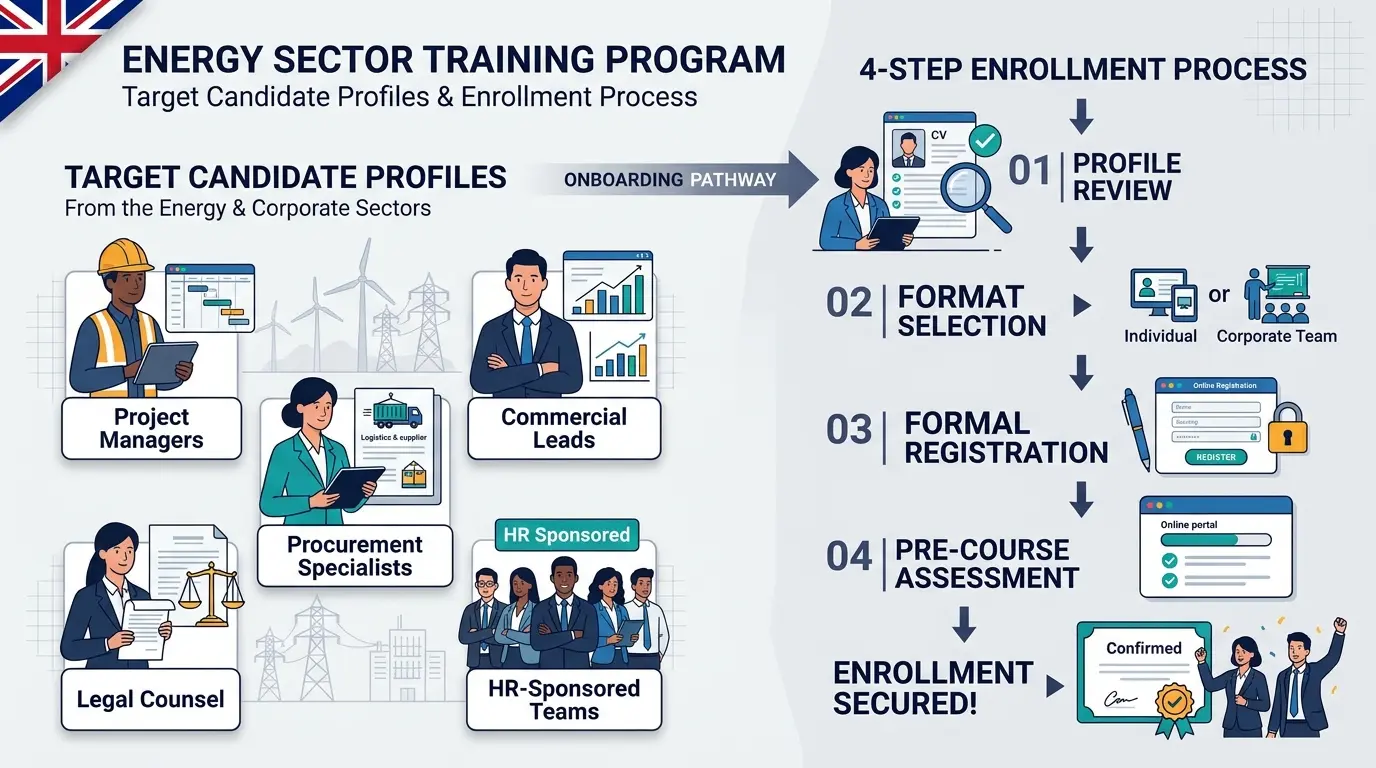
What are the entry prerequisites, target candidate profiles, and procedural steps required to secure individual or team enrollment in this program? The program is designed for project managers, commercial leads, procurement specialists, legal counsel, and HR-sponsored corporate teams within the energy sector. Enrollment involves profile review, course format selection, formal registration, and pre-course assessment.
Eligibility and Target Roles
This course is structured specifically for professionals operating within upstream, midstream, and downstream energy sectors, as well as service enterprise environments. Recommended candidate roles include:
Project Directors and Managers: Responsible for overall project execution, budget integrity, and contractor performance control.
Commercial and Procurement Leads: Tasked with structuring supply chain strategies, drafting tender documents, and managing supplier selection.
Contract Administrators and Engineers: Directing daily contract execution, reviewing variation orders, and managing claims workflows.
Legal Counsel and Compliance Officers: Drafting contract clauses, managing corporate risk exposure, and resolving dispute escalations.
Supply Chain and Logistics Managers: Overseeing major equipment manufacturing procurement, logistics agreements, and vendor compliance.
HR and L&D Teams: Sponsoring cross-functional personnel to build strategic corporate capability and management succession pipelines.
Enrollment and Completion Pathway
Application Submission: Candidates or corporate HR representatives select their preferred delivery format and submit candidate background profiles.
Profile Review: Admissions advisors at the Institute For Oil & Gas Training review professional experience to ensure peer-group compatibility and appropriate baseline knowledge.
Pre-Course Assessment: Enrolled participants complete a diagnostic self-assessment to identify specific skill gaps and contextualize commercial training objectives.
Interactive Delivery: Participants complete theoretical modules, diagnostic case studies, and practical negotiation exercises under expert guidance.
Practical Assessment and Certification: Delegates execute a final comprehensive contract audit and negotiation capstone simulation. Successful candidates receive a formal Certificate of Completion from the Institute For Oil & Gas Training.
To secure seat availability for upcoming enterprise cohorts or individual professional development tracks, teams should submit applications early. Contact your corporate training coordinator today to review the syllabus and apply for course access.
Frequently Asked Questions
What are the main types of Oil & Gas Petroleum Contracts used in the industry?
The primary agreements include Concession Contracts, Production Sharing Contracts (PSCs), Joint Operating Agreements (JOAs), and Service Contracts such as EPC and EPCM frameworks. Each contract model allocates financial exposure, operational control, and resource ownership differently between host governments and international oil companies. Training programs by the Institute For Oil & Gas Training help commercial leads evaluate and select the appropriate legal framework for specific asset development risks.
How do organizations manage risk in Oil & Gas Petroleum Contracts?
Risk management involves identifying technical, political, and commercial uncertainties early to structure appropriate liability limits, indemnities, and insurance provisions. Project teams utilize quantitative risk matrices and clear variation control procedures to prevent budget overruns and operational scope creep. The Institute For Oil & Gas Training provides structured methodologies for auditing agreements and implementing effective petroleum contract risk management frameworks.
What is the role of Joint Operating Agreements in petroleum contract administration?
A Joint Operating Agreement (JOA) governs the working relationship, cost sharing, and decision-making rules among joint venture partners sharing an oil and gas block. It establishes voting rights, sole-risk operations, operator duties, and default procedures to ensure fair governance throughout the asset lifecycle. Proper administration of Oil & Gas Petroleum Contracts ensures all joint venture participants remain aligned with regulatory and operational standards.
Why is contract auditing necessary for energy projects?
Contract auditing identifies financial discrepancies, unauthorized cost allocations, and compliance breaches before they cause severe margin erosion or legal disputes. Regular audits verify that billing, variation claims, and operational milestones align strictly with agreed commercial terms. Through specialized training at the Institute For Oil & Gas Training, procurement and commercial professionals learn to execute thorough audit protocols that protect project cash flows.
How are dispute resolution clauses structured in petroleum agreements?
Dispute resolution mechanisms in Oil & Gas Petroleum Contracts typically follow a tiered approach, starting with executive negotiation and mediation before advancing to binding international arbitration. Clear provisions for governing law and expert determination help resolve technical and financial disagreements without halting ongoing field operations. Developing structured negotiation strategies enables commercial teams to settle claims early and avoid costly formal arbitration proceedings.
Related training courses
Contract Compliance: Obligation Extraction & Monitoring Training Course
- Specialisation
- Oil & Gas Petroleum Contracts
- Duration
- 5 days · 13 CPD hours
Contract Compliance for Day-Rate Agreements & Claims Training Course
- Specialisation
- Oil & Gas Petroleum Contracts
- Duration
- 5 days · 15 CPD hours
Contract Strategy, Risk and Negotiation Training Course
- Specialisation
- Oil & Gas Petroleum Contracts
- Duration
- 5 days · 15 CPD hours
More articles

CAPEX vs OPEX Impact on Cost Recovery Training by Institute For Oil & Gas Training
Evaluate the CAPEX vs OPEX Impact on Cost Recovery Training by Institute For Oil & Gas Training. Learn modules, structure, outcomes, and enrollment details.
Read article →
How to Assess the Impact of CAPEX and OPEX Classification on Petroleum Cost Recovery
Learn how to assess CAPEX and OPEX classification in petroleum cost recovery. Evaluate audit risks, cash flow effects, and joint venture compliance.
Read article →
Why CAPEX and OPEX Classification Affects Cost Recovery in Oil and Gas
Learn how CAPEX and OPEX classification dictates cost recovery mechanisms, cash flow velocity, and regulatory compliance in upstream petroleum accounting.
Read article →