

Contract strategy and risk management in oil and gas projects is the systematic framework used to allocate financial, operational, and legal obligations across project stakeholders to prevent cost overruns, schedule delays, regulatory non-compliance, and catastrophic supply chain failures.
Commercial success in the energy sector depends directly on how capital projects structure obligations between operators, engineering, procurement, and construction contractors, and service vendors. A robust contract strategy establishes the commercial governance structure, selecting appropriate pricing models such as lump sum turnkey, cost-reimbursable, or target cost contracts based on project complexity and market conditions. Risk management within these agreements identifies potential points of failure, including volatile commodity prices, geopolitical instability, environmental liabilities, and joint venture disputes.
Organisations that implement formal contract strategies reduce project cost variances by 15% to 25% across multi-year asset development cycles. The discipline integrates legal provisions with engineering requirements, commercial milestones, and health, safety, and environmental standards. Without a clear contract strategy, energy companies face unquantified exposure to claims, scope creep, and extended litigation. Building internal competence in contract design ensures project execution matches financial expectations and corporate governance mandates.
Why Do Energy Organisations Experience Severe Contractual Failures?
Energy organisations experience contractual failures due to severe employee skill gaps in risk identification, inadequate commercial literacy among technical managers, reliance on generic contract templates, and weak post-award administration processes across complex multi-stakeholder capital projects.
Capital projects in upstream, midstream, and downstream sectors involve hundreds of active subcontracts, joint venture agreements, and regulatory mandates. A primary cause of project failure is the disconnect between engineering teams and commercial managers. Technical experts often approve design modifications without evaluating the contractual mechanics of change orders, resulting in unbudgeted expenditures and dispute cycles that delay asset commissioning by 6 to 18 months.
Misaligned commercial strategies also create systemic vulnerabilities. For instance, selecting a lump sum contract for a high-risk deepwater exploration project transfers excessive risk to contractors, leading to contractor insolvency or abandoned work scopes. Conversely, using cost-plus structures without rigorous auditing frameworks results in inflated overhead costs and diminished project returns.
Standard corporate training programs often fail because they treat contract management as a static legal function rather than a dynamic operational discipline. Employees must understand how to read, monitor, and enforce terms in real time. Organizations missing structured commercial capability frameworks regularly suffer margin erosion exceeding 30% on mega-projects.
How Does Commercial Contract Training Work in Corporate Environments?
Corporate commercial contract training works through a structured, multi-stage delivery framework that assesses current organisational skill gaps, delivers practical scenario-based instruction, and integrates real-world capital project assets into practical learning modules.
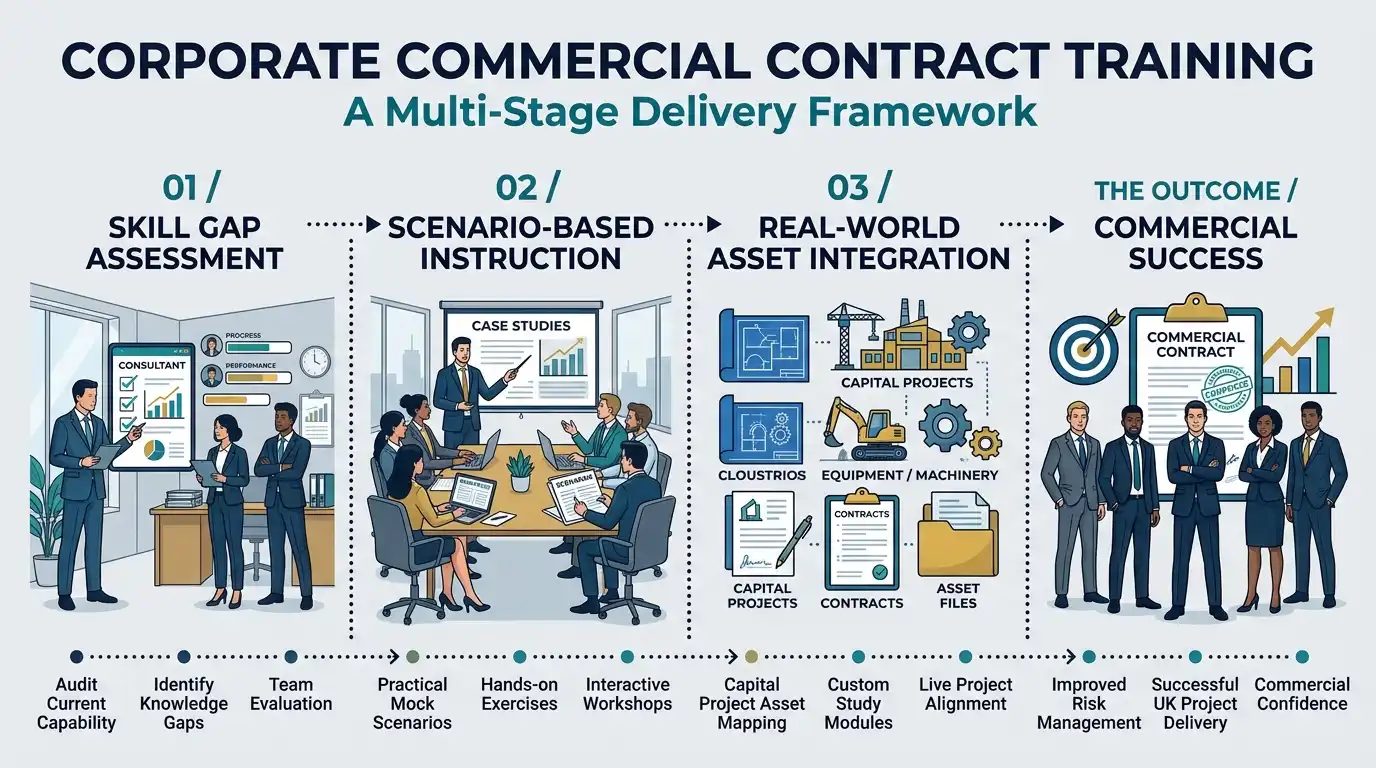
Implementation begins with an initial competency assessment across legal, procurement, project control, and engineering departments. This baseline analysis identifies specific weaknesses in contract drafting, claim defense, risk mitigation, and variation management.
The training framework is delivered over structured timelines, such as 3-day intensive executive masterclasses or 6-week hybrid learning programs combining online self-paced modules with live virtual workshops. Organisations implement these programs through cohort-based learning, pairing technical engineers with commercial managers to mirror project team dynamics.
Training delivery relies on active learning methodologies rather than passive instruction:
Case-Based Learning: Analysis of real-world project failures, such as offshore rig construction delays or pipeline EPC disputes, isolating the root contractual causes.
Simulations: Interactive negotiations where teams represent operators, prime contractors, and suppliers to experience how commercial terms affect risk distribution.
Role Play Exercises: Simulated dispute resolution boards and variation committee meetings to practice managing formal claim submissions.
Practical Assessments: Pre-course and post-course evaluations testing quantitative risk scoring, clause interpretation, and contract auditing techniques.
Organisations embed these delivery formats into broader workforce development initiatives, establishing clear progression paths for project managers, commercial directors, and procurement specialists.
What Core Components Make Up an Effective Contract Strategy Program?
An effective contract strategy program comprises targeted commercial skill modules, structured risk evaluation frameworks, legal clause analysis tools, and formal delivery formats tailored to high-capital energy developments.
A comprehensive curriculum covers the entire project lifecycle, moving from pre-tender strategy selection to post-award closeout. The primary capabilities developed within a enterprise-grade training program include:
1. Strategic Contract Selection Frameworks
Organisations must train teams to evaluate project parameters such as scope clarity, market capacity, schedule urgency, and technology readiness. Participants learn to select, adapt, and combine standard international contract forms, including FIDIC, LOGIC, NEC, and bespoke joint-operating agreements (JOAs).
2. Quantitative Risk Identification and Allocation
Training equips professionals with matrix models to score risk likelihood and financial severity. Teams master allocating risks to the party best suited to manage them, preventing inflated contingency pricing from contractors.
3. Commercial Negotiation Frameworks
Professionals learn to execute structured negotiation plans. This includes setting target positions, identifying trade-offs, managing BATNA (Best Alternative to a Negotiated Agreement), and securing favorable commercial terms without compromising supplier relationships.
4. Post-Award Administration and Auditing
Modules focus on active contract tracking, variation control systems, force majeure protocols, indemnities, parent company guarantees, and liquidated damages administration.
5. Essential Tools and Artifacts
Participants receive practical toolkits, including:
Risk Allocation Matrices (RAM)
Change Order Evaluation Checklists
Claim Verification Worksheets
Subcontractor Compliance Dashboards
To read a detailed breakdown on implementing these auditing tools, structuring negotiation positions, and analyzing specific clause risks before tender execution, consult our complete guide on How to Evaluate Contract Risks and Develop Effective Negotiation Strategies in Oil and Gas.
How Do Enterprise Organisations Implement Contract Capability Training?
Enterprise organisations implement contract capability training by integrating structured learning frameworks directly into project execution workflows, aligning training milestones with capital expenditure stages, and standardizing procurement processes across international operating units.
Implementation begins by identifying target employee cohorts across functional departments:
Procurement and Supply Chain Teams: Focus on market intelligence, vendor qualification, and contract drafting mechanics.
Project Managers and Site Engineers: Focus on variation monitoring, daily logging, claim prevention, and scope control.
Legal and Commercial Counsel: Focus on dispute resolution mechanisms, international arbitration rules, and liability caps.
Commercial Directors and Executive Sponsors: Focus on portfolio risk balance, joint venture alignment, and high-stakes negotiation.
Organisations adopt hybrid delivery models to maximize operational efficiency. Theoretical concepts and clause mechanics are delivered via asynchronous online learning modules, allowing international staff at offshore facilities or remote field operations to progress independently. Intensive, hands-on workshops are conducted in-person or via live virtual classrooms, where cross-functional teams collaborate on live contract documents.
To ensure long-term skill retention, companies embed learning outcomes directly into performance management systems. Employees earn internal certifications upon demonstrating competency in managing live contract scenarios. Organisations also establish central Knowledge Repositories containing standardized contract templates, clause libraries, and risk management guidelines developed during training workshops.
Standardizing contract training across regional divisions eliminates operational silos. Whether operating in deepwater basins, LNG processing facilities, or downstream refineries, unified teams apply identical contract administration protocols, reducing operational friction and administrative overhead.
What Measurable Outcomes Does Contract Management Training Produce?
Contract management training produces measurable business outcomes, including an 80% reduction in unrecoverable variation claims, a 20% decrease in project procurement lead times, and significant improvements in profit margin protection across capital projects.
Workforce capability directly dictates financial performance. When organisations invest in targeted commercial training, outcomes are reflected in clear key performance indicators (KPIs) and return on investment (ROI) metrics:
Performance Metric | Baseline Pre-Training | Post-Implementation Outcome | Business Impact |
Variation Claim Recovery Rate | 45% approved without dispute | 85% approved within 30 days | Prevents budget overruns and preserves operator-contractor relationships. |
Contract Dispute Frequency | 4.2 formal disputes per major project | Less than 1.0 dispute per project | Saves millions in legal representation and international arbitration fees. |
Procurement Cycle Time | 120 days from tender to award | 90 days from tender to award | Accelerates time-to-first-oil or facility commissioning dates. |
Unplanned Change Order Costs | 18% of total project expenditure | Less than 5% of project expenditure | Directly protects corporate profit margins and capital efficiency. |
Employee Retention in Commercial Roles | 72% annual retention rate | 91% annual retention rate | Reduces recruitment costs and preserves institutional knowledge. |
Corporate training programs transform contract administration from a reactive reactive administrative task into a proactive value-creation lever. Teams identify potential schedule slippages early, issue timely notices, and negotiate equitable adjustments before minor scope additions turn into major financial disputes.
Organisations track training ROI by evaluating project audit reports 6, 12, and 24 months post-training. Consistently, teams that complete formal commercial instruction demonstrate superior cost control, zero critical compliance breaches, and higher safety performance scores due to clearer subcontractor management.
What Are Common Misconceptions About Contract Strategy Training?
Common misconceptions about contract strategy training include believing that contract management is strictly a legal function, assuming standard legal degrees cover capital project administration, and viewing generic off-the-shelf business courses as sufficient for complex energy developments.
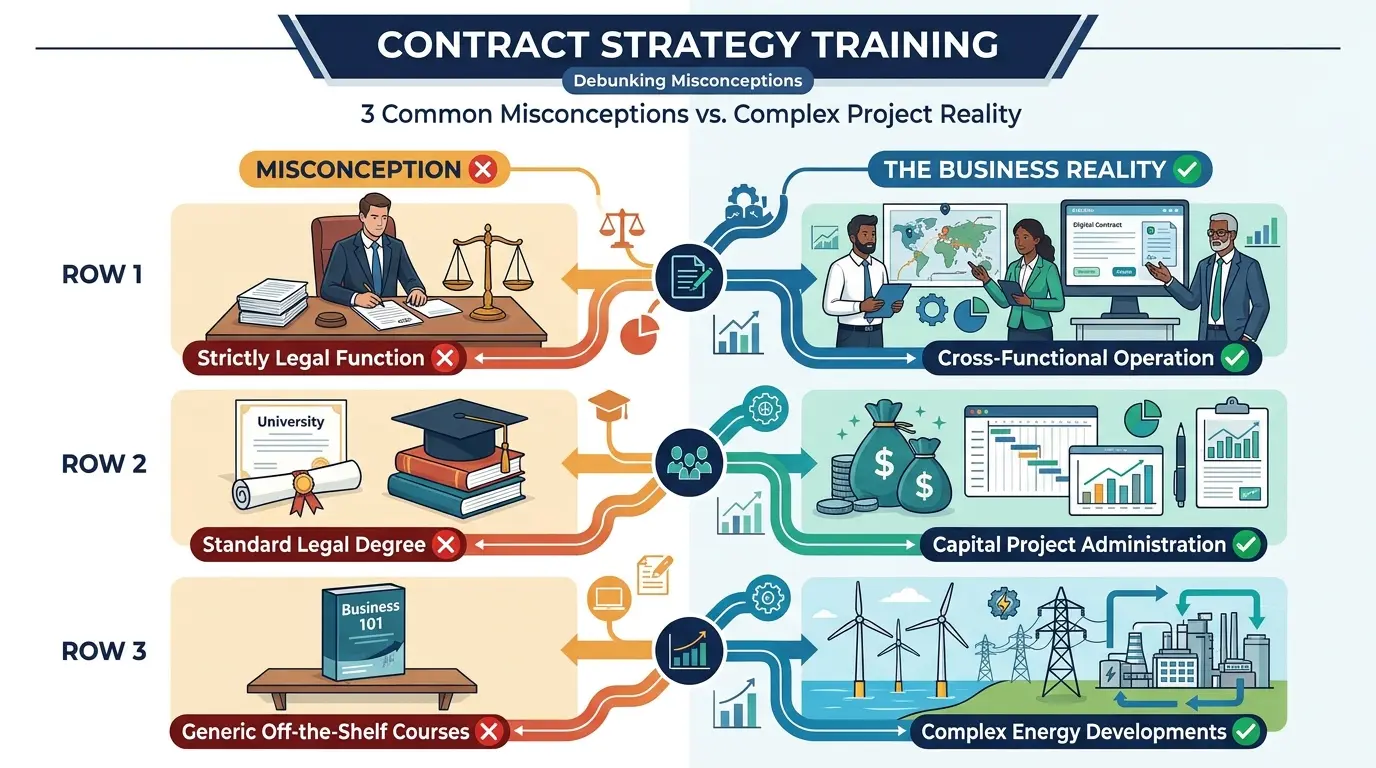
Addressing these misconceptions is essential for decision-makers building workforce development plans:
Misconception 1: "Contract management belongs solely to the Legal Department."
Reality: Legal teams draft terms, but field engineers, procurement specialists, and project managers administer contracts daily. If site personnel do not understand contractual obligations, legal provisions become unenforceable. Broad commercial literacy across technical teams is mandatory.
Misconception 2: "Standard legal and business degrees prepare managers for energy projects."
Reality: General business education rarely covers specific energy sector dynamics, such as split-EPCIC structures, farm-in/farm-out arrangements, production sharing contracts (PSCs), or severe weather force majeure provisions. Specialized, domain-specific instruction is required.
Misconception 3: "Off-the-shelf commercial training courses deliver actionable results."
Reality: Generic training modules lack sector-specific context. Effective capability development uses authentic energy case studies, real contract forms, and scenarios reflecting actual market conditions in offshore exploration, LNG export, or refining infrastructure.
Misconception 4: "Contract training is a one-time onboarding event."
Reality: Regulatory environments, supply chain dynamics, and market conditions shift continuously. Ongoing professional development ensures teams adapt to emerging challenges, such as energy transition terms, carbon capture contract structures, and evolving ESG compliance mandates.
To build structured commercial capabilities across your project teams, explore our specialized Contract Strategy, Risk and Negotiation Training Course designed for energy sector professionals.
Frequently Asked Questions
What are the main types of Oil & Gas Petroleum Contracts?
The primary types of Oil & Gas Petroleum Contracts include Concession Agreements, Production Sharing Contracts (PSCs), Service Contracts, and Joint Operating Agreements (JOAs). Each framework defines how exploration rights, financial risks, production revenues, and operational control are distributed between host governments and international oil companies. Institute For Oil & Gas Training provides professional development to help commercial teams navigate and administer these distinct contractual models effectively.
Why is risk management critical in petroleum contracting?
Risk management in petroleum contracting prevents severe cost overruns, schedule delays, legal disputes, and regulatory non-compliance across complex capital projects. Unmanaged risks in price volatility, environmental liabilities, or joint venture operations can rapidly erode project profit margins. Specialized training from Institute For Oil & Gas Training equips industry professionals with quantitative tools to identify, allocate, and mitigate operational and legal exposures within Oil & Gas Petroleum Contracts.
How do Production Sharing Contracts differ from Joint Operating Agreements?
A Production Sharing Contract (PSC) is an agreement between a host government and a contractor, where the contractor bears financial risk in exchange for a share of produced hydrocarbons. In contrast, a Joint Operating Agreement (JOA) governs the internal relationship, cost-sharing, and decision-making powers among multiple co-venturers working on a single license. Professionals trained by Institute For Oil & Gas Training learn how to negotiate and manage the operational mechanics of both contractual structures across international jurisdictions.
What key skills are required to negotiate Oil & Gas Petroleum Contracts?
Successful negotiation of Oil & Gas Petroleum Contracts requires commercial literacy, deep knowledge of international energy law, financial modeling expertise, and strategic risk allocation techniques. Negotiators must understand fiscal terms, variation management, force majeure provisions, and dispute resolution mechanisms. Institute For Oil & Gas Training builds these core capabilities through practical, scenario-based programs designed for project leaders, commercial directors, and procurement managers.
How can organisations improve their contract administration in energy projects?
Organisations improve contract administration by bridging the skill gap between technical engineering teams and commercial managers through structured capability building. Standardising variation monitoring, audit protocols, and post-award claims management ensures compliance with original agreement terms. Institute For Oil & Gas Training delivers targeted workforce programs that transform traditional contract governance into a proactive driver of project ROI and operational efficiency.
Related training courses
Contract Compliance for Day-Rate Agreements & Claims Training Course
- Specialisation
- Oil & Gas Petroleum Contracts
- Duration
- 5 days · 15 CPD hours
Contract Compliance Across JOAs, PSCs & HGAs Training Course
- Specialisation
- Oil & Gas Petroleum Contracts
- Duration
- 5 days · 15 CPD hours
Contract Strategy, Risk and Negotiation Training Course
- Specialisation
- Oil & Gas Petroleum Contracts
- Duration
- 5 days · 15 CPD hours
More articles

CAPEX vs OPEX Impact on Cost Recovery Training by Institute For Oil & Gas Training
Evaluate the CAPEX vs OPEX Impact on Cost Recovery Training by Institute For Oil & Gas Training. Learn modules, structure, outcomes, and enrollment details.
Read article →
How to Assess the Impact of CAPEX and OPEX Classification on Petroleum Cost Recovery
Learn how to assess CAPEX and OPEX classification in petroleum cost recovery. Evaluate audit risks, cash flow effects, and joint venture compliance.
Read article →
Why CAPEX and OPEX Classification Affects Cost Recovery in Oil and Gas
Learn how CAPEX and OPEX classification dictates cost recovery mechanisms, cash flow velocity, and regulatory compliance in upstream petroleum accounting.
Read article →