
Establishing and managing cost baselines for field development projects requires a structured framework that connects early engineering estimates with operational expenditure controls. Capital-intensive energy developments demand rigorous front end loading, clear stage gate definitions, and continuous deviation tracking to prevent budget inflation.
Managing capital allocation effectively across multi-year asset lifecycles depends entirely on early project alignment. Understanding Why Cost Baselines Matter in Oil and Gas Field Development Projects provides the essential context for why operators must move away from static budget spreadsheets toward dynamic control systems.
What Is a Project Cost Baseline in Field Development?
A project cost baseline is an approved, time-phased budget used to measure, monitor, and control overall financial performance throughout the field development lifecycle. It incorporates direct costs, indirect expenses, escalation, and management reserves to evaluate scope changes accurately.
The project cost baseline acts as the definitive benchmark against which all future financial progress is measured. In upstream capital projects, establishing this reference point requires integrating engineering scope estimates with project schedule timelines. A static cost figure without a time element fails to reflect cash flow dynamics, currency fluctuations, or market inflation across extended development windows.
An accurate baseline relies on precise cost estimate classification aligned with the Association for Advancement of Cost Engineering international standards. Early feasibility phases operate on Class 5 or Class 4 estimates with broad accuracy ranges. By the time a project reaches Final Investment Decision, the baseline must reflect a Class 2 estimate, backed by firm vendor quotes and detailed FEED data.
Establishing this framework requires structured execution parameters:
Work Breakdown Structure Integration: Mapping every cost element to specific physical deliverables, from subsea manifolds to topside processing units.
Time-Phased Expenditure Profile: Distributing estimated capital across specific financial quarters to track cash flow against physical progress earned.
Contingency Allocation: Separating technical risk contingency from management reserves to ensure clear drawdown authority during execution.
Organizations that train project controls teams to build structured baselines eliminate ambiguity early, preventing costly scope growth during procurement and construction phases.
How Does Front End Loading Influence Cost Baseline Accuracy?
Front end loading improves cost baseline accuracy by identifying risks, refining engineering definitions, and locking scope parameters before committing major capital expenditure. High front end loading maturity directly correlates with reduced cost growth and minimal schedule overrun during offshore execution.
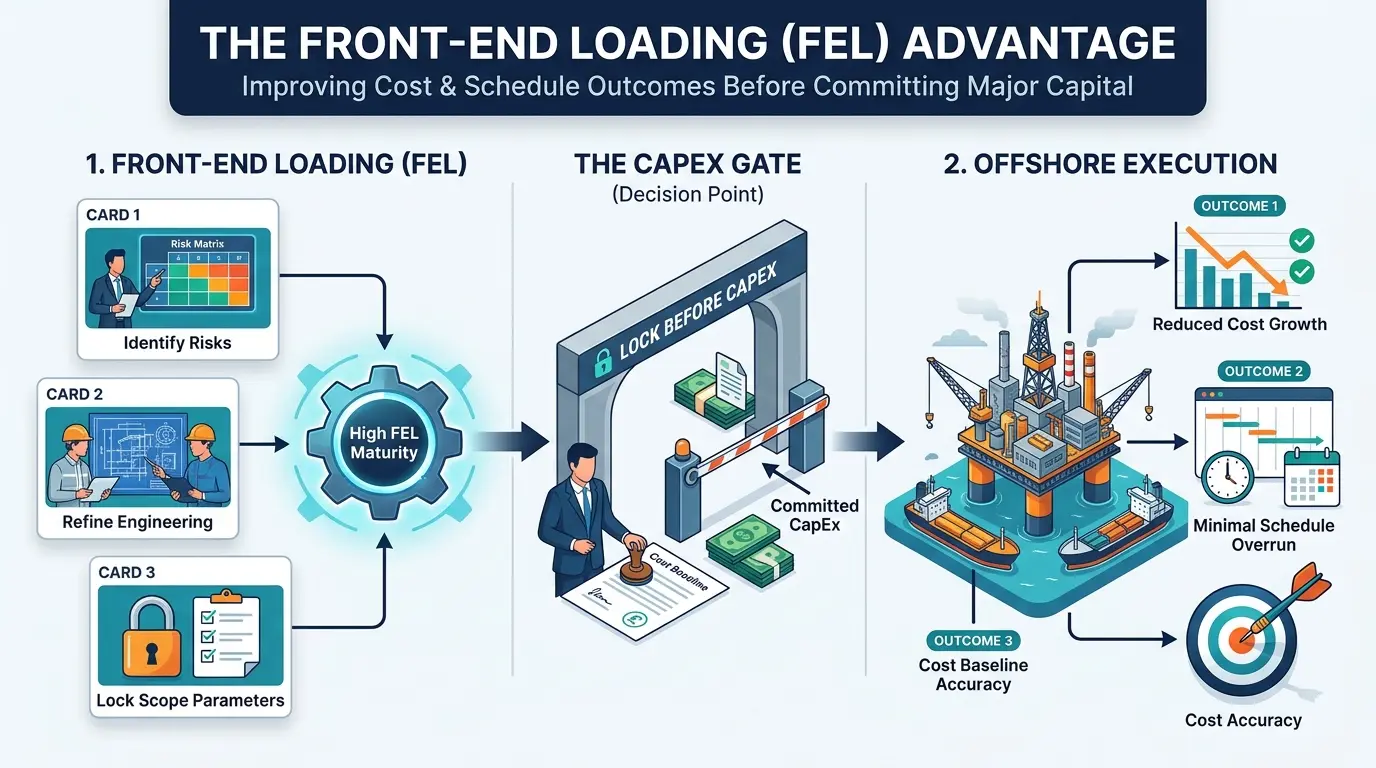
Front end loading serves as the operational foundation for capital efficiency in upstream developments. During the early concept selection and definition phases, the influence over final lifecycle costs is highest, while the cost of design changes is lowest. Attempting to establish a cost baseline without adequate engineering definition introduces unmanageable variance into the execution phase.
A robust early definition strategy requires rigorous benchmarking of project costs against regional industry metrics. Estimators compare proposed capital expenditures with historic metrics from similar basin developments. This comparison validates assumptions regarding offshore installation rates, subsea hardware costs, and fabrication man-hours before fixing the baseline.
Inadequate early definition forces project teams to rely on padded contingencies rather than engineering precision. Organizations addressing workforce skill gaps in front end definition equip their engineers to challenge scope assumptions early, leading to realistic financial commitments.
How Do Stage Gate Processes Maintain Cost Control Across Project Phases?
Stage gate processes enforce financial governance by requiring project teams to meet strict definition quality standards before passing financial gates. Each gate approval locks the previous baseline, allowing management to review variance, reassess economic viability, and approve updated capital allocations.
Implementing stage gate cost control prevents projects from advancing to high-spend execution phases without sufficient financial definition. Each stage gate serves as a formal governance checkpoint where executive leadership reviews project performance against initial strategic objectives.
Gate 1 (Concept Selection): Evaluates alternative development concepts and establishes an initial Class 5 benchmark.
Gate 2 (FEED Entry): Validates the preferred technical option and approves funding for detailed engineering design.
Gate 3 (Final Investment Decision): Locks the definitive Class 2 baseline and commits capital for procurement, construction, and commissioning.
Gate 4 (Handover to Operations): Reconciles final expenditures against the sanctioned baseline and transfers financial accountability to production teams.
At each gate, project management teams evaluate the alignment between technical scope, execution schedules, and market pricing. If a project exceeds cost variance thresholds at a gate review, the governance board halts progress until scope optimization or re-baselining occurs.
How Do Project Controls Integrate Cost and Schedule Baselines?
Integrating cost and schedule baselines links financial expenditure directly to physical work progress through earned value management frameworks. This integration enables project managers to detect productivity deviations, forecast final costs at completion, and take corrective action early.
A standalone cost plan cannot provide actionable performance data without timeline integration. Schedule and cost integration structures project data so that every dollar spent aligns with a specific activity duration and physical outcome. This alignment underpins Earned Value Management, combining Planned Value, Earned Value, and Actual Cost metrics into clear performance indexes.
The project controls function relies on integrated data to calculate key indicators:
$$\text{Cost Performance Index (CPI)} = \frac{\text{Earned Value (EV)}}{\text{Actual Cost (AC)}}$$
$$\text{Schedule Performance Index (SPI)} = \frac{\text{Earned Value (EV)}}{\text{Planned Value (PV)}}$$
A CPI below $1.0$ signals budget overruns, while an SPI below $1.0$ indicates execution delay. When project teams continuously track these metrics, they spot operational inefficiencies long before financial reporting cycles reveal overruns.
Deploying integrated controls requires cross-functional capability. Cost engineers, planning specialists, and field managers must operate within shared data structures to ensure schedule delays trigger immediate financial re-forecasting.
How Does Change Control Prevent Baseline Inflation During Execution?
Change control prevents baseline inflation by establishing formal procedures to document, evaluate, approve, or reject any modification to project scope, budget, or timeline. It ensures that only authorized scope adjustments alter the sanctioned project baseline.
Uncontrolled scope growth poses the single largest threat to field development capital targets. A robust change control process ensures that every proposed modification undergoes technical, safety, schedule, and financial evaluation before implementation.
The process relies on a dynamic trend and deviation register to capture early indicators of variance. Unlike completed change orders, trends represent potential future variances—such as unexpected soil conditions, fabrication delays, or material price increases—that require proactive mitigation.
Identification: Site engineers capture physical deviations or contractor claims as soon as they arise.
Quantification: Estimators assign potential cost and schedule impacts to the identified trend.
Mitification: Project managers develop workaround strategies to offset potential cost growth.
Disposition: The Change Control Board formally approves, rejects, or defers the scope adjustment.
Failing to maintain strict change control corrupts the baseline, rendering progress metrics meaningless. Structured organizational capabilities in change administration protect original investment returns by keeping scope additions visible and manageable.
Which Training Approaches Build Effective Cost Control Capabilities?
Effective cost control capabilities depend on practical, case-based training programs that align engineering workflows with financial governance principles. Professional corporate instruction bridges technical design decisions with measurable commercial outcomes across project teams.
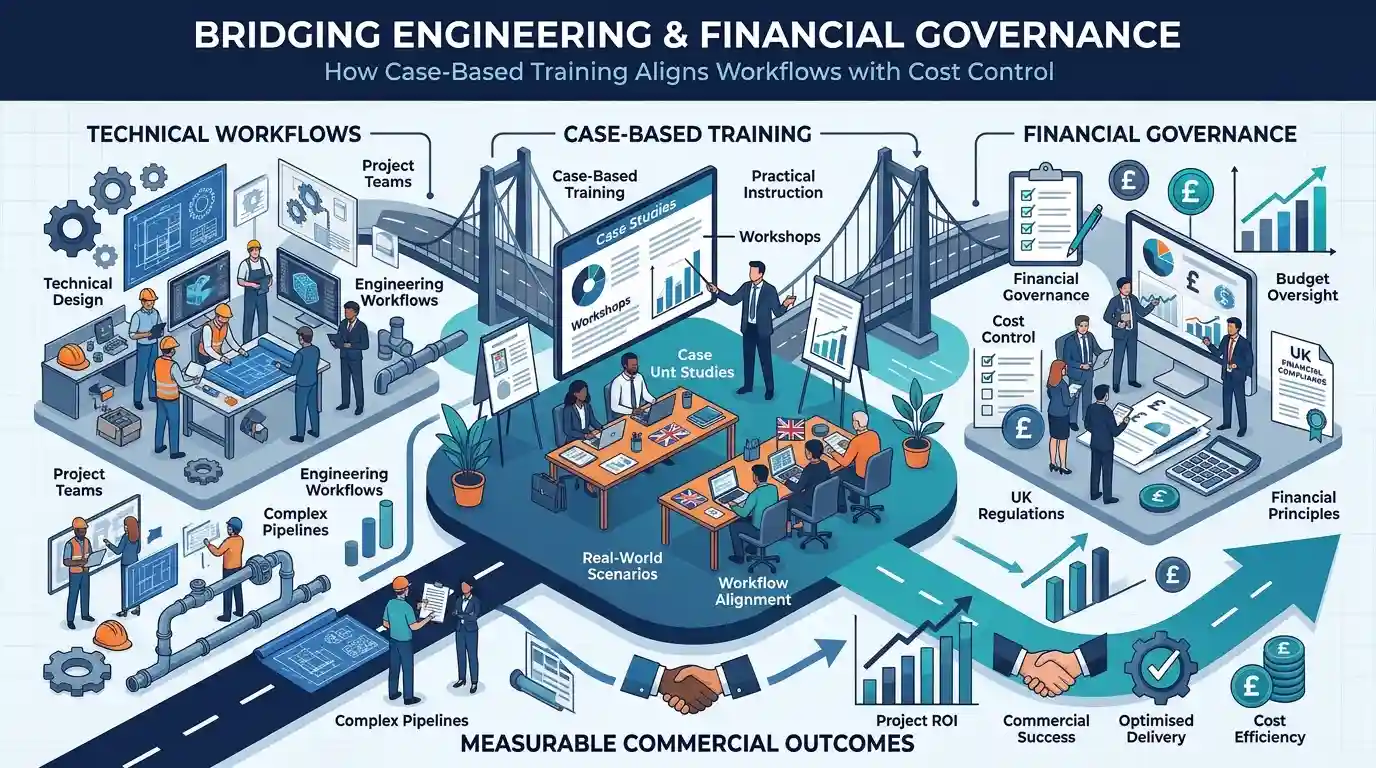
Developing organizational competency in capital management requires moving beyond theoretical finance courses. Project leaders, discipline engineers, and commercial managers need practical tools to handle complex field development variables.
When evaluating professional development models, enterprise HR teams and operational directors must compare delivery methods against business requirements:
Delivery Framework | Execution Methodology | Strengths | Strategic Business Application |
Self-Paced Online Modules | Independent, asynchronous learning covering general principles. | Low cost per head, flexible scheduling. | Broad foundational awareness for junior personnel. |
Academic Certification | Multi-month theoretical coverage of cost engineering theory. | Deep theoretical knowledge, academic accreditation. | Long-term career specialization paths. |
Applied Corporate Workshop | Intensive, scenario-based training using real-world field data. | Immediate skill application, team alignment. | Rapid capability building for active development teams. |
Corporate teams facing active field development schedules benefit most from applied training models that mirror actual project gate reviews, baseline setups, and trend evaluations. Specialized instruction like the Cost Control for Field Development Projects: Cost Baselines Training Course provides project personnel with hands-on exposure to baseline construction and variance tracking tools.
HR directors evaluating workforce development strategies should assess whether learning frameworks address internal skill gaps in cost estimation, schedule integration, and change management. Investing in practical, industry-aligned training directly impacts project execution by reducing financial leakage during active offshore or onshore campaigns.
How Should Organizations Select the Right Cost Control Training Framework?
Selecting the right cost control training framework involves assessing project complexity, team skill maturity, software capabilities, and organizational governance structures. The chosen solution must deliver practical capabilities that directly improve project predictability and capital efficiency.
Choosing an appropriate training approach requires HR leaders and project directors to evaluate learning options against clear operational criteria. A generic cost management course rarely addresses the specific risk profiles, contracting strategies, and stage gate requirements of field development projects.
Evaluating workforce learning strategies requires a clear evaluation framework:
Evaluation Attribute | Lower-Capability Options | Advanced Enterprise Solutions |
Industry Relevance | Generic construction/manufacturing focus. | Tailored upstream oil and gas workflows. |
Data Integration | Isolated cost tracking exercises. | Fully integrated cost-schedule-scope models. |
Practical Application | Multiple-choice knowledge tests. | Real-world field development scenario analysis. |
Governance Alignment | General accounting principles. | Standardized stage gate and change control protocols. |
Organizations preparing for major capital projects must select training solutions that match their operational scale. Structured corporate programs—such as specialized Cost Control for Field Development Projects Cost Baselines Training by Institute For Oil & Gas Training—deliver the targeted expertise required to align multi-disciplinary project teams around unified capital control frameworks.
Selecting targeted, industry-driven training ensures that engineering, planning, and finance departments share a common operational language, strengthening cost control performance across every stage of asset development.
Frequently Asked Questions
What is covered in the Oil & Gas Petroleum Budgeting & Cost Control training program?
The Oil & Gas Petroleum Budgeting & Cost Control training program delivered by the Institute For Oil & Gas Training covers essential financial management principles across upstream, midstream, and downstream operations. Participants learn capital expenditure (CAPEX) and operational expenditure (OPEX) budgeting, cost estimate classification, variance analysis, and cash flow forecasting tailored to volatile energy markets. The curriculum equips project control managers and finance professionals with practical tools to mitigate fiscal overruns throughout the field development lifecycle.
Why is cost control critical in energy project management?
Effective financial oversight ensures upstream development campaigns remain commercially viable during oil price fluctuations and unexpected operational delays. The Institute For Oil & Gas Training addresses this through specialized Oil & Gas Petroleum Budgeting & Cost Control methodologies, teaching professionals how to establish stage-gate controls, monitor trend registers, and apply earned value management (EVM). Implementing these frameworks helps organizations prevent scope creep, protect profit margins, and optimize capital allocation across complex offshore and onshore assets.
Who should attend the Oil & Gas Petroleum Budgeting & Cost Control course?
This professional development course is designed for project managers, cost engineers, finance specialists, asset managers, and HR development leads within the energy sector. Offered by the Institute For Oil & Gas Training, the Oil & Gas Petroleum Budgeting & Cost Control module helps multi-disciplinary teams build a unified approach to financial planning, expenditure tracking, and joint venture accounting. It is particularly beneficial for corporate teams managing high-budget field exploration, field refurbishment, or pipeline infrastructure projects.
How does petroleum cost budgeting differ from standard corporate budgeting?
Petroleum industry budgeting must account for unique sector variables, including high-risk exploration costs, extended field lifecycles, joint-venture operating agreements, and severe commodity price volatility. The Oil & Gas Petroleum Budgeting & Cost Control syllabus from the Institute For Oil & Gas Training addresses these challenges by focusing on front-end loading (FEL), risk-adjusted contingency modeling, and production sharing contract (PSC) cost recovery terms. This specialized focus enables energy teams to create flexible budget baselines that standard accounting frameworks cannot support.
What are the key outcomes of completing Oil & Gas Petroleum Budgeting & Cost Control training?
Delegates gain hands-on expertise in establishing robust project baselines, performing real-time cost variance analyses, and executing structured change control protocols. Completing Oil & Gas Petroleum Budgeting & Cost Control through the Institute For Oil & Gas Training strengthens organizational capability to deliver projects within sanctioned financial limits and improve strategic decision-making. Ultimately, businesses achieve higher forecasting accuracy, reduced capital leakage, and improved return on investment across their operational portfolios.
Related training courses
Budgeting & Forecasting for the Annual Budget Cycle Training Course
- Specialisation
- Oil & Gas Petroleum Budgeting & Cost Control
- Duration
- 5 days · 15 CPD hours
Budget Planning and Cost Optimisation Training Course
- Specialisation
- Oil & Gas Petroleum Budgeting & Cost Control
- Duration
- 5 days · 15 CPD hours
Budget Management and Management Control in the Oil & Gas Industry
- Specialisation
- Oil & Gas Petroleum Budgeting & Cost Control
- Duration
- 5 days · 15 CPD hours
More articles

Cost Control for Field Development Projects Overrun Prevention Training by Institute For Oil & Gas Training
Explore the Cost Control for Field Development Projects Overrun Prevention Training Course by Institute For Oil & Gas Training for corporate team skill gain.
Read article →
How to Identify Cost Overrun Risks and Apply Effective Prevention Strategies
Learn how to identify cost overrun risks in field development and apply proven prevention strategies to protect project capital and performance.
Read article →
Why Cost Overruns Occur in Oil and Gas Field Development Projects
Discover why cost overruns occur in oil and gas field development projects and how workforce training mitigates financial risks for energy firms.
Read article →