
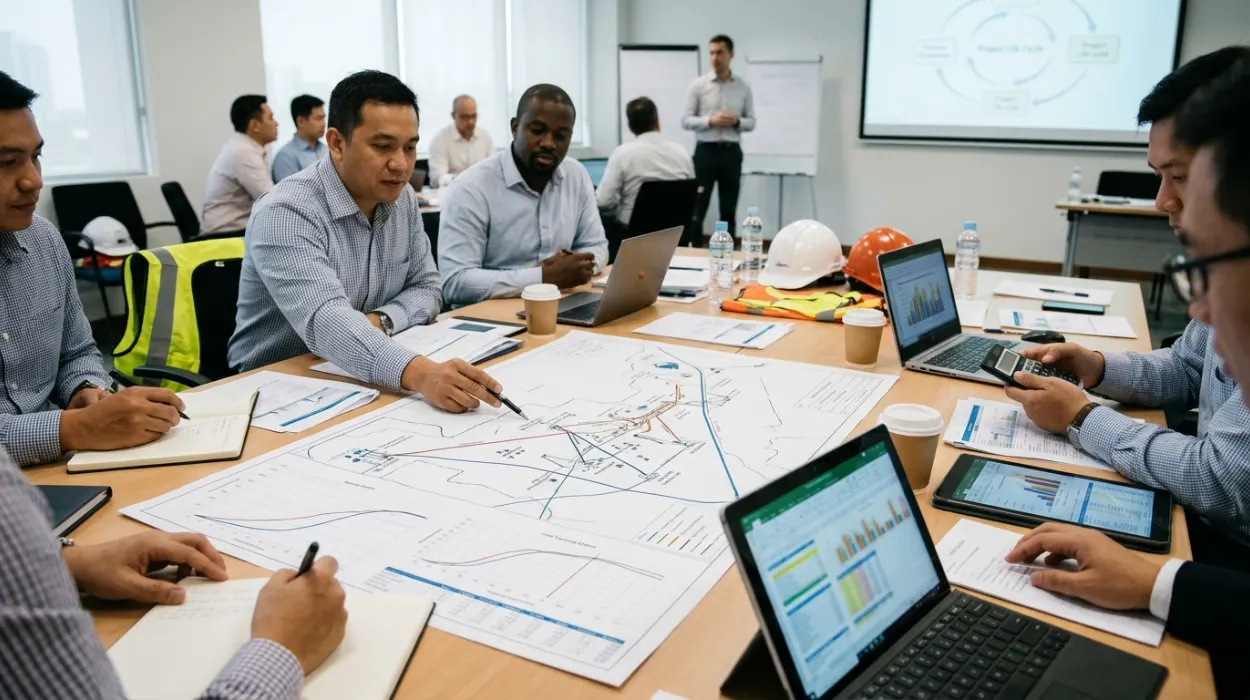
The Cost Control for Field Development Projects Cost Baselines Training by Institute For Oil & Gas Training resolves systemic budget overruns in energy infrastructure investments. It provides project control professionals, engineers, and financial teams with standardized frameworks to establish, monitor, and defend cost baselines across complex field developments.
Field development projects in the energy sector frequently experience severe capital budget overruns and schedule delays. These budget failures rarely stem from poor execution during construction. Instead, they originate from inadequate front end loading, improper cost estimate classification, and poorly established initial reference points. When an offshore or onshore field development project moves from concept selection to final investment decision, the project team must lock in a formal reference budget. Without a rigorously structured project cost baseline, project managers and financial managers cannot accurately track expenditure, quantify change, or hold contractors accountable during capital execution.
Project teams working across upstream and midstream operations often operate in departmental silos. Engineering teams produce technical designs, commercial analysts build economic models, and field construction teams manage site logistics. When these entities use disparate estimating conventions, the organization loses financial transparency. This lack of alignment corrupts the project controls function, leading to late identification of cost growth, inaccurate progress reporting, and unapproved scope creep. Organizations require a standardized methodology to integrate technical deliverables with cost structure models before committing major capital.
The Institute For Oil & Gas Training designed the Cost Control for Field Development Projects: Cost Baselines Training Course to eliminate these operational vulnerabilities. This specialized professional development program transitions project personnel from informal estimating habits to disciplined corporate project control systems. Participants learn how to construct audit-ready cost baselines, govern scope modifications, and align financial reporting with technical execution steps. By establishing a shared analytical language across engineering, procurement, and management units, the training prevents cost drift and ensures capital discipline throughout the asset development lifecycle.
Understanding the root causes of financial divergence early in the lifecycle is critical for long-term project viability. Prior to establishing formal baselines, project teams must analyze Why Cost Baselines Matter in Oil and Gas Field Development Projects. Building upon these core financial principles, the Institute For Oil & Gas Training provides the structured methodology required to convert preliminary cost data into controlled, governance-backed project execution baselines.
Why Is the Cost Control for Field Development Projects Cost Baselines Training Structured Around Stage-Gate Governance?
The Cost Control for Field Development Projects Cost Baselines Training by Institute For Oil & Gas Training structures its curriculum around stage gate cost control. This approach ensures learning progresses logically from preliminary estimate classification to front-end engineering, baseline locking, and post-sanction performance monitoring.
Upstream and midstream capital investments rely on stage-gate management systems to gatekeep expenditure decisions. A stage-gate framework divides complex field developments into distinct phases: appraisal, concept selection, front-end engineering design, detailed design, procurement, construction, and commissioning. Each gate requires a specific level of engineering definition and a corresponding level of cost estimate classification. The curriculum created by the Institute For Oil & Gas Training reflects this industry structure. Participants learn how estimate accuracy matures from rough orders of magnitude (Class 5/4) during early feasibility studies to detailed control budgets (Class 2/1) required at the final investment decision stage.
Curriculum sequencing begins with front end loading principles. Early investment in project definition directly dictates ultimate cost stability. If a project team attempts to lock a baseline before defining facility capacities, well counts, flowline routing, or regulatory compliance requirements, the baseline becomes invalid. The training guides learners through the technical inputs needed to validate a cost baseline. Participants analyze how early engineering decisions impact total installation costs, operational expenditures, and decommissioning liabilities. This logical progression ensures learners understand why cost baselines cannot exist in isolation from technical scope definition.
The course structure further integrates cost models with time-phased execution plans. Schedule and cost integration represents a core pillar of modern project control systems. The program details how to map Work Breakdown Structures (WBS) directly to Cost Breakdown Structures (CBS) and Organizational Breakdown Structures (OBS). By synchronizing expenditure schedules with project milestones, project controls personnel gain the capability to implement earned value management metrics. The Institute For Oil & Gas Training structures every learning module to reinforce this operational linkage between time, cost, scope, and technical maturity.
Evaluating complex governance frameworks requires analyzing how preliminary estimates transition into locked execution baselines. Project leaders looking to operationalize these workflows should review How to Establish and Manage Cost Baselines for Field Development Projects. The Institute For Oil & Gas Training incorporates these management methodologies directly into its core syllabus, preparing teams to manage project change systematically across all stage gates.
What Specific Modules and Skill Outcomes Are Covered in the Syllabus?
The Cost Control for Field Development Projects Cost Baselines Training delivers seven specialized modules focusing on estimate classification, baseline formulation, cost-schedule integration, contingency allocation, change governance, trend management, and project cost benchmarking across field development lifecycles.
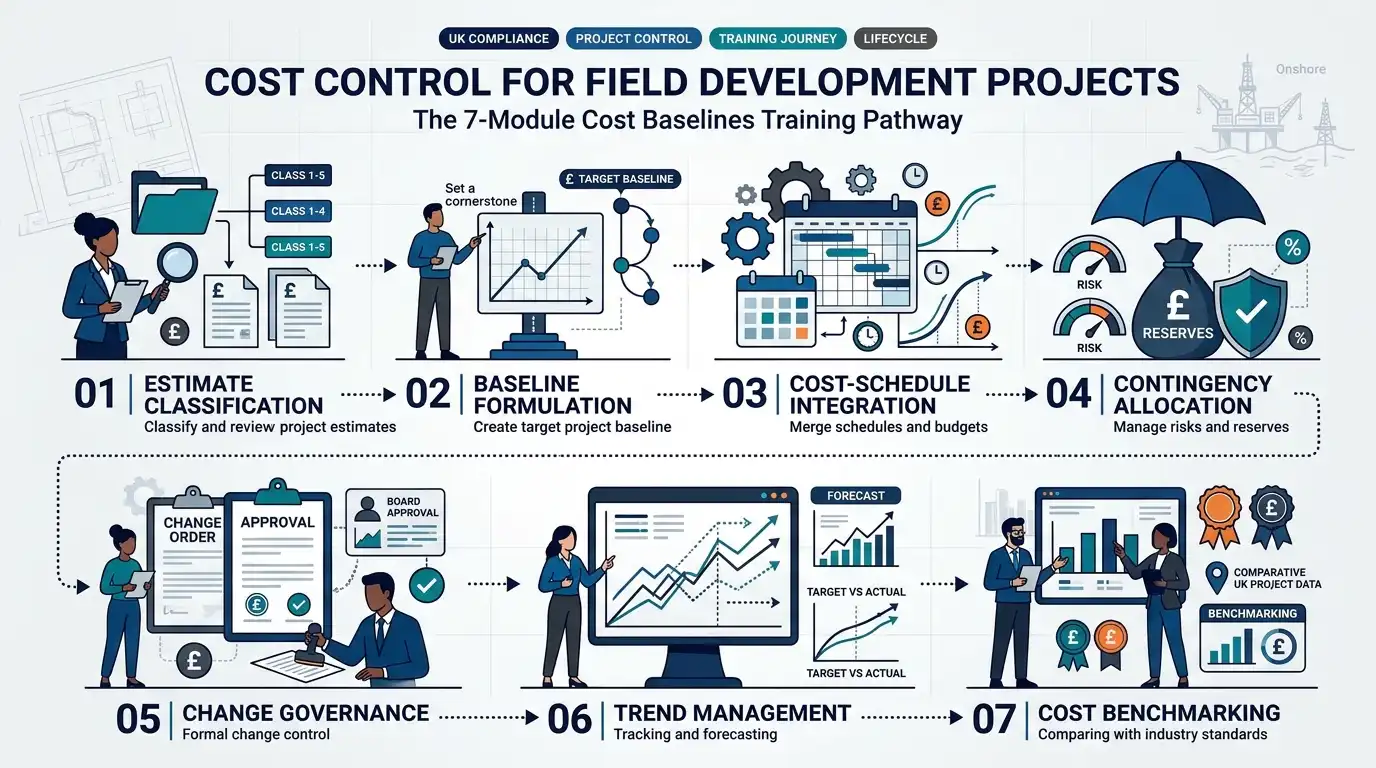
Module 1: Estimate Classification and Front End Loading
Principles of front end loading in offshore and onshore field developments.
Mapping estimate definition levels to AACE International and international oil company frameworks.
Data requirements for Class 5, Class 4, Class 3, Class 2, and Class 1 cost estimates.
Identifying technical maturity gaps prior to baseline locking.
Module 2: Cost Breakdown Structure (CBS) and WBS Architecture
Designing multi-tier Work Breakdown Structures for complex field assets.
Constructing standardized Cost Breakdown Structures tailored to upstream infrastructure.
Mapping capital expenditure (CAPEX) and operational expenditure (OPEX) categories.
Establishing coding systems for seamless Integration with Enterprise Resource Planning (ERP) software.
Module 3: Schedule and Cost Integration
Coupling time-phased planning with cost allocation curves (S-Curves).
Establishing baseline cash flows and funding limit constraints.
Aligning contractor payment schedules with measurable physical progress markers.
Integrating procurement lead times and logistics constraints into financial models.
Module 4: Risk Allocation, Escalation, and Contingency Determination
Deterministic versus probabilistic cost risk analysis methodologies.
Calculating risk-adjusted contingency using Monte Carlo simulation inputs.
Modeling inflation, market escalation, and foreign exchange exposure in long-duration projects.
Management reserve governance versus project contingency drawdown rules.
Module 5: Change Control Process and Trend Management
Designing and enforcing a formal project change control process.
Establishing and maintaining an active trend and deviation register.
Differentiating between scope growth, design evolution, and external force majeure.
Constructing variance thresholds and escalation paths for commercial approval.
Module 6: Benchmarking of Project Costs and Field Data Normalization
Principles of external and internal benchmarking of project costs.
Normalizing historical field development data across location factors, water depths, and market cycles.
Utilizing key performance indicators (KPIs) to validate estimate competitiveness.
Establishing feedback loops between completed projects and corporate estimating databases.
Module 7: Earned Value Management and Executive Cost Reporting
Calculating Earned Value (EV), Actual Cost (AC), and Planned Value (PV).
Analyzing Cost Variance (CV), Schedule Variance (SV), CPI, and SPI metrics.
Forecasting Estimate at Completion (EAC) and Estimate to Complete (ETC).
Producing executive dashboard reports for joint venture partners and corporate boards.
Module | Core Skill Focus | Deliverable Produced | Workplace Application |
Module 1 | Front End Loading | FEL Maturity Matrix | Estimate Accuracy Audit |
Module 2 | WBS/CBS Design | Integrated Cost Architecture | ERP System Coding |
Module 3 | Schedule Integration | Time-Phased Baseline S-Curve | Cash Flow Forecasting |
Module 4 | Risk & Contingency | Probabilistic Budget Model | Risk Allocation Register |
Module 5 | Change Governance | Trend and Deviation Register | Change Order Control |
Module 6 | Cost Benchmarking | Normalized Metrics Database | Scope Verification |
Module 7 | Performance EVM | EAC/ETC Forecast Models | Executive Board Reporting |
The Institute For Oil & Gas Training ensures each module yields concrete, practical capabilities. Participants do not simply absorb theoretical concepts; they build functional control assets throughout the program. This modular progression transforms project analysts into competent cost governance leaders capable of protecting corporate capital.
How Is the Training Delivered Across Virtual, Classroom, and Corporate In-House Formats?
The Cost Control for Field Development Projects Cost Baselines Training by Institute For Oil & Gas Training is delivered via interactive instructor-led virtual sessions, public classroom workshops, and customized corporate in-house programs. Delivery modalities range from intensive three-day courses to extended five-day formats.
The Institute For Oil & Gas Training offers flexible delivery mechanisms tailored to organizational schedules and geographical distributions:
Virtual Instructor-Led Training (VILT)
Delivered via secure digital platforms, the virtual format provides live instruction spread over structured half-day modules. This format minimizes workplace disruption while maintaining direct interaction with expert trainers. Virtual cohorts participate in real-time exercises, utilize digital breakout rooms for group assignments, and interact directly with instructors during dedicated Q&A sessions.
Public Classroom Workshops
Hosted in major global energy hubs (such as Houston, London, Dubai, Calgary, and Singapore), public classroom sessions provide an immersive learning environment away from daily operational distractions. The five-day workshop format allows deep focus on case studies, cross-company networking, and peer-to-peer benchmarking discussions.
Corporate In-House Solutions
For organizations seeking to upskill entire project teams, the Institute For Oil & Gas Training delivers customized corporate programs on-site at client facilities. In-house training allows the curriculum to be aligned directly with the company's internal stage-gate governance models, proprietary software platforms, and specific asset types (e.g., deepwater subsea tie-backs, LNG export facilities, or onshore unconventional gathering systems).
Every delivery format maintained by the Institute For Oil & Gas Training combines rigorous academic theory with practical application. Learning sessions feature interactive workshops where participants construct baseline models, audit flawed estimates, and calculate variance metrics using realistic oil and gas field development datasets.
What Measurable Performance Results Can Participants and Corporate HR Teams Expect?
Participants gain verifiable competence in baseline formulation, variance analysis, and change governance. Corporate HR teams and project directors observe improved budget accuracy, reduced unauthorized scope growth, and enhanced cross-departmental alignment across major capital projects.
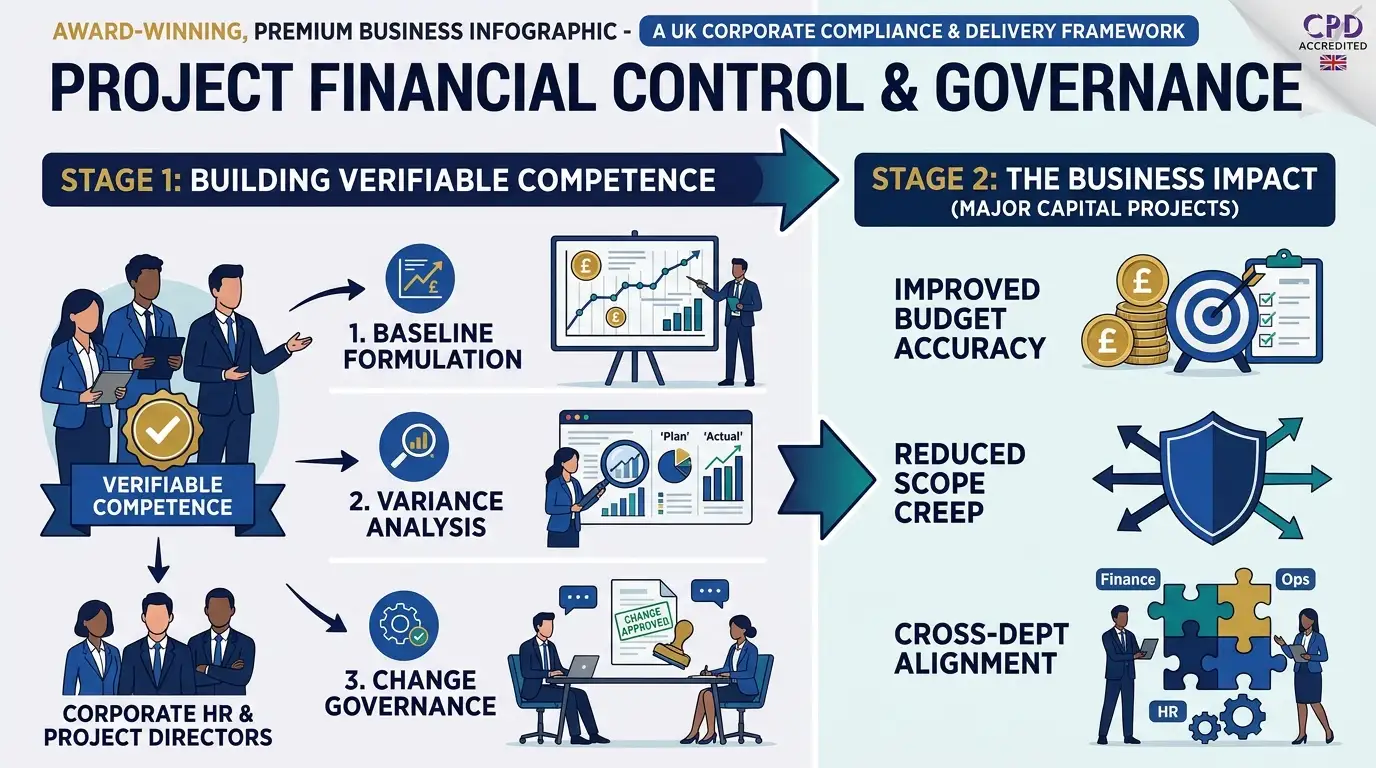
Organizations investing in project controls training require clear evidence of skill improvement and operational return on investment. The Institute For Oil & Gas Training measures learning outcomes through practical assessments, baseline modeling assignments, and post-course capability reviews. Participants demonstrate mastery by evaluating real-world field development scenarios, identifying estimating deficiencies, and constructing compliant change control frameworks.
From an organizational performance perspective, human resources departments and technical directors observe distinct operational advantages following course completion:
Enhanced Project Governance
Field development teams establish uniform definitions for baseline parameters. Project engineers, estimators, and project controllers apply identical standards when evaluating design changes, eliminating informal budget adjustments.
Proactive Cost Variance Prevention
By deploying a structured trend and deviation register, project teams identify emerging cost trends months before they manifest as actual budget overruns on accounting ledgers. This early detection enables timely corrective management action.
Streamlined Joint Venture Audits
Upstream oil and gas projects frequently involve joint venture partners and national oil companies. Standardizing cost baselines and change control processes ensures full documentation transparency, speeding up partner approvals and financial audits.
Cross-Functional Operational Alignment
Commercial teams, procurement specialists, and engineering discipline leads align their daily decisions with approved capital baselines. This alignment reduces friction during contract awards, engineering change notices, and scope negotiations.
The Institute For Oil & Gas Training builds competency frameworks that translate directly into workforce capability. Organizations sending project management personnel to this program secure a disciplined project controls function capable of defending capital investment returns.
What Are the Entry Requirements, Assessment Standards, and Enrollment Path?
Enrollment requires background experience in engineering, project controls, financial analysis, or operations management. Candidates complete practical baseline exercises and a final evaluation to earn professional certification from the Institute For Oil & Gas Training.
Target Participant Profile
The Cost Control for Field Development Projects: Cost Baselines Training Course is engineered for professionals involved in planning, approving, or executing capital projects in the energy domain. Ideal candidate roles include:
Project Control Managers, Lead Estimators, and Cost Engineers
Upstream Project Managers and Asset Development Leads
Facilities Engineers, Subsea Engineers, and Commercial Analysts
Finance Managers, Capital Allocation Analysts, and Joint Venture Accountants
HR Learning and Development Specialists sourcing technical capabilities for project teams
Entry Requirements
While there are no strict formal academic prerequisites, participants should possess a basic working knowledge of capital project execution, project management concepts, and Microsoft Excel. Familiarity with upstream field development concepts (e.g., drilling, topsides, subsea pipelines, processing facilities) accelerates learning uptake.
Assessment and Certification Standards
To earn the official Certificate of Completion from the Institute For Oil & Gas Training, participants must fulfill specific performance criteria:
Attendance: 100% participation in all lectures, group exercises, and workshop sessions.
Practical Case Study: Successful completion of a baseline construction and change control simulation assignment.
Final Knowledge Examination: Achieving a score of 80% or higher on the comprehensive technical assessment covering estimate classification, EVM calculations, and change governance.
Corporate Group Bookings
Human resource departments and project directors managing corporate training initiatives can request custom cohort scheduling. The Institute For Oil & Gas Training provides pre-course skill gap assessments to tailor case study datasets to specific corporate asset portfolios.
To review available training schedules, request customized corporate group proposals, or secure individual candidate seats, professionals can enroll in this program directly through the registration portal.
Frequently Asked Questions
What is covered in the Oil & Gas Petroleum Budgeting & Cost Control training?
The Oil & Gas Petroleum Budgeting & Cost Control training by the Institute For Oil & Gas Training covers capital expenditure (CAPEX) forecasting, operational expenditure (OPEX) management, cost baseline formulation, and stage-gate governance. Participants learn to integrate project schedules with financial control models, manage change registers, and apply earned value management (EVM) metrics. The curriculum equips energy professionals with the analytical tools required to prevent budget overruns across field development lifecycles.
Who should attend the Oil & Gas Petroleum Budgeting & Cost Control course?
This course is designed for project control engineers, cost estimators, financial analysts, project managers, and commercial leads working in upstream and midstream energy operations. It also benefits corporate HR teams and learning managers seeking structured capability development for project teams. The Institute For Oil & Gas Training tailors the Oil & Gas Petroleum Budgeting & Cost Control program to help technical and financial personnel establish a unified financial governance framework.
How does Oil & Gas Petroleum Budgeting & Cost Control improve project outcomes?
Effective Oil & Gas Petroleum Budgeting & Cost Control minimizes financial risk by establishing accurate, audit-ready cost baselines before capital execution begins. Professionals trained by the Institute For Oil & Gas Training learn to identify cost deviations early through trend registers, govern scope changes systematically, and maintain strict variance control. This proactive governance improves cash flow visibility and protects overall return on investment for major capital projects.
What delivery formats are available for the Oil & Gas Petroleum Budgeting & Cost Control program?
The Institute For Oil & Gas Training offers the Oil & Gas Petroleum Budgeting & Cost Control course through virtual instructor-led training (VILT), public classroom workshops in global energy hubs, and customized in-house corporate sessions. Public workshops run over three to five days, while in-house training allows organizations to align case studies directly with their internal stage-gate frameworks and asset portfolios.
What prerequisites are required for the Oil & Gas Petroleum Budgeting & Cost Control training?
Participants enrolling in the Oil & Gas Petroleum Budgeting & Cost Control program should have a foundational understanding of capital project execution, basic financial concepts, and spreadsheet modelling. Prior experience in engineering, cost control, or operational management within the energy sector is recommended. The Institute For Oil & Gas Training provides pre-course materials to ensure candidates possess the necessary background for advanced baseline modeling exercises.
Related training courses
Cost Control for Field Development Projects: Cost Baselines Training Course
- Specialisation
- Oil & Gas Petroleum Budgeting & Cost Control
- Duration
- 5 days · 15 CPD hours
Cash Calls, AFEs & Work Program/Budget Control: Overruns Training Course
- Specialisation
- Oil & Gas Petroleum Budgeting & Cost Control
- Duration
- 5 days · 15 CPD hours
Budget Planning and Cost Optimisation Training Course
- Specialisation
- Oil & Gas Petroleum Budgeting & Cost Control
- Duration
- 5 days · 15 CPD hours
More articles

Cost Control for Field Development Projects Overrun Prevention Training by Institute For Oil & Gas Training
Explore the Cost Control for Field Development Projects Overrun Prevention Training Course by Institute For Oil & Gas Training for corporate team skill gain.
Read article →
How to Identify Cost Overrun Risks and Apply Effective Prevention Strategies
Learn how to identify cost overrun risks in field development and apply proven prevention strategies to protect project capital and performance.
Read article →
Why Cost Overruns Occur in Oil and Gas Field Development Projects
Discover why cost overruns occur in oil and gas field development projects and how workforce training mitigates financial risks for energy firms.
Read article →