

A project cost baseline is an approved, time-phased budget used by project controls functions to measure, monitor, and manage overall financial performance. It establishes a fixed quantitative benchmark for evaluating expenditure, scope changes, and project progress throughout the execution phase.
In major capital projects across energy, petrochemical, and offshore engineering, capital expenditure ranges from £500 million to over £5 billion. Establishing financial control requires a validated structural baseline before executing field development plans. Without this control, operators experience severe budget overruns, misaligned cash flows, and unmanaged scope creep.
The baseline acts as the definitive financial reference point for executive decision-makers, commercial directors, and project managers. It aggregates direct costs, indirect costs, contingency reserves, and escalation allowances into a structured timeline. This alignment ensures project finance matches physical engineering milestones.
From an organizational development perspective, mastering cost baselines addresses critical employee skill gaps within project management offices and asset development teams. Enterprise learning programs build cross-functional competency across engineering, procurement, and finance departments. Structured upskilling transforms raw cost estimates into rigorous control mechanisms, ensuring capital discipline and board-level governance across complex asset portfolios.
Why Do Oil and Gas Projects Require Stage Gate Cost Control?
Stage gate cost control ensures that field development projects pass through rigorous reviews before securing capital expenditure approval. This gated process validates cost estimate classification accuracy, reduces financial risk, and aligns engineering maturity with corporate governance standards.
Complex field developments progress through sequential decision gates: concept evaluation, preliminary front end engineering design, detailed design, and execution. Each gate requires a specific degree of definition. The Association for the Advancement of Cost Engineering defines cost estimate classification from Class 5 (conceptual) down to Class 1 (check estimate).
Front end loading (FEL) principles dictate that early investment in scope definition yields the highest influence on cost containment. Passing a stage gate without accurate baseline data increases capital variance by 35% during construction. Corporate governance frameworks rely on these gates to halt unviable projects before major funds are committed.
Workforce development initiatives focus on equipping project leads and commercial managers with stage gate evaluation capabilities. Training programs use real-world case-based learning to teach teams how to assess front end loading maturity. Employees learn to audit cost inputs, analyze uncertainty ranges, and enforce gate compliance across multidisciplinary engineering teams.
How Does Schedule and Cost Integration Drive Project Performance?
Schedule and cost integration links work breakdown structure activities directly to time-phased expenditure profiles. This connection enables project control teams to calculate earned value management metrics, identify schedule variances early, and maintain precise cash flow forecasting.
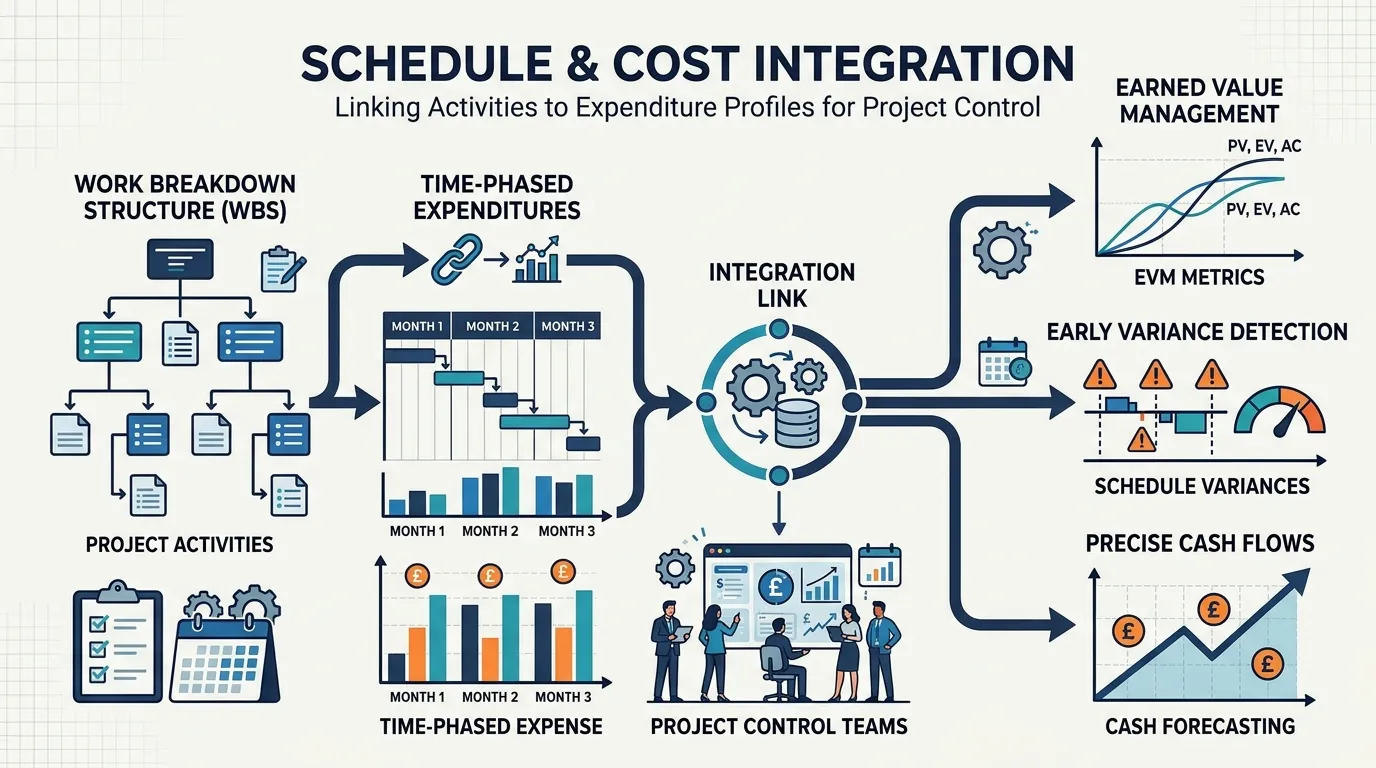
Financial allocations cannot exist in isolation from execution schedules. Integrating the project schedule with cost control systems links every dollar spent to a specific physical milestone. This process forms the basis of Earned Value Management, utilizing metrics such as Cost Performance Index and Schedule Performance Index.
$$CPI = \frac{EV}{AC} \quad \text{and} \quad SPI = \frac{EV}{PV}$$
When teams track Planned Value, Earned Value, and Actual Cost concurrently, deviations become visible long before financial audits occur. For example, if a topsides fabrication package incurs an SPI of 0.82 and a CPI of 0.88 at month 14, management can project final overruns immediately rather than at completion.
Organisations build this operational capability through targeted corporate workshops and technical simulations. L&D professionals deploy interactive learning modules where planners and cost engineers practice aligning Primavera P6 schedules with SAP or Oracle financial databases. This practical training eliminates data silos between planning teams and financial controllers.
How Do Change Control Processes Protect the Cost Baseline?
A structured change control process evaluates, approves, and documents every deviation from the baseline scope. It prevents unauthorized scope growth, updates the trend and deviation register, and maintains transparency between project teams and executive management.
Field development projects operate in volatile environments involving subsea complexity, supply chain shifts, and regulatory adjustments. Uncontrolled changes ruin project economics. A formal change management protocol ensures every potential modification undergoes technical, schedule, and cost impact assessments before approval.
Central to this workflow is the trend and deviation register. Project control functions log prospective changes as early trends. If a trend receives approval from the change control board, the project control function issues a formal baseline adjustment, drawing from management reserves or scope revisions.
Developing effective change control requires intensive role-play and decision-making scenarios during professional training sessions. Team leaders learn to manage change board dynamics, defend baseline parameters, and maintain accurate deviation logs. Upskilled teams prevent unapproved field variations, keeping execution aligned with board-sanctioned parameters.
What Are the Core Components of a Field Development Cost Baseline?
A comprehensive cost baseline incorporates direct field development costs, indirect project management overheads, risk-adjusted contingency allocations, escalation allowances, and a defined scope of work matched to a specific execution schedule.
Building a robust baseline requires synthesizing multiple data streams into a single control mechanism. Omitting key structural elements leads to inaccurate performance monitoring and premature contingency exhaustion.
Direct Capital Expenditure: Engineering costs, procurement expenses, subsea equipment, jacket fabrication, drilling operations, and hook-up activities.
Indirect Overhead Costs: Logistics support, vessel chartering, project management team salaries, regulatory compliance fees, and quality assurance audits.
Contingency and Management Reserves: Risk-weighted allowances determined through Monte Carlo schedule and cost risk analyses.
Escalation and Currency Buffers: Financial models accounting for market inflation rates, material price shifts, and foreign exchange fluctuations across multi-year schedules.
Work Breakdown Structure Dictionary: Granular definitions of every work package, assigning clear accountabilities to specific team managers.
Corporate learning programs structure technical training around these core components. Using interactive spreadsheet models and real project datasets, participants construct complete baselines from scratch. This hands-on method ensures cost managers understand the underlying mathematical dependencies of every budget element.
How Do Organisations Implement Cost Baseline Management Across Teams?
Organisations implement baseline management by deploying standardized project management frameworks, installing integrated project controls tools, establishing clear governance policies, and conducting structured capability-building programs for all project personnel.
Successful implementation transitions an asset development team from ad-hoc monitoring to systematic capital control. Enterprise rollouts follow a structured sequence to embed baseline management into everyday operations.
1.Establish Governance Policy:Prerequisite for enterprise-wide alignment.
Define stage gate criteria, cost estimate classification standards, and approval matrices for capital expenditure.
2.Deploy Integrated Software Tools:Technology platform selection.
Implement enterprise project control systems connecting scheduling software with cost management platforms and ERP systems.
3.Deliver Capability Training:Workforce upskilling phase.
Roll out targeted training courses for project managers, engineers, and financial controllers across global asset teams.
4.Audit and Refine Execution:Continuous quality assurance.
Conduct independent project baseline reviews and benchmarking of project costs against historical industry metrics to validate readiness.
Training delivery formats vary based on organizational structure. Large operators utilize hybrid learning pathways, combining self-paced technical modules with immersive, instructor-led workshops. Hybrid models allow global asset teams across operational hubs to standardize their cost management practices simultaneously.
Organizations evaluating their capital control maturity often transition from initial awareness to operational execution by reviewing structured curricula. Reviewing the Cost Control for Field Development Projects: Cost Baselines Training Course syllabus helps L&D leaders map internal competency frameworks against established industry best practices.
What Measurable Outcomes Does Effective Cost Baseline Training Produce?
Structured baseline management training yields measurable improvements in project delivery efficiency, variance reduction, contingency preservation, and overall return on capital invested across complex offshore and onshore developments.
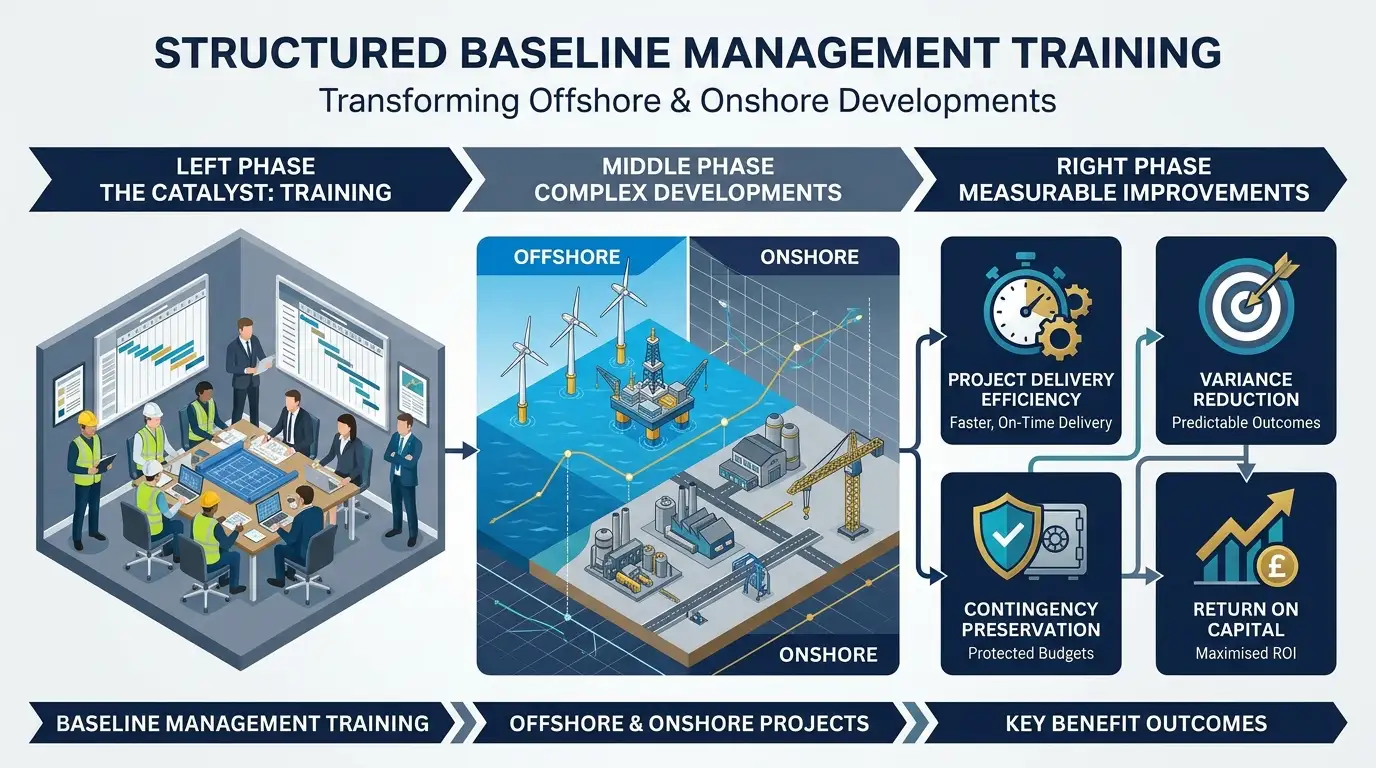
Investing in workforce development for project controls generates clear financial and operational returns. Organizations tracking performance metrics after enterprise-wide training observe improvements across critical key performance indicators.
Beyond immediate project metrics, enterprise upskilling strengthens the leadership pipeline. Mid-level engineers and cost analysts gain the strategic foresight required to step into project director roles. This retention of institutional knowledge reduces reliance on external management consultants, lowering overhead costs in the long term.
What Common Misconceptions Disrupt Cost Baseline Management?
Common misconceptions include viewing the baseline as a rigid, unchangeable budget, confusing cost estimates with control baselines, treating cost control as a purely financial task, and relying on generic, non-industry training programs.
Misalignments between theory and practice undermine project governance. Addressing these errors requires clear operational boundaries within project teams.
The belief that cost control belongs solely to the finance department isolates technical managers from financial outcomes. Engineering decisions directly drive field development costs. Cross-functional training ensures package engineers understand how design choices alter the project cost baseline.
Another persistent failure is relying on generic corporate finance courses. Standard business accounting does not cover stage gate cost control, offshore contracting structures, or benchmarking of project costs against complex energy metrics. Industry-driven technical training provides the domain-specific depth required to navigate real-world development challenges.
Frequently Asked Questions
What is included in an oil and gas petroleum budgeting & cost control training course?
An oil and gas petroleum budgeting & cost control course covers cost estimate classification, stage-gate financial governance, front-end loading, and Earned Value Management (EVM). Participants learn to construct time-phased cost baselines, integrate scheduling with expenditure, and manage trend registers. Professional programs delivered by the Institute For Oil & Gas Training focus on practical workflows to prevent capital overruns across field development projects.
How does cost control differ from general accounting in petroleum field development?
General corporate accounting records historical financial transactions, whereas Oil & Gas Petroleum Budgeting & Cost Control focuses on real-time variance analysis and future cash flow forecasting. It links work breakdown structures directly to project milestones, enabling controls teams to evaluate progress using Cost Performance Index (CPI) and Schedule Performance Index (SPI). This specialized domain allows asset leaders to manage contingency allocations and mitigate financial risks before capital commitment occurs.
Why is stage-gate cost control essential for capital-intensive energy projects?
Stage-gate cost control ensures that energy developments undergo rigorous financial and engineering evaluations at defined decision gates before securing major capital allocations. This structured approach validates cost accuracy ranges, mitigates front-end risk, and aligns scope maturity with corporate governance standards. Through practical upskilling from the Institute For Oil & Gas Training, project leaders gain the expertise required to audit gate inputs and enforce capital discipline across complex asset portfolios.
How do project teams establish a time-phased cost baseline for offshore developments?
Establishing a time-phased project cost baseline requires synthesizing direct capital expenditure, indirect management overheads, risk-adjusted contingency reserves, and escalation buffers into a defined execution timeline. Project control functions map these elements to the Work Breakdown Structure (WBS) to track real-time performance against physical engineering progress. Enterprise learning initiatives in Oil & Gas Petroleum Budgeting & Cost Control train commercial managers to build these validated structural models using standardized industry frameworks.
What change control procedures protect oil and gas project baselines from budget overruns?
Effective change control uses a formal trend and deviation register to identify, evaluate, and approve scope variations before work execution. Proposed changes undergo technical, schedule, and cost impact assessments prior to review by a change control board. Training programs provided by the Institute For Oil & Gas Training equip project managers and engineers with the decision-making skills needed to manage change board dynamics and preserve sanctioned baseline budgets.
Related training courses
CAPEX vs OPEX Classification & Decision Rules Training Course
- Specialisation
- Oil & Gas Petroleum Budgeting & Cost Control
- Duration
- 5 days · 13 CPD hours
Budgeting & Forecasting: Rolling & Zero-Based Techniques Training Course
- Specialisation
- Oil & Gas Petroleum Budgeting & Cost Control
- Duration
- 5 days · 15 CPD hours
Cost Control & Variance Analysis Using Cost Coding Training Course
- Specialisation
- Oil & Gas Petroleum Budgeting & Cost Control
- Duration
- 5 days · 15 CPD hours
More articles

Cost Control for Field Development Projects Overrun Prevention Training by Institute For Oil & Gas Training
Explore the Cost Control for Field Development Projects Overrun Prevention Training Course by Institute For Oil & Gas Training for corporate team skill gain.
Read article →
How to Identify Cost Overrun Risks and Apply Effective Prevention Strategies
Learn how to identify cost overrun risks in field development and apply proven prevention strategies to protect project capital and performance.
Read article →
Why Cost Overruns Occur in Oil and Gas Field Development Projects
Discover why cost overruns occur in oil and gas field development projects and how workforce training mitigates financial risks for energy firms.
Read article →