
Petroleum financial planning requires balancing extreme market volatility against severe capital constraints. Corporate finance teams in exploration and production, midstream operations, and refining regularly evaluate their financial planning frameworks to ensure capital allocation matches operational reality. Comparing financial planning methods requires assessing how each framework handles price swings, asset maintenance cycles, and operational risks.
When evaluating these planning systems, corporate leaders often analyze Why Rolling Forecasts and Zero Based Budgeting Matter in Petroleum Finance to establish a foundational understanding of modern fiscal management. Selecting between a continuous, driver-based outlook and a rigorous bottom-up cost justification depends on your organization's structural maturity, market exposure, and operational objectives. Strategic finance leadership must measure both methodologies across operational flexibility, resource intensity, and forecast precision to select the optimal model for long-term fiscal stability.
What Are the Fundamental Differences Between Rolling Forecasting and Zero-Based Budgeting?
Rolling forecasting updates financial projections continuously on a set cadence, while zero-based budgeting builds every budget period from a zero baseline by justifying every operational cost. Rolling forecasts adapt to market shifts, whereas zero-based budgeting eliminates embedded cost inefficiencies.
The main variance between these two financial models lies in their temporal structure and baseline assumptions. Rolling forecasting maintains a fixed horizon—typically 12 to 24 months—by adding a new projection period as each current period closes. This approach relies heavily on driver based planning, where key operational metrics like production volumes, rig counts, and Brent crude prices dictate cost projections. Instead of relying on static annual targets, finance teams execute a regular rolling forecast cycle to reflect ongoing market conditions.
Zero-based budgeting (ZBB) rejects historical spending as a benchmark. Every department head must justify every line item, from offshore logistics to head-office administration, during each budgeting cycle. This method disrupts spending creep by forcing managers to link every expenditure directly to operational activities. Unlike traditional incremental budgets, ZBB forces absolute visibility into cost drivers, making it an aggressive tool for cost containment in mature or declining oilfields.
Understanding how these frameworks handle operational changes requires analyzing their structural features side by side.
Evaluation Attribute | Rolling Forecasting | Zero-Based Budgeting (ZBB) |
Baseline Assumption | Continuous horizon extending beyond the fiscal year | Zero baseline requiring full justification per cycle |
Primary Objective | Operational agility and continuous market alignment | Total cost transparency and overhead reduction |
Resource Intensity | Moderate ongoing effort across forecast cycles | High periodic effort during budget preparation |
Key Planning Mechanism | Driver based planning tied to operational metrics | Activity based budgeting tied to decision packages |
Variance Tracking | Measures variance against latest estimate and outlook | Measures spending compliance against approved baselines |
Ideal Operational Context | Volatile commodity environments, active drilling programs | Mature assets, cost-reduction mandates, restructuring |
How Does Market Volatility Impact Rolling Forecast Cycles in Petroleum Operations?
Commodity price shifts invalidate fixed annual budgets rapidly, making rolling forecasts essential for dynamic resource allocation. By extending the planning horizon continuously, energy companies preserve visibility into liquidity, debt covenants, and capital expenditure needs across volatile market conditions.
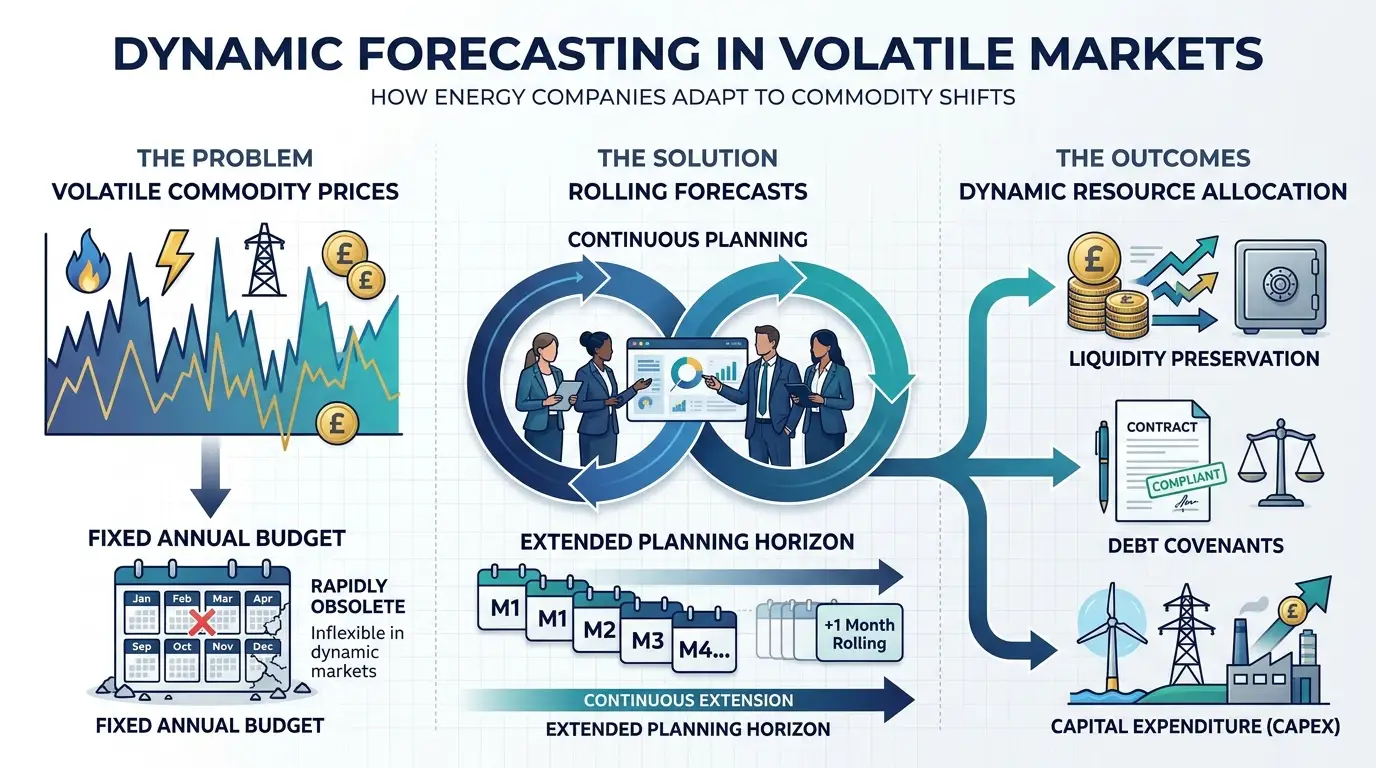
Petroleum operations face constant exposure to global supply disruptions, OPEC+ quota adjustments, and macroeconomic swings. A static 12-month budget created in October often becomes obsolete by March. A continuous rolling forecast cycle solves this problem by updating financial projections monthly or quarterly. This structure ensures that management always maintains a minimum 12-month forward view of cash flow, working capital, and capital expenditure commitments.
Continuous forecasting relies on clear reforecast triggers. Rather than updating projections strictly by the calendar, advanced financial teams trigger reforecasts when specific external or internal events occur:
Crude oil price movements exceeding predetermined percentage thresholds ($5/bbl shift over 10 consecutive trading days).
Unplanned facility shutdowns or major refining unit maintenance delays.
Significant regulatory changes or unexpected shifts in regional taxation.
Major foreign exchange rate movements affecting international supply contracts.
Integrating these triggers into your planning cycle replaces rigid annual targets with an active management mechanism. Finance teams calculate a latest estimate and outlook at every cycle end. This gives executive leadership real-time visibility into project returns and operating cash flow, allowing rapid adjustments to capital deployment before margins compress.
How Does Zero-Based Budgeting Eliminate Operational Inefficiencies in Energy Enterprises?
Zero-based budgeting stops historical spend compounding by forcing operational teams to reconstruct cost structures from the ground up. This process exposes hidden operational redundancies, unjustified vendor costs, and obsolete activities across field operations and corporate functions.
In capital-intensive upstream and downstream operations, traditional incremental budgeting encourages a "use-it-or-lose-it" mindset. Managers routinely spend their full budget allocation to secure equal or greater funding for the next fiscal year. ZBB eliminates this practice by removing historical baselines. Every expenditure must be tied to a specific operational outcome through structured decision packages.
Implementing ZBB effectively in an oil and gas context requires pairing it with activity based budgeting. Operations are broken down into discrete activities—such as wellhead maintenance, pipeline inspections, or safety audits—and costed based on required resource inputs.
ZBB forces management to evaluate spending through three primary operational lenses:
Mandatory Operational Spend: Costs required to maintain environmental compliance, structural integrity, and life-safety standards.
Performance Optimization Spend: Costs that directly increase production yields, improve throughput, or lower per-barrel operating expenses.
Discretionary Spend: Non-essential administrative, travel, or external consulting costs that can be deferred without impacting asset integrity.
By forcing managers to defend every dollar, ZBB typically identifies 10% to 25% in cost savings across support functions and non-critical field operations within the first execution cycle.
How Do You Evaluate the Right Planning Framework for Your Organization?
Selecting the right financial framework requires evaluating your asset life cycle, market exposure, corporate culture, and digital system capability. Organizations operating in volatile production environments benefit from rolling forecasts, while mature operations undergoing cost restructuring require zero-based budgeting.
No single planning framework fits every petroleum business model. Upstream exploration ventures facing high geological and price uncertainty require maximum fluid planning capabilities. Conversely, mature midstream assets with stable, tariff-based revenue streams benefit more from the strict spending controls enforced by ZBB.
To evaluate which methodology fits your organization's current operational state, finance leaders must assess four core operational dimensions.
Operational Dimension | High Rolling Forecast Fit | High Zero-Based Budgeting Fit |
Asset Maturity | Early-stage exploration, shale fracturing, active development | Late-life production, mature refining assets, corporate overhead |
Revenue Volatility | High exposure to unhedged spot prices | Fixed long-term contracts, regulated tariffs |
System Capability | Advanced enterprise resource planning and dynamic BI tools | Detailed cost accounting and granular work-breakdown structures |
Management Focus | Capital reallocation velocity and growth opportunity capture | Operational cost reduction and margin protection |
Many energy companies adopt a hybrid framework. They run zero-based budgeting every three to five years to reset operational cost baselines, combined with a quarterly rolling forecast to manage ongoing market movements.
How Do Enterprise Systems and Contingency Reserves Support Advanced Planning?
Modern financial planning frameworks require robust enterprise tool integration and structured risk buffers to function effectively. Without integrated data flows and dedicated contingency reserves, both rolling forecasts and zero-based budgets fail to reflect operational reality.
Executing sophisticated planning models requires seamless planning tool integration. Modern energy enterprises link their Enterprise Resource Planning (ERP) systems, field production data, and commercial pricing feeds directly into central planning engines. Automated data ingestion reduces forecast cycle times from weeks to days, enabling true rolling agility.
Without automated integration, rolling forecasts become a heavy administrative burden, and zero-based budgeting leads to operational burnout. Effective planning architecture requires:
Direct data connections between asset management software and financial ledgers.
Automated driver updates for currency exchange, fuel costs, and commodity indices.
Integrated forecast accuracy tracking to measure projection variance against actuals over time.
Alongside software integration, financial plans must account for operational uncertainty using a formal contingency and management reserve. In upstream drilling and complex offshore projects, unexpected geological conditions or weather delays threaten financial targets. A management reserve provides a governed financial buffer outside department operating budgets, preventing cost overruns from distorting regular operational forecasts.
How Should Financial Leaders Approach Capability Building for Modern Budgeting?
Transitioning to rolling forecasting or zero-based budgeting requires developing new analytical capabilities, operational driver models, and cross-departmental governance. Organizations must upskill their finance and operations teams to implement these frameworks successfully.
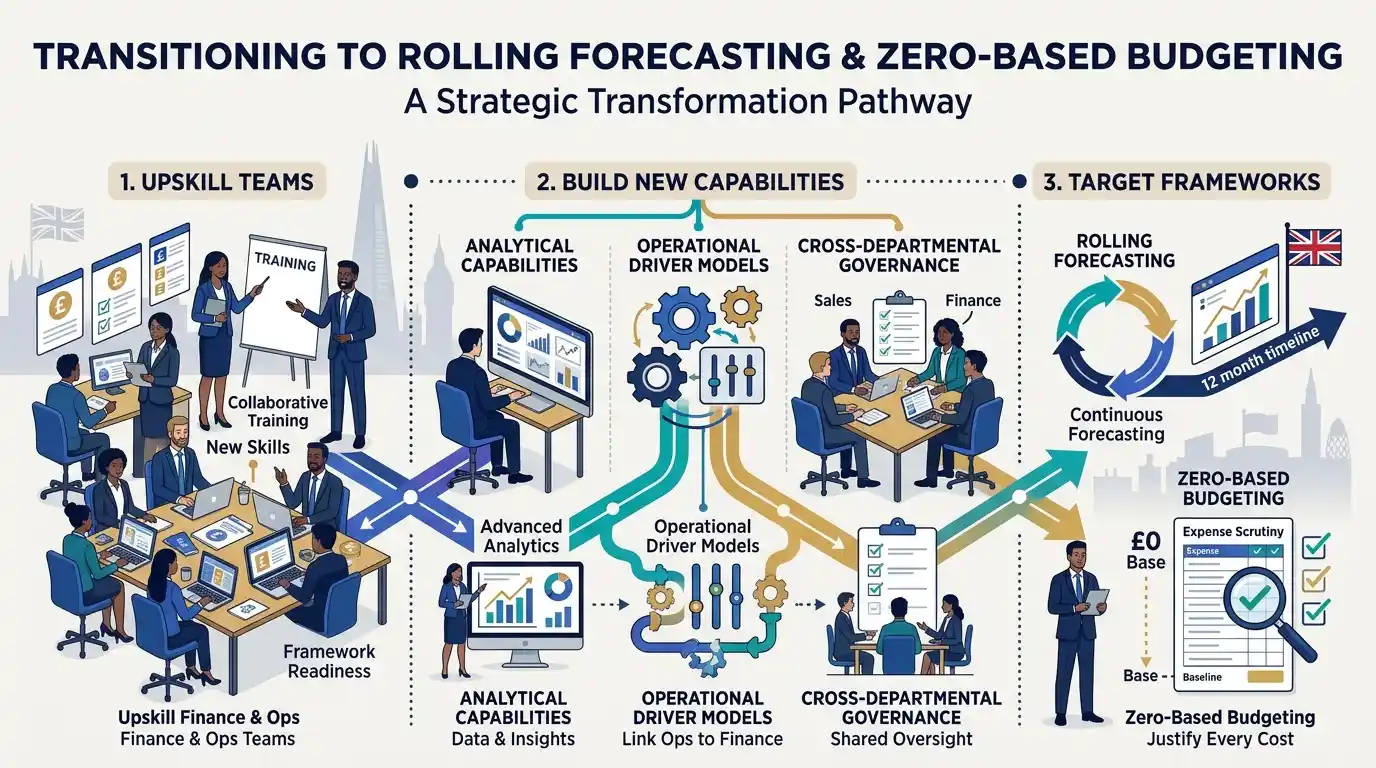
Adopting modern financial planning frameworks is not merely an IT upgrade; it requires a deep cultural shift across corporate finance, asset management, and field operations. Moving from traditional annual budgets to continuous driver-based planning demands advanced skills in data modeling, operational metric tracking, and scenario analysis.
When structuring enterprise capability building, financial leaders often choose specialized technical training programs. Executive teams seeking structured implementation methodologies frequently enroll their key personnel in specialized courses like the Budgeting & Forecasting: Rolling & Zero-Based Techniques Training Course to build internal capability across asset teams. Specialized training programs focus on building functional competence in:
Designing custom operational driver models for upstream, midstream, and downstream assets.
Establishing robust variance analysis frameworks and forecast accuracy tracking protocols.
Structuring decision packages and activity-based costing models for ZBB implementations.
Managing corporate change processes to transition budget holders away from historical spend baselines.
Organizations that invest in formal capability development shorten their implementation cycles and achieve higher forecast precision. Ensuring that financial personnel and asset managers share a common methodology prevents friction between corporate finance targets and field operations.
Companies seeking comprehensive enterprise transformation often send their operational finance managers through structured programs like the Budgeting and Forecasting Rolling and Zero Based Techniques Training by Institute For Oil & Gas Training to ensure seamless organizational adoption and measurable performance gains.
Selecting between rolling forecasts and zero-based budgeting—or implementing a hybrid model—depends on your company's operational context, asset maturity, and volatility exposure. By evaluating these methodologies against your strategic goals and investing in internal team capabilities, your organization can build a resilient financial planning architecture that protects margins and captures growth across market cycles.
Frequently Asked Questions
How does Oil & Gas Petroleum Budgeting & Cost Control differ from general corporate financial planning?
Oil & Gas Petroleum Budgeting & Cost Control addresses extreme commodity price volatility, high capital intensity, and long field development lifecycles that general financial planning frameworks cannot handle. The Institute For Oil & Gas Training equips industry leaders to manage operational expenditure (OPEX), capital expenditure (CAPEX), and joint interest accounting while maintaining strict cost control against oil price fluctuations.
Why is specialized cost control critical in upstream and downstream operations?
Upstream exploration and downstream refining carry distinct cost drivers, ranging from geological uncertainty and drilling risks to complex maintenance turnarounds. Enrolling in Oil & Gas Petroleum Budgeting & Cost Control through the Institute For Oil & Gas Training enables finance and operations managers to implement earned value management (EVM), eliminate cost leakage in production sharing contracts, and safeguard project margins.
Who should undertake training in Oil & Gas Petroleum Budgeting & Cost Control?
This professional training is designed for petroleum accountants, cost controllers, finance managers, project engineers, and commercial managers operating within energy enterprises. The Institute For Oil & Gas Training delivers practical, industry-aligned instruction that bridges the gap between field operations, joint venture accounting, and strategic fiscal oversight.
What core methodologies are taught in Oil & Gas Petroleum Budgeting & Cost Control?
Participants learn advanced forecasting techniques, driver-based planning, zero-based budgeting (ZBB), and activity-based costing (ABC) tailored to energy assets. Through the Institute For Oil & Gas Training, professionals master variance analysis, Authorization for Expenditure (AFE) tracking, and contingency reserve management to maintain financial discipline across asset life cycles.
How does Oil & Gas Petroleum Budgeting & Cost Control improve organizational performance?
Implementing standardized budgeting and variance tracking ensures capital is efficiently allocated to high-yielding assets while eliminating unnecessary administrative and operational spend. Training provided by the Institute For Oil & Gas Training helps organizations improve forecast accuracy, optimize supply chain contracts, and maintain financial compliance during volatile market conditions.
Related training courses
CAPEX vs OPEX Impact on Cost Recovery Training Course
- Specialisation
- Oil & Gas Petroleum Budgeting & Cost Control
- Duration
- 5 days · 15 CPD hours
Cash Calls, AFEs & Work Program/Budget Control: Preparation Training Course
- Specialisation
- Oil & Gas Petroleum Budgeting & Cost Control
- Duration
- 5 days · 15 CPD hours
Budget Planning and Cost Optimisation Training Course
- Specialisation
- Oil & Gas Petroleum Budgeting & Cost Control
- Duration
- 5 days · 15 CPD hours
More articles

Cost Control and Variance Analysis for Budget Deviations Training by Institute For Oil & Gas Training
Master budget deviations with the Cost Control & Variance Analysis Training Course by Institute For Oil & Gas Training. Learn financial variance techniques.
Read article →
How to Identify and Analyse Budget Deviations Through Cost Variance Analysis
Learn how to analyse budget deviations with cost variance analysis. Evaluate tracking methods, variances, and training for financial control.
Read article →
Why Cost Variance Analysis Matters in Oil and Gas Budget Control
Learn how cost variance analysis prevents budget overruns in oil and gas projects. Discover key frameworks, execution steps, and measurable ROI.
Read article →