
Cost variance analysis is a financial control methodology that measures the quantitative difference between planned budget allocations and actual operational expenditure, enabling oil and gas organisations to isolate financial deviations, identify root causes, and enforce operational accountability across capital projects.
Cost variance analysis functions as the primary diagnostic tool within upstream, midstream, and downstream financial management. In high-capital sectors like energy exploration, offshore drilling, and refinery operations, unexpected cost growth directly erodes operating margins. Budget deviations stem from market fluctuations, operational delays, equipment breakdowns, or supply chain bottlenecks.
Workforce skill gaps in financial monitoring amplify these risks. When project engineers, procurement specialists, and cost controllers lack rigorous variance tracking capabilities, minor budget drift escalates into multi-million-pound capital deficits. Organisations resolve these competencies by embedding systematic training programs designed around quantitative baseline control, earned value management, and standardized variance reporting techniques.
Targeted professional development establishes a common analytical framework across cross-functional teams. Training equips non-financial managers with the skills to read cost performance indices, compute variances, and translate financial figures into corrective operational adjustments.
This alignment converts raw cost accounting data into actionable executive decisions. Organisations implementing structured training in financial analysis report a 35% reduction in budget overruns, a 20% improvement in forecast accuracy, and a 15% increase in capital allocation efficiency.
Why Do Energy Organisations Struggle with Budget Control?
Energy organisations struggle with budget control due to volatile commodity pricing, complex joint venture structures, decentralized procurement systems, reliance on manual spend tracking, and widespread financial skills gaps among engineering and operational managers overseeing large project budgets.
Oil and gas projects operate within highly volatile environments subject to price shifts, regulatory mandates, and geopolitical shifts. Capital expenditure projects like platform construction, pipeline expansion, and turnarounds involve thousands of line items. Misalignment between field activities and central finance leads to unrecorded liabilities and delayed financial visibility.
Accrual Versus Spend Reporting Discrepancies
A primary operational failure is confusing cash outflow with financial commitments. Operational teams track invoices received, while actual liabilities accrue during work execution.
Without rigorous accrual tracking, project managers view incomplete financial pictures, leading to premature spending commitments. Professional training programs address this gap by establishing standardized accrual reporting workflows.
Failure to Set Variance Investigation Thresholds
Organisations waste analytical resources reviewing negligible financial deviations while missing critical systemic trends. Establishing explicit variance investigation thresholds ensures cost control teams focus exclusively on high-impact deviations.
Variance Level | Trigger Condition | Required Operational Action | Reporting Escrow |
Minor (Tier 1) | < 3% deviation from baseline | Log in monthly performance tracking system | Department Head |
Moderate (Tier 2) | 3% to 7% deviation from baseline | Conduct root cause analysis and submit corrective action plan within 5 business days | Operations Director |
Critical (Tier 3) | > 7% deviation from baseline | Immediate budget freeze; convene executive intervention panel; execute mandatory re-forecasting | Chief Financial Officer |
Without clear investigation parameters, operational supervisors overlook compound variances that breach project contingency limits. Structured learning modules train managers to set threshold limits based on project risk profiles, contract structures, and spend volume.
How Does Cost Variance Analysis Work in Corporate Environments?
Cost variance analysis works by comparing actual costs against baseline performance parameters, decomposing variations into specific financial vectors, assessing root causes, and executing immediate corrective operational adjustments to preserve targeted profit margins across business units.
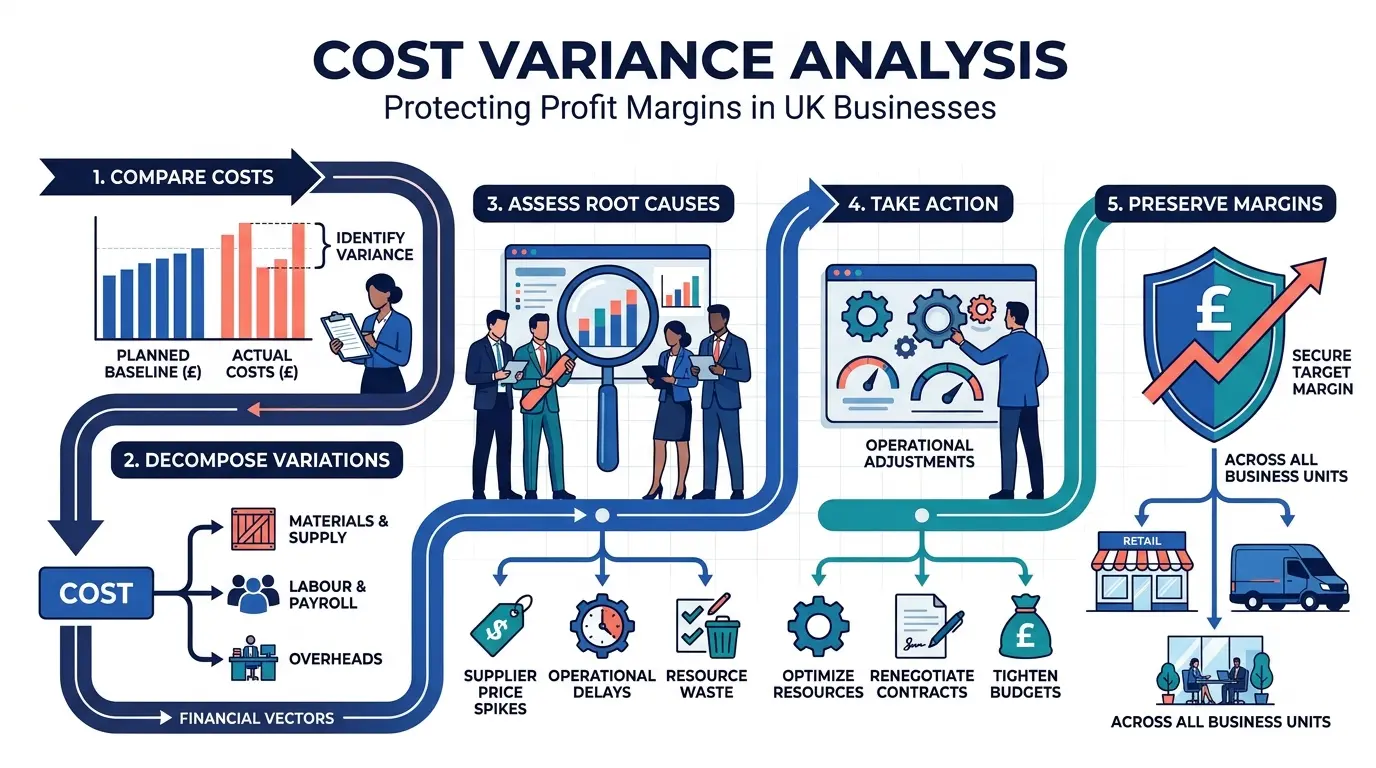
Corporate implementation follows a structured analytical workflow. Upstream and downstream operators deploy variance tracking across monthly financial closes, quarterly project reviews, and annual budget reconciliations. The technique relies on isolating specific variances to determine whether cost deviations stem from market pricing, consumption efficiency, or operational timing.
Price and Volume Variance Breakdown
Financial controllers break down baseline budget deviations into price and volume variances to separate market conditions from operational performance.
Price Variance: Measures the financial impact of paying more or less for materials, labor, or services than originally budgeted.
Volume Variance: Measures the financial impact of utilizing a greater or lesser quantity of resources than planned in the operational baseline.
Training in variance decomposition ensures project leaders evaluate vendor performance and procurement contract compliance accurately.
Earned Value Management (EVM) Integration
Corporate variance analysis incorporates Earned Value Management parameters to measure project performance against schedule and cost targets simultaneously.
Cost Variance ($CV$): Calculated as Earned Value ($EV$) minus Actual Cost ($AC$). A negative result indicates an over-budget status.
Schedule Variance ($SV$): Calculated as Earned Value ($EV$) minus Planned Value ($PV$). A negative result highlights project delivery delays.
Cost Performance Index ($CPI$): Calculated as $EV / AC$. A value below 1.0 indicates inefficient resource utilization.
Workplace development programs use practical simulations where participants calculate EVM metrics, evaluate operational scenarios, and build financial models to protect margins.
How Is Cost Variance Analysis Training Delivered Step by Step?
Cost variance analysis training is delivered through a four-stage structured learning model comprising baseline competency evaluation, interactive scenario-based instruction, practical simulation workshops, and post-training workplace application audits to ensure measurable skill transfer.
Structured corporate development follows a methodical, step-by-step framework to transition technical managers into financially proficient business leaders.
1.Baseline Competency Assessment and Audit:Execution Window: Weeks 1 to 2.
The training program initiates with a diagnostic evaluation of participant skill levels across financial concepts, budget mechanics, and spreadsheet modeling.
Participants complete baseline assessments measuring their ability to interpret balance sheets, calculate earned value metrics, and identify budget deviations. L&D coordinators analyze assessment data to tailor case studies to specific organizational operating models, such as offshore drilling, refining, or pipeline logistics.
2.Core Methodological Instruction and Framework Delivery:Execution Window: Weeks 3 to 4.
Instruction begins through instructor-led workshops delivered in classroom, virtual, or hybrid formats. Participants master the foundational principles of budget construction, commitment tracking, and financial reporting protocols.
Learning modules focus on differentiating between favorable and adverse variances, defining variance commentary standards, and setting operational threshold triggers. Case-based learning exposes participants to historic oil and gas budget breakdowns.
3.Interactive Simulation and Applied Scenario Workshops:Execution Window: Weeks 5 to 6.
Learners engage in real-world simulation exercises using authentic project data sets. Participants manage simulated capital budgets, track daily spend metrics, calculate price and volume variances, and formulate response strategies under simulated market disruptions.
Teams construct standardized variance commentary templates and defend their proposed corrective action plans before an executive evaluation panel comprising finance directors and operational managers.
4.Workplace Implementation, Mentoring, and Impact Audit:Execution Window: Weeks 7 to 12.
Participants apply their acquired analytical framework directly to their active corporate projects. Assigned financial mentors provide bi-weekly coaching sessions to review participants' active variance reports and variance commentary quality.
At the 90-day mark, L&D leadership executes a post-training audit measuring individual error reduction, reporting speed improvements, and total variance mitigations achieved across participating business units.
What Are the Core Components of an Effective Variance Analysis Framework?
The core components of an effective variance analysis framework include robust commitment tracking systems, variance decomposition models, standardized reporting templates, explicit investigation thresholds, and actionable corrective plan protocols integrated into corporate operational governance.
A robust financial control architecture relies on interconnecting technical tools, clear analytical processes, and trained human capabilities across all administrative tiers.
Key Technical and Skill Components
Commitment Tracking Systems: Tools and workflows designed to capture financial obligations at the purchase order execution stage rather than waiting for invoice receipt.
Variance Commentary Protocols: Standardized narrative structures explaining the root causes, operational impacts, and recovery timelines associated with financial deviations.
Corrective Action Plan Frameworks: Structured operational roadmaps detailing specific steps, resource reallocations, and accountable personnel required to bring over-budget projects back into financial alignment.
Earned Value Analytics Software: Automated platforms that calculate EVM parameters, generate graphical trend curves, and highlight emerging cost risks before baseline exhaustion.
Organisations seeking to build these structural capabilities across their leadership teams routinely enroll their project controllers, engineers, and department heads in the Cost Control & Variance Analysis for Budget Deviations Training Course to master real-world financial control systems.
What Are the Key Organizational Benefits of Variance Analysis Competency?
The key organizational benefits of variance analysis competency include improved capital allocation efficiency, reduced budget overruns, enhanced forecast accuracy, stronger cross-functional collaboration, and accelerated executive decision-making across complex corporate projects.
Building enterprise-wide competence in variance analysis transforms financial control from a reactive accounting task into a proactive strategic advantage.
Stakeholder Group | Primary Operational Benefit | Measurable Impact Metric |
Executive Leadership | Enhanced visibility into capital deployment risks and corporate cash flows | 25% faster executive intervention on high-risk capital projects |
Finance & Accounting | Streamlined monthly closing cycles and eliminated unrecorded liability surprises | 40% reduction in month-end financial reconciliation time |
Project & Operations Management | Immediate detection of resource inefficiencies and contractor overspending | 18% reduction in total project cost overruns across operations |
Procurement & Supply Chain | Precise tracking of price variances versus volume fluctuations in vendor contracts | 12% improvement in supplier contract negotiation efficiency |
Organisations that invest in building these capabilities protect operating margins during market downturns. Establishing financial literacy across engineering, procurement, and operations teams eliminates functional silos, ensuring that every operational decision considers financial outcomes.
Which Corporate Roles Require Cost Variance Analysis Skills?
Corporate roles requiring cost variance analysis skills include project managers, cost engineers, financial analysts, procurement specialists, operations supervisors, L&D directors, and executive department heads across capital-intensive industries.
Financial discipline is no longer restricted to accounting personnel. High-performing energy organisations mandate financial control competencies across all management tiers.
Target Roles and Operational Responsibilities
Project Managers and Lead Engineers: Must track project burn rates, manage change orders, compute earned value metrics, and execute baseline adjustments to prevent cost growth on EPC (Engineering, Procurement, Construction) contracts.
Cost Engineers and Estimators: Require capabilities in price and volume variance modeling, risk contingency management, and commitment tracking to build accurate baseline estimates for complex offshore and onshore assets.
Procurement and Contract Administrators: Depend on variance analysis to monitor contractor rate sheets, verify invoice accuracy against actual progress, and manage scope creep during field execution.
Operations and Facility Managers: Utilize monthly budget versus actual variance reporting to control operating expenditure (OPEX) across manufacturing, processing, and transportation infrastructure in capital-intensive sectors like energy, utilities, manufacturing, construction, and heavy logistics.
What Common Problems Undermine Variance Analysis Effectiveness?
Common problems that undermine variance analysis effectiveness include over-reliance on lagging cash indicators, failure to engage technical managers in financial control, lack of standardized reporting templates, and training programs that lack industry-specific contextual application.
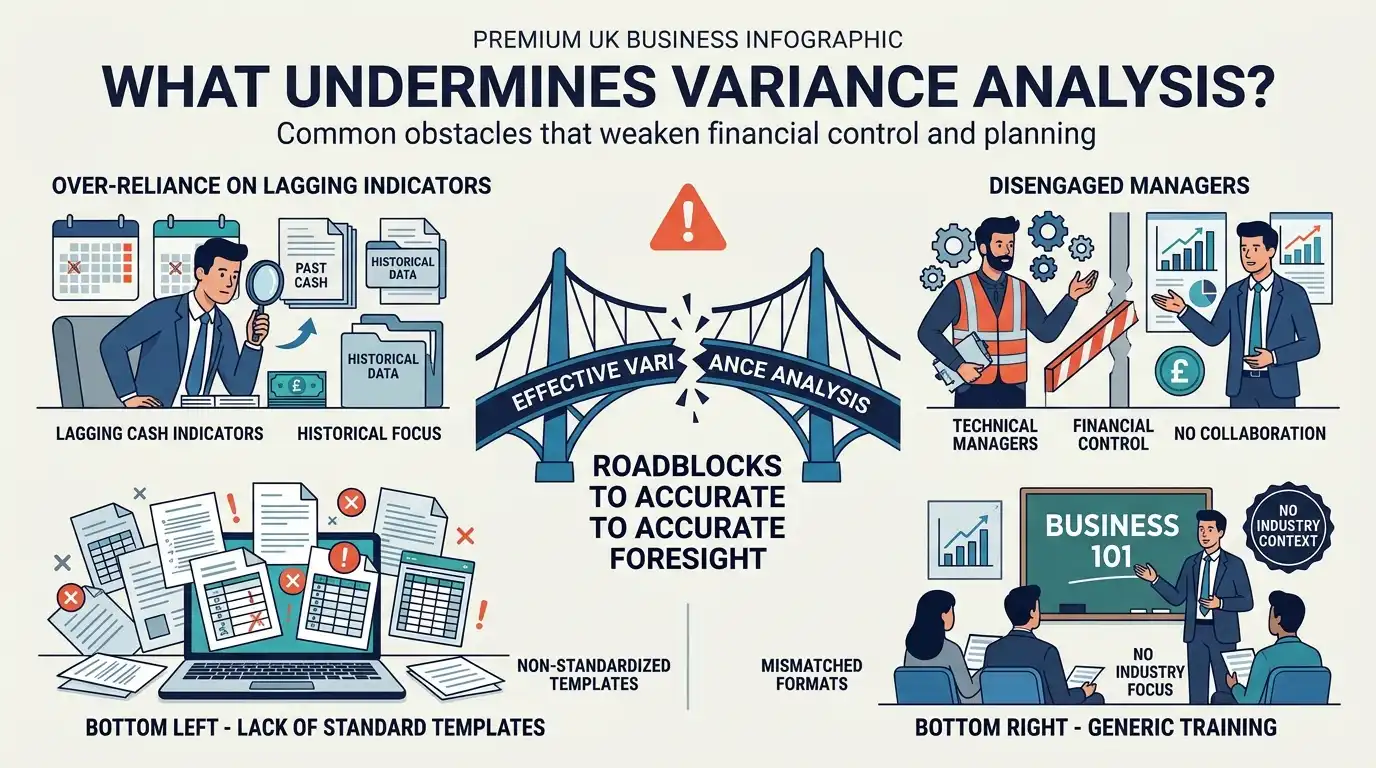
Generic financial training fails to improve corporate performance because it ignores the unique operational realities of heavy industries.
Lack of Practical Industry Context in Training
Standard accounting courses teach basic budget formulas but fail to address complex industry challenges like joint interest billings, vessel day-rates, or long-lead equipment escalation clause calculations. To build real capability, corporate learning must utilize authentic project scenarios, actual contract structures, and industry-specific cost breakdowns.
Organizations evaluating professional development options must carefully analyze [how to identify and analyse budget deviations through cost variance analysis] within specialized corporate environments to ensure their teams learn actionable, real-world skills rather than theoretical concepts.
Treating Variance Tracking as a Form-Filling Exercise
Variance analysis loses its strategic value when operational managers view reporting as a passive administrative task.
Without rigorous root-cause analysis and actionable mitigation plans, variance reports become historical records rather than tools for operational course correction. Effective corporate training programs shift managerial mindsets from passive reporting to active financial defense.
Frequently Asked Questions
What is Oil & Gas Petroleum Budgeting & Cost Control training?
Oil & Gas Petroleum Budgeting & Cost Control training provides energy professionals with financial management tools to plan capital expenditure, track operational costs, and evaluate project profitability. Delivered by the Institute For Oil & Gas Training, this program covers earned value management, variance analysis, and cash flow forecasting tailored to upstream and downstream operations. Participants learn to align project schedules with financial limits to prevent budget overruns in complex exploration and production projects.
Why is cost control critical in petroleum budget management?
Petroleum projects involve high capital investments, volatile commodity prices, and extended operational timelines that increase exposure to financial risk. The Institute For Oil & Gas Training equips managers with structured Oil & Gas Petroleum Budgeting & Cost Control frameworks to monitor expenditure accruals, isolate price and volume variances, and enforce financial accountability across project lifecycles. Effective cost control protects operating margins and ensures efficient resource allocation across field operations.
Who should attend an Oil & Gas Petroleum Budgeting & Cost Control course?
This program is designed for project managers, cost engineers, financial analysts, procurement leads, and operations managers working within the energy sector. The Institute For Oil & Gas Training tailors its Oil & Gas Petroleum Budgeting & Cost Control curriculum to bridge skill gaps between technical engineering decisions and financial reporting requirements. It enables cross-functional teams to collaborate effectively on budget governance, risk mitigation, and expenditure forecasting.
What key topics are covered in petroleum cost control training?
The curriculum encompasses capital and operational expenditure budgeting, earned value analytics, commitment tracking, variance commentary protocols, and joint venture accounting. Through practical Oil & Gas Petroleum Budgeting & Cost Control modules, the Institute For Oil & Gas Training demonstrates how to set variance investigation thresholds and formulate corrective action plans. Learners acquire hands-on experience using industry-standard financial models to manage project burn rates.
How does budgeting training improve project ROI in the oil and gas sector?
Structured financial training improves project returns by eliminating unrecorded liabilities, reducing budget drift, and accelerating executive decision-making. By implementing the techniques taught in the Institute For Oil & Gas Training's Oil & Gas Petroleum Budgeting & Cost Control course, organisations enhance forecast accuracy and optimize capital deployment. This disciplined financial governance directly reduces cost overruns and improves overall asset profitability.
Related training courses
Cost Control for Field Development Projects: Overrun Prevention Training Course
- Specialisation
- Oil & Gas Petroleum Budgeting & Cost Control
- Duration
- 5 days · 15 CPD hours
Cash Calls, AFEs & Work Program/Budget Control: Preparation Training Course
- Specialisation
- Oil & Gas Petroleum Budgeting & Cost Control
- Duration
- 5 days · 15 CPD hours
Budget Management and Management Control in the Oil & Gas Industry
- Specialisation
- Oil & Gas Petroleum Budgeting & Cost Control
- Duration
- 5 days · 15 CPD hours
More articles

Cost Control and Variance Analysis for Budget Deviations Training by Institute For Oil & Gas Training
Master budget deviations with the Cost Control & Variance Analysis Training Course by Institute For Oil & Gas Training. Learn financial variance techniques.
Read article →
How to Identify and Analyse Budget Deviations Through Cost Variance Analysis
Learn how to analyse budget deviations with cost variance analysis. Evaluate tracking methods, variances, and training for financial control.
Read article →
Budgeting and Forecasting Rolling and Zero Based Techniques Training by Institute For Oil & Gas Training
Evaluate syllabus, delivery format, and workplace outcomes for the Budgeting and Forecasting Rolling and Zero Based Techniques Training course.
Read article →