

Budget deviations present a fundamental risk to capital allocation and operational margins in resource-intensive sectors. Identifying and analysing these variances requires a structured approach to cost accounting, real-time expenditure tracking, and performance measurement. Finance managers and department heads rely on systematic frameworks to detect financial discrepancies early, determine their root causes, and execute targeted interventions to maintain fiscal discipline.
Understanding financial discrepancies begins with establishing a strong baseline for financial performance across all operational departments. When organizations examine Why Cost Variance Analysis Matters in Oil and Gas Budget Control, they gain clear insight into how cost controls protect project profitability, manage risk, and streamline financial reporting. By establishing a robust analytical framework, management transitions from reactive spending reviews to proactive cost management.
What Is Cost Variance Analysis in Operational Budget Control?
Cost variance analysis is a financial evaluation method that compares actual costs incurred against pre-established budget baselines to quantify performance discrepancies. It isolates specific financial movements, identifies operational inefficiencies, and enables targeted management interventions to preserve organizational capital allocation.
The process relies on breaking down total financial variances into underlying elements. Organizations evaluate direct material, direct labour, and overhead expenditures against baseline expectations. By establishing clear mathematical relationships between planned expenditures and real-world spending, financial controllers isolate specific operational drivers behind overruns or under-runs.
The core formula for cost variance ($CV$) is:
$$CV = BCWP - ACWP$$
Where:
$BCWP$ is the Budgeted Cost of Work Performed (Earned Value)
$ACWP$ is the Actual Cost of Work Performed
In standard management accounting terms, this relationship is expressed as:
$$Cost\ Variance\ (CV) = Budgeted\ Cost - Actual\ Cost$$
A negative result indicates an adverse (unfavourable) position where actual spending exceeds the planned allocation. A positive result reflects a favourable position where expenditure remains below budget limits. However, evaluating financial health purely on absolute values without examining root causes leads to inaccurate conclusions regarding operational efficiency.
The analytical framework evaluates variances across three core dimensions:
Price Variance: Measures the financial impact of paying a different price than planned for inputs, calculated as:
$$Price\ Variance = (Actual\ Price - Budgeted\ Price) \times Actual\ Quantity$$
Volume (Quantity) Variance: Measures the financial impact of using a different quantity of resources than budgeted, calculated as:
$$Volume\ Variance = (Actual\ Quantity - Budgeted\ Quantity) \times Budgeted\ Price$$
Efficiency Variance: Isolates performance productivity by measuring the resource inputs consumed against the standard units required for the actual output achieved.
Operational teams utilize these metrics to maintain control over project cash flows. Regular variance reviews ensure that cost overruns are caught before they compound into systemic project failures.
How Do Financial Teams Differentiate Between Price, Volume, and Efficiency Variances?
Financial teams differentiate variances by decomposing total budget discrepancies into isolated components representing input costs, resource consumption rates, and operational productivity. This mathematical segregation prevents input price fluctuations from masking internal consumption inefficiencies or poor resource allocation.
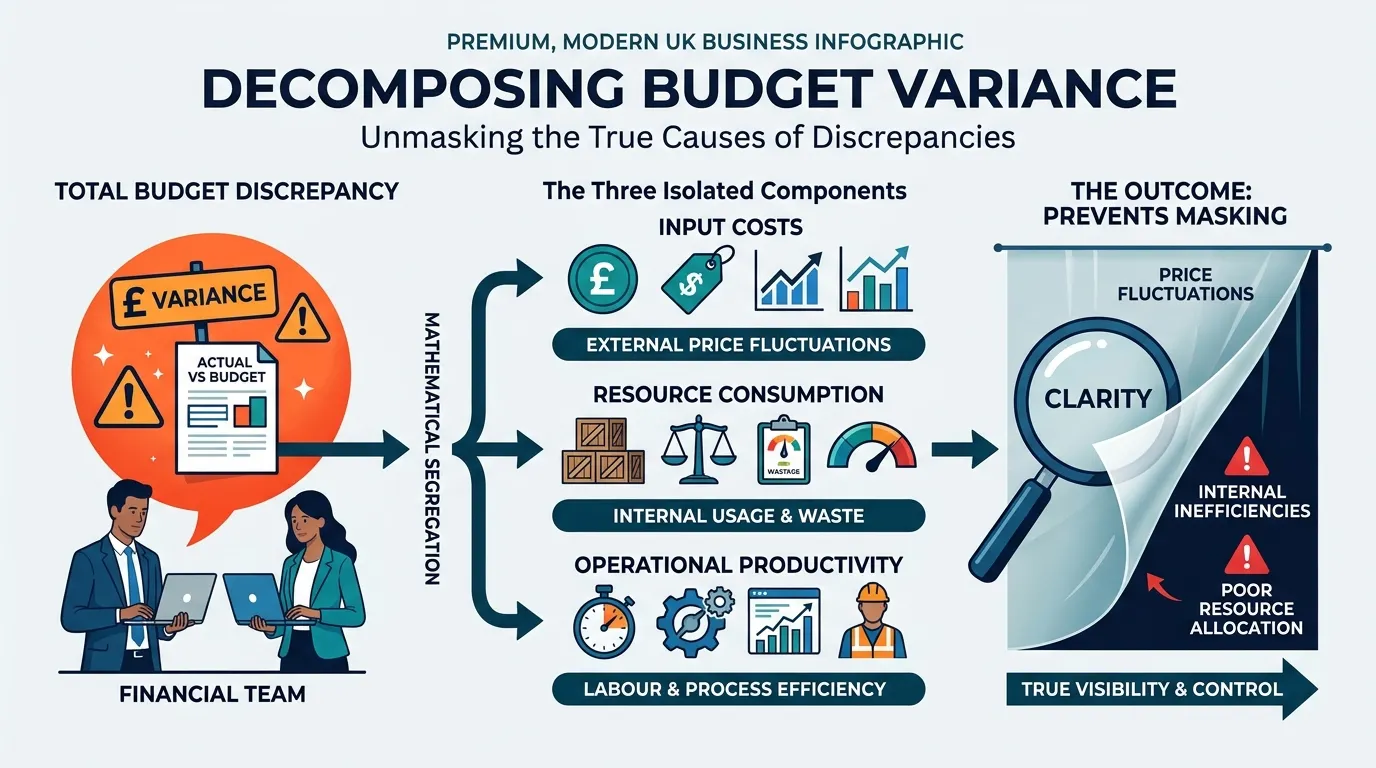
Separating cost variance drivers ensures accurate managerial accountability. A project manager might report an overall favourable cost position due to falling raw material prices, even though the site crew consumed 20 percent more materials than engineered standard limits. Without isolated variance calculations, management fails to notice underlying operational waste.
Price and rate variances isolate external market forces from internal consumption patterns. Price variance focuses on procurement performance, contract terms, and market volatility. When supply chains experience inflation, the resulting price variance reflects market shifts rather than project-level mismanagement.
Volume variance evaluates whether operational consumption stayed within planned physical limits. Calculating this variance requires multiplying the difference between actual quantity consumed and budgeted quantity by the standard budgeted unit price. Isolating the budgeted price ensures that unit cost changes do not distort the measurement of physical consumption.
Efficiency variance evaluates how effectively inputs transform into billable output. In direct labour analysis, efficiency variance measures actual hours worked against standard hours allowed for completed production units. Adverse efficiency variance signals workforce skill gaps, equipment downtime, or poor workflow design.
Distinguishing between these three variance types allows finance leaders to assign accountability precisely. Procurement teams manage price variances, operations teams manage volume variances, and department managers address efficiency discrepancies.
What Frameworks Are Used to Categorize Favourable and Adverse Variances?
Frameworks for categorizing favourable and adverse variances evaluate financial discrepancies against operational context, strategic intent, and long-term business value. Simple numerical definitions fail because an adverse variance can reflect strategic investment, while a favourable variance can indicate deferred essential maintenance.
Categorizing variances requires looking beyond simple income statement signs. A favourable direct material variance appears positive on paper, but if it stems from purchasing substandard raw materials that increase production waste, it generates long-term adverse impacts. Effective finance frameworks evaluate operational intent alongside numerical direction.
Organizations classify variances using a multi-tiered diagnostic framework:
Value-Adding Favourable Variances: Achieved through process improvements, technological automation, or superior supplier negotiations without compromising quality standards or operational safety.
Compromised Favourable Variances: Generated by skipping scheduled equipment overhauls, reducing quality assurance testing, or understaffing safety-critical positions. These short-term paper savings create future capital risks.
Operational Adverse Variances: Driven by internal inefficiencies, equipment breakdowns, scrap rework, or uncoordinated labour schedules. These demand immediate internal corrective action.
Structural Market Adverse Variances: Resulting from macroeconomic shifts, sudden regulatory compliance updates, or global trade tariffs. These require baseline budget adjustments rather than operational reprimands.
Categorization frameworks require cross-functional validation between finance and engineering teams. Contextualizing financial data prevents incorrect operational decisions based on superficial cost trends.
How Are Variance Investigation Thresholds Established for Operational Tracking?
Variance investigation thresholds are established by setting quantitative boundaries based on percentage deviations, absolute financial values, and statistical control limits. These thresholds filter minor operational noise, allowing management to focus analytical resources exclusively on material discrepancies that affect project outcomes.
Setting investigation boundaries prevents management fatigue caused by chasing negligible budget variations. Without established thresholds, finance teams spend excessive hours investigating minor line-item variances that fall within normal statistical distribution. Effective organizations combine absolute currency metrics with percentage-based rules.
Establishing investigation boundaries involves four standard methodology models:
Fixed Percentage Threshold: Triggers mandatory reporting when line-item spending deviates by more than a set limit (such as 5 percent or 10 percent) from the baseline. This model scales easily across different department budgets.
Fixed Dollar (Absolute Value) Threshold: Mandates investigation for any variance exceeding a set currency value (such as £15,000 or $50,000), regardless of its percentage proportion. This protects corporate liquidity against large absolute financial losses.
Dual-Condition (Combined) Threshold: Requires investigation only when a variance breaches both a percentage boundary and an absolute currency limit simultaneously. This focuses resources on large line items that show significant percentage movements.
Statistical Process Control Threshold: Sets boundaries using standard deviations ($\sigma$) from historical mean cost patterns. Variances exceeding $2\sigma$ or $3\sigma$ signal out-of-control operational processes that require formal analysis.
Determining threshold parameters depends on organizational risk tolerance, project complexity, and regulatory conditions. Critical infrastructure projects often enforce tighter thresholds than administrative support functions.
What Role Do Commitment Tracking and Accrual vs. Spend Reporting Play in Deviation Analysis?
Commitment tracking and accrual-based reporting provide visibility into financial obligations before cash outlays occur. Comparing purchase commitments and accrued liabilities against cash disbursements prevents artificial budget variances caused by invoice processing delays.
Traditional cash accounting creates blind spots for operational decision-makers. Cash-based tracking registers expenditures only when bank payments clear, creating a false impression of under-spending while unbilled contractor work and fulfilled purchase orders accumulate in the background. Commitment tracking records financial obligations at the moment purchase orders are approved.
Accrual accounting aligns expenditures with the precise operational period in which goods or services are consumed. Accrual reporting recognizes costs upon work completion or material receipt, independent of payment terms. This ensures management evaluates cost variances against actual project progress rather than cash timing differences.
Integrating commitment tracking with accrual and cash spend reporting creates a three-dimensional view of project financial health:
Committed Funds: Sum of open purchase orders, signed contracts, and approved requisitions.
Accrued Expenditures: Value of work completed and goods delivered awaiting formal invoice clearance.
Cash Disbursements: Settled invoices cleared through corporate accounts payable.
When management relies solely on cash disbursements, variance analysis yields inaccurate results. A department showing a 30 percent favourable variance mid-quarter may face severe budget overruns once vendor invoices arrive for work already completed on-site.
How Does Structured Variance Commentary Drive Effective Corrective Action Plans?
Structured variance commentary translates raw financial discrepancies into actionable operational context by identifying primary root causes, quantifying business impacts, and defining targeted corrective measures with clear managerial ownership.
Variance commentary bridges the gap between financial reporting and operational management. Numerical tables state what financial discrepancy occurred; clear commentary explains why it occurred and how leadership plans to resolve it. Without structured narratives, management reports fail to prompt effective corrective actions.
An actionable variance commentary follows a four-part narrative structure:
Narrative Component | Operational Objective | Analytical Content Requirements |
Root Cause Identification | Isolates underlying operational drivers | Specifies precise mechanical, market, or human factors causing the cost drift |
Quantified Impact Analysis | Measures current and projected exposure | Calculates immediate variance value and forecasts compound impact at completion |
Corrective Action Plan | Details specific operational steps | Outlines concrete interventions, resource adjustments, or contract re-negotiations |
Accountability & Timeline | Establishes execution boundaries | Assigns specific management owners and definitive operational completion dates |
Effective corrective action plans address root causes rather than symptoms. If an adverse labour efficiency variance stems from inadequate technical skills, reducing crew size will exacerbate project delays. The corrective plan must target skill deficits directly through structured workforce development.
Organizations experiencing persistent cost deviations often invest in corporate capability building. Enrolling mid-level managers and project leaders in formal external programs, such as the Cost Control & Variance Analysis for Budget Deviations Training Course, arms teams with the skills needed to design robust variance commentary and implement effective corrective action plans across complex operations.
How Do Different Cost Tracking Approaches Compare in Practice?
Different cost tracking approaches balance analytical detail against operational reporting complexity. Comparing traditional variance analysis, activity-based cost management, and earned value management highlights clear differences in cost allocation, variance detection speed, and administrative effort.
Selecting an appropriate cost tracking approach depends on project risk, operational structure, and team capability. Simple administrative functions function well under traditional variance frameworks, while complex capital initiatives require integrated methodologies to capture scope, cost, and schedule performance simultaneously.
Evaluation Attribute | Traditional Variance Analysis | Activity-Based Cost Management (ABC) | Earned Value Management (EVM) |
Primary Focus | Department cost centers vs. static budgets | Activity cost drivers and resource consumption | Integrated schedule, scope, and financial performance |
Variance Detection Speed | Monthly or quarterly financial cycles | Periodic operational batch reviews | Real-time or weekly progress intervals |
Key Metrics | Price, volume, and spending variances | Activity cost rates and resource usage ratios | Cost Performance Index ($CPI$), Schedule Performance Index ($SPI$) |
Administrative Complexity | Low to moderate setup requirements | High analytical design and tracking overhead | High systems integration and data rigor |
Ideal Operational Context | Stable business environments with static budgets | Complex overhead operations and shared services | Fixed-term capital projects and engineering contracts |
Traditional variance analysis offers simple implementation but lacks integration with project timelines. A project operating under budget may appear financially sound, but EVM metrics will reveal if that apparent saving is caused by severe work delays.
Selecting the right tracking methodology requires assessing internal capabilities. Implementing advanced tracking without proper staff training often leads to data errors and unmonitored budget drift.
How Should HR Leaders and Department Heads Select the Right Financial Training Approach?
HR leaders select financial training approaches by evaluating organizational skill gaps, delivery formats, and the practical relevance of course content to daily financial workflows. Choosing the right learning framework ensures project leaders apply variance analysis techniques directly to real-world operations.
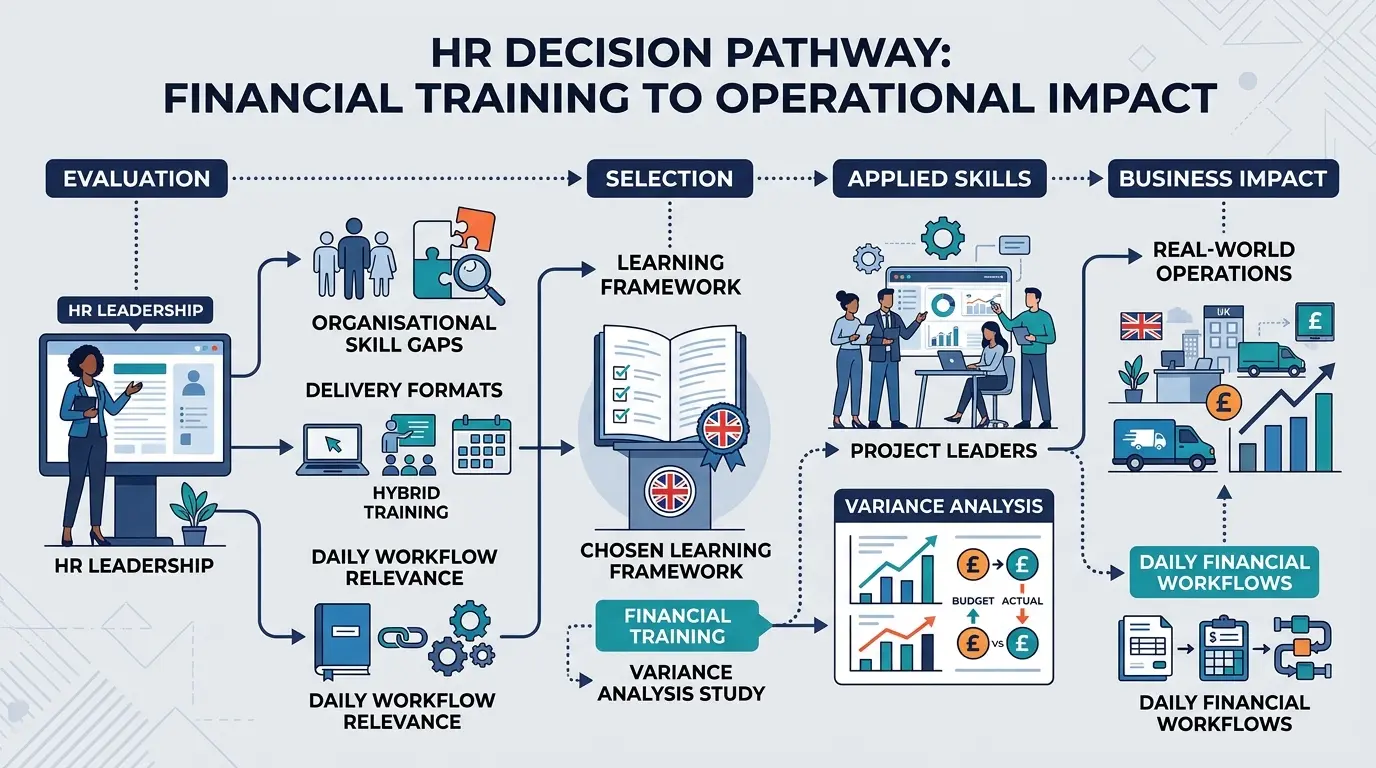
Addressing financial skill gaps requires matching delivery options to organizational priorities. Generic finance courses often focus on academic accounting principles while neglecting operational cost management, variance commentary, and commitment tracking.
Evaluating training options involves assessing three key delivery models:
Self-Paced Digital Courses: Offer flexible scheduling for general introductory concepts, but often lack industry-specific case studies and interactive problem-solving.
Academic Executive Seminars: Provide strong theoretical grounding, but frequently miss operational cost-control frameworks used in technical sectors.
Custom Corporate Programs: Deliver tailored instruction around organizational templates, reporting tools, and project contexts, accelerating practical application.
When evaluating external learning solutions, HR professionals assess provider track records, industry focus, and how effectively curriculum design translates into measurable workplace performance. Enrolling financial controllers and department heads in targeted corporate programs, such as Cost Control and Variance Analysis for Budget Deviations Training by Institute For Oil & Gas Training, ensures personnel master financial tracking skills within an applied operational framework.
Selecting a practical training approach improves financial management across all operational levels. Equipping team members to identify, analyze, and correct budget deviations protects project margins, streamlines financial reporting, and builds long-term corporate capability.
Frequently Asked Questions
What is included in the Oil & Gas Petroleum Budgeting & Cost Control training program?
The Oil & Gas Petroleum Budgeting & Cost Control program delivered by Institute For Oil & Gas Training covers essential financial planning frameworks, variance analysis methodologies, expenditure tracking systems, and capital allocation models tailored to upstream and downstream operations. Participants learn to manage operating costs, track project commitments, and develop actionable financial reporting structures to maintain control over corporate budgets.
How does cost control training benefit petroleum sector finance and project managers?
Enrolling in Oil & Gas Petroleum Budgeting & Cost Control instruction equips finance professionals, project managers, and department heads with operational tools to detect cost overruns early, mitigate financial risks, and optimise resource utilization across capital-intensive energy projects. Institute For Oil & Gas Training structures this professional development to enhance analytical capabilities, ensuring teams align spending performance directly with strategic corporate outcomes.
Who should attend the Oil & Gas Petroleum Budgeting & Cost Control course?
The Oil & Gas Petroleum Budgeting & Cost Control course from Institute For Oil & Gas Training is designed for department heads, project leaders, financial analysts, cost engineers, and HR leaders managing workforce capability development within resource-intensive organisations. It provides strategic and tactical frameworks suitable for professionals responsible for preparing, monitoring, or approving capital expenditure budgets and operational cost baselines.
How does variance analysis feature in petroleum budgeting and cost control practices?
Variance analysis is integrated into Oil & Gas Petroleum Budgeting & Cost Control workflows to isolate price, volume, and efficiency discrepancies between actual project expenditures and baseline allocations. Institute For Oil & Gas Training trains professionals to decompose budget deviations, evaluate financial risk exposure, and present structured managerial commentary that drives effective corrective action plans.
What delivery options are available for corporate Oil & Gas Petroleum Budgeting & Cost Control training?
Institute For Oil & Gas Training provides customized corporate learning programs, interactive workshops, and structured executive seminars for Oil & Gas Petroleum Budgeting & Cost Control. Organizations can select tailored in-house sessions or flexible learning formats aligned with their specific project workflows, internal financial reporting templates, and workforce skill requirements.
Related training courses
Budgeting & Forecasting for the Annual Budget Cycle Training Course
- Specialisation
- Oil & Gas Petroleum Budgeting & Cost Control
- Duration
- 5 days · 15 CPD hours
Budgeting & Forecasting: Rolling & Zero-Based Techniques Training Course
- Specialisation
- Oil & Gas Petroleum Budgeting & Cost Control
- Duration
- 5 days · 15 CPD hours
Cost Control for Field Development Projects: Cost Baselines Training Course
- Specialisation
- Oil & Gas Petroleum Budgeting & Cost Control
- Duration
- 5 days · 15 CPD hours
More articles

Cost Control and Variance Analysis for Budget Deviations Training by Institute For Oil & Gas Training
Master budget deviations with the Cost Control & Variance Analysis Training Course by Institute For Oil & Gas Training. Learn financial variance techniques.
Read article →
Why Cost Variance Analysis Matters in Oil and Gas Budget Control
Learn how cost variance analysis prevents budget overruns in oil and gas projects. Discover key frameworks, execution steps, and measurable ROI.
Read article →
Budgeting and Forecasting Rolling and Zero Based Techniques Training by Institute For Oil & Gas Training
Evaluate syllabus, delivery format, and workplace outcomes for the Budgeting and Forecasting Rolling and Zero Based Techniques Training course.
Read article →